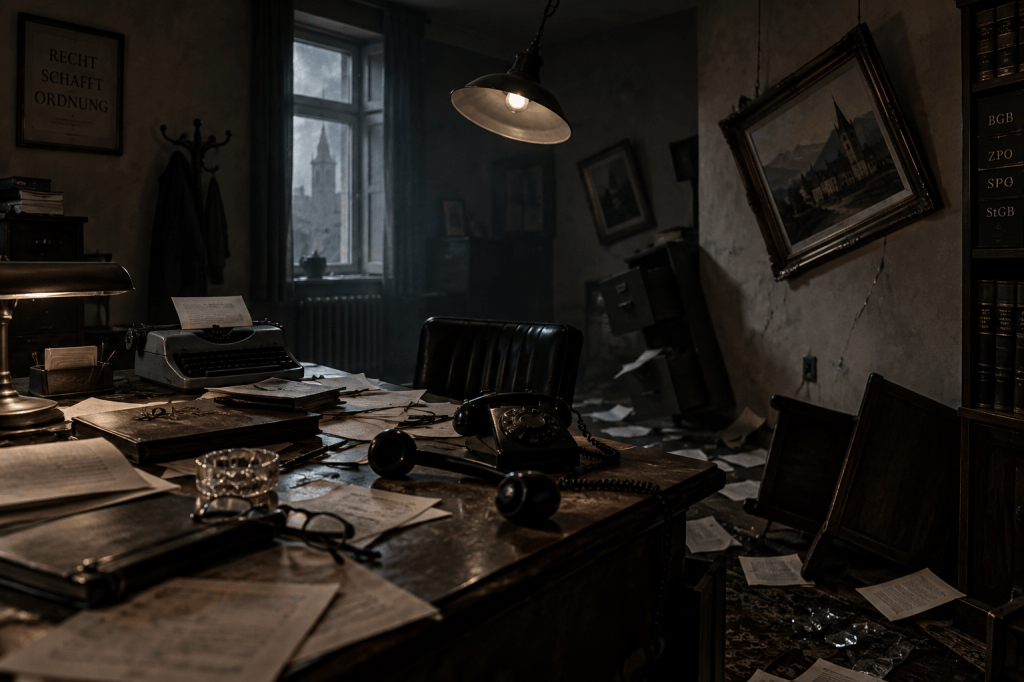
The Rosenheim Poltergeist: The Office Where Something Seemed to Bend the Rules of Reality
There are haunted houses whose stories begin with footsteps in an empty corridor, a pale figure at the foot of a bed, or the whisper of a dead relative heard in the middle of the night. Rosenheim was different. There was no ruined castle, no forgotten cemetery beneath the floorboards and no ancient family curse waiting conveniently in the background. The disturbances began inside an ordinary German law office, among ringing telephones, filing cabinets, fluorescent lights, invoices and typewriters, which may be one reason the case still feels so uncomfortable more than half a century later.
Because whatever happened there did not behave like the traditional ghost of folklore.
It behaved, at least according to those who investigated it, almost as though something invisible had learned how to interfere with electricity, machinery and matter itself.
In the autumn of 1967, strange disturbances began to be reported in the law office of attorney Sigmund Adam in Rosenheim, a Bavarian town southeast of Munich. Automatic fuses reportedly tripped without an obvious electrical cause, light bulbs burst, hanging lamps began swinging, loud cracks were heard in the rooms and the telephone system behaved in ways the staff could not explain. Calls appeared to have been registered that nobody remembered making, including repeated connections to the German telephone time service, then reached through the number 0119.
At first, nobody needed a ghost.
They needed an electrician.
And that distinction matters, because the people involved did not immediately interpret the disturbances as paranormal. The obvious possibility was that something was wrong with the building’s electrical installation, so technicians from the Rosenheim municipal utility began examining the office. According to the contemporary technical account published the following year, investigations had already been underway for more than three weeks by the time physicists Friedbert Karger and Gerhard Zicha arrived. The electricity company installed recording instruments designed to monitor voltage and current, replaced or isolated parts of the electrical system and eventually supplied parts of the office through separate wiring and an emergency generator.
Yet the reported disturbances continued.
That is where the story begins to become difficult.
The Machines Began Recording Something
Voltage and current recorders installed in the office sometimes produced dramatic deflections. The investigators were interested in these events precisely because, unlike a frightened witness saying that a lamp had moved, an instrument left a physical trace.
Karger and Zicha later published a technical investigation of the case in the Zeitschrift für Parapsychologie und Grenzgebiete der Psychologie. Their report described telephone disturbances, unexplained recorder deflections, loud noises, automatic circuit breakers switching off, exploding bulbs and lamps swinging with unusual force. They also noted that efforts by the local electricity utility — including separate lamps, wiring and an emergency power source — had not simply made the phenomenon disappear.
This did not prove anything supernatural. An unexplained measurement is not the same thing as evidence for a spirit, and it is worth remembering that unusual electrical behaviour can arise from causes that are extremely difficult to locate.
Nevertheless, Rosenheim had moved beyond the familiar territory of ghost stories told around a kitchen table. Technicians were now watching instruments, police were aware of the investigation, witnesses were being questioned and physicists were trying to understand why equipment appeared to be registering disturbances for which they could not find a satisfactory physical explanation.
Then the pictures on the walls began to move.
Hans Bender, one of Germany’s best-known researchers of alleged paranormal phenomena and at the time director of the Institute for Frontier Areas of Psychology and Mental Health in Freiburg, became involved. Bender’s own account described pictures rotating on their suspension points, sometimes falling from the walls, along with drawers and furniture apparently moving without an obvious hand pushing them. His team attempted to document events with an AMPEX video recorder, managing to record swinging lamps and noises, while some of the more dramatic events remained frustratingly unpredictable.
One particular observation preserved in Bender’s report is difficult to forget.
Paul Brunner, involved in the electrical investigation, reported standing near a floral picture when it suddenly rotated approximately 320 degrees, twisting its hanging wire around the hook. Another witness present at the time confirmed that he had seen the picture move from its resting position. Other technicians subsequently reported seeing pictures swing or turn.
Whether those observations had a paranormal cause is another question entirely.
But the witnesses themselves were real.
The reports were real.
And the investigation existed.
Then They Noticed Annemarie
Among the employees in the office was a nineteen-year-old apprentice, usually identified in accounts of the case as Annemarie Schaberl.
As the investigation progressed, Bender’s group became convinced that the frequency of the disturbances was somehow associated with her presence. Their published summary claimed that the number of incidents appeared to decrease with increasing distance from the young woman and that the phenomena eventually stopped after she left the workplace.
This detail transformed Rosenheim from an electrical mystery into something much stranger.
Bender did not believe that Annemarie was possessed by a dead person. Nor did he necessarily imagine an invisible ghost wandering around the law office unscrewing bulbs and pushing pictures.
He proposed something arguably even more disturbing.
Spontaneous psychokinesis.
Within parapsychology, this idea suggested that intense unconscious psychological states might somehow produce physical effects outside the body, particularly around certain individuals during periods of emotional strain. There is no accepted mechanism in modern physics demonstrating that human emotion can cause objects to move at a distance, and psychokinesis has never been established as a reproducible phenomenon under the standards required by mainstream experimental science.
But Bender believed that poltergeist cases might not primarily concern the dead at all.
They might concern the living.
Instead of imagining a spirit entering a room, this interpretation asks us to imagine something hidden inside the human mind somehow escaping the ordinary boundaries of the nervous system and acting upon the surrounding world.
It is a deeply unsettling idea because it changes the location of the haunting.
The haunted place would not be the building.
The haunted place would be the person.
Bender used the concept of an emotional or “affective field” when discussing spontaneous phenomena, and the Rosenheim report linked the concentration of the disturbances with the apparent proximity of the young employee. His interpretation belonged to parapsychology rather than established physics, but it would become central to the legend of Rosenheim.
There is something psychologically fascinating here even if one rejects the paranormal explanation completely. Human beings have always imagined hauntings as intrusions from outside ourselves — the dead returning, demons entering, invisible beings crossing some forbidden threshold — while the poltergeist tradition frequently reverses that image and places the source inside an emotionally disturbed living person.
If that model were ever shown to be real, the implications would be extraordinary.
There is presently no scientific basis for saying that it has been.
And Rosenheim certainly did not settle the question.
The Case Was Not as Clean as the Legend Suggests
This is the part that many paranormal retellings quietly omit.
Rosenheim became famous, and fame is rarely kind to an investigation.
By 1969, illusionist Albin Neumann, known professionally as Allan, together with Herbert Schiff and Gert Günther Kramer, had published Falsche Geister – Echte Schwindler — roughly, False Ghosts, Real Swindlers. Their account challenged the paranormal interpretation and argued that at least some of the spectacular physical phenomena could have been produced through ordinary deception.
The controversy became serious enough that the German newspaper Die Zeit revisited the case in April 1970 under the wonderfully appropriate title “Geister oder Nylon?” — “Ghosts or Nylon?” The article discussed allegations that fine nylon threads could have been used to move fixtures and objects inside the office.
This cannot simply be brushed aside because it damages a good ghost story.
If evidence of trickery existed, it matters enormously.
Later sceptical critics also attacked the methodology of the investigation, arguing that the controls were not strong enough to exclude fraud reliably and questioning whether Bender’s publications presented every problematic detail of the case. Physicist John Taylor would later argue that some of the recorder traces might themselves have been produced mechanically and regarded expectation, misinterpretation and trickery as more plausible explanations than psychokinesis.
At this point it would be tempting to close the file.
Nylon thread was alleged, therefore there was no mystery.
But that conclusion is also more convenient than the surviving evidence allows.
Showing that a lamp could have been moved with a hidden thread does not automatically reconstruct every event reported over the preceding months, nor does it by itself account for every electrical disturbance, telephone irregularity or instrument reading described during the technical investigation. Conversely, the fact that technicians failed to explain something at the time cannot transform an unexplained event into evidence for psychokinesis.
Rosenheim therefore occupies an uncomfortable space between two stories, neither of which can simply swallow the other.
The paranormal version sometimes claims too much.
The sceptical version can also become more certain than the evidence permits.
And somewhere between them is what actually happened inside that Bavarian office.
What Makes Rosenheim Different
Most famous hauntings are built almost entirely from testimony. Someone saw a woman standing on the stairs. Someone heard footsteps in a locked room. Someone woke with scratches across their body.
Rosenheim is stranger because technical people became involved before the story had finished unfolding.
The municipal utility investigated. Electrical monitoring equipment was installed. Physicists wrote a technical paper. Witness statements were collected. Attempts were made to record the phenomena. Bender’s preliminary account and the Karger-Zicha physical investigation appeared in a 1968 journal issue devoted substantially to the case, and those documents remain accessible today through the University Library of Freiburg.
That does not mean that scientists proved the paranormal.
They did not.
It means something subtler and, perhaps, more interesting: scientifically trained observers encountered a confusing collection of events, some of which they believed they could not explain using the physical causes they had examined.
History contains many unexplained observations that later received ordinary explanations. Instruments fail. Witnesses make mistakes. People deceive investigators. Investigators become attached to their theories. Rare combinations of circumstances produce events that look impossible until somebody notices the missing variable.
All of those possibilities belong inside Rosenheim.
But there is another uncomfortable fact.
Not every anomaly documented in a controversial case automatically vanishes because fraud has been demonstrated somewhere within that case.
Human reality is often messier than that.
A person can fake one incident after genuinely witnessing another that frightened them. A witness can misunderstand an event while accurately reporting something else. Investigators can correctly eliminate several explanations while overlooking the one explanation that matters. A case can contain deception, coincidence, faulty interpretation and genuinely unresolved events simultaneously.
Perhaps that is exactly what happened in Rosenheim.
Or perhaps something stranger occurred.
Was Annemarie the Poltergeist?
The strangest element remains the apparent relationship between the disturbances and the nineteen-year-old apprentice.
Bender’s published summary stated that the phenomena diminished with distance from her and ceased when she changed workplaces.
If this association was genuine, it still does not tell us why it existed.
Perhaps Annemarie herself produced some of the disturbances deliberately.
Perhaps other people did.
Perhaps her presence created heightened expectations and witnesses began interpreting ordinary events differently.
Perhaps the correlation was exaggerated afterward.
Or perhaps Bender had encountered something for which our ordinary psychological vocabulary was inadequate.
The difficulty is that Rosenheim took place in 1967, not inside a modern laboratory surrounded by synchronized high-resolution cameras, independent observers, tamper-proof sensors and continuous digital recording. The evidence that survives is substantial enough to make the story interesting but incomplete enough to prevent certainty.
And certainty is precisely what both believers and sceptics often want most.
The believer wants the final sentence to say that Rosenheim proves the mind can move matter.
The sceptic wants it to say that nylon thread solved everything.
The documents stubbornly refuse to give either side such an elegant ending.
Perhaps the Most Disturbing Possibility Is Not a Ghost
More than fifty years later, nothing in the Rosenheim material allows us responsibly to say that a supernatural entity haunted Sigmund Adam’s office.
There is no verified ghost.
There is no established physical mechanism for spontaneous psychokinesis.
There are serious allegations of deception, methodological weaknesses and competing interpretations that prevent the case from being treated as scientific proof of the paranormal.
And yet, after all of those qualifications have been made, Rosenheim does not become boring.
Quite the opposite.
Because beneath decades of sensational retelling remains an office in Bavaria where electricians installed equipment because something was repeatedly going wrong, where recording instruments produced unusual traces, where technicians and other witnesses described objects moving, where researchers arrived expecting to study an electrical anomaly and eventually began discussing psychokinesis, and where the disturbances appeared, according to the investigators, to orbit around one young woman.
Then she left.
And the office became quiet.
Perhaps the explanation was entirely human.
Perhaps some crucial technical defect was never discovered.
Perhaps a mixture of tricks, anxiety, coincidence and expectation created one of the most famous poltergeist cases of the twentieth century.
Or perhaps, hidden somewhere inside those old recorder traces and contradictory witness statements, there was a phenomenon for which the investigators simply did not possess the right language.
That is why Rosenheim still matters.
Not because it proves that ghosts exist, but because it leaves behind a question considerably more disturbing than a ghost story:
If the source of a poltergeist is sometimes not a dead person at all, but something unconscious within the living human mind, what exactly are the limits of the mind we believe we understand?
More than half a century later, Rosenheim has still not given us a reliable answer.
And perhaps that unanswered space is where the real haunting begins.
Sources and Further Reading
Hans Bender, Der Rosenheimer Spuk – ein Fall spontaner Psychokinese, Zeitschrift für Parapsychologie und Grenzgebiete der Psychologie, Vol. 11, 1968.
F. Karger & G. Zicha, Physikalische Untersuchung des Spukfalles in Rosenheim 1967, Zeitschrift für Parapsychologie und Grenzgebiete der Psychologie, Vol. 11, 1968.
Institute for Frontier Areas of Psychology and Mental Health, historical information on Hans Bender and the institute.
Alexander Adrion, Rosenheimer Spuk wieder vor Gericht: Geister oder Nylon?, Die Zeit, April 10, 1970.
Allan [Albin Neumann], Herbert Schiff & Gert Günther Kramer, Falsche Geister – Echte Schwindler, Zsolnay, Vienna, 1969. Contemporary critical discussion of the book and the Rosenheim controversy appeared in Die Zeit.

