Tag: Reality

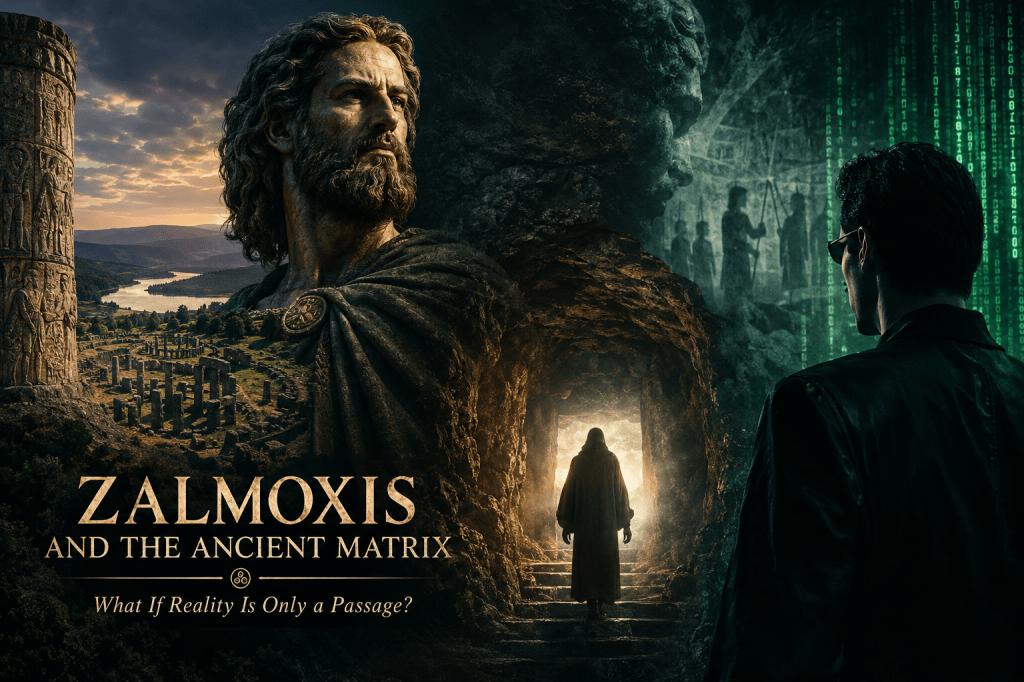
  • Zalmoxis and the Ancient Matrix: What If Reality Is Only a Passage?

    Zalmoxis and the Ancient Matrix: What If Reality Is Only a Passage?

    There is something unsettling about Zalmoxis even before we begin trying to understand who—or what—he was.

    He appears at the edge of recorded European history almost as if he had stepped out of a story that had already been told for centuries before anyone thought to write it down. A god to some, a man to others, perhaps a priest, perhaps a reformer, perhaps the distant memory of a real person whose identity dissolved into religion, he belonged to the world of the Getae north of the lower Danube, yet nearly everything we know about him was preserved by outsiders.

    That alone should make us cautious.

    It should also make us curious.

    The Getae left us no surviving sacred book explaining Zalmoxis in their own words. There is no Zalmoxian gospel hidden in a monastery, no authentic collection of his teachings waiting to be deciphered and no ancient manuscript that allows us to hear his voice directly. Instead, we find fragments scattered through Greek and Roman literature, each writer looking at the same strange tradition from a different angle.

    And yet, when those fragments are placed together, a remarkably persistent idea emerges.

    Human beings may be mistaken about what reality actually is.They may be mistaken even about death.That is where the story becomes far more interesting than a simple chapter of ancient religion, because behind Zalmoxis lies a question that humanity has never stopped asking.

    What if what we see is only the surface?

    The people who believed death was not an ending

    Our earliest substantial account comes from Herodotus, writing in the fifth century BC.

    While describing the Persian expansion into the lands around the Danube, Herodotus pauses to speak about the Getae. He calls them particularly courageous among the Thracian peoples, but it is their religious belief that captures his attention.

    According to him, the Getae believed that they did not truly die. A person who perished went instead to Zalmoxis—or, in the wording of the ancient account, to a divine figure Herodotus associates with Zalmoxis and also mentions under the name Gebeleizis.

    It is easy to read that sentence too quickly.

    Ancient cultures believed in afterlives everywhere, after all. Egyptians imagined the world beyond death, Greeks told stories about Hades, and later religions would place entire theological systems around the fate of the soul.

    But Herodotus describes something more concrete among the Getae.

    Once every five years, he says, they selected a messenger by lot. That man was entrusted with requests that he was supposed to carry to Zalmoxis. Then came the part that must have sounded shocking even to ancient readers: men held spears upright while the chosen messenger was thrown onto their points.

    If he died, the sacrifice was considered accepted. If he survived, the failure was blamed on the messenger and another could be selected.

    The ritual is brutal, and there is no reason to romanticize it. At the same time, its logic tells us something extraordinary about the world in which the ritual made sense.

    The messenger was not simply being killed.

    He was being sent.

    For the people performing the ritual, death was apparently a border that could be crossed, and on the other side of that border there was someone—or something—capable of receiving a message.Seen from that perspective, the sacrificed man was not merely a victim.

    He was a traveller into a reality inaccessible to the living.

    Whatever the Getae actually believed in all its complexity, Herodotus understood their religion as containing a radical conviction: the visible disappearance of a human being did not mean that the human being had ceased to exist.

    Then Herodotus tells another story, and this is where Zalmoxis becomes truly difficult to separate from mystery.

    The man who vanished underground

    Herodotus says that Greeks living around the Hellespont and the Black Sea told a different version of Zalmoxis’ origin.

    According to them, Zalmoxis had once been a mortal man associated with Pythagoras. In their story he had lived on Samos, learned from Greek thought, accumulated wealth and eventually returned to his homeland.

    There he gathered important men around him, entertained them and began teaching something astonishing: neither they, nor their descendants, nor Zalmoxis himself would truly die. Instead, they would go to another place where existence continued and where good things awaited them.

    Then he did something that sounds almost theatrical.

    He built an underground chamber.When it was ready, Zalmoxis disappeared into it.For three years, according to the story, nobody saw him. His people mourned him as dead.

    Then, in the fourth year, he emerged again.

    The man they believed had died had returned.

    And according to the Greek version preserved by Herodotus, that apparent return from death helped convince the Getae that his teaching had been true.It is precisely at this point that responsible history has to resist temptation.We cannot say that this event actually happened. We cannot even be certain that Zalmoxis was originally a historical person.

    Herodotus himself is surprisingly careful: he says that he neither completely believes nor completely rejects the tale of the underground chamber, and he doubts the chronology connecting Zalmoxis directly with Pythagoras. He even leaves open the basic question of whether Zalmoxis had been a man or a native Getic deity.

    That uncertainty does not weaken the story.In some ways it makes it more fascinating.Because whatever happened historically, somebody considered this story important enough to preserve: a teacher disappears beneath the earth, is mourned as dead, and then returns among the living.If this was an initiation drama rather than biography, what did it mean?

    If it was a myth, what truth was the myth trying to communicate?

    And if Zalmoxis was already a god before Greeks attempted to turn him into a former student of Pythagoras, why did the underground disappearance become such an important part of the story?

    We do not know.

    But we can see the structure.A man enters darkness.The world assumes he is gone.

    He returns possessing—or representing—knowledge about death that ordinary people do not possess.

    That structure has survived in religious myths, mystery traditions and philosophical stories across cultures because it touches a very old fear: perhaps human beings understand only the side of reality they happen to inhabit.

    Zalmoxis did not disappear from ancient literature

    Centuries later, Strabo tells another version.The Zalmoxis we meet in his Geography is less like a magician staging his own return from death and more like a sacred political figure, a man who acquires knowledge, becomes close to a ruler and eventually acts as an intermediary between divine authority and earthly power.

    Strabo says that Zalmoxis became a priest of the god most honoured among his people and was eventually himself treated as divine. He lived, according to the account, in an inaccessible cavernous place and met few people apart from the king and attendants. The mountain associated with this sacred retreat was called Cogaeonum in Strabo’s text.

    Again, we encounter withdrawal.

    Again, a sacred man is separated from ordinary society.Again, access to him is restricted.It is worth noticing how different this is from the modern image of a religious teacher speaking openly to crowds.

    Zalmoxis, as Strabo presents him, gains authority partly through distance. He occupies a space ordinary people cannot easily enter, and from that hidden space comes knowledge that affects the visible world outside it.Strabo even says that something of this religious-political institution continued later among the Getae. During the reign of Burebista, a comparable role was held by Decaeneus, the famous Deceneu of later Romanian historical tradition.This does not prove an unbroken secret order stretching across centuries, as modern esoteric stories sometimes suggest.

    The evidence simply does not allow that conclusion.

    Still, the repeated pattern is difficult to ignore.The ruler governs the visible world.The sacred figure interprets something beyond it.One possesses political power; the other possesses access to hidden knowledge.In a culture in which religion and political authority were deeply entangled, that distinction could have been enormously powerful.

    And then Plato enters the story.

    The strange physicians of Zalmoxis

    There is a passage in Plato’s Charmides that deserves far more attention than it usually receives when Zalmoxis is discussed.

    Socrates speaks of having learned from one of the Thracian physicians associated with Zalmoxis. The teaching attributed to them says, in essence, that you cannot properly treat the eyes without treating the head, nor the head without treating the body, and that you should not attempt to heal the body without considering the soul.

    The part cannot be healed while the whole is ignored.

    Plato presents Zalmoxis as both king and god within this story, and the medicine associated with him is explicitly holistic: body, soul and human character belong to the same reality and should not be artificially separated.

    Whether Plato is preserving an authentic Getic doctrine, reshaping an exotic tradition for philosophical purposes, or combining both is impossible to establish from the text alone.But something important has happened by this point.

    Zalmoxis is no longer merely the mysterious deity to whom the Getae send the dead.He has become associated with knowledge unavailable to ordinary perception.Death may not be what it seems.

    The body cannot be understood without the soul.The visible part cannot be fully understood without the invisible whole.That is an extraordinary collection of ideas to find around a figure standing in the mist between history and mythology.And this is where we can approach the Matrix—not by pretending that ancient Getae believed in computers, simulated universes or machines controlling humanity, but by recognising something much older beneath the modern language.

    The suspicion that reality has layers.

    Long before the red pill

    When people hear the word Matrix today, they often think immediately of a computer simulation.But the deeper philosophical idea behind the Matrix is much older than computers.

    The real shock is not discovering that machines exist.

    The real shock is discovering that your definition of reality was wrong.Neo begins inside a world that appears completely normal. Streets exist. Buildings exist. People go to work. Conversations happen. Food has taste. The world follows rules.Nothing initially appears artificial because Neo has never known anything against which to compare it.His prison works because it feels ordinary.

    That idea has an obvious philosophical ancestor in Plato’s Allegory of the Cave.

    Plato asks us to imagine human beings imprisoned underground from childhood, able to see only shadows projected before them. Since shadows constitute everything they have ever experienced, the prisoners naturally treat those shadows as reality.

    Only the person who turns around, leaves the cave and encounters another level of existence discovers how incomplete the former world was.

    Plato explicitly uses the image to distinguish the world apprehended through ordinary sight from a higher intelligible understanding.And here something curious happens.Plato gives us prisoners inside a cave, mistaking appearances for reality.The tradition about Zalmoxis gives us a sacred teacher who enters an underground chamber, disappears from ordinary human sight and returns carrying the authority of someone who supposedly knows what lies beyond death.The stories are not the same and should never be presented as though one copied the other.

    But place them beside one another and the resemblance of the questions becomes difficult to ignore.What can human senses actually tell us?How much of existence remains outside their range?If everybody around us agrees that something is real, does that agreement make it true?

    And what happens to the person who crosses the boundary between the accepted world and another understanding of it?These are not exclusively Greek, Getic or modern questions.They are human questions.

    Perhaps the real prison is certainty

    There is an uncomfortable reason why stories like these survive.Human beings need stable reality.We need to believe that the floor beneath us exists, that tomorrow will resemble today, that cause precedes effect and that the people around us inhabit roughly the same world we do.Without that agreement, ordinary life becomes almost impossible.Yet philosophy has always been dangerous to certainty.It asks whether seeing something is enough to know it.It asks whether consensus proves truth.It asks whether the limits of human perception have quietly become the limits of what we are willing to call real.Zalmoxis becomes fascinating in this context because the surviving traditions surrounding him attack the most absolute certainty of all.

    Death.

    A body falls.

    It stops breathing.It grows cold.It disappears into the earth.Every visible sign tells the observer that the person’s existence is over.And yet the Getic belief described by Herodotus says: you are interpreting what you see incorrectly.The person has gone somewhere.One does not have to accept that belief literally to understand its philosophical power.The senses provide evidence, but the doctrine tells the believer that the evidence is incomplete.That tension between appearance and hidden reality is precisely what gives both ancient initiation traditions and modern Matrix imagery their force.Not because they provide the same answer.Because they begin with the same doubt.

    What was inside the chamber?

    We will probably never know what Zalmoxis’ underground chamber looked like—if such a chamber existed at all.That missing information leaves a strange empty space at the centre of the story.

    Was it simply a hidden room in which a man lived for several years?Was it a ritual space connected with initiation?Did the story preserve a much older myth of a deity descending beneath the earth and returning?Was it a Greek attempt to rationalise a foreign god by turning him into a clever human teacher?

    Each possibility has been discussed in different forms, but the surviving evidence cannot settle the question.Modern scholarship also treats the Pythagorean connection cautiously.

    The story making Zalmoxis a former slave or follower of Pythagoras comes through Greek tradition, while Herodotus himself already doubted its chronology. Later analysis has continued to examine how legends linking Pythagoras with northern religious figures developed in Greek literature.This matters because Zalmoxis has accumulated an extraordinary amount of modern mythology.He has been called a prophet, a supreme god, a monotheistic reformer, a shaman, an initiate, a philosopher and the guardian of supposedly lost Dacian wisdom.

    Some of those interpretations may contain useful comparative ideas, while others go far beyond anything ancient sources actually tell us.The honest version is less comfortable and, I think, far more intriguing.

    We do not know exactly who he was.

    Herodotus did not know.

    Strabo inherited traditions centuries later.

    Plato knew the name and associated it with remarkable Thracian wisdom, yet he was using that tradition inside a philosophical dialogue rather than writing an ethnographic report.

    Zalmoxis stands precisely where evidence begins to thin and myth begins to breathe.

    And perhaps that is why he has never disappeared.

    The ancient Matrix was not a machine

    If we use the word Matrix here, we should use it carefully.There is no evidence that Zalmoxis taught that physical reality was false, that the world was artificially generated or that humanity was imprisoned inside anything resembling a technological simulation.The interesting parallel lies elsewhere.

    A Matrix can also be understood as a framework of reality that becomes invisible because we have lived inside it for too long.A culture tells us what life is.It tells us what death means.It teaches us which things are possible and which questions are absurd.

    Eventually we stop recognising those assumptions as assumptions. They become the walls of the world.The prisoner in Plato’s cave does not initially see a prison.Neo does not initially see a simulation.And the ordinary observer sees death and assumes that what has vanished from sight has vanished from existence.

    Zalmoxis enters this conversation not as proof that the ancients knew the secret structure of the universe, but as evidence of something more modest and perhaps more profound: thousands of years ago, human beings were already deeply uncomfortable with the possibility that visible reality might not be complete reality.That thought lies at the heart of our book Matrix as well.

    The question is not simply whether we live inside a computer program. That is only one modern version of a much older problem.The deeper question is what creates the reality in which we live.Our senses?Our society?Our language?Our memories?Our fears?Our education?The people who hold authority?Or something beyond all of them?Once that question is allowed into the mind, the Matrix changes shape.It no longer requires cables, machines or a digital sky.

    Sometimes the Matrix is simply everything we have been taught never to question.

    And perhaps this is why Zalmoxis still feels strangely modern

    More than two millennia separate us from the people Herodotus described.Their world has vanished. Their language has largely disappeared with them. Their sacred places survive mostly as archaeology, geography and conjecture, while their beliefs reach us through the imperfect filter of outsiders who were themselves trying to understand something foreign.

    Yet Zalmoxis remains.

    Not clearly enough for us to possess him, but not vaguely enough for us to forget him.A god who may have been a man.A man who may have become a god.A teacher associated with immortality who vanished beneath the earth.A sacred figure hidden in an inaccessible place.A tradition in which the soul mattered more than the body alone could explain.A people described as believing that death did not mean what everyone else assumed it meant.

    Perhaps there is no secret doctrine waiting to be recovered from these fragments.Perhaps there was never one.

    But imagine, just for a moment, the person standing outside the underground chamber after Zalmoxis had disappeared.Three years pass.Nothing.The man is dead. Everyone knows it.Then one day he walks out.What would collapse first?Belief in death?Belief in the evidence of your own eyes?Or the comforting certainty that the world works exactly as you have always been told?

    That is where Zalmoxis becomes more than an ancient mystery.

    Because every Matrix begins at exactly that point.

    Not when someone gives you the answer.But when, for the first time, you suspect that the reality you accepted without question may not be the whole story.
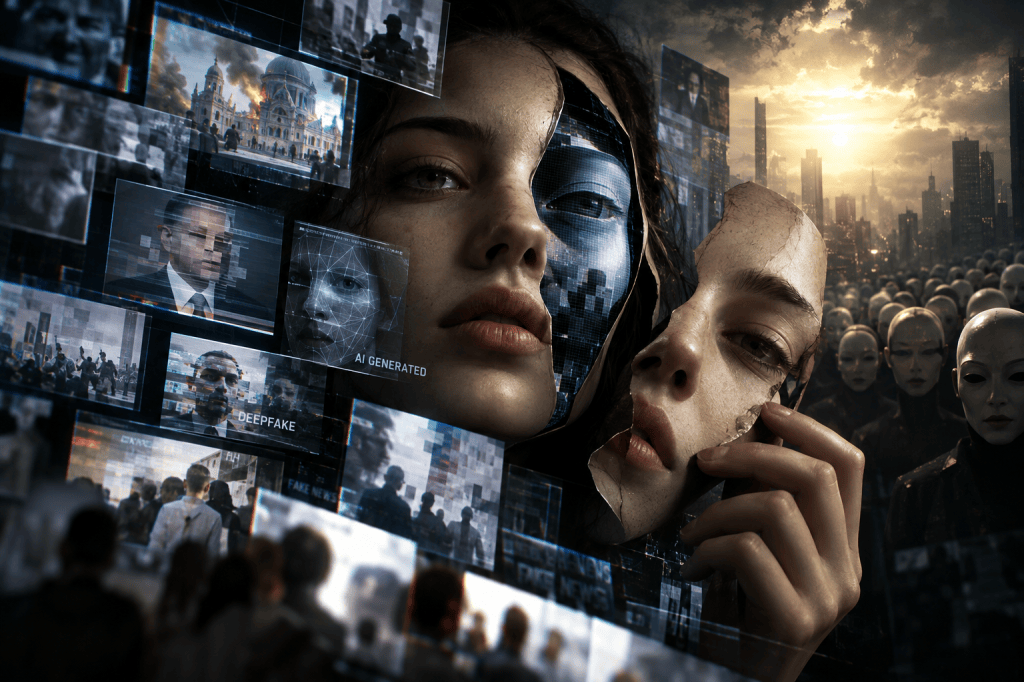
  • The Pageant of the Unreal: What Happens When We Can No Longer Tell What Is Real?

    Deepfakes, artificial images and the disturbing psychological consequences of a world in which even genuine evidence can be dismissed as fake.

    There was a time, not very long ago, when a photograph still possessed a peculiar authority over us. We knew that photographs could be staged, edited or removed from context, and anyone familiar with the history of propaganda knew that visual manipulation was hardly a modern invention, yet an image still seemed to carry something that words did not. It appeared to say that, whatever interpretation might later be imposed upon it, something had existed in front of a camera at a particular moment in time. Video strengthened that feeling even further because movement, voice, hesitation, facial expression and the small imperfections of ordinary human behavior seemed much harder to fabricate than a written account.

    Generative artificial intelligence is quietly dismantling that old psychological arrangement.

    It is now possible to manufacture faces belonging to people who never existed, clone voices from relatively small samples, reconstruct scenes that never occurred and produce increasingly convincing video in which real or invented people appear to move through events that happened only inside a computational system. None of this means that every artificial image is indistinguishable from reality, and the popular claim that nobody can tell the difference anymore would be an exaggeration. What has changed is subtler and, in some respects, more troubling: the mere knowledge that convincing fabrication is possible has entered our everyday understanding of the world, which means that suspicion no longer requires evidence of manipulation before it begins.

    A strange reversal is taking place. For most of the history of misinformation, the principal fear was that fabricated evidence might be mistaken for reality, yet researchers studying deepfakes have increasingly drawn attention to another possibility, in which genuine material loses some of its authority simply because people know that falsification has become technically plausible. The danger, therefore, is not confined to believing things that never happened. We may also be approaching an information environment in which events that really did happen can be pushed into a fog of uncertainty simply by suggesting that the evidence might have been manufactured.

    That is where the story becomes considerably darker, because a society does not need to lose reality in order to become confused. It only needs to lose agreement about how reality can be established.

    The New Problem Is Not Simply That Images Can Lie

    Human beings have always lied with images. Long before digital editing, photographs were cropped, retouched, staged and selectively published, while governments, advertisers, newspapers and private individuals learned very quickly that a camera could be used to persuade as effectively as it could be used to record. What generative AI changes is not the existence of visual deception but its accessibility, its speed and, increasingly, its realism.

    An experiment published by the Harvard Kennedy School’s Misinformation Review in November 2025 examined how realistic AI-generated images influenced belief in false headlines. Researchers found that participants were more likely to believe false headlines when accompanying synthetic images appeared realistic and seemed to provide strong visual evidence for what the headline claimed. The study did not suggest that people indiscriminately accepted every artificial image, which would be a much stronger claim than the evidence supports, but it did demonstrate something psychologically important: when an image looks plausible and appears to confirm a narrative, its visual authority can increase the credibility of information that is false.

    This is hardly surprising when we consider how people encounter information online. We do not normally sit in front of each photograph like forensic investigators, enlarging reflections, examining compression patterns and tracing the history of every file before allowing ourselves to form an impression. We scroll through hundreds of fragments of reality every day, making rapid judgments about faces, accidents, wars, celebrities, disasters, scientific discoveries, crimes and apparently ordinary moments in the lives of strangers. Context arrives in the form of captions written by people we may not know, while the emotional impression created by an image often reaches us before careful reasoning has had time to intervene.

    The artificial image therefore does not need to be perfect. It needs to survive long enough to enter the mind as a possibility.

    Correction may come ten minutes later, or ten hours later, but by then the original image may already have been copied, cropped, reposted, stripped of its context and absorbed into countless conversations. Even where a correction works, the larger lesson remains behind: photographs can no longer be approached with the same instinctive confidence they once enjoyed.

    At first, that sounds healthy. Skepticism is useful, particularly in an online world saturated with manipulation, sensationalism and commercial incentives designed to capture attention. Yet skepticism is beneficial only while it helps us distinguish reliable information from unreliable information; once it expands until every form of evidence appears equally suspect, it stops functioning as a filter and begins dissolving the distinction it was meant to protect.

    That transformation has a name.

    The Liar’s Dividend: When the Existence of Fake Evidence Protects the Truthful-Looking Lie

    In their influential work on deepfakes, legal scholars Robert Chesney and Danielle Citron described a phenomenon they called the liar’s dividend, a concept that deserves far more attention than it usually receives outside specialist discussions of misinformation.

    Their argument was unsettling because it reversed the familiar problem of the fake.

    Suppose a genuine recording emerges showing a person saying or doing something damaging. In an earlier technological environment, that person might have attempted to explain the recording, challenge its context or claim that the interpretation was misleading. In an age familiar with deepfakes, another possibility becomes available: deny that the recording is genuine at all.

    The person making that denial does not necessarily have to prove that the recording was fabricated. Public awareness that deepfakes exist may itself introduce enough uncertainty to weaken the force of authentic evidence. Chesney and Citron described this as a dividend enjoyed by liars because improvements in our awareness of digital manipulation can paradoxically provide additional protection to people confronted with genuine material.

    This is a very different informational problem from ordinary deception. A traditional lie attempts to replace one version of reality with another, whereas the liar’s dividend can operate simply by contaminating certainty. Instead of persuading everyone that an alternative explanation is true, it may be sufficient to persuade enough people that nobody can know which explanation is true.

    The distinction matters enormously because uncertainty is much easier to manufacture than an entirely convincing alternative reality.

    Imagine that an authentic video appears online. Within minutes, comments begin claiming that the mouth movement looks wrong, that the voice sounds artificial, that a shadow is inconsistent, that the camera motion resembles generative video or that an unnamed expert has supposedly identified synthetic artifacts. Other users insist that the video is genuine, while still others upload altered copies as jokes, demonstrations or deliberate attempts to create confusion. Someone produces screenshots purporting to prove authenticity; another person claims those screenshots were also fabricated. The original evidence has not disappeared and may remain entirely genuine, yet it now exists inside an ecosystem of competing claims that an ordinary viewer may have neither the time nor the expertise to resolve.

    At some point the psychological question changes from Is this real? to How could I possibly know whether this is real?

    That difference is not trivial.

    A Deepfake Can Fail as a Lie and Still Succeed

    One of the most interesting findings in deepfake research appeared before the present explosion of generative AI.

    In 2020, researchers Cristian Vaccari and Andrew Chadwick studied how a large representative sample of people in the United Kingdom responded to synthetic political video. Their results did not show a population helplessly believing every deepfake placed in front of them. Instead, participants exposed to deceptive deepfakes were more likely to become uncertain than simply to accept the false material as true, and that uncertainty was associated with reduced trust in news encountered through social media.

    This finding changes the way the problem should be understood. A deepfake does not necessarily need to convince somebody of its literal content in order to have an effect; if it makes that person less certain about the reliability of subsequent information, then the deception has produced a secondary consequence even after failing in its primary purpose.

    There is something strangely efficient about this form of manipulation. Persuading millions of people to believe the same elaborate falsehood is difficult because people possess different values, experiences, political loyalties, cultural assumptions and levels of knowledge, whereas creating doubt requires much less agreement. One person may suspect the media, another may distrust governments, another may distrust corporations, another may distrust artificial intelligence itself, yet all can arrive at the same psychological destination from entirely different directions: I don’t know what to believe anymore.

    A systematic review published in Frontiers in Political Science in June 2026 examined 74 empirical studies conducted between 2018 and 2025 and concluded that synthetic media frequently create what the authors describe as epistemic uncertainty, rather than producing universal persuasion. The review uses the expression skepticism tax to describe the additional mental burden imposed when people must constantly evaluate whether apparently authentic information might have been artificially created or manipulated.

    The idea of a skepticism tax deserves to be taken literally as a psychological cost. Every questionable photograph requires attention, every suspicious video invites verification, every source must be compared against another source, and every correction can itself become the object of another round of suspicion. For professional investigators that work is part of the job, but ordinary life was never designed to require forensic authentication before we decide whether a video of an event deserves to be believed.

    Eventually fatigue becomes part of the information environment.

    When verifying everything becomes impossible, people do not necessarily become more careful. They may simply choose whom they trust.

    When Evidence Becomes a Matter of Identity

    This is where the problem begins to intersect with conspiracy culture in a way that is more complicated than simply saying that people who believe conspiracies are easily fooled.

    Many conspiracy narratives begin with suspicion toward official explanations, and sometimes skepticism toward authority is justified; institutions have lied, corporations have concealed damaging information, intelligence agencies have conducted secret programs, governments have withheld documents, newspapers have made serious errors, and historical archives contain enough genuine deception to make unquestioning faith in authority intellectually indefensible. The difficulty begins when healthy skepticism loses any standard by which it might eventually be satisfied.

    If every official document can be dismissed as fabricated, every photograph as artificial, every witness as compromised, every recording as synthetic and every contradictory piece of evidence as part of the deception, then a theory has become almost impossible to disprove. Evidence against it no longer weakens the theory because the evidence itself can be absorbed into the theory.

    Generative AI adds a remarkable new instrument to this older psychological tendency because it provides a technically plausible explanation for almost any inconvenient piece of digital evidence.

    This does not mean that accusations of manipulation are necessarily false. Some images really are generated, some videos really are altered and some recordings really are fraudulent, which is precisely what gives the problem its strength. The most effective form of uncertainty is rarely produced by an impossible claim; it grows from something that genuinely could have happened.

    We therefore enter a peculiar informational landscape in which the existence of real fakes can help false accusations of fakery survive.

    The distinction is subtle enough to be missed while scrolling through a feed, but its implications are enormous. If people become accustomed to treating authenticity as merely one interpretation among many, evidence gradually stops functioning as a common language. Two individuals can watch the same recording and inhabit entirely different versions of the event, not because they disagree about what the recording means but because one believes that the recording itself belongs to reality while the other believes it belongs to simulation.

    At that point disagreement moves beneath interpretation and into ontology itself.

    We are no longer arguing about what happened. We are arguing about whether the thing in front of us ever existed.

    The Matrix Problem Has Changed

    For decades, popular culture has returned obsessively to the same unsettling possibility: what if the world we experience is not the world that actually exists?

    The Matrix became perhaps the most famous modern expression of that anxiety because its central horror was not simply that human beings were being deceived; they inhabited an apparently coherent reality so complete that the deception became indistinguishable from ordinary life.

    The emerging problem of synthetic media turns that fear inside out.

    The frightening question may no longer be whether artificial intelligence can construct a false reality convincing enough for us to believe. It may be whether repeated exposure to artificial realities can make us incapable of recognizing the genuine one when it appears.

    That reversal is more psychologically interesting than the familiar science-fiction scenario because it requires no secret machine controlling civilization and no hidden architect designing an illusion around us. All that is required is an environment containing enough convincing fabrications that every authentic image arrives already carrying the shadow of possible falsification.

    A generation growing up inside such an environment may develop a relationship with visual evidence quite different from that of previous generations. The photograph may cease to mean this happened and begin to mean only someone is presenting this as something that happened. Video may become less a record than a claim, while voice recordings, screenshots and digital documents acquire the same provisional status.

    There are reasonable technological responses to this problem. The Coalition for Content Provenance and Authenticity, known as C2PA, has developed standards designed to attach cryptographically verifiable provenance information to digital media, allowing systems to preserve information about the source of an asset and changes made to it. The idea behind Content Credentials is not to create an infallible machine for declaring truth but to make the history of digital content more transparent and tamper-evident.

    This is important, although provenance alone cannot solve the deeper psychological problem. A technically authenticated photograph can establish information about where a file came from and how it was modified, but technology cannot force someone to trust the organization providing the authentication. Every system of verification ultimately reaches a human question about which institutions, standards and authorities deserve confidence.

    That may become the real battlefield of the synthetic age.

    The Most Dangerous Fake May Be the One Nobody Believes

    Much of the public conversation about generative AI still concentrates on improving detection. Researchers search for patterns invisible to ordinary viewers, platforms develop labeling systems, digital provenance standards are being refined, and users are repeatedly instructed to look for anomalies in hands, text, reflections, lighting, lip synchronization and movement.

    Those tools are necessary, but they address only one side of the problem.

    Detection assumes that our central task is separating real objects from fabricated ones, yet the liar’s dividend suggests that the larger problem may eventually involve restoring confidence in authentic material after a culture of suspicion has already taken hold. An AI detector that occasionally makes mistakes can itself generate new uncertainty, while competing detectors may produce conflicting results, and ordinary users may have little idea which system deserves greater trust.

    The situation becomes almost paradoxical: as tools for manufacturing reality improve, tools for verifying reality become increasingly necessary, yet the very need for constant verification teaches us that unverified perception can no longer be trusted.

    This is why a badly made deepfake can still contribute to the problem.It does not need to fool you personally. It only needs to remind you that better ones exist.

    After enough reminders, every surprising video contains a small hesitation before belief. Every extraordinary photograph invites suspicion before wonder. Every recording of something consequential arrives alongside the possibility that somebody made it yesterday on a laptop.

    That hesitation is rational, but a civilization cannot operate entirely through hesitation.

    Courts, journalism, history, science and ordinary interpersonal trust all depend upon methods for deciding that, after reasonable investigation, some things are sufficiently established to be treated as true. Absolute certainty has never been available, but practical certainty is indispensable. We cross bridges because engineers certify them, take medicine because evidence supports it, reconstruct crimes from testimony and physical traces, and understand historical events because different forms of evidence converge strongly enough to make endless doubt unreasonable.

    A culture that loses the ability to reach that point does not become more intelligent merely because it distrusts everything.

    It becomes easier to manipulate.

    The Pageant of the Unreal

    There is an old assumption buried deep inside many theories of propaganda: whoever controls the story controls the audience. Artificial intelligence may be revealing a more sophisticated possibility, because control does not always require constructing one story powerful enough to dominate all the others. Sometimes the easier strategy is to produce so many competing versions that the audience eventually gives up attempting to establish which one corresponds to reality.

    The result would not necessarily resemble an authoritarian world in which everyone is forced to believe the same official narrative. It could look almost like the opposite: millions of people surrounded by unlimited information, each apparently free to choose what they believe, while shared standards of evidence quietly disintegrate beneath them.

    That world would be loud rather than silent, crowded rather than censored and filled with images rather than deprived of them. There would be more recordings, more photographs, more documents, more commentary and more apparent witnesses than any previous civilization possessed, yet the abundance itself could make certainty harder to achieve because every authentic fragment would coexist with countless imitations.

    This is why the coming crisis of artificial media may ultimately have less to do with whether computers can perfectly imitate reality than with whether humans can preserve a workable relationship with truth after imitation becomes ordinary.

    The greatest success of a fabricated world would not be making everyone believe the same lie. Such uniform deception is probably impossible, and human beings have always been too argumentative for that.

    A much more realistic possibility is that enough contradictory images, synthetic voices, manipulated documents, confident accusations and competing explanations accumulate until truth begins to feel like something that belongs to personal allegiance rather than evidence.

    When that threshold is crossed, a photograph will no longer settle an argument, a recording will no longer end a denial, and the existence of proof may become only the beginning of another dispute about whether the proof itself is real.

    The uncomfortable question raised by deepfakes is therefore not simply whether artificial intelligence will learn to deceive us.It is whether we are constructing an information environment in which deception no longer needs to succeed because certainty itself has become difficult to defend.

    Perhaps that is the real pageant of the unreal: not a world in which everything is fake, but one in which reality continues to exist exactly as before while our confidence in recognizing it slowly disappears.And once a society reaches that point, the oldest question in philosophy acquires an unexpectedly modern form.

    We will still ask what is true, but before we can answer it we may increasingly have to answer something even more fundamental: what kind of evidence are we still willing to believe?