
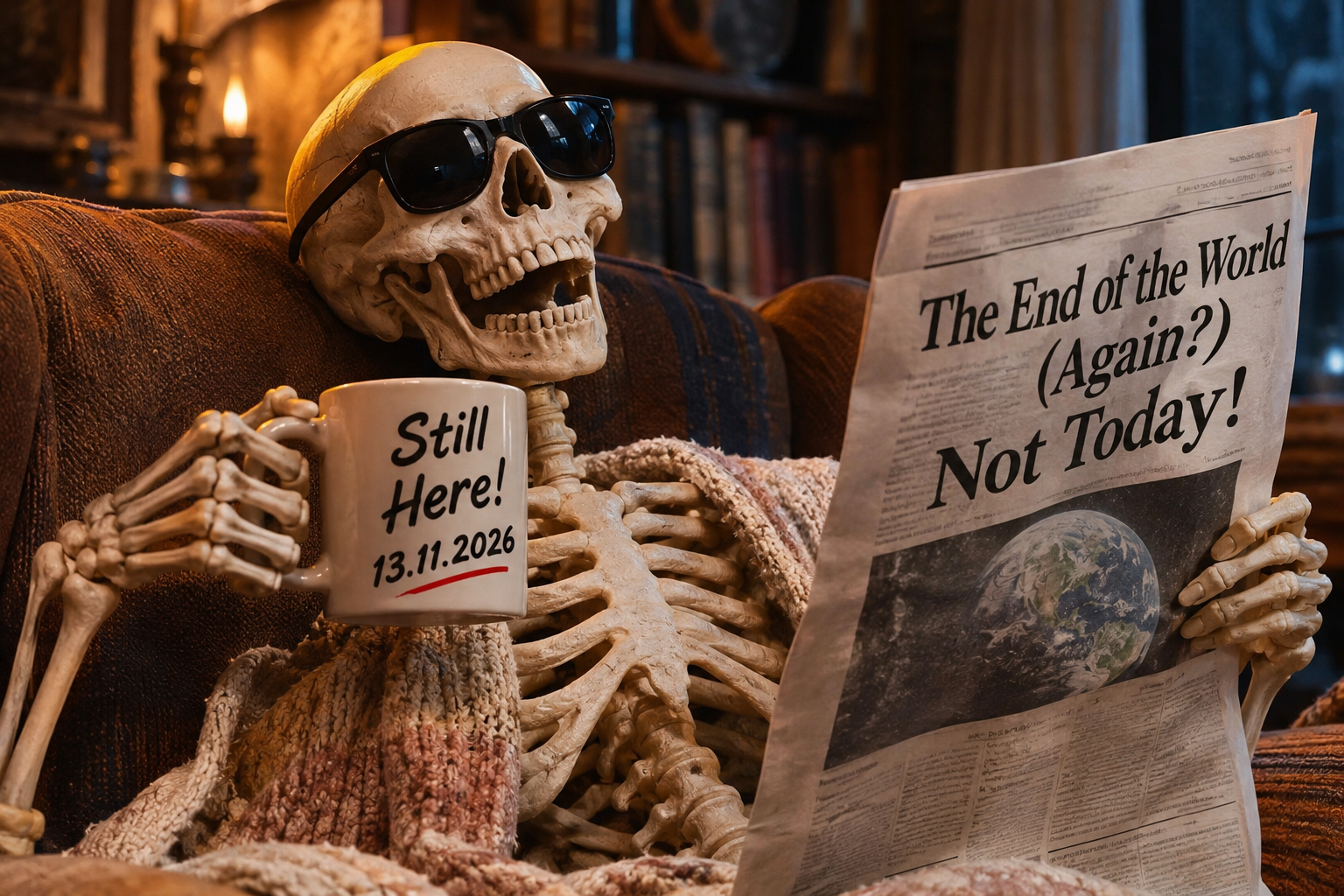
This is how the news started today in Greece!!!
What happens when science gives the world an expiration date, and that date finally arrives?
I don’t usually follow the news, either on television or in newspapers. This morning, while drinking my coffee, my eyes happened to fall on an article on my phone. I wasn’t particularly interested in the news itself, but something about the headline caught my attention. Today is November 13, and I became curious about what connection there could possibly be between this particular date and a prediction made more than sixty years ago.
What I discovered was rather extraordinary, because the story did not involve an ancient prophecy, a religious revelation, or one of those apocalyptic predictions that appear periodically and disappear just as quickly. It involved a mathematical equation, three scientists, and a scientific paper published in one of the most respected journals in the world.
According to that equation, Friday, November 13, 2026, was supposed to mark humanity’s mathematical doomsday.
And today, as I sit here writing these words, that date has finally arrived.
The Scientist Who Gave Humanity an Expiration Date
On November 4, 1960, the scientific journal Science published a paper with a title that would have sounded more appropriate in a book of prophecies than in an academic publication: Doomsday: Friday, 13 November, A.D. 2026.
Its authors were Heinz von Foerster, an Austrian-born physicist who became an influential figure in cybernetics, and his colleagues Patricia M. Mora and Lawrence W. Amiot.
Their research examined estimates of the world’s population stretching from approximately 400 BC to 1958. What interested them was not simply the increasing number of human beings, but the disturbing acceleration hidden within those numbers.
For centuries, humanity had grown relatively slowly. Gradually, however, the intervals required for the population to double became shorter, and the historical data suggested a pattern of accelerating growth.
The researchers developed a mathematical formula to describe that pattern and extended it into the future.
The result was astonishing.
According to their model, the world population would exceed 25 billion by 2020, before approaching mathematical infinity in November 2026.
Of course, an infinite human population is physically impossible. The equation was approaching what mathematicians call a singularity, a point at which the mathematical expression ceases to provide a meaningful description of reality.
But the researchers deliberately presented their findings in language that was difficult to ignore, suggesting that future generations might face a world so overcrowded that human survival itself would become impossible.
What makes this story even more unusual is that November 13 was also Heinz von Foerster’s birthday. He was born on November 13, 1911, and the provocative date chosen for the paper carried an element of scientific humor.
Behind that humor, however, was a serious question about whether the extraordinary population growth observed during previous centuries could continue indefinitely.
Why the World of 1960 Was Afraid of Its Own Future
To understand why such an equation attracted attention, we need to remember the world in which it appeared.
The Second World War had ended only fifteen years earlier. Medical advances, improved sanitation, vaccination, and declining mortality were transforming human survival. More children were reaching adulthood, life expectancy was increasing, and the world’s population was growing at a remarkable pace.
Humanity had entered an era in which scientific progress was saving millions of lives, while simultaneously creating new anxieties about the planet’s ability to support an expanding population.
In 1968, eight years after von Foerster’s paper, biologist Paul Ehrlich published The Population Bomb, a book that helped bring fears of overpopulation into mainstream public debate.
Food shortages, environmental destruction, diminishing resources, and the possibility of widespread famine became central concerns in discussions about humanity’s future.
What I find particularly interesting is the contradiction that emerged during this period. Scientific progress had helped humanity overcome many of the conditions that once caused premature death, yet that very success encouraged predictions of a future catastrophe.
The problem was no longer simply whether enough people could survive.
It was whether too many people might survive for the planet to sustain them.
The Equation That Could Not Understand Human Beings
There is something deeply unsettling about the idea that thousands of years of human history could be reduced to a mathematical curve.
The equation developed by von Foerster and his colleagues was based on a measurable historical trend, and for a considerable period it described population growth surprisingly well.
But a mathematical model is not a prophecy.
Its conclusions depend on the assumptions used to construct it, and one of the most dangerous assumptions is that the future will continue behaving exactly like the past.
By the 1990s, the actual population trajectory was increasingly diverging from the predicted curve.
The world had changed in ways that a simple extrapolation of historical population growth could not adequately capture.
Education had expanded, particularly for women. Access to contraception had improved in many societies, urbanization had changed family structures, and economic conditions had influenced decisions about marriage and children. As child mortality declined, families in many countries also began choosing to have fewer children.
These developments are part of what demographers call the demographic transition, a process through which societies move from high birth and death rates toward lower ones.
The numbers reveal just how dramatically human behavior has changed.
According to the United Nations’ World Population Prospects 2024, the global fertility rate had fallen to approximately 2.3 births per woman, compared with 3.3 in 1990.
Instead of the impossible population explosion suggested by the 1960 equation, the United Nations projects that the world’s population will reach approximately 10.3 billion in the mid-2080s before beginning a gradual decline.
And here is a detail that deserves more attention: by 2024, more than a quarter of humanity was already living in countries whose populations had reached their historical peak.
The same species that once appeared destined to multiply without limits is now confronting population decline and aging in many parts of the world, while other regions continue to experience rapid growth.
The old equation did not fail because mathematics suddenly stopped working. It failed as a prediction because the assumptions that made it fit the past did not remain true.
The Most Disturbing Part of This Story Is Not the Prediction
What troubles me most about this story is not the date itself, nor the dramatic suggestion that humanity might disappear.
It is our extraordinary confidence in our ability to predict a future that has not yet happened.
Throughout history, human beings have tried to discover patterns that would reveal what awaits them. Ancient civilizations searched the movements of the stars, religious traditions interpreted sacred texts, and modern societies increasingly turn to statistics, computer simulations, and artificial intelligence.
The methods have changed enormously, but the underlying desire remains familiar.
We want to know what comes next because uncertainty has always frightened us.
Today, mathematical models influence decisions about climate change, economic development, epidemics, technology, and the future of entire societies. Many of these models are essential scientific tools, but their usefulness depends on understanding their assumptions, uncertainties, and limitations.
There is an important difference between using mathematics to explore possible futures and believing that mathematics has already determined which future must occur.
The equation published in 1960 is a remarkable example of that distinction.
Its mathematical conclusion was real within the conditions of the model, but those conditions did not describe an unchanging world.
Human beings are not passive numbers moving obediently toward a predetermined destination. Our choices, technologies, institutions, and social transformations can alter the very patterns that researchers are trying to measure.
That does not mean we can escape every consequence of our actions, nor does it mean that the environmental and demographic challenges facing humanity have disappeared.
It means that the future cannot always be understood by extending a line drawn through the past.
November 13, 2026: What Really Ends Today?
As I think again about the article that caught my attention over my morning coffee, I find myself returning to a question that has very little to do with the supposed end of the world.
What if the most important lesson of this equation is not that scientists made a prediction that failed, but that human beings are far more difficult to predict than we like to believe?
Sixty-six years ago, three researchers published a mathematical model that pointed toward today’s date. The paper was provocative, partly humorous, and rooted in a genuine concern about the future of humanity.
Today, November 13, 2026, has arrived, and the mathematical singularity has not become a physical catastrophe.
Yet the questions raised by that study have not disappeared.
How many people can our planet sustain? How will technology change our future? What happens when societies grow older, when resources are distributed unequally, or when scientific progress creates consequences that nobody anticipated?
And perhaps the most uncomfortable question of all is whether the predictions we trust today will look equally mistaken to someone reading them sixty years from now.
I began this morning with a cup of coffee and an unexpected newspaper headline. I ended up thinking about the strange relationship between time, human knowledge, and our desire to control what has not yet happened.
There is something almost poetic about a scientific equation that attempted to assign humanity a final date, only to become a reminder of how unpredictable humanity can be.
Perhaps the greatest mystery was never whether the world would end on November 13, 2026, but why we are so determined to believe that the future can be written before we have lived it.
And that, to me, is a far more fascinating question than any prediction of the apocalypse.
Sources and Further Reading
Eos (1989). A retrospective discussion of the population-growth equation and its implications. Historical scientific commentary
Von Foerster, H., Mora, P. M., & Amiot, L. W. (1960). Doomsday: Friday, 13 November, A.D. 2026. Science, 132(3436), 1291–1295. Original scientific publication — PubMed
United Nations, Department of Economic and Social Affairs (2024). World Population Prospects 2024: Summary of Results. UN Population Division
United Nations (2024). UN Projects World Population to Peak Within This Century. Official UN press release
Οικονομικός Ταχυδρόμος (November 13, 2026). Παρασκευή και 13 Νοεμβρίου 2026: Η «συντέλεια του κόσμου» που προέβλεψε μαθηματική εξίσωση το 1960. Read the Greek article