
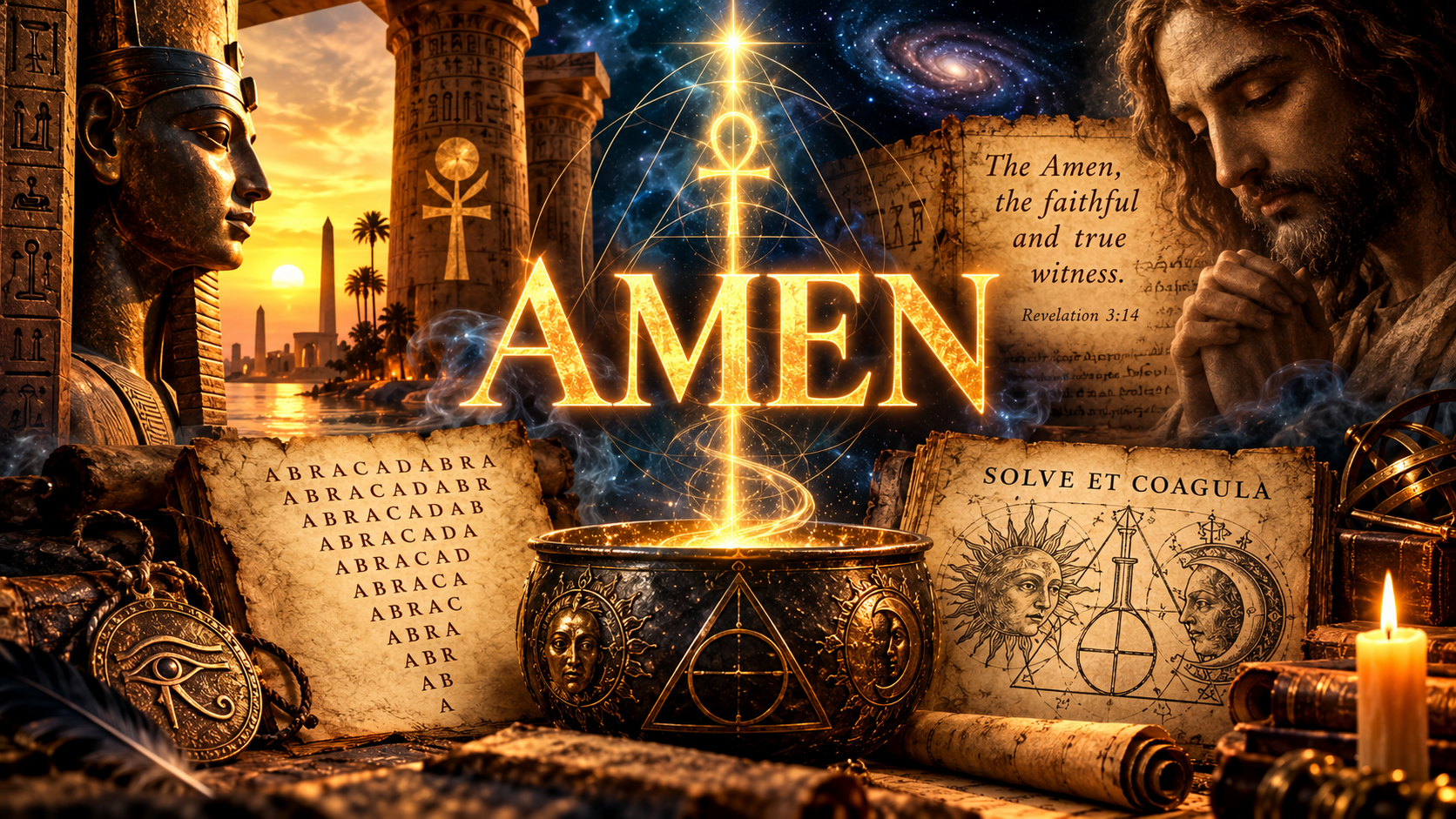
There are certain words we repeat so often that, after a while, we stop hearing them altogether. They become part of the background of our lives, familiar sounds that pass through the mouth almost automatically, carrying traditions much older than our own understanding of them. For me, Amen had always belonged to that category, because I had heard it at the end of prayers, funerals, blessings, private pleas and ceremonial words so many times that I had unconsciously reduced it to a religious full stop, a conventional way of saying that the prayer was over.
What changed my perception was not one dramatic discovery, but a series of details that began to accumulate once I started looking at the word more carefully. I wanted to know where it came from, why it had survived for so long almost unchanged, why it appeared in Jewish and Christian traditions with such extraordinary persistence, and why certain esoteric interpretations had turned it into something far more mysterious than a simple liturgical response. What began as a curiosity about one familiar word gradually pulled me into a much wider investigation, one that led from ancient Hebrew and Egyptian religion to the sayings attributed to Jesus, from medieval alchemy to a Roman medical charm, and finally to one of the most famous words in the history of magic: Abracadabra.
The deeper I went, the more I found myself returning to the same unsettling question. What if ancient people did not always think of words merely as instruments for describing reality, but as actions capable of participating in reality, shaping it, confirming it, dissolving it or fixing it into form?
The Word We Say Without Hearing It
The first thing that intrigued me was the realization that Amen is far older than Christianity. Its accepted linguistic origin is Hebrew, from the Semitic root ʾ-M-N, a family of words associated with firmness, reliability, faithfulness, trust and truth. The same root lies behind emunah, a term commonly translated as faith or faithfulness, but whose older sense is richer than a vague inner belief because it also carries the idea of something dependable, stable and worthy of trust.
This immediately changed the way I understood the familiar translation “so be it.” In modern usage, that expression can sound almost passive, as if the speaker were merely hoping that something might happen in the future, yet the older range of meaning attached to Amen is far stronger and more active. Depending on context, the word can function as an affirmation that what has just been spoken is accepted as true, binding or worthy of trust, almost as if the speaker were saying, “I stand behind these words; I accept their meaning; let what has been spoken be confirmed.”
One of the passages that stayed with me appears in Numbers 5:22, where a woman responds to a solemn oath with the doubled formula “Amen, Amen.” Another appears repeatedly in Deuteronomy 27, where the assembled people answer Amen after a series of declarations. In both cases, the word is not decorative and it does not merely end the exchange. It does something socially and spiritually important, because the person saying it places himself or herself inside the statement that has just been made.
That distinction fascinated me, because it made Amen seem less like punctuation and more like a verbal seal. I do not mean a magical seal in the later occult sense, but a deliberate act of confirmation through which spoken words become accepted, witnessed and, in a certain sense, completed.
Rabbinic tradition gives the word even greater depth. In the Babylonian Talmud, in tractate Shabbat 119b, Rabbi Ḥanina asks what Amen signifies and interprets its Hebrew letters as an acronym for El Melekh Ne’eman, meaning “God, Faithful King.” Other rabbinic discussions treat the response Amen not as the insignificant echo of someone else’s prayer, but as a meaningful act in itself, one that binds the person answering to what has been pronounced.
I found that reversal beautiful, because in modern religious habit we tend to assume that everything important has already happened before Amen is spoken. The prayer, the blessing, the request and the declaration seem to contain the substance, while the final word appears to be little more than closure. Yet older traditions suggest something more subtle, because sometimes the act of confirmation is precisely what gives the preceding words their final weight.
Amun and the Egyptian Connection I Wanted to Believe
Sooner or later, anyone who investigates the history of Amen encounters another ancient name that is almost impossible to ignore: Amun, also written Amon, one of the most important gods of ancient Egypt.
The resemblance between Amun and Amen is immediately seductive, especially for anyone drawn to ancient mysteries. Amun rose to immense religious importance in Egypt, particularly from the Middle Kingdom onward, and later became closely associated with Ra as Amun-Ra. His cult at Karnak developed into one of the most important religious centers in the ancient world, while his name was traditionally interpreted as “the Hidden One,” a designation that fits his association with the invisible, concealed and mysterious aspects of divinity.
When I first encountered the similarity between Amun and Amen, I wanted the connection to be real. It was the kind of idea that seems almost too perfect to resist: an Egyptian god known as “the Hidden One,” worshipped for centuries before Christianity, and a sacred word that would later become one of the most recognizable expressions in Judaism and Christianity, both surviving with remarkably similar sounds.
It would make a magnificent secret history, but the evidence does not support a direct linguistic derivation. The Hebrew Amen belongs securely to the Semitic root ʾ-M-N, while the Egyptian name Amun arises within a different linguistic system. Similarity of sound, even when striking, is not enough to prove common origin, and this is one of those moments where I think mystery becomes more interesting when we resist the temptation to force it into certainty.
What remains is still remarkable. Two ancient religious cultures, geographically close and historically intertwined, preserved sacred forms whose sounds resemble one another while their meanings move in different directions: one toward hiddenness and divine invisibility, the other toward truth, faithfulness and confirmation. I find the coincidence powerful enough on its own, precisely because it does not need to be turned into a false etymology.
When Amen Moves to the Beginning
The next stage of my investigation became even more intriguing when I noticed the way Amen appears in the sayings attributed to Jesus.
In ordinary liturgical use, the word usually follows a statement. Someone speaks, blesses or prays, and another person answers Amen. Yet in the Gospel tradition, Jesus repeatedly places the word before what he is about to say. English Bibles usually translate this as “Truly I say to you,” but behind the word “truly” stands the Greek transliteration amēn, preserving the Semitic expression itself.
This unusual introductory use has been discussed by scholars for a long time. In the Synoptic Gospels it appears frequently, while the Gospel of John intensifies the formula by doubling it: “Amen, amen, I say to you,” commonly translated into English as “Truly, truly, I say to you.”
What intrigued me was the shift in function. The word is no longer being used by an audience to confirm something already spoken, but by the speaker himself to establish the certainty and authority of what is about to follow. Instead of closing a statement, Amen now stands at the threshold of one.
That alone is unusual, but Revelation 3:14 goes even further. There, Christ is referred to as “the Amen, the faithful and true witness.” At this point, Amen is no longer simply a response or an introductory formula; it has become a title.
I remember stopping when I first read that verse in this context, because it completely changed the scale of the word. A term I had spent years hearing as the automatic ending of prayers was suddenly being used as a name associated with faithfulness and truth. The connection with Isaiah 65:16, where the Hebrew text contains an expression that can be rendered as “the God of Amen,” “the God of faithfulness” or “the God of truth,” only deepens the background.
At that point I began to see Amen less as the end of religious speech and more as an ancient concept of reliability transformed into language. Something spoken, affirmed and made firm.
And that was precisely when another phrase entered my mind.
Solve et Coagula
Anyone who spends enough time reading about alchemy eventually encounters the expression Solve et Coagula, usually translated as “dissolve and coagulate.”
The popular image of alchemy reduces it to eccentric men attempting to turn lead into gold, yet historical alchemy was much more complex than that. Its texts describe the dissolution, separation, purification, recombination and fixation of substances through repeated processes, and these material operations often acquired symbolic, philosophical and spiritual meanings as well.
What interested me most was the rhythm implied in Solve et Coagula. Something must first be broken apart, released from its previous form or reduced to a more fluid state, and only afterward can it be recombined, stabilized and fixed into something new.
While reading about this process, I began to see an unexpected symbolic parallel with Amen.
I want to be careful here, because I found no historical evidence showing that ancient Hebrew speakers intended Amen to mean Coagula, nor did I find evidence that alchemists derived their formula from Jewish or Christian liturgical usage. The connection belongs to symbolic interpretation, not etymology.
Even so, the correspondence is striking.
A prayer begins in a state that is almost entirely intangible. It may start as fear, gratitude, longing, uncertainty or desire. Then it becomes thought, thought becomes breath, breath becomes sound, and sound becomes a sequence of words directed outward toward another person, a community, a divinity or even one’s own inner life.
At the end comes Amen, the moment of confirmation.
Seen through an alchemical metaphor, everything before that final word remains fluid, expressive and open, while Amen resembles the moment of fixation, the point at which the speaker gathers the intention, accepts it and gives it a defined boundary.
This does not require the belief that certain syllables mechanically force the universe to obey human wishes. What interested me more was the ancient recognition that an intention changes once it acquires form.
A vow kept silently in the mind is not the same as a vow spoken aloud. A contract imagined is not the same as a contract signed. A verdict considered privately is not the same as a verdict pronounced in court. In each case, language transforms an inner state into an event with consequences.
Long before modern psychology or linguistics studied the social power of speech, ritual cultures had already understood that words could mark transitions, bind people, create obligations and change circumstances.
That idea would become even more fascinating when I encountered Abracadabra.
The Word That Was Supposed to Disappear
I had always associated Abracadabra with stage magicians, children’s performances and cheap theatrical tricks. It was the kind of word that seemed too familiar to deserve serious attention, precisely because popular culture had turned it into a cliché.
Its actual history is far stranger.
The earliest surviving written appearance usually cited by scholars occurs in a Latin medical poem associated with Quintus Serenus Sammonicus, probably in the third century CE. Serenus recommended the word not as entertainment but as part of a treatment for recurring fever, generally interpreted in modern scholarship in connection with malaria.
The patient was instructed to write the word repeatedly, removing one letter from each successive line until the formula narrowed into a triangle:
ABRACADABRA
ABRACADABR
ABRACADAB
ABRACADA
ABRACAD
ABRACA
ABRAC
ABRA
ABR
AB
A
The logic is visually obvious once you see it. The word shrinks line by line, and the illness is symbolically expected to diminish with it.
That was the moment when the relationship with Solve became impossible for me to ignore, because the written charm itself performs a kind of dissolution. The letters disappear gradually until the original form has almost completely vanished.
In the ancient worldview behind the charm, this was not merely decorative symbolism. Medicine, religion, astrology and magic often overlapped in ways that modern categories tend to separate. A written word could function simultaneously as language, image, ritual object and supposed therapeutic instrument.
The details of the ritual are even stranger than the word itself. According to accounts derived from Serenus, the written charm was to be tied with flax and worn around the neck, and after nine days it was to be removed and thrown backward over the shoulder into a stream flowing eastward.
That detail stayed with me because the word alone was not considered sufficient. The body, the written object, the number of days, the direction of the flowing water and the act of disposal all became part of the same ritual structure.
Once I understood that context, Abracadabra stopped looking like a ridiculous stage-magician formula and began to look like the fossil of a very old human conviction: that words, when written, arranged and ritualized correctly, could participate in the transformation of physical reality.
What Does Abracadabra Actually Mean?
This was also where I encountered one of the most attractive myths surrounding the word.
Modern esoteric sources frequently claim that Abracadabra comes from an Aramaic phrase supposedly meaning something like “I create as I speak” or “I will create through the word.” It is an interpretation so perfectly suited to the idea of manifestation that it has been repeated almost endlessly.
The problem is that the derivation is not securely documented.
Scholars have proposed connections with Aramaic, Hebrew, the Gnostic name Abraxas and various magical formulas, yet no explanation has been demonstrated conclusively. The origin of Abracadabra remains uncertain.
I found myself liking that uncertainty more than the neat explanation.
There is something deeply unsettling about a word that has survived for nearly eighteen centuries, a word recognized today by children across much of the world, while its original meaning still escapes us. We know what people did with it before we know with confidence what it meant to the person who first recorded it.
That, to me, is far more mysterious than forcing it into a convenient translation.
Abracadabra as Solve, Amen as Coagula
Once I placed Abracadabra and Amen on opposite sides of the alchemical expression Solve et Coagula, a symbolic pattern began to emerge.
I do not mean that I had discovered a secret historical doctrine connecting ancient Judaism, Roman medical magic and medieval alchemy. There is no evidence for such a unified system, and pretending otherwise would weaken the article rather than deepen it.
What interested me was the recurrence of the same symbolic logic.
Abracadabra, in its ancient triangular form, is gradually dissolved.
Amen, in its older religious use, affirms, confirms and stabilizes what has been spoken.
The first visually resembles Solve.
The second symbolically resembles Coagula.
Between them lies one of humanity’s oldest obsessions: the belief that language can mediate between what exists inside us and what exists outside us.
A thought becomes breath, breath becomes sound, sound becomes language, language becomes declaration, and declaration becomes action. Sometimes that action becomes law, ritual, commitment or history.
We live inside this process every day, even if we no longer call it magic.
A judge speaks a sentence and a person loses freedom. Two people pronounce words in a legal ceremony and their social status changes. A doctor names a disease and an entire family begins reorganizing its future around that diagnosis. A government signs and announces an agreement and borders, rights or obligations change. Someone says “I promise,” and suddenly there is an expectation that did not exist before.
None of this requires supernatural forces to demonstrate that words can alter reality.
The deeper question is why so many ancient traditions believed that the power of language extended even further.
In the Beginning Was the Word
At this point in my investigation, it became impossible not to think of one of the most famous openings in religious literature: “In the beginning was the Word.”
The Gospel of John begins with the Logos, while Genesis presents creation itself as an act structured through divine speech. God speaks, and reality follows.
I do not believe we need to claim that Genesis, John, Egyptian religion, Jewish liturgy, Roman medical charms and European alchemy all preserve fragments of one secret doctrine. That kind of claim is attractive because it creates a complete pattern, but history is usually more complicated than the patterns we want to impose on it.
What fascinates me more is that different civilizations repeatedly return to the intuition that language possesses more than descriptive power.
Names could invoke.
Oaths could bind.
Blessings could protect.
Curses could injure.
Sacred formulas could heal.
Written letters could become talismans.
A true name could grant authority.
Even silence could become part of ritual.
When I began placing these traditions side by side, I did not find proof that words release invisible energies capable of rearranging physical matter according to desire. What I found was something more historically defensible and, in many ways, more profound: human beings have understood for thousands of years that language shapes consciousness, consciousness shapes behavior, behavior changes circumstances, and circumstances become the world in which we live.
Ancient ritual compressed that chain into symbol.
Alchemy encoded it through transformation.
Religion expressed it through sacred speech.
Modern psychology studies parts of the same process using another vocabulary.
Was Amen Ever a Manifestation Formula?
This is where I think it becomes important to resist the simplest answer.
There is no reliable historical basis for calling Amen “the oldest manifestation formula in human history,” and I found no evidence that ancient speakers believed the sound itself could mechanically force a private desire into material existence.
That claim sounds powerful, but it risks replacing genuine mystery with a modern slogan.
At the same time, reducing Amen to a meaningless habit would also miss the complexity of the word.
Historically, it carries ideas of truth, trust, affirmation, reliability and confirmation. Biblically, it appears in oaths, communal responses and formal declarations. In the Gospel tradition it is placed at the beginning of authoritative sayings, while in Revelation it becomes a title associated with faithfulness and truth.
That is already remarkable enough.
The esoteric reading can begin after the historical evidence, without pretending to replace it.
When I interpret Amen through the symbolism of Coagula, I am not claiming to have uncovered a hidden dictionary used by ancient alchemists. I am doing something closer to what esoteric traditions have always done, which is to observe correspondences between different systems of meaning.
The prayer releases intention into language, while the final affirmation gathers it into certainty.
The inner state becomes a spoken form.
The spoken form becomes accepted.
The volatile becomes fixed.
That is where Solve et Coagula becomes, for me, more than an alchemical motto.
Why Words Were Never Just Words
The further I went into this subject, the more I found myself questioning the modern assumption that words are neutral containers.
Why do we instinctively lower our voices when making certain promises? Why does naming a fear sometimes make it more terrifying, while at other times speaking it aloud diminishes its power? Why have people in so many cultures written sacred formulas on walls, parchment, metal, stone, amulets and even skin? Why do religions repeat particular phrases? Why do legal systems demand exact verbal declarations? Why do rituals insist that certain words be spoken in a prescribed sequence?
We behave as though words matter because they do.
The disagreement begins only when we ask how far that power extends.
Ancient people may have attributed effects to sacred language that modern science does not accept, while modern culture may sometimes underestimate the psychological, social and symbolic power that carefully chosen words continue to exercise over human beings.
Between uncritical belief and automatic dismissal lies a much more interesting territory, and that is the territory where this investigation eventually led me.
When I now hear Amen, I no longer hear a religious full stop. I hear a word that has travelled through millennia carrying the ideas of affirmation, trust and confirmation.
When I encounter Abracadabra, I no longer think only of a theatrical trick. I think of a person living nearly eighteen centuries ago, carrying a written triangle of diminishing letters against the body, waiting nine days before casting it into running water in the belief that illness could disappear as the word disappeared.
When I read Solve et Coagula, I no longer imagine only furnaces, manuscripts and metals. I see a recurring human pattern in which old forms are broken apart so that new forms can emerge, after which the unstable must once again be fixed.
These are not identical traditions, and I would never claim that they are.
Yet they circle around the same ancient human intuition: invisible things become powerful when we give them form.
The Real Secret of Amen
By the time I reached the end of this investigation, I had become less interested in proving that Amen possesses some hidden supernatural frequency and more interested in understanding why a word like this could survive for so long.
The true force of Amen may never have belonged to sound alone.
It may lie in the moment when a person stops merely thinking and begins affirming, when uncertainty becomes commitment, when an intention receives language and when language is consciously accepted as one’s own.
The old alchemists understood that nothing remains forever in a volatile state. At some point, something must be fixed.
That is Coagula.
The Roman charm reduced Abracadabra until the word almost vanished completely.
That resembles Solve.
Between dissolution and fixation stands the human being, doing what humans have always done: giving invisible things shape through symbols, names, ritual and speech.
For me, this is where the deepest mystery of sacred language begins.
Not in the simplistic idea that a word automatically commands the universe, but in the much older and more unsettling realization that a word can direct attention, shape belief, organize intention, bind communities, alter decisions, define identities, create obligations and survive long after the person who first spoke it has disappeared.
Civilizations vanish, temples collapse, languages transform, dynasties end and gods are forgotten or renamed, yet certain words continue travelling through time.
One of them is still spoken every day by millions of people who may never stop to ask what they are actually saying.
And now, whenever I hear Amen, I no longer hear the end of a prayer.
I hear the moment when the words before it are made firm.
Sources and Further Reading
Etymological scholarship on the uncertain origin of Abracadabra.
British Museum, educational resources on Amun and ancient Egyptian religion.
Metropolitan Museum of Art, Egyptian collections and material on the cult of Amun.
Babylonian Talmud, Shabbat 119b, on Amen and El Melekh Ne’eman.
John Strugnell, “Amen, I Say Unto You” in the sayings of Jesus and early Christian literature.
G. K. Beale, research on the Old Testament background of Revelation 3:14.
Princeton University Library, material on alchemy and the principle Solve et Coagula.
Historical medical studies on Quintus Serenus Sammonicus and the Abracadabra fever amulet.