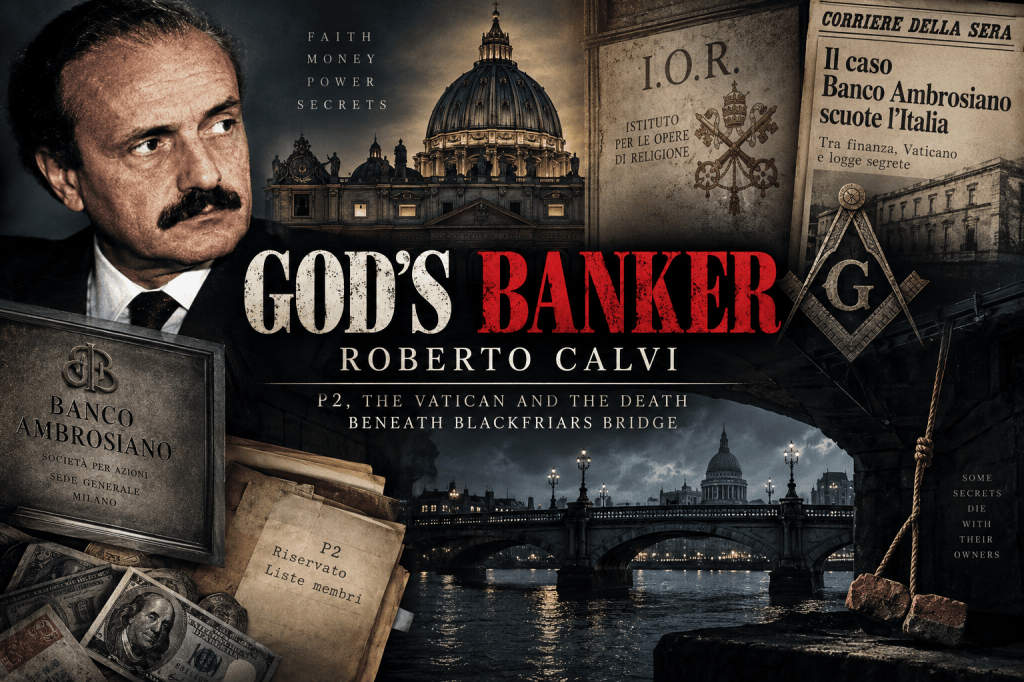
He controlled one of Italy’s most important private banks, belonged to the secret P2 network, maintained extraordinary financial relationships with the Vatican Bank and fled Italy while a financial empire was collapsing around him. Days later, Roberto Calvi was found hanging beneath a London bridge, his pockets containing bricks and large amounts of foreign currency, and more than four decades later the central question still has no judicially established answer: who wanted “God’s Banker” dead?
On the morning of June 18, 1982, a postal worker crossing London noticed something beneath Blackfriars Bridge that seemed, at first, almost impossible to understand. Suspended from scaffolding above the River Thames was the body of a well-dressed man, a length of orange rope around his neck, while bricks had been placed inside his clothing and substantial sums of money in several currencies remained in his pockets.
The dead man was Roberto Calvi, sixty-two years old, chairman of Banco Ambrosiano and one of the most controversial financiers in Europe, whose intimate relationship with the Vatican’s Institute for the Works of Religion had earned him the nickname “God’s Banker.”
Within months, Banco Ambrosiano would become synonymous with one of Europe’s largest postwar banking scandals, while Calvi’s death would develop into something considerably stranger than a financial crime story, because following the money meant entering a labyrinth in which an Italian bank, offshore companies, the Vatican Bank, members of the clandestine P2 lodge, businessmen, intelligence connections and organized crime repeatedly appeared in the same historical landscape. Italian archival material describing Calvi’s career explicitly records his P2 affiliation and the opaque network of relationships linking Banco Ambrosiano, the IOR, international financial institutions, elements of the Italian political world and organized crime.
What happened beneath Blackfriars Bridge remains unresolved.
What happened before Calvi reached London, however, is documented sufficiently well to make the mystery disturbing without embellishment.
THE BANKER WHO ENTERED THE SHADOW WORLD OF P2
Banco Ambrosiano had been founded in Milan at the end of the nineteenth century as a Catholic-oriented financial institution, but under Calvi its operations expanded aggressively beyond Italy, developing a complicated international network involving subsidiaries, holding companies and offshore structures.
Calvi became president of the bank in 1975, and during approximately the same period another relationship increasingly shaped his world: his association with Propaganda Due, or P2, the clandestine organization controlled by Licio Gelli.
The Italian national archival description of Calvi’s career is unusually direct about this period, stating that the years from 1975 until his death were marked by his affiliation with P2 and his relationship with its leaders, Licio Gelli and Umberto Ortolani. It also notes that Banco Ambrosiano became involved in increasingly risky operations and eventually participated in the acquisition of Rizzoli, the publishing group that controlled one of Italy’s most influential newspapers, Corriere della Sera.
This is where the story begins to resemble the previous P2 article.
A secret network was not merely operating beside the worlds of finance and media.
Its members were moving inside them.
When investigators discovered the P2 membership lists in 1981, Calvi’s name became part of a national scandal that was already engulfing politicians, military officers, intelligence officials and businessmen.
The banker who handled enormous international transactions was therefore not simply an isolated financier who happened to know influential people; he belonged to the same clandestine organization whose discovery had shaken the Italian state.
Yet P2 was only one side of Calvi’s network.
The other led behind the walls of Vatican City.
THE VATICAN CONNECTION
The institution commonly described as the Vatican Bank is formally known as the Institute for the Works of Religion — IOR, and during Calvi’s rise it was headed by the American archbishop Paul Marcinkus.
The relationship between Banco Ambrosiano and the IOR became intensely controversial because of a network of offshore companies and enormous loans originating through Ambrosiano’s foreign subsidiaries. Investigators found that large sums had traveled toward companies located in jurisdictions such as Panama and Liechtenstein, creating a financial architecture so opaque that even today accounts of the scandal can become difficult to follow.
At the center of the controversy were documents known as letters of patronage, issued in connection with companies involved in the network.
Contemporary investigations reported that the letters indicated connections between these companies and the IOR, creating the appearance that the Vatican institution stood behind them, although the Vatican consistently disputed that the documents amounted to legally enforceable guarantees. One contemporary reconstruction also described a separate “liberating letter” that relieved the IOR of responsibility, while the banks extending the loans apparently did not initially receive the same information.
This distinction is essential because later mythology frequently transformed a complex financial relationship into the much simpler claim that “the Vatican stole the Banco Ambrosiano money,” which is not what the surviving evidence establishes.
The relationship was nevertheless sufficiently serious that, after years of negotiations, the Vatican agreed in 1984 to make a payment of approximately $241 million to foreign creditors of the failed Ambrosiano group, describing the payment as a voluntary contribution while continuing to deny legal liability for the debts.
That is not proof of a Vatican conspiracy to kill Calvi.
It is proof that the financial relationship was substantial enough to survive the banker’s death and require an enormous international settlement.
A BILLION-DOLLAR HOLE
By the beginning of the 1980s, the structure Calvi had constructed was becoming increasingly difficult to sustain. Italian monetary authorities were examining Ambrosiano’s foreign operations, questions were being raised about the destination and recoverability of massive loans, and the bank’s international network was beginning to expose liabilities that could no longer be concealed behind layers of companies and financial transactions.
Historical banking archives describe a deficit reaching approximately 1,200 billion Italian lire, while contemporary international reporting frequently placed the missing or problematic exposure at more than a billion US dollars.
Calvi had already been convicted in 1981 for currency violations, although he remained free pending appeal, and his political and financial position deteriorated dramatically as the P2 scandal exploded around him.
The very people and institutions that had once represented access and protection were increasingly becoming liabilities.
Gelli was exposed.
P2 had been uncovered.
The Bank of Italy was investigating.
Banco Ambrosiano’s directors were losing confidence.
The Vatican relationship was deteriorating.
The offshore structure was becoming impossible to explain.
By June 1982, Calvi was running out of places to hide.
THE LETTER TO THE POPE
Among the most chilling details associated with Calvi’s final days is a letter he wrote to Pope John Paul II shortly before his death.
Reporting on the correspondence later noted that Calvi warned that the collapse of Banco Ambrosiano could cause catastrophic consequences for the Church, while his increasingly desperate communications suggested that he believed the financial network contained secrets whose exposure could damage powerful institutions far beyond his own bank.
One does not need to assume that every threat or implication in Calvi’s letters was accurate. A man whose financial empire was collapsing had obvious reasons to exaggerate his importance and the consequences of abandoning him.
Nevertheless, the letter introduces one of the questions that has haunted the case ever since.
What exactly did Roberto Calvi know?
Not merely about Banco Ambrosiano, because the bank’s financial condition was already becoming visible, but about the relationships that had allowed the system to operate for so long.
If Calvi possessed documents showing where certain money had gone, who had authorized particular arrangements and which powerful figures had benefited from his network, his value as a banker was disappearing at precisely the moment when his value as a witness might have been increasing.
THE ESCAPE
In June 1982, Calvi left Italy using a false passport and traveled through Austria before reaching London, where he hid in an apartment in Chelsea.
The scene surrounding his final days is extraordinary because almost every structure supporting his life appeared to be collapsing simultaneously.
On June 17, Banco Ambrosiano’s board stripped him of his authority, while Italian banking authorities intervened in the institution.
That same day, another death occurred in Milan.
Calvi’s longtime secretary, Graziella Corrocher, fell from a fourth-floor window at Banco Ambrosiano’s headquarters and died, leaving behind what was reported as a note blaming Calvi for the disaster affecting the bank and its employees.
Within hours, Calvi himself would be dead in London.
Two deaths.
One collapsing bank.
A secret lodge.
Hundreds of millions moving through offshore structures.
A Vatican financial institution drawn into the controversy.
And a banker hiding under a false identity in another country.
It is not difficult to understand why the case produced conspiracy theories.
The remarkable part is how much of the surrounding story was real.
BENEATH BLACKFRIARS BRIDGE
When Calvi’s body was discovered, the circumstances immediately seemed theatrical.
There was the orange rope.
There were the bricks.
There was the foreign currency.
There was the location itself: Blackfriars Bridge.
Because Calvi had belonged to P2, writers eventually began suggesting that the bridge represented some kind of Masonic message, noting the literal translation of Black Friars as Frati Neri — “Black Friars” or “black brothers” — and constructing elaborate theories around the symbolic choice of location.
It is an irresistible detail.
It is also not proven.
Even investigators who came to believe that Calvi had been murdered expressed skepticism about whether the bridge had been selected because of a Masonic message, and there is no definitive judicial finding establishing that the location represented a P2 ritual or warning.
The bricks have similarly inspired decades of speculation about Masonic symbolism because masonry naturally evokes bricks, stones and builders.
Again, the symbolism is intriguing.
Again, it remains speculation.
The physical evidence surrounding Calvi’s death is more important.
SUICIDE — OR A PERFECTLY STAGED MURDER?
The original British investigation leaned rapidly toward suicide, and the first inquest returned that verdict.
Calvi’s family refused to accept it.
A second inquest in 1983 produced an open verdict, meaning that the circumstances of death could not be determined with sufficient certainty.
Years later, the case changed dramatically.
Private investigators hired by Calvi’s family reconstructed the scaffolding beneath Blackfriars Bridge and examined what Calvi would have needed to do in darkness to reach the location where his body was found. Later forensic examinations also focused on the absence of marks investigators expected to find if he had climbed across the scaffolding himself.
In 2002, new forensic work carried out during the reopened Italian investigation concluded that the circumstances were compatible with Calvi having been immobilized or strangled before being suspended beneath the bridge, strengthening the hypothesis that his apparent suicide had actually been staged.
British investigators who later assisted the Italian inquiry similarly treated murder as the more credible explanation.
Yet here we encounter a crucial distinction.
Evidence suggesting murder is not the same as identifying the murderer.
And in Roberto Calvi’s case, that second step has never been completed successfully.
THE MAFIA THEORY
As investigators reconstructed Calvi’s financial world, suspicion increasingly focused on people connected with organized crime, particularly the idea that Banco Ambrosiano or its associated structures may have handled money belonging to criminal organizations.
Italian prosecutors eventually advanced a theory according to which Calvi was killed because he had mishandled money, possessed dangerous financial knowledge and represented a threat to powerful interests.
Several people were eventually placed on trial, including Giuseppe “Pippo” Calò, a major Sicilian Mafia figure, along with Flavio Carboni, Ernesto Diotallevi, Silvano Vittor and Manuela Kleinszig.
The prosecution’s reconstruction was spectacular, involving the possibility that Calvi had been brought toward the Thames, killed and then suspended beneath Blackfriars Bridge to create the appearance of suicide.
But in 2007, all five defendants were acquitted because the court found insufficient evidence to establish that they had committed the murder.
The acquittals of Carboni, Calò and Diotallevi were subsequently confirmed on appeal in 2010.
Therefore, anyone claiming that “the Mafia was proven to have murdered Calvi” goes further than the judicial record permits.
The murder hypothesis became considerably stronger.
The identity of the killers did not.
P2, THE VATICAN AND THE MAFIA: WHAT CAN ACTUALLY BE CONNECTED?
This is precisely where the Calvi case becomes a perfect example of how genuine conspiracies and speculative conspiracies become entangled.
Calvi’s membership in P2 is documented.
His close financial relationship with the Vatican Bank is documented, as are the controversial letters of patronage and the subsequent financial settlement.
Banco Ambrosiano’s enormous network of offshore lending and its catastrophic collapse are documented.
The later forensic evidence that led investigators to treat Calvi’s death as probable murder is documented.
Investigations and prosecutions examining possible organized-crime involvement are documented.
What has not been proven is a single unified conspiracy in which P2, the Vatican and the Mafia collectively ordered Calvi’s death.
There is an enormous difference between those two statements.
The first describes a documented network of relationships surrounding one extraordinarily compromised banker.
The second proposes a final explanation for his murder that no court has established.
That gap between what can be demonstrated and what remains hidden is where the real mystery survives.
THE MONEY THAT DISAPPEARED
One of the enduring questions is not simply who killed Calvi, but where all the money went.
Banco Ambrosiano’s offshore system contained layers of companies whose ownership, control and ultimate beneficiaries were difficult to reconstruct, while billions in liabilities and loans passed through entities that sometimes appeared to have little independent commercial purpose.
Contemporary reporting described Panamanian shell companies financed by Ambrosiano subsidiaries, while Vatican connections became important because letters from the IOR appeared to establish relationships with some of those companies.
This created a situation in which every missing document mattered.
Every nominee shareholder mattered.
Every offshore company mattered.
Every letter mattered.
And Calvi was one of the few individuals positioned near the center of the system who may have understood how the pieces connected.
That fact provides a perfectly rational reason why so many different theories of motive emerged after his death.
A banker controlling secrets involving ordinary clients is useful.
A banker controlling secrets involving powerful institutions is dangerous.
A bankrupt banker controlling those secrets while threatening to talk may be something else entirely.
THE STRANGEST PART OF THE STORY
Perhaps the most unsettling aspect of the Calvi affair is that the supposedly fantastic parts gradually became less fantastic as investigators uncovered the surrounding world.
A clandestine lodge operating among powerful Italians?
P2 existed.
A prominent banker belonging to it?
Calvi belonged to P2.
Secret offshore companies moving enormous sums of money?
They existed.
A deep financial connection with the Vatican Bank?
It existed.
A financial collapse exceeding a billion dollars?
It happened.
A dead banker hanging beneath a London bridge under circumstances later considered incompatible with a simple suicide by many investigators?
That happened too.
The only part of the story that remains beyond reach is the one people most want answered.
Who put Roberto Calvi beneath Blackfriars Bridge?
THE MEN WHO WERE NEVER IDENTIFIED
More than forty years after the death, no court has conclusively identified the person or people who physically killed Calvi, nor has a judicial judgment established who ordered his death.
That fact makes irresponsible certainty tempting because a mystery creates a vacuum, and a vacuum attracts explanations.
The Mafia did it.
P2 did it.
The Vatican did it.
Political interests did it.
Secret services did it.
Calvi killed himself.
Every version has had supporters.
Yet the evidence does not permit us to close the case so neatly.
What we can say is far more interesting: Calvi existed at the intersection of several structures that genuinely possessed enormous power, enormous amounts of money and enormous reasons to fear exposure, while investigators later developed substantial reasons to question the original suicide explanation.
The banker died.
The bank collapsed.
The Vatican paid hundreds of millions to help settle the international creditors’ dispute without accepting legal liability.
P2 became one of the greatest political scandals in postwar Italy.
And the person who could perhaps have explained how those worlds intersected never returned from London.
WHEN THE CONSPIRACY IS NOT ONE CONSPIRACY
There is a deeper lesson hidden inside the Calvi story.
People frequently imagine conspiracies as perfectly organized secret plans controlled by a single group, when historical reality often consists of several overlapping networks whose interests temporarily coincide.
A banker may work with a religious financial institution without that institution knowing every transaction he performs.
A criminal organization may use a financial system without controlling the entire bank.
Members of a clandestine lodge may help one another without every member understanding what others are doing.
Politicians may accept favors without belonging to the same conspiracy.
Financiers may hide losses for completely different reasons.
When those networks overlap, however, an outsider can look at the final picture and see one enormous organization controlling everything.
Perhaps that is the wrong model.
Roberto Calvi’s world may have been more dangerous precisely because there was no single center.
Instead, there were intersecting circles of money, loyalty, influence, secrecy and fear, each containing people who knew something about the others but perhaps nobody who knew everything.
Except possibly the banker standing in the middle.
THE MAN UNDER THE BRIDGE
Today, the image of Roberto Calvi hanging beneath Blackfriars Bridge has almost separated itself from the man who actually existed.
He has become the “Banker of God,” the mysterious financier, the P2 Mason, the keeper of Vatican secrets, the possible custodian of Mafia money and the victim in one of Europe’s most famous unsolved deaths.
Some of those descriptions are established.
Others remain allegations.
That distinction matters because the factual story is already astonishing enough.
Calvi did not need to possess an occult secret.
He possessed financial secrets.
He did not need to know the hidden rulers of the world.
He knew bankers, financiers, P2 figures and people connected with extremely powerful institutions.
And he did not need to leave behind a coded message beneath an ancient bridge to create one of the greatest mysteries of the twentieth century.
All he had to do was die before he could explain where the money had gone.
More than four decades later, Roberto Calvi’s bank has disappeared, P2 has been exposed, many of the principal figures are dead and mountains of documents have entered archives, yet the final minutes of his life remain hidden somewhere between history and the Thames.
Perhaps that is why Blackfriars Bridge continues to fascinate us.
Not because we know what its symbolism meant.
But because we still do not know who chose it.
Source
Italian National Archival System — historical profile of Roberto Calvi and Banco Ambrosiano.Italian Senate Historical Archive — P2 and Banco Ambrosiano archival collections.Contemporary documentation concerning the IOR letters of patronage and Banco Ambrosiano’s offshore structure.Records concerning the Vatican’s 1984 voluntary payment to Banco Ambrosiano’s foreign creditors.Later forensic investigation into the circumstances of Roberto Calvi’s death.Reports concerning the 2007 murder trial and subsequent acquittals.
In the next episode, we uncover another case where secrecy, power, money, and hidden networks crossed paths — and where the truth proved stranger than the conspiracy.Continue the investigation.
Missed the beginning of the story?
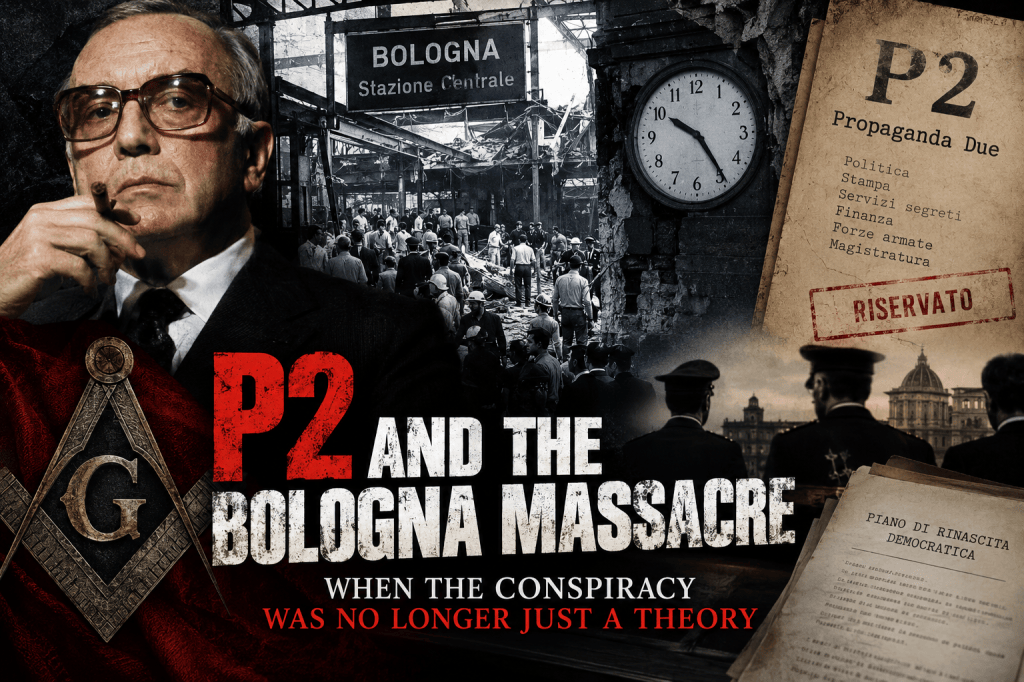
Return to the first episode and discover how the P2 network, the Bologna massacre, secret intelligence connections, and deliberate disinformation first revealed the darker side of this hidden world.
Read Episode One: P2 and the Bologna Massacre