Hoia-Baciu: The Romanian Forest Where Reality Seems to Misbehave
UFO photographs, twisted trees, a strangely persistent clearing and decades of disturbing testimony have turned a forest outside Cluj-Napoca into one of Europe’s most enduring paranormal mysteries. Yet the deeper one looks into Hoia-Baciu, the more difficult it becomes to tell where documented history ends and legend begins.
There are forests that become frightening because of what happened inside them, and there are others that seem unsettling long before anyone tells you a story.Hoia-Baciu belongs to the second kind.
On the western edge of Cluj-Napoca, in Transylvania, the forest is close enough to the city that it should hardly feel isolated. Roads, houses and the ordinary rhythms of modern life are never impossibly far away.
Parts of the surrounding area have genuine geological and botanical significance; the nearby Baciu Gorge, for example, is a protected natural area formed in Eocene limestone.
Yet over the second half of the twentieth century, this otherwise accessible woodland acquired another identity entirely. It became a place associated with strange lights, photographs that seemed to contain things invisible to the photographer, unusual sensations, distorted trees and, most famously, one of Romania’s best-known UFO encounters.
Today, Hoia-Baciu is repeatedly described as one of the world’s most haunted forests.
That description is excellent tourism, but it also creates a problem: once a place becomes famous for the paranormal, every shadow begins to acquire a story.
The real mystery of Hoia-Baciu is therefore not simply whether something unexplained happens there.It is whether we can still separate the original mystery from everything that was added afterward.
Before the Ghost Stories Came the Photographs
The modern history of the Hoia-Baciu mystery is closely connected with Alexandru Sift, a Cluj biologist whose work remains surprisingly important to the story.
Long before paranormal tourism arrived, Sift was reportedly spending years observing unusual manifestations in the area around the forest. Adrian Pătruț’s later account states that by the time Sift entered public attention in 1974, he had already been systematically investigating unusual phenomena near Cluj for more than two decades.
Sift was not simply a wandering occult enthusiast; records reproduced in Pătruț’s work describe him as having worked at a biological research centre, including research involving plant mutations produced by radiation.
That background makes his story more interesting, although it does not automatically validate his conclusions.
Sift reportedly photographed lights and unusual formations that sometimes appeared only after photographs were developed. His observations remained almost unknown outside a small circle until the Romanian magazine Flacăra published an article about him in May 1974.
The article brought his investigations into public view and helped establish the idea that something unusual had been occurring around Hoia-Baciu long before the forest acquired its modern international reputation. But something even more dramatic had already happened six years earlier.
18 August 1968On Sunday,
18 August 1968, Emil Barnea was spending the day in the forest with three companions.According to the account later investigated and circulated by Romanian UFO researchers, the group noticed a bright, flattened object moving above the trees.
Barnea had a camera with him and managed to take several photographs before the object disappeared.
Three of the images became particularly famous and would eventually circulate far beyond Romania.
The photographs show what appears to be a dark, disc-like object against the sky.And this is where Hoia-Baciu begins to become difficult.
Within UFO literature, the photographs were treated with extraordinary seriousness and were subjected to analyses by researchers abroad. Romanian UFO organisations continue to regard them as an important historical case. Yet none of this establishes that the object was an extraterrestrial vehicle.
The photographs document an object whose interpretation remains disputed; they do not tell us what the object actually was.
This distinction is important because the legend has gradually simplified the incident.In many modern retellings, Barnea “photographed an alien spacecraft.”Historically, what we can say with confidence is narrower and more interesting: he photographed something in the sky that he and his companions considered unusual, and those photographs became one of the defining UFO cases of communist-era Romania.
That alone was enough to change the forest forever.
The Clearing at the Centre of the StoryAlmost every modern account of Hoia-Baciu eventually arrives at Poiana Rotundă, the Round Clearing.Seen from above, it creates precisely the type of image from which legends are born: woodland seems to open unexpectedly around an approximately circular patch of ground.
Over time, the clearing has been described as a place where nothing grows, where trees refuse to take root, where electronic equipment behaves unpredictably and where strange physical sensations become more intense.But here the mythology has outrun the visible reality.
The clearing is not literally sterile.
Grass and other low vegetation can grow there. What is conspicuous is the absence of mature trees across the open area, not the complete absence of plant life.
Describing Poiana Rotundă as an entirely barren circle is therefore misleading.
That correction does not make the place visually ordinary.
A rounded opening surrounded by woodland naturally produces a peculiar psychological effect, especially when viewed through photographs that flatten perspective and make the boundary appear more precise than it necessarily is on the ground.Humans are remarkably sensitive to geometry in nature.
A nearly circular clearing invites intention. It seems designed even when no designer exists.
And once a place has been presented as the centre of paranormal activity, expectation does something else: it changes the way we experience it.
A sudden silence becomes significant.
A headache becomes evidence.
A camera error becomes an anomaly.
A feeling of being watched stops being merely a feeling.
This does not mean that witnesses are lying. In many cases they may be describing exactly what they experienced. The difficult question is what caused the experience.
The Trees That Look as Though They Tried to Escape
Then there are the trees.
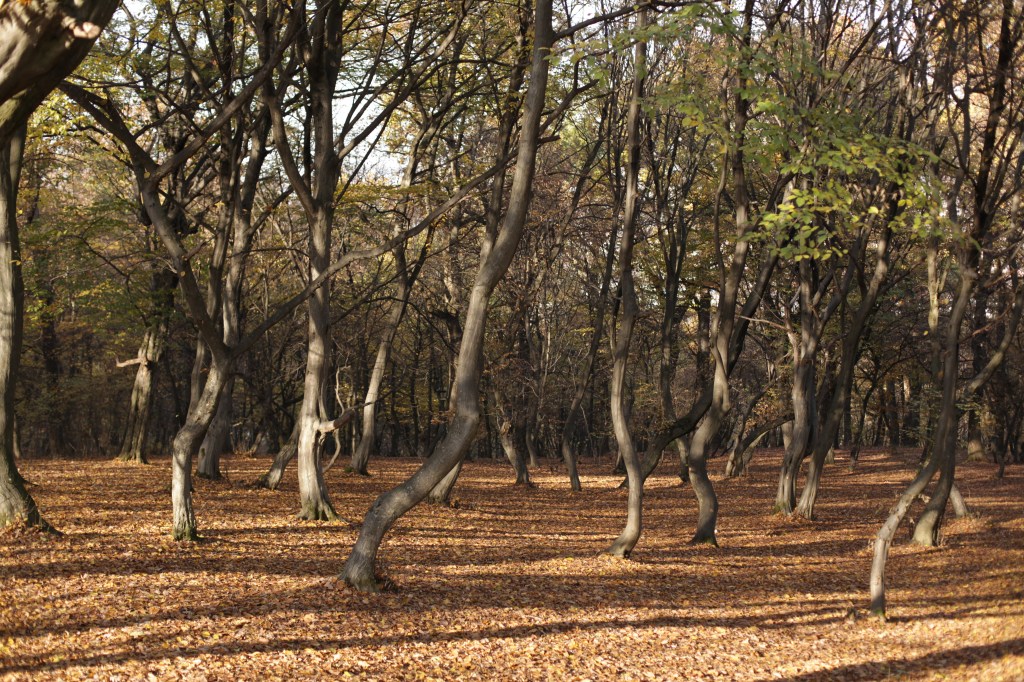
Some photographs from Hoia-Baciu show trunks bending close to the ground before curving upward again, creating shapes that seem almost sculpted.
Other trees grow at strange angles or form dramatic twists.These forms are real enough that even official tourism material mentions the unusual shapes of trees surrounding the Baciu area.
They are also among the most visually persuasive elements of the legend because they require no belief in ghosts or UFOs. You can photograph them. You can stand beside them. You can touch the bark.
The mistake comes when unusual biology is automatically transformed into evidence for an unknown force.Trees can become deformed for many reasons, including repeated physical damage during early growth, weather, competition for light, soil conditions or earlier human interference.
Without careful dendrological analysis of individual specimens, their shape alone cannot demonstrate electromagnetic fields, radiation or paranormal influence.Yet there is something genuinely unsettling about seeing an entire photograph filled with trees that appear to have changed direction halfway through their lives.
Even when nature has an explanation, nature does not always look natural.
The Lost Archive of Alexandru Sift
Perhaps one of the most intriguing parts of the Hoia-Baciu story has nothing supernatural about it at all.It concerns documentation.Alexandru Sift died in 1993.
Accounts preserved by the Cluj County Library state that much of the documentary archive connected with his decades of observations was subsequently destroyed or lost under circumstances that have themselves become part of Hoia-Baciu folklore.
This absence matters because Sift’s archive might have allowed later researchers to examine his photographs, dates, experimental procedures and observations systematically.Instead, we are left largely with selections, reconstructions and later testimony.
Lost evidence is dangerous territory.It encourages two opposite mistakes.
Believers may assume that whatever disappeared must have contained extraordinary proof, while sceptics may assume that nothing important could have been there.
Neither conclusion follows from the loss itself.What disappeared is simply unavailable.And an unavailable archive cannot prove anything.Adrian Pătruț and Forty Years of Strange ObservationsIn 1995, Adrian Pătruț published Fenomenele de la Pădurea Hoia-Baciu, a monograph devoted to the forest and the observations associated with it. Bibliographic records confirm the volume was published in Cluj in 1995, while contemporary reporting described it as bringing together decades of photographs, testimony and investigations by several contributors.
Pătruț approached the subject from the perspective of parapsychological investigation and regarded at least some of the phenomena as genuinely anomalous.Yet one detail attributed to him is particularly revealing.
A Cluj County Library account of his work states that he believed only a small percentage of reports deserved serious investigation, with most being explainable as optical illusions or observations influenced by the desire to see something unusual. That observation deserves more attention than it usually receives.Because this is precisely how a legendary place evolves.
Once thousands of people arrive hoping to encounter a phenomenon, the number of reported phenomena inevitably rises.Not necessarily because the forest has changed.Because the observer has.
The Shepherd, the Missing Girl and the Problem With Perfect Legends
The older folklore attached to Hoia-Baciu is considerably harder to document.One frequently repeated story claims that the name Baciu comes from a shepherd who entered the forest with approximately 200 sheep and vanished together with the entire flock.
Another famous tale describes a young girl who disappeared in the forest and returned years later without having aged and without remembering what happened to her.Versions of these stories are repeated by paranormal-tourism sources and modern articles, but reliable contemporary documentation establishing that these events actually occurred is extremely difficult to find.
Even the Hoia-Baciu Project presents the shepherd story explicitly as a legend. That does not make the stories worthless.Folklore tells us something different from police records.It tells us what a community feared, repeated and remembered.But there is an important difference between saying that a shepherd vanished with 200 sheep and saying that a legend developed in which a shepherd vanished with 200 sheep.For Whisper Mysteries, that distinction matters.Mystery becomes more powerful, not less powerful, when we know exactly where certainty stops.
Missing Time, Voices and the Feeling of Being Watched
Modern visitors have reported headaches, anxiety, nausea, sudden feelings of fear, unexplained lights, strange sounds, electronic malfunctions and an intense impression that someone or something is watching from between the trees.Some accounts go further and describe missing time.The difficulty is that these experiences are almost impossible to evaluate after the event.
A person can genuinely experience fear without there being an external threatening presence. A battery can fail without an electromagnetic anomaly. A photograph can contain a lens reflection the photographer never noticed. An unfamiliar forest can distort our sense of distance and time more easily than we realise.
Expectation can also influence perception enormously.If someone walks through an ordinary forest expecting an evening hike, the cracking of a branch means very little.If that same person enters a place described as one of the most haunted forests on Earth, the identical sound arrives carrying an entirely different meaning.None of this proves that every report from Hoia-Baciu has a mundane explanation.It means only that subjective experience cannot, by itself, tell us which explanation is correct.
The Most Important Question Is Not Whether the Forest Is Haunted
The temptation with Hoia-Baciu is to demand a verdict.
Haunted or not haunted.UFO or hoax.Portal or clearing.
Paranormal phenomenon or imagination.But perhaps that binary question has prevented us from seeing what makes the place genuinely fascinating.Hoia-Baciu contains several layers of reality occupying the same landscape.There is the physical forest with its trees, paths, clearings and geology.
There is the historical forest of Emil Barnea, Alexandru Sift and decades of investigation.
There is the folkloric forest filled with vanished shepherds and people returning from nowhere.There is the psychological forest carried inside every visitor who already knows the stories.And finally there is the digital forest, the one constructed from thousands of photographs, videos, television programmes and articles calling Hoia-Baciu the Romanian Bermuda Triangle.
All of them now overlap.Perhaps this explains why entering Hoia-Baciu today can never reproduce what it might have felt like to enter the same woodland in 1950.The forest has acquired a memory.
Not necessarily a supernatural memory, but something almost as powerful: a human one.Every person who walks beneath those trees carries fragments of all the previous stories with them.
So What Really Happened at Hoia-Baciu?
Something certainly happened.Emil Barnea really did take the photographs that became famous in 1968. Alexandru Sift really investigated unusual manifestations around the area. A 1974 article really brought those investigations before a wider Romanian audience. Adrian Pătruț really compiled a substantial volume devoted to decades of observations. The unusual-looking trees exist, and so does Poiana Rotundă.
What has not been demonstrated is the extraordinary conclusion.There is no established scientific evidence that Hoia-Baciu is a portal, that extraterrestrial craft regularly visit it, that ghosts inhabit the forest or that known physical laws cease to operate there.But that does not make Hoia-Baciu uninteresting.
Quite the opposite.The most disturbing mysteries are rarely those in which everything can be proved. They are the cases in which a small core of documented reality survives beneath decades of exaggeration, leaving just enough uncertainty that the story cannot be completely closed.Somewhere beneath the ghost tours, television documentaries and internet mythology there remains a real forest outside Cluj.
A biologist spent years watching it.
A man pointed a camera toward its sky in August 1968.
Several photographs survived.Thousands of stories followed.And more than half a century later, people are still entering the trees hoping that, for a few seconds, Hoia-Baciu will show them something that should not be there.Perhaps the strangest thing about the forest is not that so many people claim to have seen the impossible.
Perhaps it is that after all these years, we are still looking.

