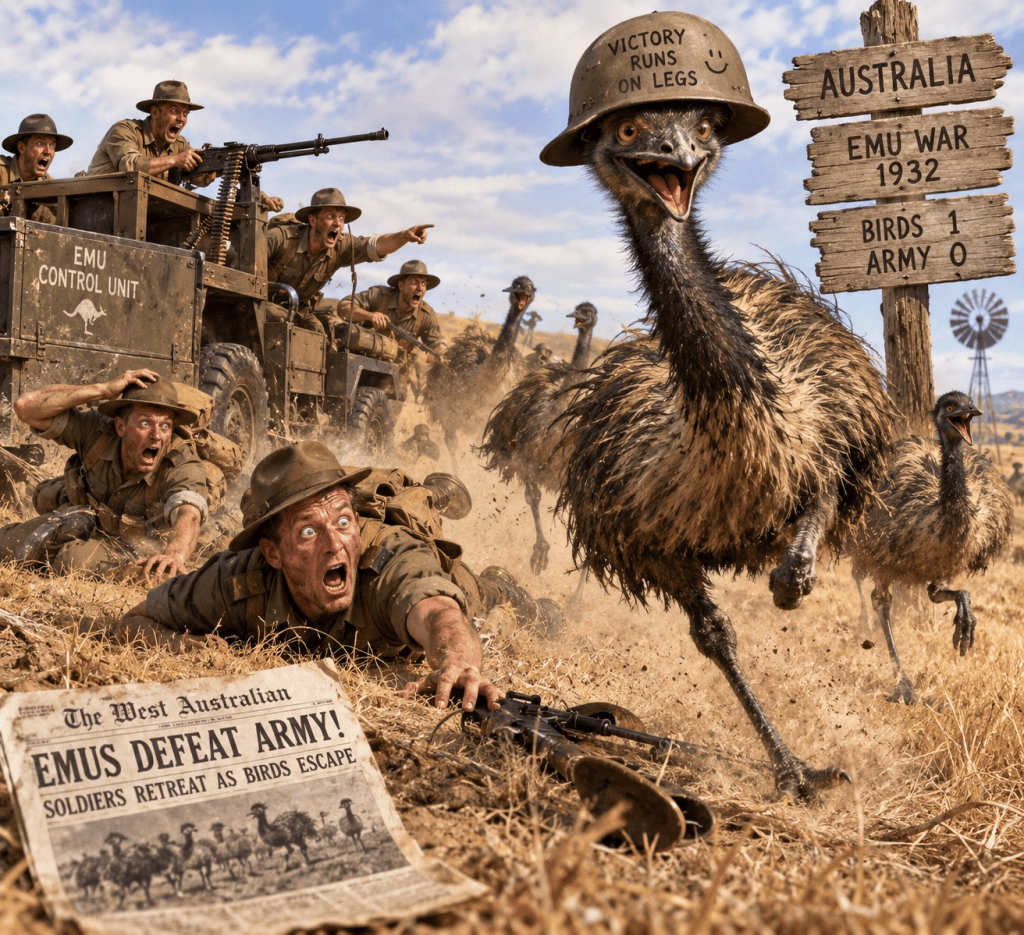
There are wars that begin over borders, religion, dynasties, resources or political ambition, and then there is the peculiar Australian episode of 1932, when armed soldiers carrying Lewis machine guns were sent into the wheat-growing country of Western Australia to deal with an enemy that had no government, no commander, no territorial demands and, as far as anyone could tell, absolutely no respect for military authority.
The enemy was the emu.
Large, fast, remarkably difficult to intimidate and apparently unimpressed by the technological achievements of Homo sapiens, thousands of these flightless birds had wandered into farming districts looking for food and water, trampling crops and damaging fences along the way. The farmers were desperate, the government became involved, the military arrived, machine guns were prepared, and what followed entered Australian folklore under the irresistible name The Great Emu War.
It was not technically a war, of course. No declaration of hostilities was delivered to an emu ambassador, and no peace treaty was eventually signed beneath a eucalyptus tree. It was a military wildlife-control operation. Yet once you read what actually happened, calling it a war somehow feels entirely appropriate, particularly because the humans possessed the machine guns while the emus possessed, among other useful qualities, the ability to run away.
And for a while, running away proved surprisingly effective.
The Problem Began With Wheat, Drought and About 20,000 Uninvited Guests
Western Australia in the early 1930s was not an easy place to be a farmer. Australia was suffering through the economic pressures of the Great Depression, and many of the men trying to make a living from the land were veterans of the First World War who had settled on farms under government-supported settlement schemes.
Then came the emus.
After breeding inland, large numbers of birds migrated toward the coast, as they naturally did in search of food and water. Unfortunately for the farmers around places such as Campion and Walgoolan, their wheat fields looked less like private agricultural property and more like an enormous complimentary buffet.
Estimates commonly put the number of emus moving into the farming district at around 20,000. The birds ate crops, flattened plants and pushed through fences, sometimes leaving openings through which rabbits could enter as well. For farmers already struggling economically, watching several enormous birds stroll through a wheat field with the confidence of landowners inspecting their estate was not especially amusing.
The farmers wanted help.
Some of them were former soldiers, and a rather logical idea emerged: if ordinary methods were failing and there were thousands of birds, perhaps machine guns could solve the problem.
On paper, this probably looked wonderfully efficient.
History was about to demonstrate the danger of making plans on paper when your opponent can run at roughly 50 kilometres per hour.
Enter Major Meredith and the Lewis Guns
The Australian government approved military assistance under Defence Minister Sir George Pearce, whose political and defence career is well documented in the collections of the Australian War Memories
The operation was placed under the command of Major G. P. W. Meredith of the Royal Australian Artillery. He was accompanied by soldiers equipped with two Lewis machine guns and thousands of rounds of ammunition.
The plan was beautifully simple.
Find emus.
Point machine guns at emus.
Fire.
Problem solved.
Unfortunately, nobody had explained the plan to the emus.
The operation began in early November 1932, after rain had delayed the soldiers’ arrival. Almost immediately, one fundamental difficulty became obvious: an emu is not a military formation. It does not politely advance in a straight line toward a machine-gun position while somebody gives the order to fire.
Emus scatter.
And they scatter extremely well.
The First Battle Did Not Go According to Plan
When soldiers encountered groups of birds, the emus tended to break apart and run in different directions, making them frustratingly difficult targets. Attempts to approach closely enough for concentrated machine-gun fire frequently ended with the birds simply moving away.
Then came one of the most famous episodes of the campaign.
Near a dam, Meredith’s men encountered a large concentration of emus and decided that this was finally their opportunity. Instead of wasting ammunition on scattered individuals, they would wait until the birds were within effective range and then unleash the Lewis gun.
Hundreds of emus approached.
The soldiers waited.
The birds came closer.
This was it.
The machine gun opened fire — and after only a brief burst, it jammed.
One can only imagine the silence.
The emus dispersed.
Somewhere in Western Australia, natural selection was having an excellent afternoon.
The Army Tried Putting a Machine Gun on a Truck
At some point during the operation, someone had another idea that must have sounded magnificent before anyone actually attempted it.
Mount a machine gun on a truck.
Chase the emus.
Shoot while moving.
The difficulty was that rural Western Australia was not a billiard table. The vehicle bounced over rough ground while the birds ran rapidly across terrain they understood considerably better than the men pursuing them.
Accurate shooting from the moving truck proved extremely difficult, while the emus apparently had no comparable problem with running.
The technological contest had therefore reached an unusual stage.
Australia had a motor vehicle and a machine gun.
The emus had legs.
The advantage remained unclear.
Major Meredith Began to Sound Almost Respectful
The strangest part of the story is that the military men themselves appear to have developed a grudging admiration for their feathered opponents.
Meredith was later quoted in the press comparing the emus’ ability to withstand gunfire and disperse under attack to highly effective soldiers. Another famous remark attributed to him suggested that, if Australia had a military division with the emus’ capacity to absorb punishment, it could face virtually any army.
There was also something genuinely fascinating behind the comedy. Emus did not behave as a single frightened herd. When threatened, groups could scatter rapidly, which made concentrated fire much less effective than expected. A weapon designed to fire into masses of human soldiers was an absurdly clumsy answer to a collection of fast-moving birds refusing to remain conveniently grouped together.
In other words, the machine gun was enormously powerful.
The emus simply declined to stand in front of it.
Parliament Eventually Had to Discuss the Emus
By this point, the affair was becoming public entertainment as well as agricultural policy.
Newspapers reported on the operation, and contemporary Australian press coverage confirms that the machine-gun campaign was resumed after an interruption; The Argus, for example, reported from Canberra on 11 November that the attack against emus damaging Western Australian crops had begun again.
Once politicians became involved, the story acquired the final ingredient required for historical comedy.
Someone had to ask who was winning.
The operation attracted criticism, questions were raised about the use of military weapons against wildlife, and the spectacle of the Australian Army apparently struggling to defeat large birds was simply too good for newspapers to ignore.
It is worth correcting one modern exaggeration, however. Australia did not mobilize an army against the emus in the conventional sense, nor was the country literally at war with them. This was a small military detachment conducting a pest-control operation at the request of farmers.
But “A Small Government-Supported Wildlife Management Operation Experiencing Unexpected Tactical Difficulties” would have been a terrible title.
The Great Emu War was destined to win.
The Second Campaign Was More Successful — Sort Of
After the embarrassing early encounters, operations resumed and the soldiers eventually became more effective. Rather than expecting enormous groups of birds to present themselves for destruction, they adjusted their tactics, and substantially more emus were killed during the later phase.
The numbers vary somewhat between historical accounts, which is worth remembering whenever dramatic statistics about the Emu War circulate online. Contemporary reporting and later retellings do not always agree perfectly about ammunition expenditure, birds killed or the precise sequence of encounters, and the story has accumulated considerable folklore during the last nine decades.
What is not really disputed is the larger result.
The machine-gun operation did not eliminate the emu problem.
The soldiers eventually withdrew in December 1932, while the birds remained in Western Australia doing what emus had presumably intended to do all along: being emus.
No surrender was obtained.
No emu leader was captured.
No occupied territory was returned.
And, perhaps most humiliatingly, not a single emu appears to have acknowledged that Australia had won anything.
The Government Eventually Found a Better Weapon: Money
The long-term response to the emu problem was far less cinematic.
Rather than soldiers chasing birds through wheat fields with Lewis guns, authorities increasingly relied on measures such as bounties and improved fencing, approaches that lacked the dramatic charm of military operations but made considerably more sense as wildlife management.
This is perhaps the funniest lesson hidden inside the entire affair. The Australian government briefly tried one of the most sophisticated infantry weapons of its era against an ecological and agricultural problem, only to discover that fences and economic incentives were rather more practical.
There is a philosophical lesson in there somewhere.
There is also an emu, probably walking through a fence while we search for it.
Did the Emus Really “Win the War”?
This is where history and internet mythology need to be separated.
The popular version says that Australia declared war on emus and lost. That is wonderfully funny, but not literally what happened. Australia never formally declared war, the operation involved only a small number of military personnel, and soldiers did kill a significant number of birds.
So if we are being strictly historical, the emus did not defeat the Australian Army in battle.
But if victory means achieving your strategic objective while preventing your opponent from achieving his, the question becomes considerably more entertaining.
The humans wanted the emu problem solved.
The emu problem was not solved.
The humans withdrew.
The emus stayed.
You may award the medal yourself.
Why the Great Emu War Is More Interesting Than the Joke
Behind the absurdity lies a surprisingly revealing little episode of Australian history. The conflict happened during the Great Depression, involved struggling farmers and First World War veterans, reflected the difficulties of transforming marginal land into productive agriculture, and exposed something governments have repeatedly discovered throughout history: nature has an irritating habit of refusing to behave like an administrative problem.
The emus were not invading Australia. They were Australian wildlife following migration patterns in a landscape that humans had dramatically altered through farming and fencing. From the farmers’ perspective they were destructive pests threatening already precarious livelihoods; from the emus’ perspective, if we may risk imagining one, somebody had simply planted an astonishing quantity of food along their traditional route.
That tension makes the story much better than the meme.
It was never really Man versus Bird.
It was human planning colliding with ecology, economics, geography and several thousand extremely fast animals that had absolutely no intention of cooperating.
And the Winner Is…
Ninety years later, almost nobody remembers the operation because of its agricultural significance. We remember it because the image is irresistible: professional soldiers arriving with machine guns to confront enormous flightless birds, discovering that the birds would not remain conveniently in range, trying to pursue them with a truck, watching a gun jam at precisely the wrong moment and eventually leaving while the supposed enemy continued wandering through the countryside.
Perhaps the emus did not technically win.
But history has been remarkably kind to their propaganda department.
Today the episode survives as one of Australia’s strangest historical anecdotes, endlessly retold because it contains that rare combination of genuine hardship, bureaucratic optimism, military overconfidence and complete absurdity.
And somewhere, metaphorically at least, an emu is still looking back over its shoulder at Major Meredith and running.
Sources & Further Reading
For the final WordPress version, I would ground the historical notes in the Australian War Memorial collections and official-record guides, particularly its material concerning Defence Minister George Pearce and Australian military records. The Memorial confirms that its collections preserve government and military operational records, correspondence and other primary material useful for reconstructing episodes of Australian military history.
Contemporary newspaper evidence is especially valuable because the story has been embellished heavily online. The Argus of 12 November 1932 contains a contemporary report titled “Attack on Emus”, noting that the machine-gun operation against emus damaging Western Australian crops had resumed.
For archival research, the Australian War Memorial explains how official records, operational reports and related military material are preserved and how the National Archives’ RecordSearch catalogue can be used to locate them.

