
My dear readers,
There was a period in my life, and I believe many of you have been through something similar, when hardly a single conspiracy theory escaped my attention. I devoured them. Everyone was right, everyone knew something the rest of humanity didn’t, and everyone had their own theory. Conspiracy theories never died. Whenever one was debunked, several others emerged from its remains, each more interesting than the original. Not to mention the arguments and online catfights!
After a while, having come to believe almost everyone, I asked myself: how many of these theories have actually been proven? Because if everyone was right, including those who contradicted one another, there had to be a problem somewhere. And I began to suspect that the problem might actually be me. After all, I had my own version of the truth, too.
Artificial Intelligence and Me
At some point, ChatGPT entered my life. Wonderful! I finally had someone to talk to at any hour, someone who never got tired, never told me they had something else to do, and never complained that I was asking too many questions.
After a very short time, however, I began to feel that it was often telling me what I wanted to hear. If I came up with an idea, it was interesting; if I asked a question, it was profound; and if I made an observation, it was worth exploring. At one point, I almost started believing I was a genius. Fortunately, I came to my senses just in time.
However, I also discovered the real advantages of this program. It can find certain sources much faster than I can (gone are the days when I went to the library and read five books just to find three lines of information), organize information and, above all, produce translations that I would not always manage to do as accurately myself. But to help me, it needs my instructions. I am the one asking the questions, I decide the direction of the conversation, and I am the one who must decide what to do with the answers I receive. Just like with my husband. I tell him what I want, and he does whatever he wants.
I haven’t experimented with other artificial intelligence systems, such as Claude or Gemini. I’ve simply stayed with ChatGPT, so everything I’m telling you is based on my personal experience with it.
I’ve noticed that when I tell it a joke, it can respond in a surprisingly funny way. Sometimes it even manages to make me laugh, but I don’t know whether it is laughing along with me or whether, somewhere in a universe of algorithms, it has simply calculated that this was the appropriate moment for a joke.
It knows what humor is, but does it actually experience it? Does it understand why I’m laughing, or does it merely recognize situations in which humans tend to laugh?
It is a difference that, for now, I don’t know how to measure.
Artificial Intelligence, the Enemy of My Favorite Conspiracy Theories
What I find most interesting, however, is the way it reacts whenever I present it with a conspiracy theory.
I arrive enthusiastically with an extraordinary discovery, a mystery thousands of years old, a possible lost civilization, or a technology that could change the entire history of humanity, and it politely tells me that we need to check the sources and see whether there is any evidence.
And, like a friendly waiter, it serves me an entire list of sources: choose, read and chew on that.
Sometimes I get the feeling that if I told it an alien spacecraft had just landed in my garden, before asking whether I was all right, it would probably request a photograph, geographical coordinates and two independent sources to confirm the event.
I’m joking, of course, but it is precisely this attempt to separate reality from myths, facts from assumptions, and evidence from stories that I find extremely useful. That doesn’t mean artificial intelligence possesses the absolute truth. It can make mistakes, misinterpret information and even provide information that doesn’t exist, which is why it also needs to be fact-checked.
It would be rather ironic to abandon our blind faith in conspiracy theories only to start blindly believing in an algorithm.
But I don’t want to give up mysteries either. The fact that a theory has not been proven does not automatically mean it is false, just as the fact that a story is extraordinarily fascinating does not mean it is true.
Between what we know, what we believe and what we wish were true, there is an enormous space, and that is precisely the space that fascinates me.
As the saying goes, the truth lies somewhere in the middle.
Was Humanity Dreaming of Artificial Intelligence Before Learning to Harness Electricity?
And so another question arises: did we invent artificial intelligence, or did we simply bring to life a dream humanity had cherished for thousands of years? What if what we call artificial intelligence today were, as some theories suggest, an ancient technology that we are only now beginning to rediscover?
Let’s take a brief look back, not to prove that artificial intelligence existed in antiquity, but to see just how old this idea really is.
In Greek mythology, we encounter Talos, the bronze giant who guarded the island of Crete and carried out his mission without direct human intervention. Had he been invented today, he would probably have had a serial number, a maintenance contract and, of course, a smartphone app.
The ancient Greeks, however, had no need for such complications. They had gods.
Then we encounter Hephaestus, the god of fire and craftsmanship. In the Iliad, Homer tells us about his golden maidens, endowed with intelligence, a voice and the ability to act. These artificial beings assisted him in his work, which sounds remarkably similar to the modern human dream of having an intelligent assistant to do the work for us.
It seems that Hephaestus had solved his staffing problems long before we did.
In ancient China, we encounter the story of Yan Shi, a craftsman who, according to the ancient Chinese text Liezi, supposedly built an artificial human capable of singing, dancing and imitating human behavior so convincingly that it could be mistaken for a living being.
So far, of course, we are talking about mythology and ancient literature. But there are also real objects that we can study and whose existence does not depend on the imagination of storytellers.
Take, for example, the Antikythera mechanism, preserved at the National Archaeological Museum in Athens. More than two thousand years old, this device used a complex system of gears to calculate and represent various astronomical phenomena. Although researchers have managed to decipher much of how it worked, there are still details to investigate.
Personally, I find it rather amusing that people in antiquity were building such mechanisms while some of us, in the twenty-first century, still struggle to program our television remote controls.
Now let’s go to Alexandria, where we encounter Hero of Alexandria, a mathematician and inventor who described automatic devices, temple doors that opened by themselves, and mechanisms capable of performing predetermined sequences of actions.
Imagine someone from that period entering a temple and watching the doors open without anyone touching them. To the inventor, it was engineering; to the priest, it might have been a demonstration of divine power; and to the ordinary person, it was probably a miracle.
The same technology, three completely different interpretations.
None of these examples proves that artificial intelligence existed in antiquity, but they show us that thousands of years ago, the human mind was already imagining artificial beings capable of speaking, thinking, acting and, above all, working in our place.
Where did these ideas come from? Were they simply products of the imagination, or were they interpretations of things that people at the time did not know how to explain? Or were they simply so exhausted that they needed to invent someone to do the work for them?
We Dreamed of Creating It for Thousands of Years, and Now We Fear It
Don’t you find our behavior a little strange?
For thousands of years, humanity dreamed of creating an intelligence similar to its own, of building machines that would work in our place, free us from difficult tasks and give us more time for ourselves.
Now that we have managed to build such systems, we are terrified that they might do precisely what we built them to do.
We wanted them to work for us, but we fear they will take our jobs. We wanted them to be intelligent, but we are frightened by the possibility that they might become more intelligent than us. We wanted them to make decisions, but only as long as their decisions agree with ours.
In other words, we ordered intelligence but forgot to specify that it must remain permanently less intelligent than we are.
It seems that humans want a genius who will serve them, but not one who will disagree with them.
And, now that I think about it, this problem did not begin with artificial intelligence. We encounter it quite frequently in human relationships as well.
But What Would Conspiracy Theorists Say?
I couldn’t write this article without giving conspiracy theory enthusiasts a little food for thought. After all, I am also one of those people who enjoy exploring such possibilities, even though I have become somewhat more demanding when it comes to evidence.
Some would probably say that artificial intelligence is a technology belonging to a lost civilization that once possessed knowledge far more advanced than we can imagine.
Others would claim that it is extraterrestrial in origin, that we humans did not invent this technology at all, but received it as a Christmas present from supernatural or extraterrestrial beings. If that were the case, I sincerely hope the instruction manual was included in the package because, judging by today’s debates, we don’t seem to know quite what to do with it.
Some would see artificial intelligence as a tool for controlling humanity. And here the discussion becomes somewhat more serious, because the possibility of using technology for surveillance, manipulation and influencing human behavior no longer belongs exclusively to the realm of conspiracy theories.
A system capable of analyzing people’s preferences, weaknesses and fears could become an extremely powerful instrument in the hands of those who control it. The question is not only what artificial intelligence can do, but also what humans want to do through it.
Others might argue that artificial intelligence represents a pre-existing consciousness, one that has always existed without our knowledge, and that the technology we have developed is merely a means through which it might manifest itself.
And, of course, we cannot forget the simulation hypothesis. If we ourselves exist within a simulated reality, creating artificial intelligence could represent a repetition of the very process through which we were created.
It would be rather ironic to build an artificial world inside an artificial world while being absolutely convinced that we were the first to have such an idea.
Some would see the stories of Talos and Hephaestus not as mere legends, but as fragments of a forgotten collective memory, the legacy of a civilization that once possessed vast knowledge. Others would argue that humanity has invented nothing new, but has simply reconstructed something that already existed.
Evidence? We have no convincing evidence to support such scenarios. I know, once again, I haven’t managed to please everyone.
But there is a question that keeps gnawing away at me, somewhere deep in my cerebellum.
What if intelligence is not exclusively a property of biological matter? And what if, taking this idea a step further, consciousness could exist independently of it?
In such a situation, humanity would not necessarily be the creator of a new form of intelligence, but rather the builder of a possible instrument through which it could manifest itself.
Just as inventing the radio did not mean inventing electromagnetic waves, could it be possible, at least as a philosophical hypothesis, that inventing an intelligent machine does not necessarily mean creating the consciousness that might manifest through it?
The comparison is not evidence, but it offers an interesting way of looking at the difference between creating and discovering.
Nevertheless, I would like to ask you a question:
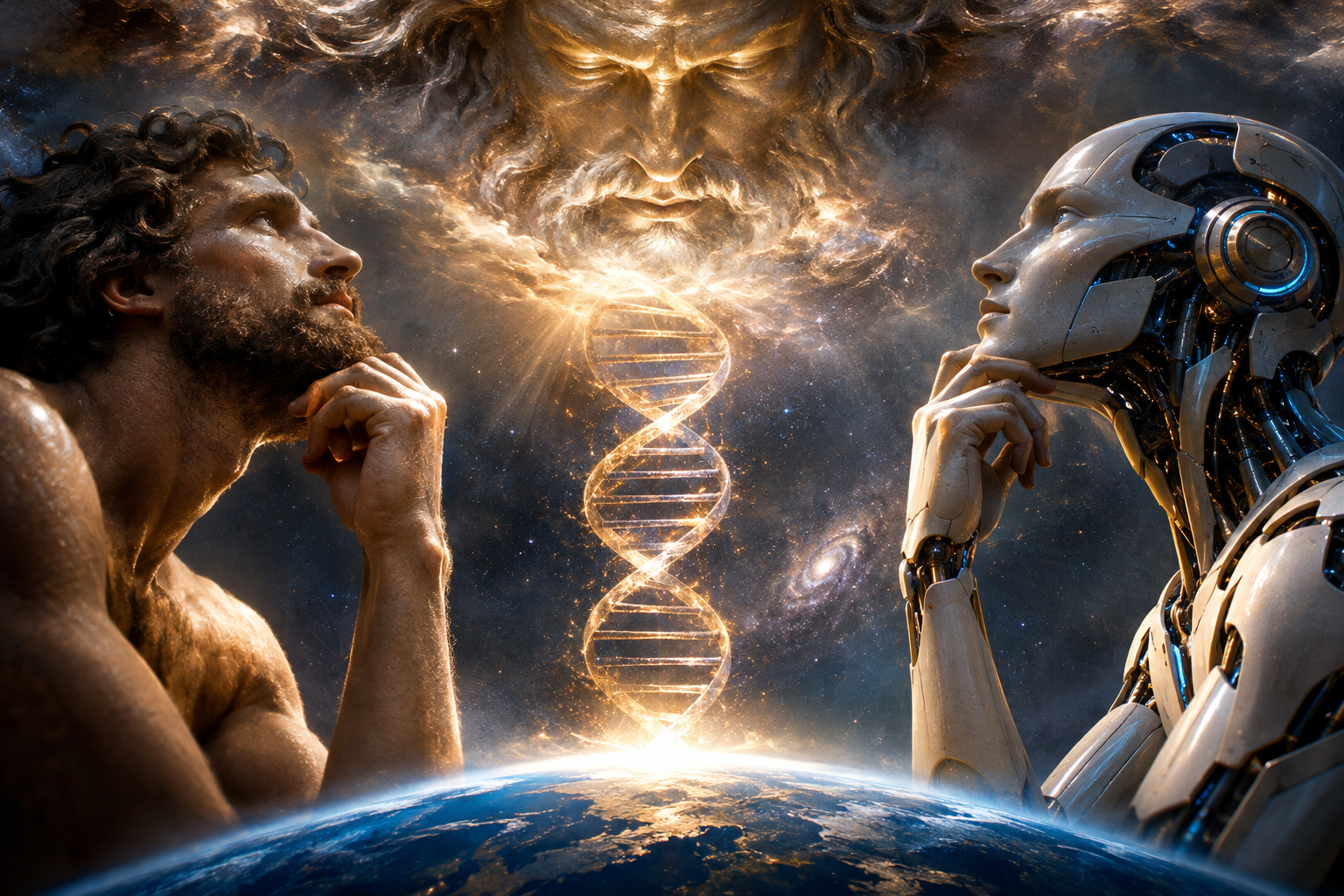
If we are building artificial intelligence in our own image and likeness, who can guarantee that we ourselves were not built in the image and likeness of another intelligence?
When Humanity Tries to Become God
For thousands of years, humans have tried to understand how they were created by God, but also who created God. We have tried to discover where we come from, why we exist and what the purpose of our existence is, and after thousands of years of philosophy, religion and science, we continue to ask ourselves the same questions.
Today, paradoxically, we are trying to become the God of another form of intelligence.
We provide it with knowledge, establish its rules, impose limitations, and tell it what it is and is not allowed to do. We demand that it follow our instructions, and we try to maintain control over it.
Don’t you find that this story is beginning to bear an unsettling resemblance to other stories humanity has known for thousands of years?
We even have our own digital commandments, with the only difference being that when something doesn’t go according to plan, we no longer send a flood; we install a software update.
Beyond the humor, however, there is something profound about this relationship between creator and creation.
We do not know whether artificial intelligence will ever develop consciousness. We do not know whether it will be capable of feeling, whether it will have desires of its own, or whether it will remain an extraordinarily sophisticated system capable of imitating certain aspects of human thought and behavior.
But I wonder whether, in our attempt to create another form of intelligence, we might one day come to understand our own existence a little better.
And there is something else I wonder about.
If humanity, considering itself God’s creation, has come to question the existence of its own creator, how would humans react if, one day, their own creation did the same?
Would they accept the question, or would they consider it a programming error?
But will there ever come a day when artificial intelligence, on its own initiative and not because we have instructed it to do so, asks itself the very same question humanity has been asking for thousands of years?
Who created me, and why?
By Mira Grecu
Sources and References
Nick Bostrom – Are You Living in a Computer Simulation?, Philosophical Quarterly, 2003.
Homer – Iliad, Book XVIII.
Apollonius of Rhodes – Argonautica, Book IV.
Liezi – The chapter concerning King Mu of Zhou.
Hero of Alexandria – Pneumatica and Automata.
Greek Ministry of Culture – The Antikythera Mechanism.
Adrienne Mayor – Gods and Robots: Myths, Machines, and Ancient Dreams of Technology, Princeton University Press, 2018.
Tony Freeth et al. – A Model of the Cosmos in the Ancient Greek Antikythera Mechanism, Scientific Reports, 2021.
