Tag: Dark History

  • LA VOISIN — THE WOMAN WHO SOLD BLACK MAGIC TO THE COURT OF THE SUN KING

    Behind the splendour of Louis XIV’s France existed another Paris, one of fortune-tellers, clandestine poisons, forbidden rituals and people willing to pay almost anything to alter love, inheritance and fate.
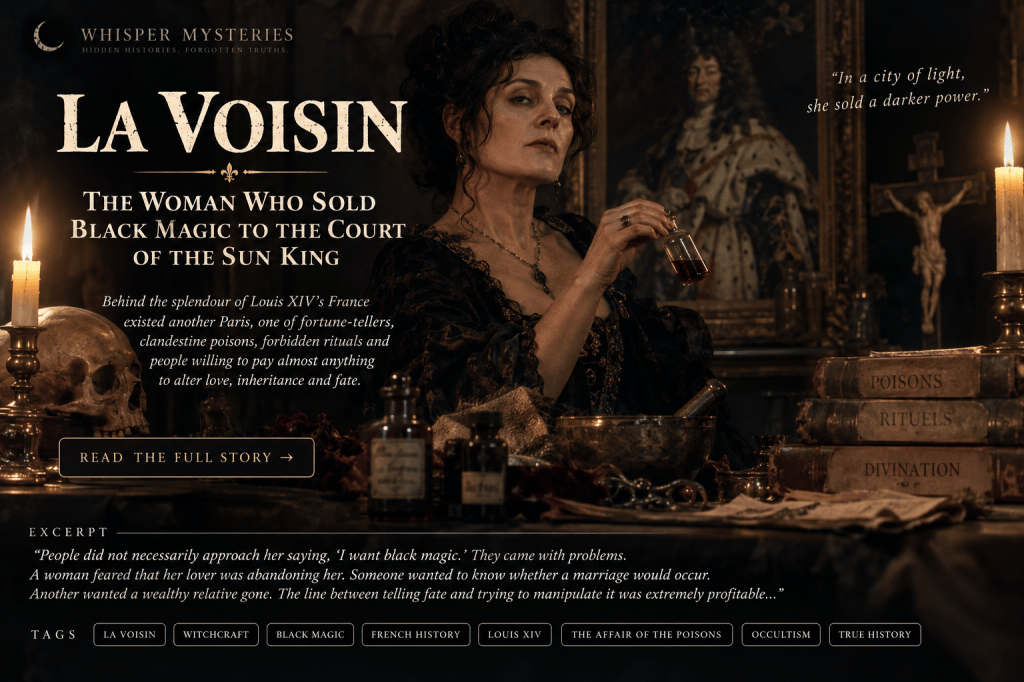
    There is something almost indecent about the contrast. While Louis XIV was constructing the image of an absolute monarchy bathed in gold, ceremony and divine authority, while Versailles was becoming the theatre from which the Sun King intended to astonish Europe, another world was flourishing only a carriage ride away in Paris. It existed behind ordinary doors, in rented rooms and suburban houses, among astrologers, midwives, apothecaries, disgraced priests, fortune-tellers and women whom respectable society visited discreetly after nightfall. They were consulted about husbands who would not die, lovers who had lost interest, inheritances that seemed too distant, rivals who needed removing and futures that people were too impatient to leave in the hands of God.
    At the centre of that world appeared a woman whose name eventually became inseparable from one of the darkest scandals of Louis XIV’s reign: Catherine Deshayes Monvoisin, remembered simply as La Voisin.
    It would be convenient to describe her as a witch and leave it there, because that is how later generations transformed her into legend, but the surviving record is far stranger. La Voisin occupied an uncomfortable territory where several worlds overlapped. She practised divination and chiromancy, dealt in remedies and supposed love preparations, moved among people accused of supplying poisons, and became associated through testimony with rituals that contemporaries regarded as sorcery and sacrilege. Some accusations were supported by overlapping testimony; others emerged under interrogation and torture, and some were so extravagant that even modern historians must approach them cautiously. The French Ministry of Justice itself, in its account of the Affair of the Poisons, warns that the investigation became filled with exaggerations, inaccuracies and fabrications alongside genuine criminal activity.

    That uncertainty does not make the story less disturbing. It makes it more so, because behind the fantastic language of demons and spells there was a very real underground economy built around desperation.
    The Paris beneath Paris
    The scandal did not begin with La Voisin.
    Years before her arrest, France had already been shaken by the case of the Marquise de Brinvilliers, whose crimes helped create an atmosphere in which every unexpected death among the wealthy might conceal poison. In 1672, Jean-Baptiste Godin de Sainte-Croix died unexpectedly. Among his possessions were found bottles containing dangerous substances and letters linking him to the Marquise de Brinvilliers. She was eventually accused of poisoning members of her own family, fled France, was captured and brought back to Paris, where she was tried and executed in 1676. The case lodged itself in the imagination of the capital and gave a sinister expression to the age: poudre de succession, “inheritance powder,” poison purchased when waiting for an inheritance had become inconvenient.
    (Ministère de la justice)
    Soon the authorities began to suspect that Brinvilliers had not belonged to an isolated world of murderers. In September 1677, an anonymous warning concerning a supposed plot against Louis XIV and the use of a mysterious “white powder” drew further attention from the police. Nicolas de La Reynie, Louis XIV’s powerful lieutenant-general of police, began following the threads.
    Those threads led into a Paris that respectable society officially despised and privately used.
    Fortune-tellers were not necessarily marginal figures serving only the ignorant poor. Their clients could include people with money, influence and access to court. Astrology remained culturally powerful, charms and divination existed alongside orthodox Catholic belief, and medicines, cosmetics, aphrodisiacs, abortifacients and poisons could circulate through overlapping networks whose boundaries were not nearly as clear as a modern distinction between healer, magician and criminal might suggest. A scholarly history of the Affair describes precisely such a loose underworld of diviners, sorcerers, renegade clergy and sellers of magical remedies and poisons serving customers across Parisian society.
    (Encyclopedia.com )
    One of the women caught in the investigation was Marie Bosse, a fortune-teller who allegedly boasted that wealthy women came to her seeking ways to rid themselves of inconvenient husbands. The police arranged a trap, she was arrested, and under interrogation she began naming others.
    Among the names was Catherine Deshayes Monvoisin.
    La Voisin was arrested on 12 March 1679. What initially looked like another investigation into fortune-telling and poisoning soon expanded so violently that the monarchy created a special tribunal to contain it. On 7 April, Louis XIV established the commission that became famous as the Chambre Ardente, the Burning Chamber, which met at the Arsenal in a room described as draped in black and illuminated by torches. Between 1679 and 1682, hundreds of people would be questioned or implicated. The French Ministry of Justice records 442 people heard by the tribunal, 367 arrest orders, 218 detentions and ultimately dozens of severe sentences, including executions.
    (Ministère de la justice ⚖️)
    For a scandal supposedly born among obscure fortune-tellers, it was moving dangerously close to the throne.
    What exactly did people buy from La Voisin?
    This is where Catherine Monvoisin becomes more interesting than the caricature of a seventeenth-century witch.
    People did not necessarily approach her saying, “I want black magic.” They came with problems.
    A woman feared that her lover was abandoning her. Someone wanted to know whether a marriage would occur. Another wanted a wealthy relative gone. Someone wanted a pregnancy ended. Someone else needed a rival to lose favour. The client might begin by asking for a prediction, but if the prediction was unwelcome, the conversation could apparently move toward changing the predicted future.
    The line between telling fate and trying to manipulate it was extremely profitable.
    Accounts of the affair associate La Voisin with palmistry, physiognomy and fortune-telling, but also with love preparations, drugs and access to people capable of providing stronger substances. Contemporary investigators believed that a network existed in which magical services and poison trafficking could overlap. Whether every death attributed to these people was truly a poisoning is impossible to establish, because seventeenth-century toxicology was primitive and many accusations rested on testimony rather than forensic evidence. What is certain is that poisons were genuinely being traded and that the authorities recovered substances capable of killing.


    La Voisin also became associated with abortion, an activity that placed her clientele in another clandestine world where secrecy was essential. Modern accounts repeatedly identify her as having practised or facilitated abortions, although some of the later stories about what happened to infants became intertwined with allegations of ritual murder and must be treated far more cautiously.


    Then the investigation entered territory that would turn a criminal scandal into an occult legend.
    Priests began appearing in the testimony.
    So did forbidden masses.
    And eventually, demons.
    The Masses nobody was supposed to celebrate
    The most famous accusations surrounding La Voisin involve what later writers called black masses, ceremonies in which the Catholic Mass was supposedly inverted, corrupted or employed for magical purposes. Several priests accused during the Affair were alleged to have conducted sacrilegious rituals for clients seeking love, power or revenge.
    Among the names that emerged was Étienne Guibourg, an elderly priest whose testimony would later become central to the most sensational version of events.
    Here we have to move carefully, because this is precisely where historical documentation and legend begin feeding upon one another.
    There is documentary evidence that witnesses and defendants described ritualised masses involving women, priests and magical intentions. A recent Cambridge University Press history of Satanism notes testimony concerning a Mass reportedly performed in La Voisin’s home over a woman’s abdomen and observes that the episode may represent one of the earliest recorded descriptions of the motif later recognised as the Satanic or black mass using a woman as an altar. Yet the same scholarship stresses the wider context: the Affair of the Poisons was also a panic saturated with rumours about Satanism, and some confessions emerged from a judicial system that used coercion and torture.
    (Cambridge Assets)
    The later stories became considerably darker.
    According to testimony produced in the investigation, some ceremonies allegedly called upon demonic names, while other statements accused Guibourg and associates of using infant blood or performing sacrifices. These are among the most repeated details in popular accounts of La Voisin, yet they should never be written as though a modern investigator had walked into the room and witnessed them. The French Ministry of Justice explicitly describes allegations involving murdered infants, black masses and demons while also observing that the proceedings accumulated exaggerations, imprecisions and fabrications and that tangible evidence was often lacking.

    That distinction matters.
    The documents prove that such accusations were made. They do not prove that every ritual described in those accusations happened exactly as reported.
    Yet even after removing the embellishment, something uncomfortable remains. There really were people in Louis XIV’s Paris prepared to pay for ceremonies they believed might influence another human being, and there really were clergy accused of lending religious ritual to this underground commerce. The magical act did not have to work for the trade in magic to be real.
    Its power existed first in belief.
    And belief was enough to make people pay.
    Then a name appeared that could destroy everything
    After La Voisin was executed, the investigation should have begun to die with her.
    Instead, it became more dangerous.
    Her daughter, Marie-Marguerite Monvoisin, began providing information to investigators, and among the names appearing in subsequent testimony was one that could transform an embarrassing criminal affair into a catastrophe for the monarchy: Françoise-Athénaïs de Rochechouart de Mortemart, Marquise de Montespan, one of the most powerful women at Louis XIV’s court and the mother of several of his children.
    Montespan was not an obscure aristocrat with a passing connection to Versailles. She had become Louis XIV’s official mistress and occupied apartments adjoining his. Versailles itself describes her circle as having become an epicentre of court life, pleasure, fortune, ambition and fear. She patronised artists including Molière and La Fontaine and stood for years extraordinarily close to the centre of royal power.
    -(Château de Versailles | Site officiel)
    Now witnesses were suggesting that she had consulted La Voisin.
    The less sensational part is entirely plausible and is acknowledged even in the French Ministry of Justice’s account: Montespan appears to have consulted La Voisin concerning horoscopes, love preparations or magical remedies. Such practices, however improper, were not in themselves evidence that she had ordered murder.

    The accusations went much further.
    Marie-Marguerite and other prisoners claimed that Montespan had employed magical rituals to preserve the king’s affection. More lurid testimony connected her to black masses supposedly intended to retain Louis XIV’s love or harm rivals. Still darker allegations suggested attempts at poisoning.
    Historians have argued over these accusations ever since.
    The important fact is not that every allegation can be believed; it cannot. What matters is what happened when the allegations approached the king’s bedroom.
    Louis XIV intervened.
    According to the French Ministry of Justice, once Montespan’s name became dangerous, the king ordered that certain interrogations no longer be entered in the normal registers but recorded on separate sheets. Material concerning her was placed in a sealed container under royal control, and the Chambre Ardente was eventually prevented from pursuing cases in which her name appeared. In 1709, long after the scandal had disappeared from public life, Louis XIV personally ordered the incriminating papers held in that collection destroyed.

    It is one of those moments in history that almost seems designed for conspiracy.
    Documents existed.
    The king intervened.
    Some documents were later destroyed.
    But that does not mean that the most horrifying accusations were therefore true.
    A king might suppress an accusation because it was true, but he might just as readily suppress a false accusation because allowing the king’s former mistress and mother of his children to be publicly examined for sorcery, poison and sacrilege would be politically devastating regardless of the verdict.
    The destruction of evidence leaves us not with proof, but with absence.
    And absence is where legends thrive.
    La Voisin herself remained remarkably difficult to break
    One detail of Catherine Monvoisin’s final days deserves more attention than it usually receives because it complicates the popular image of the theatrical witch gleefully confessing every imaginable atrocity.
    She did not provide investigators with the complete occult horror story later attached to her name.
    Some of the most extreme revelations emerged only after her death.
    La Voisin was interrogated repeatedly and subjected to brutal judicial pressure, yet important claims involving the alleged black masses and Montespan became clearer through other witnesses and particularly through her daughter. Even accounts sympathetic to the prosecution acknowledge the problem posed by contradictory statements, self-serving denunciations and testimony obtained under torture.


    On 22 February 1680, Catherine Deshayes Monvoisin was taken to the Place de Grève in Paris and burned alive.
    Public execution in seventeenth-century France was deliberately theatrical. Punishment had to be seen. Authority had to appear stronger than crime, heresy and disorder. The woman who had spent years promising clients that the future might be read or perhaps altered now reached a future she could no longer negotiate.
    Yet her death solved almost nothing.
    The Chambre Ardente continued its work until 1682. The investigation eventually became so politically poisonous that Louis XIV suspended it. Some defendants who might have revealed compromising information about the court were imprisoned without ordinary public trials and remained confined for years. The official French account records 34 executions, five sentences to the galleys and 23 banishments arising from the tribunal’s work.


    The scandal had begun with powders and suspicious deaths.
    It ended with the monarchy trying to control what could safely be known.
    Was La Voisin really a witch?
    Perhaps this is the wrong question.
    If by witch we mean a woman possessing supernatural powers, history cannot establish that Catherine Monvoisin ever caused a death by magic, summoned a demon or altered Louis XIV’s affections through a ritual. No surviving document can demonstrate supernatural causation, and serious treatment of the case should never pretend otherwise.
    If, however, we ask whether she participated in a culture in which magic was sold, purchased and believed to be capable of manipulating reality, the answer becomes much more interesting.
    Her world contained divination, astrology, charms, ritual magic, suspected poisons, illicit medicine and a clientele willing to cross boundaries when ordinary solutions failed. The people approaching figures such as La Voisin did not necessarily perceive the neat categories we impose today between superstition, religion, medicine, crime and magic. A prayer could become a spell depending on intention. A remedy could become poison depending on dosage. A Mass could become magical if someone believed that the sacred words themselves possessed a power that could be redirected.
    That is perhaps the darkest aspect of the Affair of the Poisons.
    Not demons.
    Not the extravagant stories of midnight ceremonies.
    The clients.
    Because behind almost every practitioner stood someone respectable enough to fear scandal and wealthy enough to purchase secrecy. The occult underground of Paris was not separated from elite society by an impenetrable wall; according to the investigation, members of that society entered it whenever love, jealousy, money or ambition became sufficiently desperate.
    The splendour of Versailles and the darkness surrounding La Voisin were therefore not opposite worlds at all.
    They belonged to the same century.
    Perhaps even to the same people.
    Louis XIV built his monarchy around light. He chose the Sun as his emblem, constructed halls filled with mirrors and surrounded himself with an elaborate ritual intended to make royal power appear almost cosmic in its order. Yet during the same reign, investigators discovered a Paris where another kind of power was being bought quietly in rooms far from the palace, power whispered over cards and palms, mixed into powders, requested through forbidden prayers and attributed to forces that respectable society publicly insisted it feared.
    Whether those forces existed is a question history cannot answer.
    But La Voisin existed.
    Her clients existed.
    The poisons existed.
    The court that investigated them existed.
    And somewhere among the surviving testimonies, the coerced confessions, the political manoeuvring and the papers that Louis XIV eventually ordered destroyed lies the part of the story that can no longer be recovered.
    That missing part may be exactly why, more than three centuries later, La Voisin still refuses to remain merely a criminal and continues to haunt history as a witch.

    Sources used for the historical reconstruction

    The strongest source for the judicial chronology, arrests, Chambre Ardente, executions, Montespan allegations and destruction of the secret papers is the French Ministry of Justice’s historical dossier on the Affair of the Poisons. The Château de Versailles provides the court context and Montespan’s documented position beside Louis XIV. For the broader scholarly treatment of magical commerce and the development of the black-mass allegations, I also checked academic/encyclopedic histories of the Affair and a recent Cambridge University Press discussion of the episode.
  • The Pope Who Was Put on Trial After His Death: The Terrifying Cadaver Synod of 897

    The Pope Who Was Put on Trial After His Death: The Terrifying Cadaver Synod of 897

    In the winter of 897, Rome witnessed a spectacle so disturbing that, more than eleven centuries later, it remains one of the most infamous episodes in the history of the papacy. Inside the Lateran Basilica, where ecclesiastical disputes were normally decided among living men, bishops and clergy gathered for a trial whose defendant had already been dead and buried for approximately nine months.

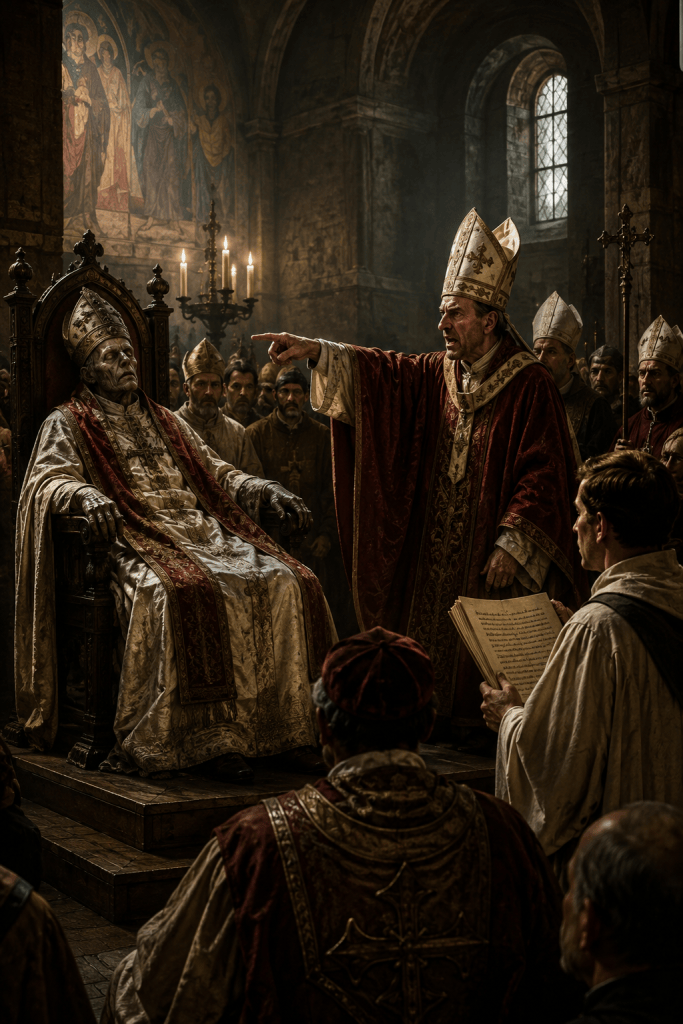
    The man being judged was Pope Formosus, but he was not represented merely by documents, witnesses or memories of his pontificate. His body had been removed from its tomb, dressed once again in papal vestments and brought into the basilica, where it was reportedly placed upon a seat before the assembled clergy. According to later accounts of the proceedings, a deacon was assigned the extraordinary task of answering on behalf of the dead pope while Pope Stephen VI presided over the accusations against his predecessor.

    The episode would become known as the Cadaver Synod, and later tradition would remember it under the chilling Latin designation Synodus Horrenda, the Horrible Synod. Although its most sensational details sound as though they belong to a Gothic novel rather than to ecclesiastical history, the trial itself was very real, and its purpose becomes considerably more understandable once the violent political struggles surrounding the papacy at the end of the ninth century are brought into view.

    The corpse on the throne was horrifying, but the real struggle concerned the living.

    Before the Corpse, There Was a Powerful Churchman

    Long before his body was brought into a courtroom, Formosus had been one of the most prominent and controversial churchmen of his generation. Born around the beginning of the ninth century, he eventually became bishop of Porto, an important episcopal see near Rome, and acquired a reputation as an able missionary and diplomat whose ecclesiastical career brought him into contact with some of the most significant political conflicts of his age.

    His abilities did not protect him from enemies. During the pontificate of Pope John VIII, Formosus became involved in a serious dispute with papal authorities and was accused of abandoning his diocese, conspiring against the pope and aspiring improperly to the Roman see. He was excommunicated and compelled to swear that he would never return to Rome or resume his episcopal functions, although changing political circumstances eventually allowed him to be restored to communion and to return to his position.

    When Formosus was elected pope in October 891, therefore, he arrived at the papal throne carrying both considerable experience and a history that his enemies would later use against him. One particularly important canonical problem concerned his position as bishop of Porto, because church law strongly discouraged the transfer of a bishop from one episcopal see to another, and his eventual election as Bishop of Rome provided his opponents with an argument that could later be transformed into an accusation of illegitimacy.

    Had this been merely a technical ecclesiastical dispute, Formosus might never have become the defendant in history’s most famous posthumous trial. What transformed the controversy into something far more dangerous was the struggle for political control of Italy and the imperial crown.

    A Pope Caught Between Rival Rulers

    The political landscape of late ninth-century Italy was extraordinarily unstable. The Carolingian order that had once provided a measure of imperial unity was disintegrating, powerful aristocratic families competed for territory and influence, and the papacy frequently found itself caught between rulers whose military strength could determine who controlled Rome itself.

    Among the most powerful forces in Italy was the house of Spoleto. Formosus initially recognized its position and crowned Lambert of Spoleto as co-emperor, but relations deteriorated, and the pope eventually sought assistance from Arnulf of Carinthia, the East Frankish king whose intervention offered the possibility of breaking Spoletan dominance.

    Arnulf crossed into Italy and entered Rome in 896, after which Formosus crowned him emperor. The decision was politically explosive because it represented a rejection of the interests of Lambert and his powerful mother, Ageltrude, while simultaneously tying the papacy to Arnulf’s military fortunes.

    Those fortunes changed almost immediately. Arnulf became seriously ill during his Italian campaign and was forced to withdraw, leaving the political situation unresolved, while Formosus himself died on 4 April 896. The pope was buried according to the customs of his office, and under ordinary circumstances his participation in the struggle might have ended there.

    Instead, the political balance shifted again, the Spoletan faction recovered its influence, and Formosus’s enemies discovered that death did not necessarily prevent them from attacking the legitimacy of everything he had done.

    Nine Months After Burial, the Grave Was Opened

    Following Formosus came the extremely brief pontificate of Boniface VI, whose reign lasted only a matter of days, and then Stephen VI became pope. During Stephen’s pontificate, probably in January 897, an extraordinary decision was made: Formosus would be prosecuted formally despite the inconvenient fact that he had been dead for months.

    His grave was opened and the corpse was removed.

    Historical accounts describe the body being dressed again in papal vestments and brought into the Lateran Basilica, where an ecclesiastical assembly had been convened. The dead pope was positioned before the court as though his physical presence were necessary for the proceedings, while Stephen VI assumed the role of his accuser and judge.

    Later narrative sources describe a deacon standing beside Formosus and answering questions on his behalf, creating an almost surreal scene in which the forms of a conventional ecclesiastical hearing were maintained even though the defendant was incapable of hearing the charges, understanding the proceedings or defending himself.

    It would be easy to dismiss the entire spectacle as nothing more than an eruption of medieval superstition or personal madness, yet doing so would obscure the political calculation behind it. Stephen and the enemies of Formosus were not interested merely in humiliating a corpse; they wanted to destroy the legal and ecclesiastical consequences of Formosus’s pontificate.

    To accomplish that, they first had to establish that he should never have been pope at all.

    What Could a Dead Pope Be Accused Of?

    The accusations revived controversies that had followed Formosus during his lifetime, particularly those involving his earlier position as bishop of Porto and the canonical restrictions concerning the transfer of bishops between sees. His opponents argued, in effect, that he had occupied the Roman see illegitimately and had therefore exercised papal authority that he should never have possessed.

    Other accusations concerned the oaths and obligations arising from his earlier conflict with John VIII, but the significance of the proceedings extended far beyond Formosus’s personal reputation. If his election to the papacy could be declared invalid, then the decisions he had made while occupying the office could also be challenged, including his ecclesiastical appointments and the ordinations he had performed.

    This was where the trial became politically useful, because Formosus had created networks of authority through the bishops and clergy he had ordained. Invalidating those acts could weaken men whose positions depended upon him while strengthening their rivals, which meant that the prosecution of a dead pope could have very real consequences for powerful living churchmen.

    The corpse could not defend itself, and the verdict was hardly in doubt.

    Formosus was condemned.

    Punishing a Man Who Could No Longer Feel Punishment

    Once the court had declared Formosus guilty, the proceedings entered their most macabre phase. His papal vestments were stripped from the corpse, and the acts associated with his pontificate were declared invalid. According to the traditional accounts, three fingers of his right hand, associated with the gesture of papal blessing, were cut away, an act whose symbolism was far more important than any physical punishment that could obviously no longer be inflicted upon the dead man.

    Everything about the treatment of the body communicated the same message: the authority Formosus had exercised as pope was being erased symbolically from his remains.

    His body was subsequently buried in a common grave rather than being allowed to retain the honor associated with papal burial. Later accounts state that it was then removed once more and thrown into the River Tiber, transforming a former pope, bishop and imperial kingmaker into a mutilated corpse discarded in the water flowing through Rome.

    Some of the vivid details of the trial survive through chroniclers writing after the event, which means that historians must distinguish carefully between the firmly established outline of the Cadaver Synod and dramatic elements preserved by later narrative tradition. There is no serious doubt, however, that Formosus was exhumed and subjected to a posthumous ecclesiastical trial under Stephen VI, nor that subsequent popes considered the proceedings sufficiently serious to overturn their consequences.

    Whatever Stephen hoped to achieve, the spectacle did not bring stability to Rome.

    It helped produce the opposite.

    The Living Judge Soon Followed the Dead Defendant

    The reaction against Stephen VI was rapid and severe. His political position collapsed during the months following the Cadaver Synod, and he was eventually deposed, imprisoned and strangled in the summer of 897.

    The reversal is one of the most striking features of the entire episode. At the beginning of the year, Stephen had possessed enough authority to order the exhumation and condemnation of a former pope; only months later, he himself was a prisoner whose pontificate had ended violently.

    Formosus, meanwhile, began an extraordinary posthumous rehabilitation.

    Tradition records that his body was recovered after being thrown into the Tiber, and later in 897 Pope Theodore II convened a synod that annulled the judgment against him and recognized the validity of his ordinations. His remains were restored to an honorable papal burial, reversing the humiliation imposed during Stephen’s pontificate.

    Theodore II occupied the papal throne for only a short period, but his actions were followed by those of John IX, who continued the rehabilitation of Formosus and convened synods that rejected the Cadaver Synod and attempted to prevent similar proceedings from occurring again. At Ravenna in 898, the measures against Formosus were overturned, while records associated with the grotesque trial were ordered destroyed.

    The dead pope, in effect, had received an appeal and won.

    Why the Ordinations of a Dead Pope Could Threaten the Living

    The controversy did not disappear simply because Formosus was returned to his tomb, because the question of his legitimacy created a theological and legal problem with potentially enormous consequences.

    A pope ordained bishops, and those bishops could subsequently ordain priests, consecrate other bishops and perform sacramental acts whose legitimacy depended upon their own ecclesiastical authority. If the ordinations performed by Formosus were invalid because he had supposedly occupied the papal office illegitimately, then doubts could spread through an expanding chain of clergy whose authority ultimately traced back to him.

    The problem therefore resembled a crack moving through the foundations of a building. What began as an attack on one dead pope could destabilize the status of numerous living churchmen and create uncertainty about sacraments and appointments that had already taken place.

    Writers defending Formosus consequently argued vigorously for the validity of his ordinations, while the controversy continued to influence papal politics after the principal participants were dead. Pope Sergius III, who became pope in 904, was associated with renewed hostility toward the Formosan position, demonstrating how difficult it was to bury a dispute that had already survived the man at its center.

    The Cadaver Synod was therefore never simply an absurd trial of a corpse. It represented an attempt to use canon law, ritual and physical humiliation to rewrite the legal consequences of an earlier pontificate.

    Was Stephen VI Insane?

    Modern retellings sometimes explain the episode by portraying Stephen VI as a deranged pope whose hatred of Formosus drove him to an act of grotesque irrationality. The temptation is understandable, because exhuming a decomposing predecessor and placing him before an ecclesiastical tribunal certainly appears incomprehensible when viewed outside its historical setting.

    There is, however, no reliable basis for diagnosing Stephen’s mental state more than eleven centuries after his death, and the political context provides motives that do not require such speculation. Formosus had supported Arnulf of Carinthia against the interests of the Spoletan faction, while his ecclesiastical acts had created positions and loyalties that remained important after his death. Declaring his pontificate illegitimate could therefore serve political interests by weakening the authority of his supporters and strengthening those who wanted his legacy destroyed.

    Seen in this context, the trial becomes more disturbing rather than less, because it suggests that the grotesque treatment of the corpse was not necessarily meaningless madness. It could function as calculated political theater in which the body of a dead pope became an instrument for changing the balance of power among living men.

    The courtroom was merely the stage.

    The real struggle was taking place throughout Rome and Italy.

    The Painting That Gave the Trial a Face

    Almost a thousand years after the Cadaver Synod, French painter Jean-Paul Laurens created one of the most memorable visual interpretations of the episode. His 1870 painting Le Pape Formose et Étienne VI depicts the dead Formosus seated rigidly before Stephen, surrounded by clergy inside a dark architectural space whose theatrical lighting intensifies the horror of the confrontation.

    The painting should not be mistaken for a reconstruction based on eyewitness evidence, because Laurens was creating a nineteenth-century historical drama rather than documenting the precise appearance of the Lateran in 897. Nevertheless, his composition captures something fundamental about the episode: the dead figure appears strangely passive and almost dignified while the living men surrounding him generate the violence and menace of the scene.

    Perhaps this is why the image remains so effective. The corpse is not really the frightening part.

    The frightening part is what the living are willing to do with it.

    A Trial That Was Never Really About the Dead

    The Cadaver Synod continues to fascinate because it violated an expectation that seems almost universal: whatever conflicts surround a person during life, death eventually removes that person from the immediate struggle for power.

    Formosus was denied even that final separation.

    His enemies could no longer force him to surrender authority, retract his decisions or answer accusations, so they attacked the surviving structures of his pontificate instead. By removing his body from the grave and placing it physically before a tribunal, they transformed a legal dispute into an extraordinary ritual in which the dead were temporarily dragged back into the political world of the living.

    For a brief moment in Rome in 897, the boundaries between courtroom and tomb, punishment and memory, law and political revenge became almost impossible to distinguish. A dead pope was dressed in the clothing of the office he had once occupied, a living pope demanded answers that the defendant could never provide, and an ecclesiastical assembly pronounced judgment upon a man whose earthly punishment had already been completed by death.

    Yet the final irony belongs to Formosus.

    The judgment against him was overturned, his ordinations were defended, his remains were restored to honorable burial and the spectacle intended to destroy his legacy instead ensured that his name would be remembered for more than a thousand years.

    Stephen VI, who had attempted to place a dead predecessor permanently among the condemned, was himself deposed, imprisoned and strangled only months after the trial.

    Formosus returned to his tomb.

    The Cadaver Synod entered history.

    And perhaps that is the most unsettling part of the entire story, because beneath the decomposing body, the papal robes and the macabre courtroom lies something far more recognizable than medieval superstition: the ancient human desire to rewrite the past when controlling the present is no longer enough.

    Sources & Further Reading

    Liudprand of Cremona, Antapodosis — an important later narrative source for the episode, although it was written decades afterward and its dramatic details must therefore be approached critically.

    Horace K. Mann, The Lives of the Popes in the Early Middle Ages — provides historical context for Formosus, Stephen VI and the political struggles surrounding the late ninth-century papacy.

    Catholic Encyclopedia, “Pope Formosus” — useful for the ecclesiastical career of Formosus, the Cadaver Synod and his subsequent rehabilitation.

    Bilal, M. and Tubbs, R. S., “Popes Convict Dead Pope Twice! The Unbelievable Cadaver Synod,” Clinical Anatomy (2017) — a modern scholarly discussion of the treatment of Formosus’s corpse and the extraordinary posthumous proceedings.

    Encyclopaedia Britannica, entries concerning Formosus and the ninth-century papacy — useful for the broader political and ecclesiastical context.

    Fediverse Reactions