
The story of a Greek name, a star that never changed its light, and a religious interpretation that has traveled through two millennia.
There are things we read dozens of times without paying much attention to them, until one seemingly insignificant detail forces us to look at the entire story from a different perspective. This happened to me recently when I returned to two figures from Greek mythology, Eosphoros and Hesperos, and to a question that became more disturbing the more closely I examined it: how did a name that meant the bringer of light become associated, in the Christian imagination, with the very ruler of darkness?
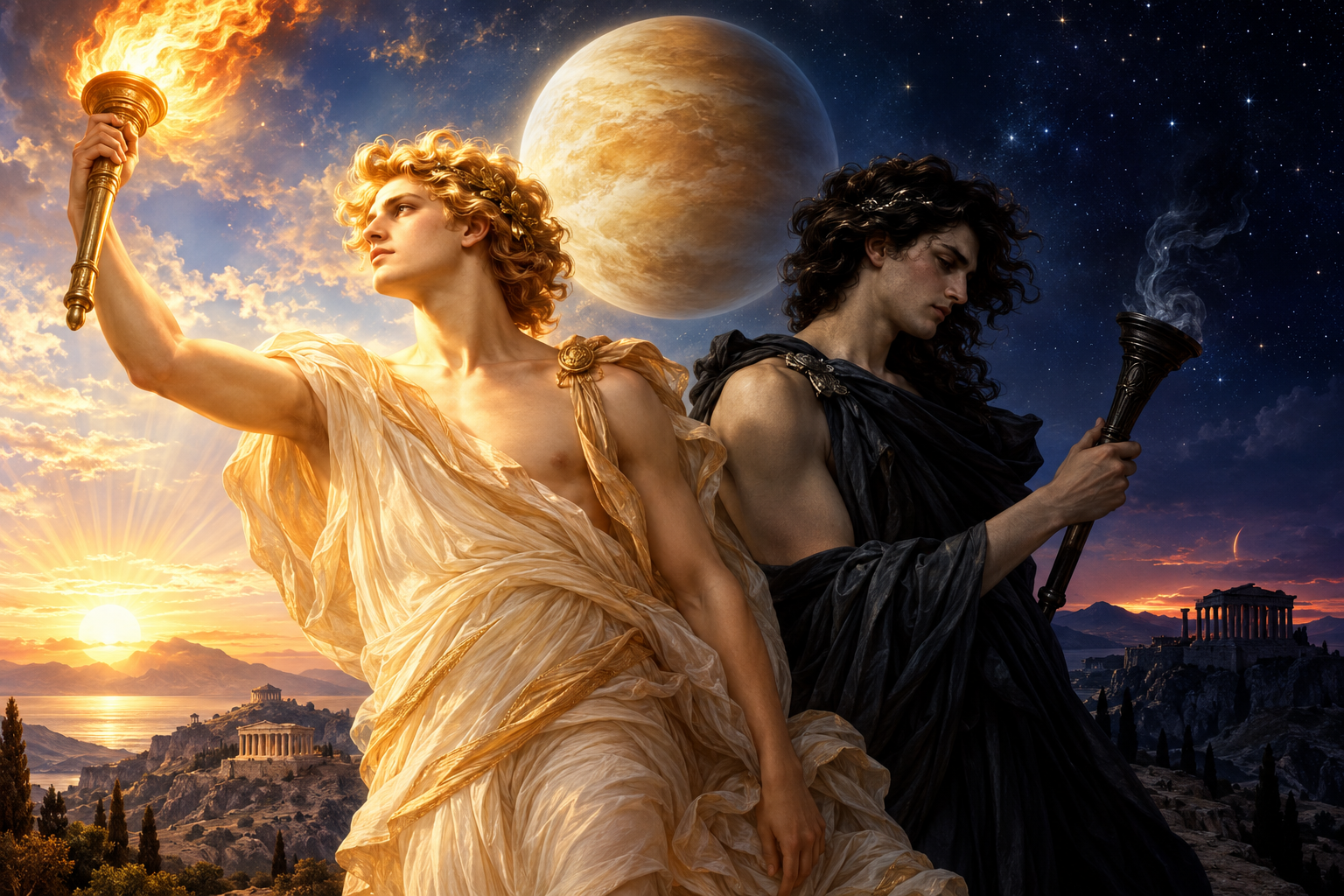
At first, what caught my attention was a painting from 1881 by the British artist Evelyn De Morgan, entitled Phosphorus and Hesperus. Two young men, two torches, two manifestations of light, captured in a composition that seems to speak of something far more profound than the simple alternation between morning and evening.
One of the figures carries a burning torch, while the other holds one that has been extinguished. I was drawn to this representation because, beyond its beauty, it conceals an astronomical truth known since Antiquity: the two are not, in reality, two different stars, but two appearances of the same planet.
Venus.
And yet, it was not astronomy that made me continue my investigation, but the history of a word.
Eosphoros and Hesperos: Before Light Became Suspicious
In ancient Greek, Ἑωσφόρος (Eosphoros) referred to the bringer of dawn, the celestial body that appeared before sunrise. Another name used for the Morning Star was Φωσφόρος (Phosphoros), the bearer of light, derived from phōs, meaning light, and phoros, meaning one who carries.
Hesperos, Ἕσπερος, was the Evening Star, the brilliant celestial body that appeared after sunset.
In Greek mythology, these celestial appearances were personified and given divine genealogies, just like many natural phenomena that the people of Antiquity attempted to understand through stories about gods.
Hesiod, in his Theogony, mentions Eosphoros among the children of the goddess Eos, the Dawn, and the Titan Astraios. This is an important testimony because it shows us that the figure of the bringer of dawn existed in Greek tradition many centuries before the emergence of Christianity.
Something else, however, intrigued me. The Greeks eventually came to understand that the Morning Star and the Evening Star were the same celestial body. This identification was known in ancient astronomical tradition and was associated by later writers with Pythagoras or Parmenides, although the precise attribution remains uncertain.
Thus, the same planet could be viewed under two different names, depending on the moment of its appearance.
It was neither good nor evil. It was neither divine nor demonic in the sense these words would later acquire in Christian theology.
It was simply the light that announced the morning or accompanied the arrival of night.
But what happens when an astronomical symbol enters the world of religious interpretation?
A Verse from Isaiah and the Beginning of a Transformation
I inevitably arrived at one of the most debated passages of the Old Testament, Isaiah 14:12.
In the Hebrew text, we encounter the expression Helel ben Shachar, commonly translated as the shining one, son of the dawn.
What I found particularly interesting is that, in its immediate context, the passage does not speak about Satan. Chapter 14 of Isaiah contains a song of mockery directed against the king of Babylon, portrayed as an arrogant ruler who aspires to divine heights but ultimately finds himself brought down.
The image of the Morning Star falling from heaven is used to describe the collapse of a power that considered itself untouchable.
When the text was translated into Greek in the Septuagint, the translators used the term heōsphoros, meaning the bringer of dawn.
Later, in the Latin translation known as the Vulgate, produced by Jerome during the late fourth and early fifth centuries, the word lucifer appears.
In classical Latin, lucifer was an ordinary term for the Morning Star, formed from lux, meaning light, and ferre, meaning to carry.
It was not, in itself, the name of the Devil.
This is the point at which the story truly began to interest me.
Because if the Hebrew text referred to the fall of a king, and the Latin word designated a luminous celestial body, when and through what mechanism did Lucifer become the name associated with the rebellious angel?
When Interpretation Becomes More Powerful Than the Text
The transformation did not occur through a simple alteration of a dictionary definition, nor did it happen at a single moment in history.
Early Christian writers frequently approached Scripture through methods of interpretation that allowed them to identify spiritual meanings beyond the immediate historical context. A character, a king, or an event could be understood as the image of a supernatural reality.
In this way, the fall of the king of Babylon in Isaiah gradually became associated with the idea of Satan’s fall.
Origen, a Christian theologian of the third century, contributed to the development of this interpretation, discussing the passage from Isaiah in connection with the origin and fall of the Devil. Later, other Christian writers strengthened the connection between the pride of a ruler who wished to elevate himself above others and the rebellion of a spiritual being against God.
Other biblical passages were also brought into this interpretation, including Ezekiel 28, which refers to the king of Tyre, and Luke 10:18, where Jesus speaks of Satan falling from heaven like lightning.
Gradually, these passages came to be read as parts of a shared history, although each originally belonged to a different context.
I believe it is essential to observe something here: there is insufficient historical evidence to support the claim that Christian translators deliberately chose the word lucifer in order to demonize a Greek deity and distance the Greeks from their ancient religion.
There were undoubtedly conflicts between Christianity and the traditional cults of the Greco-Roman world, and certain pagan symbols were reinterpreted or rejected. But the history of this particular word is far more complicated than the explanation of a linguistic conspiracy.
And precisely because it is more complicated, I find it considerably more interesting.
An Uncomfortable Detail: Christ and the Morning Star
Here I discovered the aspect that surprised me the most.
In Revelation 22:16, Jesus identifies himself as the bright Morning Star.
I reread the passage because I found it extraordinary that the same astronomical symbol could be associated, within Christian tradition, with both Christ and the being regarded as his adversary.
But the surprise does not end there.
In the Second Epistle of Peter, chapter 1, verse 19, the Greek term phōsphoros appears, used in a spiritual image describing the rising of the Morning Star in the hearts of believers.
The very same Greek word that, in Antiquity, designated the bearer of light.
Furthermore, there is a remarkable example in the Latin liturgical tradition. In the Exsultet, the Easter proclamation sung during the Easter Vigil, the word lucifer appears in a context identifying Christ as the Morning Star that never sets.
Therefore, in the Latin language of Christian tradition, lucifer was not always a demonic name.
It could designate the light of the morning, and in certain contexts it was even used as an image of Christ.
There was also a Christian bishop of the fourth century known as Lucifer of Cagliari, a name that did not necessarily carry the connotation it has for modern readers.
At that moment, I found myself wondering how many people who use the name Lucifer today exclusively as a synonym for Satan actually know this history.
And, above all, how many realize that the symbol of the Morning Star never disappeared from the Christian language of light and hope.
Venus: The Same Light, Two Interpretations
From an astronomical perspective, Venus does not produce its own light but reflects the light of the Sun. It is the brightest star-like object ordinarily visible in the sky after the Sun and Moon, and its apparent proximity to the Sun explains why we generally see it before sunrise or after sunset.
I find it almost ironic that such a simple phenomenon came to carry such an extraordinarily complex symbolic meaning.
For the ancient Greeks, its appearance could announce the coming of morning. For Roman poets, Lucifer could represent the celestial body preceding dawn. For biblical writers, the image of a fallen star could illustrate the collapse of an arrogant ruler. For certain Christian theologians, that same image became a representation of Satan’s fall.
And for other Christian writers, the Morning Star remained a symbol of Christ.
The planet did not change.
What changed were the stories people told about it.
What Does Evelyn De Morgan’s Painting Actually Tell Us?
I then returned to the painting that had initially awakened my curiosity.
Phosphorus and Hesperus, painted in 1881, presents the two bearers of light in a composition that evokes the transition between night and day.
Phosphorus carries the burning torch, while Hesperus is depicted with his torch extinguished. The visual contrast may suggest the difference between the light announcing dawn and the light disappearing with the arrival of night.
However, it would not be correct to consider the painting evidence that the artist intended to denounce the transformation of Lucifer into Satan. Such an intention would need to be demonstrated through documents, letters, or explanations provided by the artist herself.
What we can observe is that De Morgan chose to represent two figures from classical mythology without turning them into a simplistic opposition between good and evil.
And this is something I particularly appreciated.
Because it reminded me how much a symbol can lose when we view it exclusively through the meaning assigned to it by a single tradition.
Was Lucifer a Deity Whose Identity Was Stolen?
It is a provocative question, but the answer requires caution.
Eosphoros and Phosphoros belonged to the religious and poetic imagination of the Greeks, while Lucifer was their linguistic and astronomical equivalent in Latin. However, these names did not always designate a deity with an independent cult comparable to that of Zeus, Apollo, or Aphrodite.
Likewise, Satan did not first appear with Christianity. The Hebrew term satan means adversary or accuser and has a history in biblical literature and Jewish traditions that predate Christianity. The figure underwent significant transformations over time, both before and after the emergence of Christianity.
Therefore, we cannot simply say that a Greek god was renamed Satan.
What we can say, however, is something historically documentable and, in my opinion, equally fascinating: a term that originally designated the light of the morning became, through a long process of religious interpretation, one of the most recognizable names associated with the Devil.
This transformation deserves investigation not because it automatically proves the existence of a conspiracy, but because it demonstrates the extraordinary power of interpretation over collective memory.
Who Decides What a Word Means?
While researching this subject, I noticed how rarely we question the origins of words we use with such certainty.
We inherit them together with their explanations, their images, and the emotions that entire generations have attached to them. Sometimes we forget that, before becoming religious or moral symbols, many of these words referred to simple, visible things belonging to the natural world.
A celestial body.
A morning.
A light appearing on the horizon.
What intrigues me is not only the fact that Lucifer became associated with Satan, but also the way its original astronomical meaning has become almost unknown in popular culture.
Today, when we pronounce the name Lucifer, most people immediately think of a fallen angel, rebellion, hell, or evil.
Very few think of Venus.
And yet, before all these interpretations, the name designated the Morning Star.
I do not believe history needs to be rewritten in order to become mysterious. On the contrary, authentic documents sometimes conceal contradictions far more disturbing than invented stories.
In Lucifer’s case, the mystery does not lie in the existence of a proven secret hidden for two thousand years, but in the overlapping of traditions that assigned radically different meanings to the same image.
A fallen king, a luminous celestial body, a rebellious angel, and an image of Christ all came together in the history of the same symbol.
The Light Never Changed Its Name. Humanity Changed Its Story.
When I began reading about Eosphoros and Hesperos, I expected to discover a beautiful story from Greek mythology, perhaps a few astronomical explanations, and an interesting connection with Christian tradition.
I did not expect to arrive at such a profound question about the way human beings construct and transmit truth.
Because ultimately, the history of Lucifer is not only about religion. It is about language, authority, interpretation, and the ability of a tradition to influence what future generations will consider self-evident.
Not every transformation of meaning is a deliberate falsification. Some occur naturally through translation, metaphor, and cultural change. Others are influenced by religious conflicts, power, or a community’s need to define its own symbols.
But every transformation leaves traces.
And when we follow those traces back to their sources, we sometimes discover that things we believed to be incompatible once shared a common point of origin.
Eosphoros announced the morning. Hesperos accompanied the evening. Lucifer was the bearer of light. And the Morning Star became, in different Christian texts, both an image of a fall and an image of hope.
While human beings continued to debate, translate, condemn, and venerate these symbols, Venus continued to appear in the sky, just as it had in the time of Hesiod.
And this may be the observation with which I want to conclude.
What disturbs me is not so much that human beings changed the meaning of a name, but how easily, after enough centuries have passed, we come to believe that the name never had any other meaning.
And the question I leave with the reader is this:
If even the bearer of light could become, in collective memory, a name associated with darkness, how many other symbols from our history do we know today only through the interpretations of those who came after them?
Historical Sources and Bibliography
Henry Ansgar Kelly — Satan: A Biography (2006). Research into the development of Satan’s figure in biblical texts and Christian tradition.
Hesiod — Theogony, lines 378–382. The genealogy of Eosphoros in Greek mythology.
Plato — Timaeus, 38d. References to celestial bodies and the Greek astronomical tradition.
Aristotle — De Caelo, II.12. Context for ancient Greek astronomy.
The Hebrew Bible — Isaiah 14:4–23. The original context of the song directed against the king of Babylon.
The Septuagint — Isaiah 14:12. The Greek translation of the Hebrew expression referring to the Morning Star.
The Latin Vulgate — Isaiah 14:12. The use of the Latin term lucifer.
Origen — De Principiis, I.5.5. The theological interpretation of the Devil’s fall.
The New Testament — Luke 10:18; 2 Peter 1:19; Revelation 22:16. Images of the fall from heaven and the Morning Star.
The Exsultet — The Easter Proclamation of the Roman liturgy. The use of the term lucifer in reference to Christ.
Evelyn De Morgan — Phosphorus and Hesperus (1881). The artistic representation of the two personifications of the planet Venus.
Jeffrey Burton Russell — The Devil: Perceptions of Evil from Antiquity to Primitive Christianity (1977). A study of the evolution of the concept of the Devil.

