
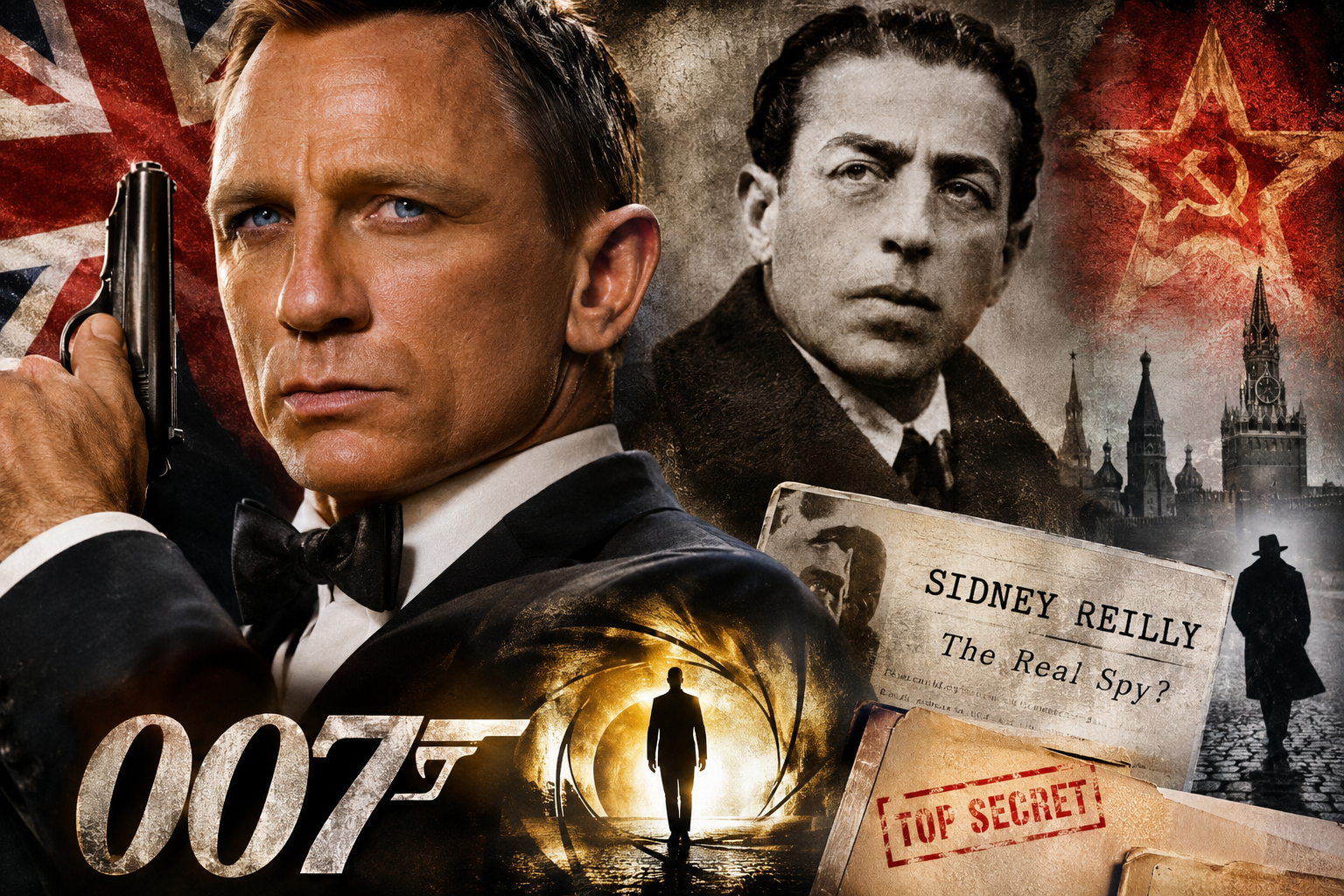
The extraordinary story of Sidney Reilly, the mysterious intelligence agent whose life helped inspire one of cinema’s most unforgettable characters.
Last October, Greek television dedicated an entire month to James Bond 007, and I found myself doing something I hadn’t done in quite a while: sitting down to watch those wonderful old adventures all over again. From Sean Connery’s irresistible charm and Roger Moore’s unmistakable sense of humour to Pierce Brosnan’s elegance and Daniel Craig’s darker interpretation, I rediscovered a world that had fascinated me since childhood, and I was surprised by how little that fascination had changed.
There is something rather comforting about returning to films you loved many years ago and discovering that they can still make you smile, even when the world around you has changed almost beyond recognition.
I must confess something that might make you laugh. When I was a little girl, I wanted to become James Bond. Not an actress playing alongside him, not one of the beautiful women he rescued, but James Bond himself. I wanted the adventures, the secret missions, the mysterious identities and, above all, the ability to walk into a dangerous situation knowing something nobody else knew.
Unfortunately, after a memorable beating from my mother, my promising career in international espionage came to an abrupt end, and I discovered that mathematics was a considerably safer passion.
James Bond, however, never left my heart.
What I have always loved about those films is not simply the action, but the peculiar combination of intelligence, elegance, irony and humour that made the character so unforgettable. Of course, Bond films have always contained violence, but many of the earlier adventures possessed a playful sophistication that I sometimes miss in modern cinema, where brutality and graphic bloodshed can seem more important than the story itself.
I suspect that people will still be watching James Bond twenty or fifty years from now, just as I continue to enjoy films that were made long before our present world existed.
But while watching those adventures again, I found myself returning to a question that has always intrigued me.
What if James Bond was not entirely a creation of someone’s imagination?
What if, behind the perfectly tailored suits, the dangerous missions and the impossible escapes, there had once been a real man whose life was even stranger than fiction?
That question leads us to Sidney Reilly, a man whose name is unfamiliar to many cinema lovers, although his reputation became part of the mythology from which James Bond eventually emerged.
And unlike the fictional agent 007, Sidney Reilly walked into a trap from which no ingenious gadget, secret weapon or last-minute rescue could save him.
The Man Who Had Too Many Lives
Sidney Reilly was born around 1873 or 1874, somewhere in the southern territories of the Russian Empire, most probably in the region of present-day Ukraine. Even his original name remains disputed, although historians generally associate him with the Rosenblum family and names such as Sigmund or Shlomo.
I find this uncertainty remarkable, because we are not discussing a medieval traveller whose records disappeared centuries ago. We are talking about a man who lived in the age of photography, international passports, newspapers and increasingly sophisticated police surveillance.
Yet he managed to leave behind a biography in which even the beginning is difficult to establish.
Reilly spoke several languages, moved comfortably between different countries and social environments, and possessed an extraordinary ability to convince people that he was exactly who they wanted him to be. He operated in business circles, negotiated commercial deals, cultivated influential acquaintances and gradually became involved in intelligence work.
His reputation suggested an almost supernatural talent for deception, although modern historians have uncovered a considerably less romantic personality beneath the legend.
Benny Morris, whose 2022 biography Sidney Reilly: Master Spy examines the surviving evidence, describes a resourceful businessman and confidence trickster whose intelligence activities developed alongside his financial ambitions.
What particularly interests me is that Reilly did not live the carefully regulated existence we associate with modern intelligence officers. He moved through a world in which espionage, private business, personal ambition and political intrigue frequently overlapped.
His romantic life was equally complicated. British intelligence records contain references to his marriages, including allegations of bigamy, and documents relating to his wife, the actress Pepita Bobadilla.
The charming secret agent who effortlessly wins women’s hearts was not entirely a cinematic invention, although the real Reilly’s relationships were considerably more troubling than the romantic adventures of James Bond.
The Spy Who Wanted to Change Russian History
To understand Sidney Reilly’s most dangerous undertaking, we have to return to Russia in 1918, when the country was being torn apart by revolution, civil conflict and competing political ambitions.
The Bolsheviks had seized power in October 1917, but their position remained precarious. The First World War had devastated the country, the old imperial institutions were collapsing, and foreign governments were deeply concerned about the consequences of the new revolutionary regime.
Reilly became involved in a conspiracy associated with the British diplomat Robert Bruce Lockhart, an episode that entered history as the Lockhart Plot.
The objective was to undermine the Bolshevik government, and one of the most extraordinary elements of the plan involved the Latvian Riflemen, military units that played an important role in protecting the revolutionary leadership.
The conspirators believed that some of these soldiers might be persuaded to turn against the government they were guarding.
At first glance, the idea seems almost absurd. Why would men entrusted with protecting the Bolshevik leadership suddenly betray it?
Yet historian Geoffrey Swain, writing in the academic journal Intelligence and National Security, has shown that dissatisfaction among Latvian troops made such an approach more plausible than later accounts sometimes suggested.
The conspiracy nevertheless failed, partly because Soviet security officers had penetrated the operation and partly because Reilly’s actions altered the original plan.
This is an important distinction. The popular version of the story presents Reilly as a brilliant spy who nearly overthrew Lenin single-handedly, but the historical evidence reveals a much more complicated affair, involving conflicting objectives, questionable decisions and an intelligence operation that was already compromised.
Reilly escaped from Russia, but the Bolshevik authorities had not forgotten him.
He had made enemies who understood something essential about his character: his determination to fight the Soviet regime could eventually be used against him.
Operation Trust: When the Enemy Invented an Entire Resistance Movement
Of everything I discovered about Sidney Reilly, this is the episode that I find most disturbing, because it demonstrates that the most effective weapon in espionage is not necessarily a gun, a poison or a hidden explosive.
Sometimes it is simply a convincing story.
During the early 1920s, Soviet state security developed an elaborate deception operation that became known as Operation Trust.
Its central instrument was a supposedly clandestine anti-Bolshevik organisation, commonly identified by the initials MOCR, derived from its Russian name, the Monarchist Union of Central Russia.
The organisation appeared to consist of influential Russians who remained inside the Soviet Union while secretly preparing to overthrow the communist government.
To anti-Bolshevik exiles living abroad, this was precisely the kind of resistance network they had been hoping existed.
But the organisation was controlled by Soviet intelligence.
The deception was not limited to forged documents or invented messages. It involved intermediaries, carefully maintained relationships, apparently credible political contacts and an entire network designed to make the false organisation appear authentic.
What makes Operation Trust so remarkable is that the Soviet security services were not merely trying to discover what their opponents knew. They were attempting to influence what those opponents believed.
By presenting a fabricated resistance movement as genuine, they could identify hostile networks, manipulate intelligence reports and encourage political exiles to expose themselves.
The deception also exploited a weakness that remains familiar today: people are often most vulnerable to information that confirms what they desperately want to believe.
For those who had fled revolutionary Russia and dreamed of returning to overthrow the Bolsheviks, the possibility of an organised resistance inside the country was extraordinarily attractive.
And Sidney Reilly was among those who could not resist it.
The Fatal Journey of September 1925
By 1925, Reilly was no longer the officially supported British intelligence operative he had once been. Historical records examined in a study published by the United States National Security Agency indicate that British intelligence had ended its working relationship with him several years earlier, although he retained influential contacts.
This detail matters because it changes the way we understand his final journey.
He was not simply James Bond receiving orders from London before departing on another dangerous assignment. He was a man driven by political convictions, personal ambition and a longstanding desire to strike against the Soviet regime.
The Trust organisation appeared to offer him the opportunity he had been waiting for.
Despite warnings about the danger of returning to Soviet territory, Reilly crossed the frontier from Finland in September 1925, expecting to meet representatives of the supposed underground movement.
Instead, he entered a carefully prepared Soviet trap.
He was arrested and taken to Moscow, where he was held in the notorious Lubyanka prison.
There is a particularly unsettling detail in the historical accounts of his capture. Soviet authorities circulated a false story suggesting that Reilly had been killed while crossing the frontier, concealing the fact that he was alive and being interrogated.
In other words, even after his arrest, the deception continued.
His enemies were controlling not only his movements but also the information the outside world received about his fate.
For a man who had spent much of his life manipulating identities and appearances, the reversal was devastating.
What Happened Inside Lubyanka?
The surviving evidence indicates that Reilly was interrogated by Soviet security officers during his imprisonment, and later investigations have helped reconstruct his final weeks.
Historian Andrew Cook, who researched Reilly’s life and death extensively, examined Soviet records and interviewed Boris Gudz, a former Soviet intelligence officer involved in Operation Trust.
Cook’s findings, reported by The Guardian in 2002, supported the conclusion that Reilly had been executed rather than secretly recruited or allowed to disappear.
According to the account reconstructed from Soviet records and testimony, Reilly was taken into a wooded area near Moscow on 5 November 1925 and shot.
The same investigation reported testimony that the decision to execute him had been approved by Stalin. That specific attribution rests on the historical testimony presented by Cook and should be distinguished from the broader, well-supported conclusion that Reilly was killed by Soviet security officers.
His death brought an extraordinary life to an end, but it did not end the mystery surrounding him.
For years, stories circulated suggesting that he might have survived, changed sides or adopted yet another identity.
Such rumours were almost inevitable. Reilly had spent so long living behind different names and competing stories that even his death seemed too ordinary to be accepted.
Yet the evidence available to historians strongly supports his execution in November 1925.
And this is where I find the story almost unbearably ironic.
A man who understood deception better than most people, who had spent years exploiting human weaknesses and moving between fabricated identities, was ultimately destroyed because he believed in a carefully manufactured reality.
How Sidney Reilly Became Part of the James Bond Legend
The connection between Reilly and James Bond is fascinating, but it deserves more care than the simple claim that Reilly was the real 007.
Ian Fleming, who created James Bond in his 1953 novel Casino Royale, had served in British naval intelligence during the Second World War. His professional environment exposed him to genuine espionage operations, intelligence officers and the complicated machinery of secret warfare.
According to historian Andrew Cook, Fleming knew of Reilly’s reputation and had connections with Robert Bruce Lockhart, who had personally known Reilly during the revolutionary period in Russia.
Lockhart also helped preserve and promote Reilly’s public legend. In 1931, Reilly’s widow Pepita published an account of his adventures, and newspaper publicity helped transform the dead intelligence operative into a celebrated master spy.
This is one of the least appreciated aspects of the story: the legend of Sidney Reilly was partly constructed after his death.
The real man had been a mixture of intelligence operative, adventurer, political conspirator and opportunist, but the stories that circulated about him increasingly emphasised his extraordinary courage, resourcefulness and almost impossible achievements.
Fleming encountered that mythology, and Reilly appears to have contributed to the broader idea of the sophisticated, dangerous and morally ambiguous secret agent.
However, Bond was not a direct portrait of one individual. Fleming drew on multiple people, his own wartime experiences and his imagination.
There are nevertheless striking similarities.
Both Reilly and Bond were associated with international travel, sophisticated social circles, gambling, romantic entanglements and the ability to move between different identities or environments.
But there is another resemblance that interests me more than the superficial details.
Neither the literary Bond nor the historical Reilly was simply a conventional hero.
Both inhabited a world where loyalty could be uncertain, deception was essential and morality often became entangled with political objectives.
The Bond of Fleming’s novels was considerably harder and more ruthless than the charming cinematic figure many of us remember.
And the real Reilly was certainly no harmless gentleman adventurer.
The Difference Between a Film and Reality
When I think about James Bond, I remember the humour, the elegant clothes, the impossible escapes and those wonderful moments when everything seems lost until the hero finds one final way out.
With Sidney Reilly, there was no such ending.
There was no Aston Martin waiting beyond the prison gates, no ingenious device concealed in a wristwatch and no helicopter arriving just before the execution.
There was only a man who had misjudged his enemies.
But perhaps the most unsettling part of his story is that the Soviet officers did not need to convince him of something entirely unfamiliar. They created a version of reality that matched his existing ambitions.
He wanted to believe that an organised anti-Bolshevik resistance was waiting inside Russia, and Operation Trust gave him exactly that.
This is why I consider the case much more than an interesting chapter in the history of espionage.
It illustrates a form of manipulation that remains relevant long after the disappearance of the political world in which Reilly lived.
The most convincing deception is often the one that does not force us to abandon our beliefs, but encourages us to trust them even more.
I sometimes wonder whether this is the real reason stories about spies continue to fascinate us. Beneath the glamour and adventure, they confront us with a disturbing question about human nature: how much of what we believe is based on evidence, and how much depends on what we are emotionally prepared to accept?
The Man Behind the Myth
I began this story with a childhood memory, a rather unfortunate encounter with my mother’s disciplinary methods and a lifelong affection for a fictional British secret agent.
I never became James Bond, although mathematics eventually offered me its own kind of mystery, one in which the challenge was to discover what lay hidden behind apparently complicated problems.
And after revisiting the films, I found myself thinking that perhaps the greatest difference between James Bond and Sidney Reilly is not courage, intelligence or charm.
It is the ending.
James Bond belongs to a world in which the audience can trust that the hero will usually survive, no matter how impossible the situation appears.
Sidney Reilly belonged to a world in which survival was never guaranteed, where the people offering help might be the very people planning your destruction, and where one mistaken decision could erase every previous success.
I will undoubtedly watch James Bond again, and I suspect I will enjoy those films just as much as I always have.
But the next time I see 007 walking confidently into a room filled with enemies, I will remember a real man who crossed the Soviet frontier in September 1925, convinced that he was approaching an opportunity that could change history.
He had spent years mastering the art of deception.
What he failed to recognise was that, this time, someone else had written the script.
And unlike James Bond, Sidney Reilly never reached the final scene.
Sources and Further Reading
- Benny Morris, Sidney Reilly: Master Spy (Yale University Press, 2022). A modern scholarly biography examining Reilly’s origins, intelligence career and the myths surrounding his life.
https://doi.org/10.2307/j.ctv2vvsx45 - Geoffrey Swain, “An Interesting and Plausible Proposal: Bruce Lockhart, Sidney Reilly and the Latvian Riflemen, Russia 1918,” Intelligence and National Security, Vol. 14, No. 3 (1999), pp. 81–102. An academic analysis of the 1918 conspiracy and its political and military context.
https://doi.org/10.1080/02684529908432553 - National Security Agency, Issues in British and American Signals Intelligence, 1919–1932, Part 2: “The Tale of the Trust.” Historical intelligence research examining Operation Trust, its disinformation networks and Reilly’s involvement.
https://www.nsa.gov/portals/75/documents/about/cryptologic-heritage/historical-figures-publications/publications/misc/issues-in-british-and-american-signals-intelligence-1919-1932.pdf - The National Archives (UK), Sidney George Reilly, file KV 2/827. Declassified British security records relating to Reilly, including biographical and marriage information.
https://discovery.nationalarchives.gov.uk/ - Andrew Cook, “Master Spy Sidney Reilly: The Inspiration for James Bond,” The History Press (2018). An examination of the historical Reilly, his mythology and his influence on Ian Fleming.
https://thehistorypress.co.uk/article/master-spy-sidney-reilly-the-inspiration-for-james-bond/ - Owen Bowcott, “How Fate, and Stalin, Finally Dealt the ‘Ace of Spies’ a Losing Hand,” The Guardian, 7 September 2002. Reporting on Andrew Cook’s research into Reilly’s execution and testimony from former Soviet intelligence officer Boris Gudz.
https://www.theguardian.com/uk/2002/sep/07/russia.artsandhumanities - Greg Daugherty, “The Real Spycraft That Inspired James Bond,” HISTORY, 11 September 2025. Background on Ian Fleming’s wartime intelligence experience and the multiple influences behind James Bond.
https://www.history.com/articles/james-bond-inspiration-ian-fleming-wwii-intelligence
Whisper Mysteries — Where history, deception and the unexplained meet.