Category: Curiosities

  • Demodex: The Microscopic Creatures Living on Your Face While You Sleep

    Demodex: The Microscopic Creatures Living on Your Face While You Sleep

    There is something quietly unsettling about looking into a mirror and realizing that the face staring back at you is not inhabited by you alone.

    Inside the tiny follicles around the nose, forehead, cheeks, eyebrows and eyelashes, microscopic creatures may be living out their entire existence almost completely unnoticed. They feed, move, reproduce and die within a landscape measured not in miles but in fractions of a millimeter, and although most of us will never feel them or see them, they are remarkably common companions of adult human beings.

    They are called Demodex mites, and unlike many of the creatures that populate stories about parasites, these are not rare tropical organisms or invaders picked up during some unfortunate encounter. They belong to a much stranger category because, for many people, Demodex is simply part of life on human skin.

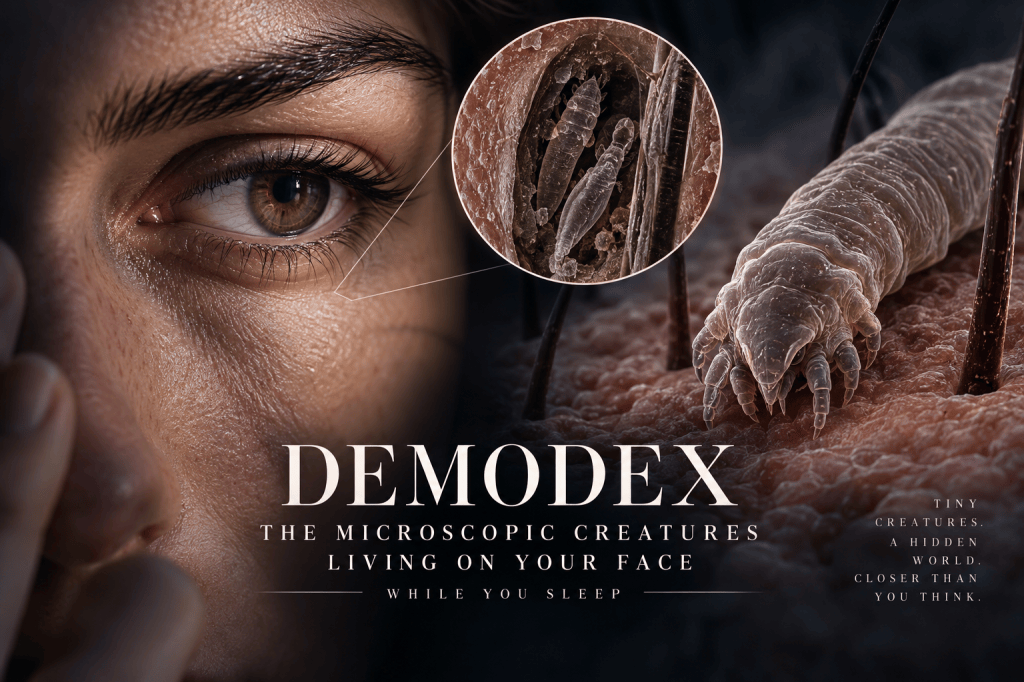
    Under a microscope the creature looks almost unreal: a long, translucent body, a cluster of eight short legs near its head and a shape that seems better suited to a science-fiction illustration than to the pores of an ordinary human face. Yet Demodex has been known to medicine since the nineteenth century, and modern research has revealed a surprisingly intimate relationship between these mites and their human hosts.

    The disturbing part is not that they exist.

    It is how close they have always been.

    A creature hidden inside the human face

    Two species are primarily associated with humans: Demodex folliculorum and Demodex brevis.

    Demodex folliculorum is the larger of the two, generally measuring around 0.3 to 0.4 millimeters, and tends to live in hair follicles, often gathering near facial hairs and eyelashes. Demodex brevis is shorter and prefers a deeper existence, inhabiting sebaceous glands and the meibomian glands located along the eyelids.

    Their favorite territory is therefore exactly where human skin tends to be richest in oil: around the nose, cheeks, forehead, chin, eyebrows and eyelids.

    To us, a pore is almost nothing, a tiny opening visible only when we examine the skin closely. To an organism the size of Demodex, however, the same structure is an entire habitat, providing darkness, protection and a steady supply of material from the skin and sebaceous glands.

    Their elongated bodies are remarkably well suited to this environment. Instead of the rounded appearance we usually associate with mites, Demodex resembles a microscopic translucent worm with legs concentrated toward the front of its body, allowing it to fit into the narrow architecture of a follicle.

    It is an arachnid, belonging to the same broad class as spiders and ticks, although its existence could hardly be more different.

    Most of the time, it remains invisible not only to our eyes but also to our awareness.

    What happens after the lights go out

    This is where the biology of Demodex becomes considerably stranger.

    The mites show nocturnal activity. During periods of darkness they can leave the deeper parts of the follicle and move across the surface of the skin, while bright light encourages them to retreat again. Laboratory and microscopic observations have estimated their movement at only a few millimeters per hour, which sounds insignificant until one remembers the scale of the creature itself.

    For Demodex, crossing a small portion of the face can represent a substantial journey.

    Research into the mite’s biology has suggested that darkness is closely connected with its activity and reproductive behavior. Adults can move toward follicular openings, encounter other mites and mate before returning to the protected environment of follicles and glands, where eggs develop and a new generation begins.

    Their lives are remarkably short, generally lasting only a matter of weeks.

    From egg to larva, through immature stages and eventually to adulthood, the entire cycle unfolds on the human host. There is no hidden nest beneath the bed, no colony waiting somewhere in the bathroom and no mysterious external phase of the animal’s existence. For a human-associated Demodex mite, our skin is essentially its world.

    This nocturnal behavior also helps explain an observation reported in some people suffering from Demodex-related eyelid disease: itching and irritation may become particularly noticeable during the night or shortly after waking.

    For most people, however, nothing happens that they can feel at all.

    Does everyone have Demodex?

    Not literally everyone, and claims that every single human being carries thousands of mites should be treated cautiously, but Demodex becomes extremely common with increasing age.

    Children tend to have far fewer mites, while colonization becomes progressively more frequent in adults. Differences between studies are substantial because results depend on age, population and the technique used to detect the mites, but the overall pattern is clear: Demodex is a very ordinary inhabitant of adult human skin.

    That distinction matters because finding a Demodex mite does not mean someone has a disease.

    Human skin was never intended to be sterile. It supports complicated communities of bacteria, fungi, viruses and microscopic organisms whose presence may be harmless, beneficial, problematic or some combination of all three depending upon circumstances.

    Demodex occupies an especially ambiguous position within this hidden ecosystem.

    When present in small numbers, the mites may coexist with us without producing any recognizable symptom. When their population becomes unusually dense, however, the relationship can change.

    And this is where medicine becomes interested.

    When a harmless resident becomes a problem

    An excessive proliferation of Demodex can be associated with a condition known as demodicosis, which may produce facial redness, roughness, scaling, burning, itching, follicular irritation and small inflammatory eruptions.

    The difficulty is that these symptoms can resemble other dermatological disorders.

    Someone may believe they have acne, sensitive skin, an allergic reaction or rosacea when the underlying picture is more complicated. Conversely, discovering Demodex does not automatically prove that the mites caused the inflammation because they can also be found on perfectly healthy skin.

    The important factor appears to be not merely their presence but their density, their location, the condition of the skin barrier and the way the immune system responds to them.

    This has led to one of the most intriguing debates surrounding Demodex: when large numbers of mites are found on diseased skin, are they helping to create the disease, or has the altered skin environment simply created perfect conditions for the mites to multiply?

    The answer is still developing.

    The strange connection with rosacea

    Few aspects of Demodex research have generated as much interest as its connection with rosacea, the chronic inflammatory disorder that can produce facial flushing, persistent redness, visible blood vessels, papules and pustules.

    Study after study has found greater densities of Demodex on the skin of many patients with rosacea than on unaffected controls. One systematic review discussing the skin microbiome reported research in which levels of Demodex folliculorum were several times higher in people with rosacea than in controls.

    That association is real.

    Its meaning is more complicated.

    Rosacea is not simply a Demodex infestation. The disorder involves interactions among blood vessels, immune responses, the skin barrier, environmental triggers, genetics and the cutaneous microbiome. The mites appear to be one possible participant in this inflammatory network rather than a complete explanation for the disease.

    Researchers have proposed several mechanisms by which high mite densities might contribute to inflammation. Their physical presence can affect follicles, components associated with the mites may stimulate the immune system, and microorganisms carried within or around them may potentially add another layer to the reaction.

    Other researchers have pointed out the reverse possibility: rosacea may alter the skin environment in ways that allow Demodex populations to flourish.

    There is therefore a peculiar biological circle that science is still trying to untangle.

    Perhaps inflammation encourages the mites.

    Perhaps the mites encourage inflammation.

    Perhaps both processes occur at the same time.

    They also live among your eyelashes

    If the thought of microscopic mites in facial follicles is uncomfortable, their preferred location around the eyes may be even harder to ignore.

    Demodex folliculorum is frequently found around eyelash follicles, while Demodex brevis can inhabit sebaceous and meibomian glands associated with the eyelids.

    In excessive numbers they have been linked to Demodex blepharitis, an inflammatory condition affecting the eyelid margins. People may experience itching, burning, dryness, redness, watering, a foreign-body sensation or irritation that is particularly noticeable around the eyelashes.

    One of the characteristic signs doctors look for is the presence of cylindrical material, often described as collarettes, around the bases of the lashes. These deposits can contain keratinized material and debris associated with mite activity.

    This is not simply an obscure medical curiosity. Modern ophthalmology increasingly recognizes Demodex as an important factor in some cases of persistent blepharitis, particularly when symptoms continue despite conventional eyelid care.

    Once again, however, context matters. A mite found in an eyelash follicle is not automatically a disease diagnosis because asymptomatic people can carry them too.

    The difference between coexistence and illness often lies in numbers and inflammation.

    What do they actually eat?

    For years, descriptions of Demodex were sometimes simplified into the claim that the mites merely consume dead skin.

    Their feeding behavior appears to be more complex.

    They inhabit environments rich in sebum and cellular material and possess mouthparts adapted to obtaining substances available inside follicles and sebaceous structures. Studies describe their diet in relation to sebum, epithelial material and substances associated with the follicular environment.

    This makes the human face remarkably suitable habitat because the areas surrounding the nose, forehead, eyebrows and eyelids contain abundant sebaceous structures.

    In evolutionary terms, Demodex has become so closely adapted to this environment that its biology makes little sense without its mammalian host.

    The mite is not simply visiting us.

    It has evolved to live here.

    The famous Demodex myth that refuses to die

    Anyone who has explored Demodex on social media has probably encountered a particularly memorable claim: the mites supposedly have no anus, accumulate waste throughout their lives and then burst open after death, releasing everything into the human pore.

    It is an excellent horror story.

    It is also misleading.

    Modern anatomical and genomic work has challenged the claim that Demodex lacks a functional way of eliminating waste, and researchers studying its biology have specifically pointed out that the popular story of accumulated feces exploding into the follicle after death is incorrect.

    The persistence of this myth illustrates something interesting about our relationship with microscopic life. Once people discover that an eight-legged creature lives inside human pores, reality already sounds strange enough that almost any additional detail becomes believable.

    Demodex does not need fictional embellishment.

    Its genuine biology is peculiar enough.

    Can you feel them walking across your face?

    Normally, no.

    A single mite is far too small and moves far too slowly for someone simply to feel it crawling across the skin. Sensations such as itching or irritation associated with Demodex-related disorders are connected with inflammation and the interaction between the mites, follicles and immune system rather than with a person consciously detecting individual footsteps.

    The same applies when looking into a mirror.

    Although an adult Demodex folliculorum approaches the lower limits at which an object might theoretically become detectable under ideal conditions, ordinary observation of the skin will not reveal mites walking around the face. Proper identification generally requires magnification and clinical examination techniques.

    Dermatologists may use skin-surface sampling, microscopy and other methods when demodicosis is suspected, while eye-care professionals can examine the eyelashes and lid margins when Demodex blepharitis is considered.

    For people without symptoms, there is generally no reason to go hunting for them.

    Should we try to kill them?

    Probably the most important thing to understand about Demodex is that discovering these mites should not lead to an attempt to sterilize the face.

    Aggressive cleansing, excessive exfoliation or unproven chemicals can damage the skin barrier and create problems far more significant than the mites themselves.

    When Demodex is genuinely involved in a diagnosed skin or eyelid disorder, targeted medical treatments are available, and management depends on whether the problem involves the facial skin, rosacea, demodicosis or the eyelids. Dermatologists and eye-care professionals can distinguish these conditions more reliably than photographs or home experiments.

    The goal is not necessarily to create a completely mite-free human being.

    The goal is to restore a healthy balance.

    That concept feels strangely modern, yet it reflects something biology has been telling us for a long time: health is not always the absence of other organisms. Sometimes it is the ability of many organisms to occupy the same environment without allowing one part of the system to overwhelm the rest.

    The face in the mirror is an ecosystem

    Perhaps Demodex fascinates us because it challenges one of the simplest assumptions we make about our own bodies.

    We instinctively think of the boundary of the skin as the place where the self ends and the outside world begins, yet biology has never respected that boundary as neatly as we do. The human body is inhabited by enormous communities of microscopic life, and the line separating us from that living environment is far more complicated than it appears.

    Demodex occupies one of the most intimate territories imaginable, inside structures belonging to our skin, sometimes only fractions of a millimeter from the surface we touch when we wash our faces in the morning.

    While we sleep, some of these mites become active. They move through a landscape formed by our follicles, reproduce within it and disappear again into spaces too small for us to see.

    By morning the mirror looks exactly the same.

    Perhaps that is what makes Demodex more fascinating than frightening. The discovery does not reveal that something suddenly invaded the human body; it reveals that an entire miniature world was already there, carrying on with its existence while we remained completely unaware of it.

    And once you know that, it becomes difficult to look at an ordinary human face in quite the same way again.

    Sources & Further Reading

    University of Reading — The Secret Lives of Mites in the Skin of Our Faces. Explanation of the genomic study and the unusual biology of Demodex folliculorum.
    https://www.reading.ac.uk/news/2022/Research-News/Secret-lives-of-skin-mites-in-our-faces

    Significance of Demodex folliculorum and Demodex brevis in Pathogenesis of Dermatological Diseases — Current State of Knowledge. A recent scientific review covering Demodex biology, demodicosis, rosacea, blepharitis, diagnosis and treatment.
    https://pmc.ncbi.nlm.nih.gov/articles/PMC12028426/

    Beyond the Surface: Understanding Demodex and Its Link to Blepharitis and Facial Dermatoses. Review of the relationship between Demodex mites, facial skin disorders, ocular rosacea and eyelid inflammation.
    https://pmc.ncbi.nlm.nih.gov/articles/PMC11213710/

    Demodex Blepharitis: A Comprehensive Review of the Disease, Current Management, and Emerging Therapies. Detailed review of Demodex infestation around the eyelashes, collarettes, inflammation and ocular symptoms.
    https://pmc.ncbi.nlm.nih.gov/articles/PMC10351901/

    Demodex and the Eye — A Review. Overview of ocular Demodex, blepharitis, rosacea and the still-debated relationship between mite proliferation and disease.
    https://pmc.ncbi.nlm.nih.gov/articles/PMC11831939/

    Human Follicular Mites: Ectoparasites Becoming Symbionts. Molecular Biology and Evolution, 2022. Genomic research into Demodex folliculorum, its extraordinary adaptation to human follicles, nocturnal behavior and reduced genome.
    https://doi.org/10.1093/molbev/msac125

  • The Great Emu War: The Day Australia Sent Soldiers to Fight Birds — and the Birds Refused to Surrender

    There are wars that begin over borders, religion, dynasties, resources or political ambition, and then there is the peculiar Australian episode of 1932, when armed soldiers carrying Lewis machine guns were sent into the wheat-growing country of Western Australia to deal with an enemy that had no government, no commander, no territorial demands and, as far as anyone could tell, absolutely no respect for military authority.
    The enemy was the emu.
    Large, fast, remarkably difficult to intimidate and apparently unimpressed by the technological achievements of Homo sapiens, thousands of these flightless birds had wandered into farming districts looking for food and water, trampling crops and damaging fences along the way. The farmers were desperate, the government became involved, the military arrived, machine guns were prepared, and what followed entered Australian folklore under the irresistible name The Great Emu War.
    It was not technically a war, of course. No declaration of hostilities was delivered to an emu ambassador, and no peace treaty was eventually signed beneath a eucalyptus tree. It was a military wildlife-control operation. Yet once you read what actually happened, calling it a war somehow feels entirely appropriate, particularly because the humans possessed the machine guns while the emus possessed, among other useful qualities, the ability to run away.
    And for a while, running away proved surprisingly effective.
    The Problem Began With Wheat, Drought and About 20,000 Uninvited Guests
    Western Australia in the early 1930s was not an easy place to be a farmer. Australia was suffering through the economic pressures of the Great Depression, and many of the men trying to make a living from the land were veterans of the First World War who had settled on farms under government-supported settlement schemes.
    Then came the emus.
    After breeding inland, large numbers of birds migrated toward the coast, as they naturally did in search of food and water. Unfortunately for the farmers around places such as Campion and Walgoolan, their wheat fields looked less like private agricultural property and more like an enormous complimentary buffet.
    Estimates commonly put the number of emus moving into the farming district at around 20,000. The birds ate crops, flattened plants and pushed through fences, sometimes leaving openings through which rabbits could enter as well. For farmers already struggling economically, watching several enormous birds stroll through a wheat field with the confidence of landowners inspecting their estate was not especially amusing.
    The farmers wanted help.
    Some of them were former soldiers, and a rather logical idea emerged: if ordinary methods were failing and there were thousands of birds, perhaps machine guns could solve the problem.
    On paper, this probably looked wonderfully efficient.
    History was about to demonstrate the danger of making plans on paper when your opponent can run at roughly 50 kilometres per hour.
    Enter Major Meredith and the Lewis Guns
    The Australian government approved military assistance under Defence Minister Sir George Pearce, whose political and defence career is well documented in the collections of the Australian War Memories


    The operation was placed under the command of Major G. P. W. Meredith of the Royal Australian Artillery. He was accompanied by soldiers equipped with two Lewis machine guns and thousands of rounds of ammunition.
    The plan was beautifully simple.
    Find emus.
    Point machine guns at emus.
    Fire.
    Problem solved.
    Unfortunately, nobody had explained the plan to the emus.
    The operation began in early November 1932, after rain had delayed the soldiers’ arrival. Almost immediately, one fundamental difficulty became obvious: an emu is not a military formation. It does not politely advance in a straight line toward a machine-gun position while somebody gives the order to fire.
    Emus scatter.
    And they scatter extremely well.
    The First Battle Did Not Go According to Plan
    When soldiers encountered groups of birds, the emus tended to break apart and run in different directions, making them frustratingly difficult targets. Attempts to approach closely enough for concentrated machine-gun fire frequently ended with the birds simply moving away.
    Then came one of the most famous episodes of the campaign.
    Near a dam, Meredith’s men encountered a large concentration of emus and decided that this was finally their opportunity. Instead of wasting ammunition on scattered individuals, they would wait until the birds were within effective range and then unleash the Lewis gun.
    Hundreds of emus approached.
    The soldiers waited.
    The birds came closer.
    This was it.
    The machine gun opened fire — and after only a brief burst, it jammed.
    One can only imagine the silence.
    The emus dispersed.
    Somewhere in Western Australia, natural selection was having an excellent afternoon.
    The Army Tried Putting a Machine Gun on a Truck
    At some point during the operation, someone had another idea that must have sounded magnificent before anyone actually attempted it.
    Mount a machine gun on a truck.
    Chase the emus.
    Shoot while moving.
    The difficulty was that rural Western Australia was not a billiard table. The vehicle bounced over rough ground while the birds ran rapidly across terrain they understood considerably better than the men pursuing them.
    Accurate shooting from the moving truck proved extremely difficult, while the emus apparently had no comparable problem with running.
    The technological contest had therefore reached an unusual stage.
    Australia had a motor vehicle and a machine gun.
    The emus had legs.
    The advantage remained unclear.
    Major Meredith Began to Sound Almost Respectful
    The strangest part of the story is that the military men themselves appear to have developed a grudging admiration for their feathered opponents.
    Meredith was later quoted in the press comparing the emus’ ability to withstand gunfire and disperse under attack to highly effective soldiers. Another famous remark attributed to him suggested that, if Australia had a military division with the emus’ capacity to absorb punishment, it could face virtually any army.
    There was also something genuinely fascinating behind the comedy. Emus did not behave as a single frightened herd. When threatened, groups could scatter rapidly, which made concentrated fire much less effective than expected. A weapon designed to fire into masses of human soldiers was an absurdly clumsy answer to a collection of fast-moving birds refusing to remain conveniently grouped together.
    In other words, the machine gun was enormously powerful.
    The emus simply declined to stand in front of it.
    Parliament Eventually Had to Discuss the Emus
    By this point, the affair was becoming public entertainment as well as agricultural policy.
    Newspapers reported on the operation, and contemporary Australian press coverage confirms that the machine-gun campaign was resumed after an interruption; The Argus, for example, reported from Canberra on 11 November that the attack against emus damaging Western Australian crops had begun again.

    Once politicians became involved, the story acquired the final ingredient required for historical comedy.
    Someone had to ask who was winning.
    The operation attracted criticism, questions were raised about the use of military weapons against wildlife, and the spectacle of the Australian Army apparently struggling to defeat large birds was simply too good for newspapers to ignore.
    It is worth correcting one modern exaggeration, however. Australia did not mobilize an army against the emus in the conventional sense, nor was the country literally at war with them. This was a small military detachment conducting a pest-control operation at the request of farmers.
    But “A Small Government-Supported Wildlife Management Operation Experiencing Unexpected Tactical Difficulties” would have been a terrible title.


    The Great Emu War was destined to win.


    The Second Campaign Was More Successful — Sort Of


    After the embarrassing early encounters, operations resumed and the soldiers eventually became more effective. Rather than expecting enormous groups of birds to present themselves for destruction, they adjusted their tactics, and substantially more emus were killed during the later phase.
    The numbers vary somewhat between historical accounts, which is worth remembering whenever dramatic statistics about the Emu War circulate online. Contemporary reporting and later retellings do not always agree perfectly about ammunition expenditure, birds killed or the precise sequence of encounters, and the story has accumulated considerable folklore during the last nine decades.
    What is not really disputed is the larger result.
    The machine-gun operation did not eliminate the emu problem.
    The soldiers eventually withdrew in December 1932, while the birds remained in Western Australia doing what emus had presumably intended to do all along: being emus.
    No surrender was obtained.
    No emu leader was captured.
    No occupied territory was returned.
    And, perhaps most humiliatingly, not a single emu appears to have acknowledged that Australia had won anything.
    The Government Eventually Found a Better Weapon: Money
    The long-term response to the emu problem was far less cinematic.
    Rather than soldiers chasing birds through wheat fields with Lewis guns, authorities increasingly relied on measures such as bounties and improved fencing, approaches that lacked the dramatic charm of military operations but made considerably more sense as wildlife management.
    This is perhaps the funniest lesson hidden inside the entire affair. The Australian government briefly tried one of the most sophisticated infantry weapons of its era against an ecological and agricultural problem, only to discover that fences and economic incentives were rather more practical.
    There is a philosophical lesson in there somewhere.
    There is also an emu, probably walking through a fence while we search for it.
    Did the Emus Really “Win the War”?
    This is where history and internet mythology need to be separated.
    The popular version says that Australia declared war on emus and lost. That is wonderfully funny, but not literally what happened. Australia never formally declared war, the operation involved only a small number of military personnel, and soldiers did kill a significant number of birds.
    So if we are being strictly historical, the emus did not defeat the Australian Army in battle.
    But if victory means achieving your strategic objective while preventing your opponent from achieving his, the question becomes considerably more entertaining.
    The humans wanted the emu problem solved.
    The emu problem was not solved.
    The humans withdrew.
    The emus stayed.
    You may award the medal yourself.
    Why the Great Emu War Is More Interesting Than the Joke
    Behind the absurdity lies a surprisingly revealing little episode of Australian history. The conflict happened during the Great Depression, involved struggling farmers and First World War veterans, reflected the difficulties of transforming marginal land into productive agriculture, and exposed something governments have repeatedly discovered throughout history: nature has an irritating habit of refusing to behave like an administrative problem.
    The emus were not invading Australia. They were Australian wildlife following migration patterns in a landscape that humans had dramatically altered through farming and fencing. From the farmers’ perspective they were destructive pests threatening already precarious livelihoods; from the emus’ perspective, if we may risk imagining one, somebody had simply planted an astonishing quantity of food along their traditional route.
    That tension makes the story much better than the meme.
    It was never really Man versus Bird.
    It was human planning colliding with ecology, economics, geography and several thousand extremely fast animals that had absolutely no intention of cooperating.
    And the Winner Is…
    Ninety years later, almost nobody remembers the operation because of its agricultural significance. We remember it because the image is irresistible: professional soldiers arriving with machine guns to confront enormous flightless birds, discovering that the birds would not remain conveniently in range, trying to pursue them with a truck, watching a gun jam at precisely the wrong moment and eventually leaving while the supposed enemy continued wandering through the countryside.
    Perhaps the emus did not technically win.
    But history has been remarkably kind to their propaganda department.
    Today the episode survives as one of Australia’s strangest historical anecdotes, endlessly retold because it contains that rare combination of genuine hardship, bureaucratic optimism, military overconfidence and complete absurdity.
    And somewhere, metaphorically at least, an emu is still looking back over its shoulder at Major Meredith and running.
    Sources & Further Reading
    For the final WordPress version, I would ground the historical notes in the Australian War Memorial collections and official-record guides, particularly its material concerning Defence Minister George Pearce and Australian military records. The Memorial confirms that its collections preserve government and military operational records, correspondence and other primary material useful for reconstructing episodes of Australian military history.


    Contemporary newspaper evidence is especially valuable because the story has been embellished heavily online. The Argus of 12 November 1932 contains a contemporary report titled “Attack on Emus”, noting that the machine-gun operation against emus damaging Western Australian crops had resumed.

    For archival research, the Australian War Memorial explains how official records, operational reports and related military material are preserved and how the National Archives’ RecordSearch catalogue can be used to locate them.

  • You Have Never Seen the Sun as It Really Is: Why Our Star Is Not Yellow

    There is an extraordinarily simple question that almost nobody thinks to ask because the answer seems to have been learned before we were old enough to question it: What color is the Sun?

    Ask a child to draw it and the crayon will almost certainly be yellow, perhaps orange if the scene represents sunset, while schoolbooks, religious paintings, cartoons, flags, advertisements and thousands of years of artistic symbolism have reinforced the same image until the association between the Sun and the color yellow feels almost instinctive. We do not normally regard this as an assumption because it seems to be confirmed every time we raise our eyes toward a bright afternoon sky, yet the moment we leave Earth’s atmosphere, the certainty begins to dissolve, and a surprisingly deep mystery of physics, biology and perception appears in its place.

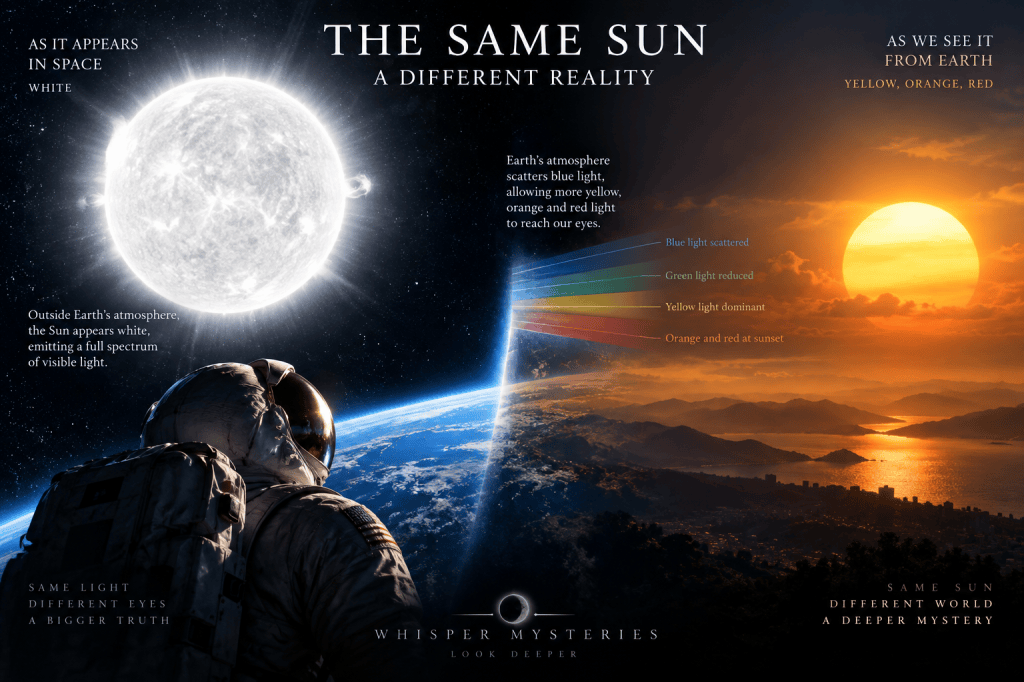
    The Sun, viewed from space under appropriate protection, does not look like the golden disk most of us imagine.

    It appears essentially white.

    NASA solar physicists have addressed this seemingly trivial question directly, explaining that an observer above Earth’s atmosphere, viewing the Sun through proper protective equipment, would perceive it as white because it emits strongly throughout the visible spectrum rather than producing only the wavelengths we associate with yellow.

    The disturbing part is not that generations of children have chosen the wrong crayon.

    The disturbing part is that the object responsible for nearly every naturally illuminated thing we have ever seen has been standing in front of us throughout our entire lives, while Earth’s atmosphere and our own visual system have quietly altered the experience before consciousness receives it.

    And the Sun is only the beginning.


    The White Star We Learned to Paint Yellow

    Sunlight appears deceptively simple because the human eye experiences it as a unified brightness, yet when sunlight passes through a prism it separates into the familiar sequence of violet, blue, green, yellow, orange and red, revealing that what we call white sunlight is actually a combination of many visible wavelengths.

    NASA describes visible sunlight as extending approximately from 400 to 700 nanometers, although the Sun itself produces radiation far beyond the limits of human sight, including infrared, ultraviolet, X-rays and other regions of the electromagnetic spectrum that surround us without ever becoming part of our conscious visual world.

    This immediately creates a fascinating problem with the question What color is the Sun?, because color is not simply a substance carried by an object in the way that mass or electrical charge is a physical property. Light arrives with particular wavelengths and intensities, photoreceptors in the retina respond to portions of that radiation, neural circuits compare those responses, and the brain eventually constructs the experience that we call red, blue, green, yellow or white.

    In other words, somewhere between the surface of the Sun and the experience occurring inside your consciousness, physics becomes perception.

    The Sun’s photosphere has an effective temperature of roughly 5,800 kelvin and radiates energy across a broad spectrum, with substantial emission throughout the wavelengths detectable by the human eye. Astronomers classify the Sun as a G2V main-sequence star, sometimes popularly described as a yellow dwarf or yellow-white star, but this astronomical classification should not be confused with saying that a human observer in space would see a distinctly yellow sphere.

    That distinction is small enough to sound technical, yet large enough to overturn one of the most familiar images in human culture.


    But Doesn’t the Sun Emit Most Strongly in Green?

    Here the story becomes even stranger, because an often repeated explanation says that the Sun’s spectrum peaks somewhere around the green portion of visible light, which naturally raises another question: if the Sun is not yellow, should it actually be green?

    The answer is also no, and the reason reveals how misleading it can be to reduce a complicated spectrum to a single color.

    When scientists plot solar radiation according to energy per unit wavelength, the distribution reaches a maximum around the visible region near green wavelengths, but the curve is extremely broad, meaning that large amounts of red, orange, yellow and blue light are being emitted at the same time. The three principal classes of cone photoreceptors involved in normal human color vision therefore receive strong stimulation together, and the combined percept is close to white rather than saturated green. NASA specifically notes that although solar emission is strong in the green region, it remains strong across the visible spectrum, allowing the brain to integrate the signals into white.

    There is another subtle complication that makes the story even more interesting: the apparent location and shape of a spectral peak depend partly upon what is being plotted, whether energy per wavelength interval, energy per frequency interval or the number of photons arriving at different wavelengths. NASA notes that when the solar spectrum is considered in terms of photon flux rather than energy alone, the visible distribution becomes flatter and the perceptual interpretation changes somewhat.

    So even the seemingly innocent statement that the Sun peaks at one particular color can become misleading unless we first ask exactly what measurement is being used.

    Nature rarely owes us the simplicity of our diagrams.


    Earth’s Atmosphere Is Editing the Sun Before You See It

    If the Sun’s visible light is essentially white, why has humanity so consistently experienced it as yellow, orange or red?

    Part of the answer floats invisibly between us and space.

    Earth’s atmosphere is not a perfectly transparent window through which an untouched universe reaches our eyes, because molecules and particles scatter different wavelengths of incoming sunlight with different efficiencies. Shorter visible wavelengths, particularly blue and violet, are scattered far more strongly by atmospheric molecules than longer wavelengths, a process commonly associated with Rayleigh scattering.

    This is one reason the sky appears blue.

    NOAA explains that blue light is scattered throughout the atmosphere more strongly than the longer wavelengths, while much of the remaining sunlight continues more directly toward the observer.

    The paradox is beautiful: the blue sky and the warmer-looking Sun are parts of the same optical story.

    Some of the shorter-wavelength light is removed from the direct solar beam and scattered across the sky, which can give direct sunlight viewed from Earth’s surface a warmer tint than it would have outside the atmosphere. When the Sun approaches the horizon, the effect becomes much stronger because its light must travel through a considerably longer path within the atmosphere before reaching the observer, allowing still more of the shorter wavelengths to be scattered away while red and orange wavelengths become increasingly dominant in the direct beam.

    That enormous blood-red Sun sinking into the sea is therefore not evidence that the star itself has suddenly changed color.

    It is evidence that the medium between the star and the observer has changed the light that finally arrives.

    And this has a profound implication that extends well beyond astronomy: what you perceive depends not only upon the object being observed, but also upon everything standing between that object and you.


    Sunrise and Sunset Are Natural Optical Illusions

    Imagine two people observing exactly the same Sun at approximately the same moment, one from Earth’s surface during a deep orange sunset and another from orbit above much of the atmosphere.

    Their descriptions of its color could be very different even though the Sun itself has not undergone any corresponding transformation.

    The observer on Earth is looking through a long corridor of atmospheric gases, aerosols, dust and sometimes water droplets, while the orbital observer encounters a very different optical path. NOAA notes that at sunrise and sunset the increased distance traveled through the atmosphere allows scattering processes to become far more pronounced, particularly when aerosols or other particles are present.

    This means that some of the most dramatic colors we associate with the Sun actually tell us as much about Earth as they do about the star.

    A volcanic eruption, desert dust, smoke, pollution or unusual atmospheric conditions can alter the spectral composition reaching an observer and produce sunsets of astonishing intensity, while the nuclear furnace approximately 150 million kilometers away continues producing its radiation without caring whether a human standing on a beach describes it as golden, crimson or white.

    The sunset is real, but its color is relational rather than absolute.

    That distinction matters.


    The Hidden Barcodes Inside Sunlight

    There is another secret inside white sunlight that the naked eye normally cannot see, and it is one of the most beautiful chapters in the history of astronomy.

    When solar light is dispersed with sufficient precision, the resulting rainbow is not perfectly continuous. Thousands of darker features cross the spectrum at particular wavelengths, creating what appear almost like thin scars or barcodes embedded inside the light.

    These are spectral absorption lines, historically associated with the work of Joseph von Fraunhofer, and their patterns provide information about the chemical elements interacting with radiation in the Sun’s atmosphere.

    Suddenly, sunlight is no longer simply illumination.

    It becomes a message.

    Different atoms interact with specific wavelengths according to their atomic structure, meaning that astronomers can use spectral lines to identify substances in objects that no human being could ever physically reach. Long before spacecraft existed, scientists learned to read the chemistry of the heavens from patterns hidden inside beams of light.

    Perhaps the most extraordinary example involves helium.

    During the solar eclipse of 1868, observations of the Sun’s spectrum revealed a spectral feature that could not initially be matched to a known terrestrial element, contributing to the identification of a previously unknown element that became known as helium, its name derived from Helios, the Greek Sun. ESA notes that helium was detected through the solar spectrum before it was later identified on Earth.

    Consider what that means.

    Human beings discovered a chemical element in the Sun before recognizing it on their own planet.

    A distant star had revealed part of the periodic table through light.


    The Sun in NASA Photographs Is Often Not the Color You Think

    There is another layer of confusion created by modern imagery, because many of the spectacular pictures of the Sun circulating online show an enormous orange, crimson, blue, violet or electric green sphere filled with looping arcs and violent eruptions.

    Those images are real scientific observations, but their colors do not necessarily represent what the human eye would see.

    NASA’s Solar Dynamics Observatory examines the Sun at multiple wavelengths, including forms of ultraviolet radiation invisible to human vision, and scientists assign visible colors to those datasets so that different wavelengths, temperatures and structures can be distinguished by the eye. NASA explicitly explains that these color assignments allow information our eyes cannot naturally perceive to become visually interpretable.

    A red solar image may therefore represent one wavelength range, while a green or blue image represents another, and the strange landscape revealed by ultraviolet instruments contains structures that could remain completely invisible to an unaided human observer.

    This produces one of the great paradoxes of modern astronomy: sometimes scientists must create an artificial visible color in order to reveal something physically real.

    The color may be translated.

    The phenomenon is not.


    The Universe Contains More Light Than Your Eyes Will Ever See

    Human vision occupies only a narrow window within the electromagnetic spectrum, which means that the universe surrounding us contains enormous amounts of radiation to which our eyes are completely blind.

    The Sun emits infrared radiation beyond the red limit of human vision and ultraviolet radiation beyond violet, while its energetic atmosphere also produces radiation at wavelengths such as extreme ultraviolet and X-rays, allowing specialized instruments to reveal magnetic structures and temperatures that ordinary visible-light observation cannot expose.

    If human beings had evolved different photoreceptors, our subjective universe could have looked dramatically different.

    Flowers might display patterns invisible to us today, the sky might possess unfamiliar contrasts, thermal radiation could conceivably become part of visual experience, and the Sun might occupy a very different perceptual category.

    The cosmos would not have changed.

    The observer would have changed.

    This distinction leads directly toward one of the deepest questions in neuroscience and philosophy: when we say that something has a color, are we describing the external world itself, or the way a biological nervous system translates information from that world?


    Your Eyes Do Not Simply Record Color

    It is tempting to imagine the eye as a biological camera transmitting a miniature photograph to the brain, yet vision does not operate so simply.

    Color perception depends upon specialized cone photoreceptors in the retina and subsequent neural processing, with the human visual system comparing signals rather than merely assigning a fixed color to each incoming wavelength. Neuroscience research describes three cone classes as the basis of normal trichromatic vision and shows that later retinal and cortical processing contributes to opponent color mechanisms, local contrast and the construction of color appearance.

    Even more remarkable is the phenomenon known as color constancy.

    A white object can remain subjectively white whether it is illuminated by relatively bluish daylight or warmer artificial illumination, even though the exact wavelengths entering the eye may have changed substantially. Researchers studying color constancy describe perception as a process in which the visual system uses contextual information to maintain relatively stable object colors despite changing illumination.

    Your brain is therefore not passively receiving color.

    It is interpreting circumstances.

    It estimates illumination, compares surrounding surfaces, evaluates relationships between signals and produces a stable perceptual world that is useful for survival.

    That world feels immediate because the computation happens before you become consciously aware of it.


    The Color You See Exists Somewhere Between the Sun and Your Mind

    This does not mean that reality is imaginary, nor does it mean that physical objects exist only because we observe them, which would be an unjustified leap from neuroscience into metaphysics.

    What it means is more subtle and, in some ways, more unsettling.

    There is an external physical world in which electromagnetic radiation possesses measurable wavelengths and energy, but the subjective experience called yellow does not simply travel through space as a tiny parcel of yellowness waiting to enter the eye. Instead, light interacts with matter, photoreceptors respond according to their biological properties, neural systems compare those responses, and consciousness experiences the result as color.

    Recent research continues to emphasize that color is produced by the visual system from the light reflected or emitted by objects and from the context in which that light appears.

    The yellow Sun of childhood therefore exists in a curious territory between astronomy, atmosphere, biology, culture and memory.

    It is not entirely false.

    But neither is it simply the intrinsic color of the star.


    Why Did Humanity Make the Sun Yellow?

    Once the physical explanation is understood, another mystery remains, although this one belongs partly to psychology and culture rather than astrophysics.

    Why do children across many cultures so naturally draw the Sun as yellow?

    One possible explanation is straightforward: viewed from Earth’s surface, particularly when it is lower in the sky or softened by haze and clouds, the Sun frequently does acquire a yellowish or orange appearance, while the surrounding sky provides a powerful blue contrast that makes yellow an intuitive artistic choice.

    Another influence may come from the way pigments and screens represent brightness. A truly white circle on white paper disappears, whereas yellow immediately distinguishes the Sun from its background. Over generations, representation becomes convention, convention becomes expectation, and expectation eventually feels like observation.

    We begin by painting what we think we see.

    Later, we may begin seeing what we have learned to paint.


    Even the Name “Yellow Dwarf” Can Mislead Us

    Anyone researching the subject will quickly encounter another apparent contradiction because the Sun is routinely called a yellow dwarf.

    Does that not prove that it is yellow after all?

    Not quite.

    Astronomical color terminology emerged partly from spectral classification, temperature and comparative stellar appearance, rather than from the simplistic palette used in children’s drawings. NASA describes the Sun as a G2V star and elsewhere refers to this spectral category as yellow-white, while NASA’s SOHO material directly answers the color question by describing the Sun as white.

    Both statements can coexist because they belong to different descriptive contexts.

    Scientific language often becomes misleading when technical classifications are removed from the systems in which they were created.

    The phrase yellow dwarf sounds simple.

    The physics behind it is not.


    Perhaps We Have Never Seen Anything “Exactly as It Is”

    The mystery of the Sun’s color eventually leads to a much larger question, because precisely the same principle applies, in different ways, to almost everything we see.

    Every face, tree, building, ocean and star enters conscious experience only after light has interacted with matter, traveled through an environment, passed through the optics of the eye, stimulated photoreceptors and undergone extensive neural processing.

    What arrives in consciousness is therefore not an untouched copy of the external world.

    It is a biological reconstruction constrained by the external world.

    This distinction is important because saying that perception is constructed does not mean that anything can be true or that reality is arbitrary. The wavelengths can be measured, the atmospheric scattering can be calculated, solar spectra can be recorded by independent instruments, and predictions derived from these measurements repeatedly work.

    Yet our experience of those measurements belongs to another layer.

    Physics describes radiation.

    Neuroscience describes processing.

    Consciousness experiences color.

    And somewhere among those three levels lies the world each of us believes we simply “see.”

    Research into individual differences in color vision adds another intriguing layer, because genetic and neural variations mean that human observers do not necessarily experience every color in precisely identical ways, even when looking at the same physical stimulus.

    We share a world.

    We do not necessarily share an identical perceptual rendering of it.


    The Star Hidden in Plain Sight

    Perhaps this is why the question of the Sun’s color is more profound than it first appears.

    For thousands of years, humanity has watched the same star rise above temples, battlefields, oceans, deserts and cities, while civilizations worshipped it, measured time by it, painted it, feared eclipses of it and eventually sent machines into space to study it.

    Yet even after all that familiarity, a childlike question can still reveal something unexpected.

    The Sun is not simply the yellow circle we inherited from drawings, nor is it accurately represented by every red and orange astronomical image appearing on our screens. Its visible radiation is broadly distributed across the colors our eyes can detect, the combination is perceived as essentially white outside Earth’s atmosphere, atmospheric scattering modifies what reaches observers on the ground, and the nervous system performs another transformation before the final experience emerges in consciousness.

    Perhaps the strangest discovery is therefore not that we misunderstood the color of the Sun.

    It is that seeing was never as simple as we assumed.

    The universe sends radiation toward us, the atmosphere filters it, our eyes sample only a tiny portion of it, and our brain silently constructs a coherent visual world from incomplete information, while consciousness receives the finished result and calls it reality.

    The yellow Sun may therefore serve as a small crack in an enormous wall.

    Once you notice that crack, a far more unsettling question appears behind it:

    If something as familiar as the Sun is not experienced exactly as it physically exists, how much of the world around us have we mistaken for reality itself when we are actually experiencing reality translated through the limits of the human mind?


    A Note on Observing the Sun

    The ideas discussed here should never be tested by staring directly at the Sun. Except during the brief total phase of a total solar eclipse, direct observation requires appropriate solar-viewing protection, and ordinary sunglasses are not sufficient; telescopes, binoculars and cameras also require properly designed solar filters. NASA warns that unprotected direct viewing can cause severe eye injury.

    Sources and Further Reading

    NASA Goddard Space Flight Center — What Color Is the Sun?

    NASA Science / SOHO — Solar color, spectral classification and solar observations.

    NASA Scientific Visualization Studio — Why Does NASA Observe the Sun in Different Colors?

    NASA Space Place / NOAA — Atmospheric scattering and the blue sky.

    NOAA Global Monitoring Laboratory — Rayleigh scattering, aerosols and red sunsets.

    European Space Agency — Solar spectroscopy and the discovery of helium.

    National Library of Medicine / PubMed — Research on color perception, retinal processing and color constancy.

    Annual Review of Vision Science — Research on color perception, objects and perceptual constancy.

    If even the Sun is not exactly as we perceive it, what else about reality have we misunderstood? Discover a deeper exploration in Matrix — The Hidden Truth: Who Controls Reality?

  • Alfred Nobel:The Inventor of Dynamite and the Tragic Story Behind the Nobel Prize

    Discover the remarkable life of Alfred Nobel,the Inventor of Dynamite,whose personal tragedies inspired the creation of the world-famous Nobel Prize.

    History remembers Alfred Nobel as the founder of the Nobel Prize, the world’s most prestigious award for science, literature, and peace. Yet behind this celebrated name stood a man whose life was marked by danger, personal tragedy, and relentless determination. The irony remains striking: the inventor whose discoveries revolutionized explosives ultimately chose to dedicate his fortune to honoring those who benefited humanity.”My home is where I work, and I work everywhere.” With these words, Alfred Nobel expressed his belief that science belonged to no nation, but to all mankind.Born in Stockholm on October 21, 1833, Nobel grew up under the influence of his father, Immanuel Nobel, an engineer and inventor deeply involved in the study of explosive substances. At a time when chemistry still held many dangerous mysteries, the Nobel family lived on the frontier between innovation and catastrophe. Alfred received his first formal education in St. Petersburg, where his father’s business had prospered, before being sent abroad at the age of seventeen to study mechanical engineering in New York. There he spent four formative years learning from the renowned Swedish-American engineer John Ericsson, whose military inventions had already earned international fame.The young inventor quickly demonstrated an exceptional talent for chemistry and engineering. In 1863, he patented a mixture of gunpowder and nitroglycerin, although the invention attracted little commercial interest. His truly revolutionary breakthrough came soon afterward, when he solved one of the greatest challenges surrounding nitroglycerin.Unlike conventional explosives, nitroglycerin could not simply be ignited with a burning fuse. The oily liquid burned harmlessly when exposed to flame, refusing to detonate unless subjected to a sudden and violent shock. Nobel concluded that only an instantaneous release of energy within the liquid itself could unleash its devastating power. From this insight emerged one of the most important inventions in the history of explosives: the mercury blasting cap, a device that transformed the practical use of high explosives and changed mining, engineering, and military technology forever.The significance of the invention attracted the attention of Emperor Napoleon III of France, who helped Nobel obtain financial support of 10,000 francs to establish a factory at Heleneborg, near Stockholm. There, father and sons resumed their dangerous experiments with nitroglycerin, fully aware that each day carried the possibility of disaster.Disaster arrived on September 3, 1864.A massive explosion destroyed the factory in an instant, killing several workers, including Alfred’s youngest brother, Emil Nobel. The tragedy devastated the family. Within a year, Alfred’s father died, his health broken by grief, while the Swedish authorities forbade the construction of another nitroglycerin factory on land.Many would have abandoned such perilous research. Alfred Nobel refused.Forced to continue his experiments on a floating laboratory anchored on Lake Mälaren, he worked almost as an exile, moving from shore to shore as local communities rejected the dangerous enterprise. The laboratory became a symbol of his isolation—an inventor carrying both extraordinary ambition and the weight of repeated catastrophe.It was during this period that Nobel made the discovery that would secure his place in history.He found that a soft, porous mineral known as kieselguhr, composed largely of the fossilized skeletons of microscopic algae called diatoms, possessed an extraordinary property: it could absorb several times its own weight in nitroglycerin. The resulting paste remained remarkably powerful while becoming far safer to transport and handle than liquid nitroglycerin itself.Nobel gave his invention a simple name that would soon become known throughout the world:Dynamite.The invention transformed industries. Railways crossed mountains, tunnels pierced solid rock, mines expanded deeper into the earth, and vast engineering projects became possible on a scale previously unimaginable. Yet the same invention also found military applications, creating a contradiction that would haunt Nobel for the rest of his life.Perhaps no inventor has lived with such a profound paradox. His discoveries accelerated human progress while simultaneously increasing humanity’s capacity for destruction. That inner conflict would eventually shape one of history’s greatest acts of philanthropy.When Alfred Nobel died in 1896, he shocked the world by leaving the overwhelming majority of his immense fortune to establish annual prizes honoring achievements in Physics, Chemistry, Physiology or Medicine, Literature, and Peace. It was as though the man who had spent a lifetime mastering explosive force wished his final legacy to celebrate knowledge, creativity, and reconciliation rather than conflict.Today, the Nobel Prize is remembered far more vividly than dynamite itself. Yet without the hardships, failures, personal losses, and relentless perseverance that defined Alfred Nobel’s extraordinary life, neither would ever have existed. His story remains one of history’s most compelling reminders that the greatest inventions often emerge from tragedy—and that even those associated with destruction can ultimately choose to leave behind a legacy dedicated to humanity’s highest ideals.