Category: Forbidden Books & Lost Knowledge

  • Picatrix: The Secret Almost No One Notices

    Liber Juratus Honorii (The Sworn Book of Honorius) is one of the best-known medieval grimoires. The manuscript Royal MS 17 A XLII, preserved at the British Library, dates from the 15th century.
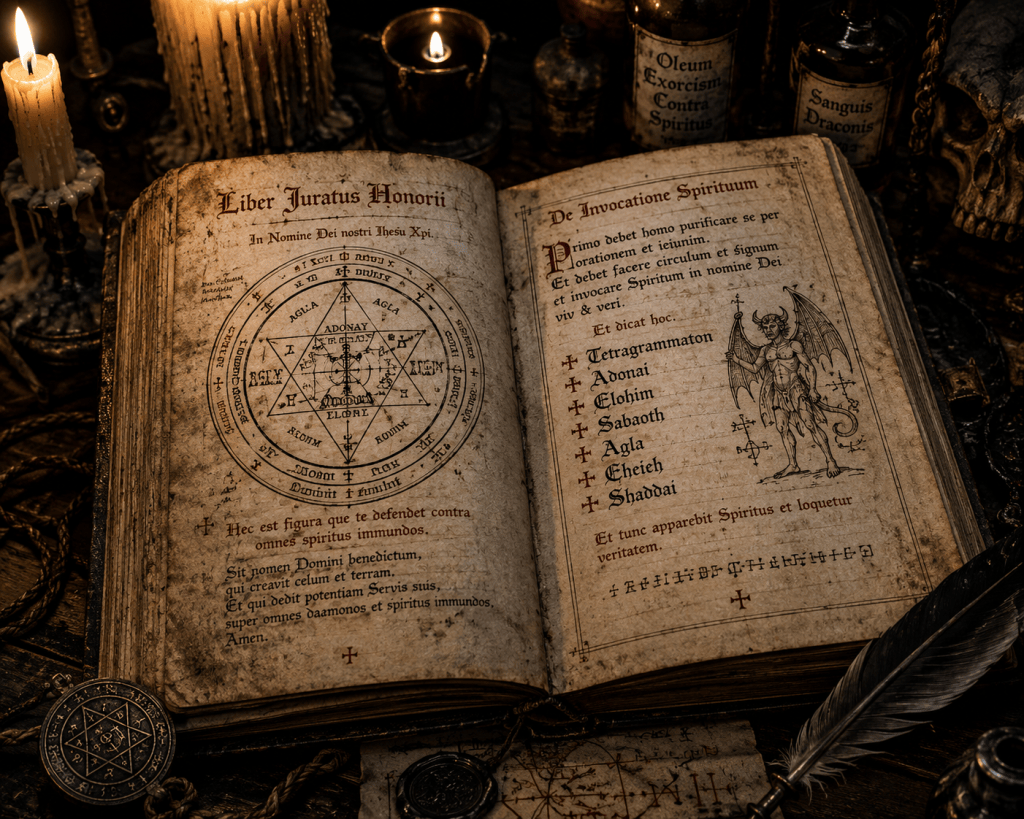
    Most articles about the Picatrix describe it as a medieval grimoire filled with talismans, astrology, and mysterious rituals. But the true mystery of this legendary book is not hidden in its rituals.

    It is hidden between the lines.

    Few people know that the author claims to have studied more than 200 books before compiling the work. In other words, the Picatrix is not an isolated creation but a remarkable collection of knowledge drawn from Greek, Egyptian, Persian, and Arabic traditions, carefully woven into a single manuscript.

    But there is an even more intriguing detail.

    When historians compare the text with its sources, they find that many of its ideas do not come from other grimoires at all. Instead, they trace back to an unexpected work known as The Nabataean Agriculture—a book about farming, seasonal cycles, plants, and the rhythms of nature. In the Picatrix, these observations are transformed into a broader vision in which the heavens, time, and the natural world are seen as parts of one interconnected system.

    This may be the greatest secret of the Picatrix.

    The book is not simply about magic. It presents a philosophy of the universe in which human beings, the stars, the earth, and the changing seasons all belong to the same cosmic order. During the Middle Ages, this was understood as a way of explaining how the universe itself functioned.

    Perhaps this is why the Picatrix had such a profound influence during the Renaissance. Philosophers and scholars were fascinated not only by its mysterious reputation but also by its ambitious attempt to unite astronomy, philosophy, symbolism, and the natural world into a single vision of reality.

    Today, many readers search the Picatrix  hoping to discover forgotten rituals or hidden formulas. Yet its greatest lesson may be something far more enduring: the belief that nature is not a collection of separate objects but a web of relationships, patterns, and correspondences.

    Whether we see this as medieval philosophy, intellectual history, or a fascinating cultural artifact, one thing remains certain.

    Nearly a thousand years after it was written, the Picatrix still invites us to ask the same timeless question:

    How much of the universe do we truly understand?
    Fediverse Reactions
  • LIBER JURATUS HONORII

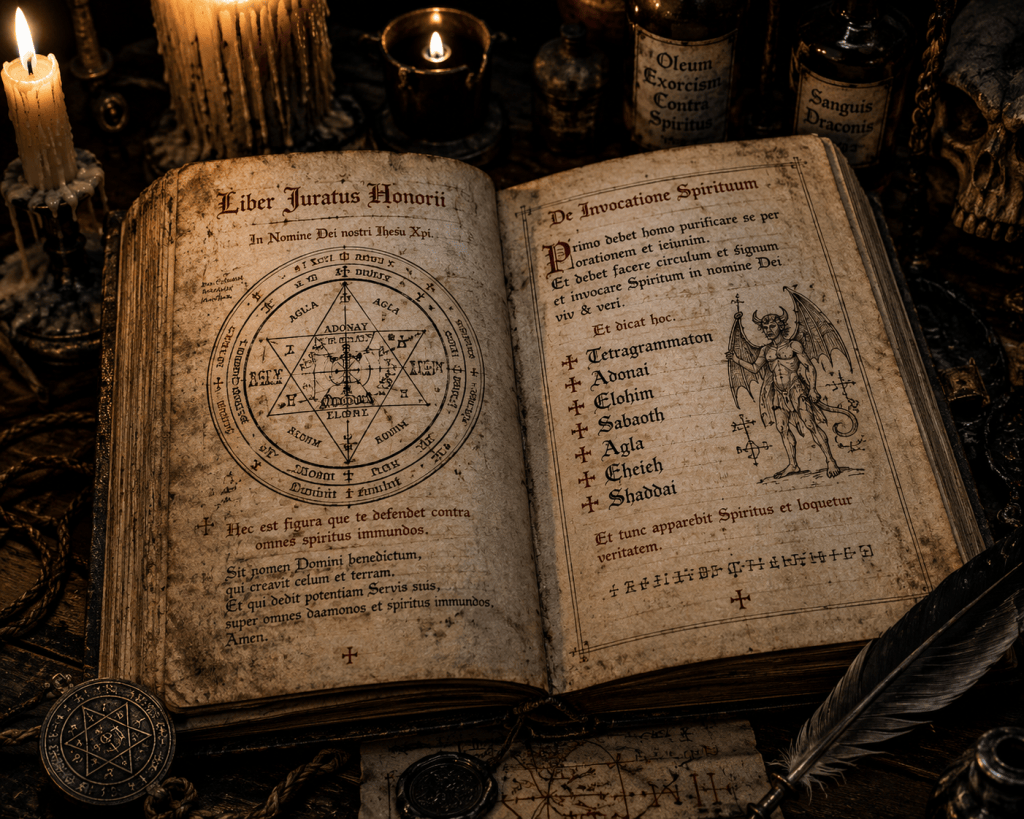
    Liber Juratus Honorii (The Sworn Book of Honorius) is one of the best-known medieval grimoires. The manuscript Royal MS 17 A XLII, preserved at the British Library, dates from the 15th century.

    The Forbidden Book That Was Never Meant for Everyone

    Among the many medieval grimoires that have survived the centuries, few are surrounded by as much mystery as the Liber Juratus, also known as The Sworn Book of Honorius.

    Unlike many famous grimoires, its greatest secret is not hidden in unusual symbols or elaborate diagrams.

    It is hidden in its intended audience.

    The title itself offers the first clue. The word Juratus means “sworn.” According to the introduction preserved in medieval manuscripts, the book was intended only for individuals who had taken a solemn oath to protect its contents. Whether this account reflects historical events or serves as a literary device is uncertain, but it reveals how exceptional and restricted the text was meant to appear.

    This immediately sets the Liber Juratus apart from many other medieval works.

    Rather than presenting knowledge as something anyone could possess, it portrays wisdom as something that required discipline, discretion, and moral responsibility.

    Another fascinating aspect is that the manuscript focuses less on material gain than many later grimoires. Modern readers often expect medieval occult books to revolve around treasure, power, or supernatural control. The Liber Juratus is different.

    Much of its content reflects a search for divine wisdom, contemplation, and a deeper understanding of creation. Historians generally view it as a product of medieval religious and intellectual traditions, where prayer, symbolism, and philosophy were often intertwined.

    One detail that is rarely mentioned is the extraordinary effort required to produce a manuscript like this.

    Every copy was written entirely by hand. Before the invention of the printing press, creating a single manuscript demanded months—sometimes years—of careful work by trained scribes. As a result, no two surviving copies are exactly alike. Differences in wording, additions, omissions, and annotations reveal that the text evolved as it was copied across generations.

    In many ways, each manuscript became a historical document in its own right.

    This is one reason why scholars continue to study the Liber Juratus today. They are not only interested in what the book says but also in how it changed over time, what those changes reveal about medieval Europe, and how ideas traveled across different regions and cultures.

    Perhaps the greatest lesson of the Liber Juratus is not that it contains hidden secrets.

    Its real value lies in showing us how knowledge was regarded nearly eight centuries ago—not as entertainment or instant information, but as something precious, demanding patience, study, and personal responsibility.

    That may be why this remarkable manuscript continues to fascinate historians, collectors, and curious readers today.

    Sometimes, the greatest mystery is not the book itself.

    It is the world that believed such a book was worth protecting with an oath.

    Fediverse Reactions
  • Voinich Manuscript

    The Voynich Manuscript: The Book That Refuses to Be Read


    Some books preserve knowledge.Others preserve stories.
    But one book appears to preserve a secret.
    Hidden today inside Yale University’s Beinecke Library lies a manuscript that has defied scholars, cryptographers, linguists, historians, artificial intelligence, and even some of the greatest codebreakers of the twentieth century.
    For more than six centuries, no one has convincingly read a single sentence from it. Despite countless attempts, the Voynich Manuscript remains silent.Yet perhaps the greatest mystery is not what it says……but whether it was ever meant to be understood.

    A Book Without a Voice

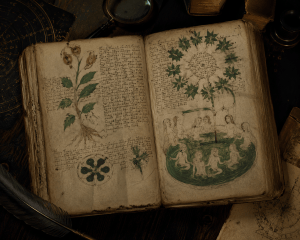
    Radiocarbon dating places the parchment between 1404 and 1438, making the manuscript undeniably medieval. Its pages are filled with elegant illustrations of impossible plants, strange constellations, mysterious circular diagrams, alchemical-looking vessels, and groups of women immersed in interconnected pools of green liquid.

    None of these images fully resemble anything found in known medieval books.The text itself is even stranger.
    Nearly 40,000 words flow across its pages in a beautiful script that resembles a real language. It follows statistical patterns found in genuine human languages, yet no known alphabet matches it. Every proposed translation has eventually collapsed under careful examination.Imagine opening a book that clearly wants to communicate……while refusing every attempt to understand it.


    The Secret Hidden in the Plants


    At first glance, the manuscript appears to be a herbal encyclopedia.Look closer.Most of the plants do not exist.Some resemble familiar herbs, while others seem to combine leaves, roots, and flowers from entirely different species.
    Was the artist inventing imaginary plants?
    Or were these illustrations intentionally altered to conceal real medicinal knowledge?Several historians have suggested that changing botanical details would have been an effective way to hide valuable medical information from outsiders. The reader would need the “key” before recognizing the true plant.Perhaps the illustrations are not mistakes.Perhaps they are camouflage.


    The Women in the Green Water


    One section has fascinated researchers more than any other.Dozens of unclothed women appear connected by intricate tubes and pools, as though flowing through an enormous hidden mechanism. Some scholars believe these represent medieval bathing therapies or women’s medicine. Others argue they symbolize alchemical transformation rather than anatomy.But there is another possibility rarely discussed.What if these women are not human at all?Throughout medieval Europe, sacred springs were believed to be inhabited by spirits capable of healing, revealing visions, or granting forbidden knowledge. Could these strange figures represent beings from forgotten folklore rather than ordinary people?No one knows.

    A Language That Doesn’t Want to Be Broken


    The Voynich Manuscript has attracted some of history’s greatest minds.Professional cryptographers.Military codebreakers.Linguists.Computer scientists.Artificial intelligence.None has produced a translation accepted by the academic world. Even today, the manuscript officially remains unread.That failure has inspired an uncomfortable question.What if we are trying to solve the wrong puzzle?Perhaps the symbols are not letters.Perhaps the illustrations themselves form the true language.Or perhaps the manuscript requires a tradition that disappeared centuries ago—a missing way of reading that vanished with its last keeper.

    The Forgotten Theory


    Among the many theories, one remains strangely overlooked.Suppose the manuscript was never intended for ordinary readers.Imagine a secret circle where every initiate already knew the spoken teachings. The book would then serve only as a memory device—its symbols acting as reminders rather than complete explanations.Without belonging to that tradition, every modern reader would be attempting to read half of a conversation.The other half would already be lost.

    A Door Still Closed


    Every generation believes it will finally solve the Voynich Manuscript.

    Every generation leaves with more questions than answers.
    Perhaps one day a forgotten archive will reveal the missing key.
    Perhaps a hidden diary will identify its creator.
    Or perhaps the manuscript was designed to ensure that only those who already possessed the knowledge could ever understand it.

    Until that day arrives, the Voynich Manuscript remains what it has always been:Not simply an unread book……but one of history’s greatest invitations to wonder.

    The secrets of the Voynich Manuscript may never be fully revealed… but your own journey into ancient wisdom can begin today.

    Fediverse Reactions