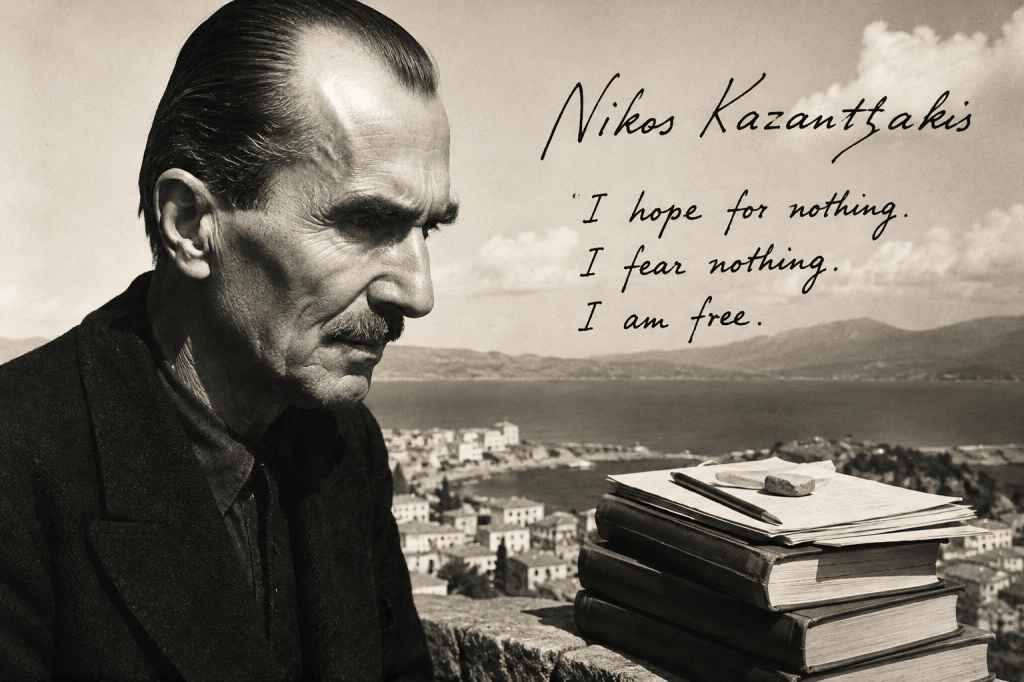
Few modern Greek writers have crossed the borders between literature, philosophy, religion and existential questioning as fearlessly as Nikos Kazantzakis. To many readers around the world, his name is inseparable from Zorba the Greek, the exuberant story that became internationally famous through cinema, yet reducing Kazantzakis to Zorba means overlooking the much more complicated writer behind the novel: a man fascinated by Christ and Nietzsche, by Buddhism and ancient Greece, by revolution and solitude, by the struggle between the body and the spirit, and above all by the question of what a human being should do when certainty disappears.
Born in Crete in 1883 and dying in 1957, Kazantzakis lived during a period of extraordinary political and intellectual upheaval, experiencing wars, revolutions, ideological conflicts and profound transformations in Greek society. His novels emerged from this turbulent world, but they also reached beyond it, repeatedly returning to questions that have no simple historical boundary: whether freedom is worth suffering for, whether faith can survive doubt, whether human beings need God, and whether the search for meaning matters even when no final answer can ever be found.
The result was a body of work that made him one of Greece’s most internationally recognized literary figures while simultaneously making him controversial in his own country.
From Crete to a Much Larger World
Kazantzakis was born in Heraklion, Crete, at a time when the island was still under Ottoman rule, and the atmosphere of resistance, political instability and the struggle for independence left a deep impression on his imagination. Crete would later become far more than a geographical background in his writing; it represented a particular idea of freedom, pride, suffering and defiance that would repeatedly reappear in his fictional characters.
He studied law in Athens before continuing his intellectual formation in Paris, where he encountered the philosophy of Henri Bergson. During his life he traveled extensively, moving through Europe and visiting regions of Asia and the Middle East, while absorbing influences that ranged far beyond the conventional boundaries of Greek literature.
His intellectual world became extraordinarily wide. Christianity fascinated him, although his relationship with institutional religion was complicated and frequently contentious. Nietzsche influenced his understanding of struggle and self-overcoming, while Buddhist thought introduced another vision of liberation from attachment. Ancient Greek philosophy, modern European thought, political revolution and mystical traditions all entered the restless conversation taking place within his work.
Kazantzakis did not seem interested in choosing one comfortable system and remaining inside it. He was interested in what happened when contradictory ideas collided.
Zorba Was Only One Side of Kazantzakis
For millions of readers, the doorway into Kazantzakis remains Zorba the Greek, originally published in Greek in 1946 under a title referring to the life and adventures of Alexis Zorbas.
The novel contrasts two radically different approaches to existence. Its intellectual narrator observes, thinks and questions, while Zorba seems determined to experience life directly, through work, music, desire, food, grief and his famous dance. Their friendship becomes something larger than the story of two men attempting a business venture in Crete; it becomes a confrontation between thought and experience.
This is one reason Zorba has remained such an enduring literary figure. He represents something many people feel they have lost: the ability to inhabit life rather than continually analyze it.
The internationally celebrated film adaptation directed by Michael Cacoyannis, starring Anthony Quinn as Zorba, transformed the character into a cultural icon and helped carry Kazantzakis’s name to audiences far beyond Greece. The Nikos Kazantzakis Museum still uses the novel and Cacoyannis’s adaptation in its educational work devoted to the writer’s characters and ideas.
Kazantzakis Museum Educational Actions
Yet Zorba’s exuberance represents only one current within Kazantzakis. Elsewhere, the writer entered much darker and more dangerous intellectual territory.
The Last Temptation of Christ and the Scandal of a Human Jesus
Few of Kazantzakis’s books generated more controversy than The Last Temptation of Christ.
His Jesus is not presented simply as a distant figure untouched by ordinary human conflict. Kazantzakis imagines Christ confronting fear, desire, doubt, responsibility and the possibility of another life, thereby making the spiritual victory meaningful precisely because temptation exists.
For Kazantzakis, this tension between flesh and spirit was central to the human condition. The greatness of Christ, within the imaginative world of the novel, does not depend upon the absence of struggle but upon passing through struggle.
That interpretation inevitably provoked religious opposition.
The controversy surrounding the novel eventually became almost as famous as the book itself, and decades later Martin Scorsese’s 1988 film adaptation reignited international disputes over Kazantzakis’s portrayal of Jesus.
Yet describing the novel simply as an attack on Christianity misses much of what makes it interesting. Kazantzakis was deeply preoccupied with spiritual questions throughout his life. His conflict was not necessarily between belief and disbelief, but between the human desire for absolute truth and the impossibility of reaching it without doubt.
His Christ struggles because Kazantzakis’s human beings struggle.
Christ Recrucified: What Happens When Faith Becomes Real?
Another of his major novels, Christ Recrucified, approaches Christianity from a different direction.
In a Greek village, inhabitants preparing to stage a Passion play are assigned the roles of Christ and other biblical figures. What begins as religious representation gradually becomes disturbingly real when refugees arrive seeking assistance and the moral questions of the Gospel cease to be abstract.
The villagers must decide what Christian compassion actually requires when helping others threatens comfort, property and social order.
This is where Kazantzakis becomes particularly uncomfortable for readers who prefer religion to remain safely symbolic. His characters are forced to confront the difference between venerating an ideal and living according to it.
The question underlying the novel is deceptively simple: what would happen if people who claimed to follow Christ were suddenly required to behave like him?
Kazantzakis rarely provides comfortable answers.
Captain Michalis and the Cretan Obsession With Freedom
In Captain Michalis, often published in English as Freedom or Death, Kazantzakis returned intensely to Crete and its struggle against Ottoman rule.
The novel draws upon the historical and emotional landscape of the writer’s childhood, transforming Cretan resistance into a broader exploration of freedom, honor, violence and sacrifice. Kazantzakis’s characters frequently behave as though freedom possesses a value greater than survival itself, an idea deeply connected with the mythology and historical memory of Crete.
This helps explain why his work can feel simultaneously modern and ancient. His protagonists wrestle with twentieth-century philosophical problems, yet they often possess the uncompromising intensity of figures from Greek tragedy.
They are rarely moderate people.
They love excessively, believe excessively, rebel excessively and sometimes destroy themselves because compromise feels more unbearable than suffering.
The Odyssey That Contained 33,333 Verses
Kazantzakis’s ambition extended far beyond the novels for which he is now most famous.
One of his most extraordinary achievements was his enormous poetic work The Odyssey: A Modern Sequel, in which he imagined the adventures of Odysseus continuing after the conclusion of Homer’s epic.
Kazantzakis worked on the poem repeatedly, producing multiple drafts before reaching the final version of 33,333 verses. His Odysseus cannot simply return home and remain there, because the desire to continue searching is stronger than the desire for security.
That idea could almost serve as a metaphor for Kazantzakis himself.
Arrival never seems sufficient.
Every answer produces another question, every belief contains the possibility of rebellion, and every destination eventually becomes another point of departure.
The Writer Who Came Close to the Nobel Prize
Kazantzakis’s international literary reputation was substantial during his lifetime, and his connection with the Nobel Prize is more extensive than popular retellings sometimes suggest.
The official Nobel Prize nomination archive records 14 nominations involving Nikos Kazantzakis between 1947 and 1957. Among his nominators were academics, literary organizations and the Society of Men of Letters of Greece.
Nobel Prize
In 1957, the final year of his life, he was nominated by both Samuel Baud-Bovy of the University of Geneva and the Society of Men of Letters of Greece. The Nobel Prize in Literature that year ultimately went to Albert Camus.
Nobel Prize +1
Kazantzakis never received the prize.
Yet literary history has a strange way of rendering prizes less important with time. The question eventually becomes not who received a particular award in a particular year, but whose books people continue opening generations later.
Kazantzakis survived that test.
God, Freedom and the Endless Struggle
Perhaps the deepest thread connecting Kazantzakis’s apparently different works is the concept of struggle.
His characters struggle against political oppression, social convention, bodily desire, religious certainty, death and themselves. Even when victory appears impossible, the struggle itself can acquire meaning.
This reaches one of its most concentrated forms in The Saviors of God: Spiritual Exercises, a philosophical and spiritual text that attempts to express Kazantzakis’s vision of existence beyond the conventions of the traditional novel.
The world that emerges from his writing is rarely peaceful. Human beings stand between matter and spirit, instinct and aspiration, mortality and the desire to transcend mortality. There is no guarantee that the universe will provide them with an answer.
Kazantzakis nevertheless refuses resignation.
His philosophy repeatedly suggests that dignity may lie not in receiving certainty, but in continuing the ascent despite uncertainty.
A Writer Too Religious for Some and Too Dangerous for Others
One of the fascinating contradictions surrounding Kazantzakis is that he has been interpreted both as profoundly spiritual and as dangerously irreverent.
The contradiction makes sense because he did not treat religion as something fragile that had to be protected from questioning. He entered directly into its most difficult territory, placing sacred figures inside psychological and philosophical conflict and asking what faith means when doubt is taken seriously.
For some readers, this approach appeared offensive.
For others, it made religious questions more meaningful precisely because they were no longer protected from uncertainty.
Kazantzakis’s relationship with Christianity therefore cannot be adequately summarized by simply labeling him believer or unbeliever. His writing reveals something considerably more complicated: a lifelong confrontation with God, transcendence and the limits of human understanding.
He did not walk away from these questions.
He wrestled with them.
Death and the Return to Crete
Kazantzakis died in Freiburg, Germany, on 26 October 1957, following illness after returning from a journey to Asia.
His body was eventually returned to Crete, the island that had shaped so much of his imagination. He was buried on the Martinengo Bastion overlooking Heraklion rather than in an ordinary cemetery.
His tomb became associated with one of the most famous phrases connected with him:
“I hope for nothing. I fear nothing. I am free.”
The words seem almost designed as the final sentence of his intellectual life, bringing together the themes that had pursued him through decades of writing: fear, hope, attachment and freedom.
Today the Nikos Kazantzakis Museum stands in Myrtia, approximately 15 kilometers south of Heraklion, in the ancestral village associated with his family, preserving manuscripts, personal material and the memory of his life and work.
Kazantzakis Museum Educational Actions +1
Why Kazantzakis Still Matters
Kazantzakis belongs to the unusual category of writers whose books can be read as stories while simultaneously opening doors into philosophy.
A reader can encounter Zorba simply as an unforgettable character, but behind him waits a question about whether thinking too much prevents us from living. A reader can approach The Last Temptation of Christ as historical fiction, only to encounter questions about desire, sacrifice and the nature of spiritual victory. Christ Recrucified can be read as a village drama until its characters force us to consider whether moral principles retain their meaning when following them becomes costly.
That is why Kazantzakis has not disappeared into literary history.
His questions remain inconveniently alive.
How much freedom can a person actually bear? Can faith exist without doubt? Is intellectual knowledge enough to make a life meaningful? What should we do when the body wants one thing and the spirit another? And if death ultimately defeats every individual human being, can the struggle to transcend ourselves still possess meaning?
Kazantzakis spent his life moving between countries, philosophies, religions and literary forms without finding — or perhaps without wanting — a comfortable final answer.
In the end, that may be the most important thing to understand about him.
Nikos Kazantzakis was not a writer who wanted to tell his readers what to think.
He wanted to make it impossible for them to stop thinking.
Sources & Further Reading
The Nobel Prize Nomination Archive documents Kazantzakis’s fourteen recorded Nobel nominations between 1947 and 1957 and provides the nominators and years involved.
Nobel Prize +1
The Nikos Kazantzakis Museum in Myrtia, Crete preserves material relating to the writer’s life and work and provides historical and educational resources concerning his novels, travels and intellectual world.

