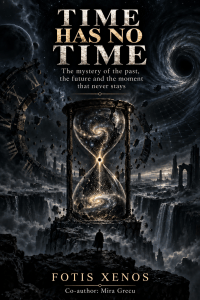
We measure our lives in seconds, hours and years, yet the deeper we look into physics, memory and consciousness, the less obvious time becomes. We experience it as a river moving relentlessly forward, carrying us from childhood toward old age, from memory toward expectation, from what has happened toward what has not happened yet. It feels so natural that questioning it can seem almost absurd.
And yet some of the most unsettling ideas in modern physics begin precisely there: with the possibility that the passage of time may not be as fundamental as it feels.
Perhaps the past has not vanished in the absolute sense we imagine. Perhaps the future is not simply an empty territory waiting to be created. Perhaps what we call the present is only the narrow window through which consciousness encounters a reality far stranger than the ordinary rhythm of clocks allows us to see.
That possibility is where Time Has No Time begins.
The Clock Measures Change, but Does It Measure Time?
A clock never actually captures time itself. It measures repetition and change: the swing of a pendulum, the vibration of a quartz crystal, the oscillation of atoms. We compare one changing process with another and call the relationship between them time.
This works extraordinarily well. Civilizations depend upon it. Trains arrive, satellites synchronize, computers communicate and human lives are organized around carefully divided hours.
But usefulness is not the same thing as understanding.
When Einstein’s theory of relativity overturned the old Newtonian picture of the universe, time ceased to be a universal clock ticking identically everywhere. Two observers moving differently, or experiencing different gravitational conditions, can measure different intervals between the same kinds of events. Time is therefore connected to motion and gravity in a way that ordinary experience hides from us.
The implication is uncomfortable because it undermines something we instinctively assume: that somewhere behind everything there must be one universal present moment.
Physics does not give us such a simple cosmic “now.”
The Strange Problem of the Present
Imagine two events occurring far apart in the universe. Depending on how an observer is moving, the order assigned to some sufficiently separated events can differ. What one observer considers simultaneous may not be simultaneous to another.
This does not mean that anything can happen in any order or that cause can casually follow effect. Relativity preserves strict causal structures. But it does mean that the ordinary human idea of one universal present sweeping across the cosmos becomes difficult to defend.
From this emerged one of the most fascinating ways of thinking about reality: the so-called block universe.
In this interpretation, spacetime can be imagined as a four-dimensional structure in which events we call past, present and future occupy different positions. We experience events sequentially, but the entire spacetime structure does not necessarily “move” from one moment to another.
It is important to be precise here. The block-universe picture is an interpretation associated with relativity, not an experimentally established proof that the future exists in exactly the same way as the present. Philosophers and physicists continue to debate what the mathematics tells us about the nature of reality.
Yet the idea remains extraordinary.
If spacetime is something more like a complete landscape than a river being created moment by moment, what exactly is passing?
Is it time?
Or is it us?
Perhaps Consciousness Creates the Sensation of Flow
Our brains do not perceive the world continuously in some perfectly objective fashion. They collect sensory information, integrate it with memory, anticipate what may happen next and construct a coherent experience from enormous amounts of incomplete information.
The present we experience may therefore already be a biological construction.
You never encounter reality without processing. Light must reach the eye. Signals must travel through neural pathways. The brain must interpret them. What you experience as “now” is already mediated by a nervous system attempting to build a useful model of reality.
Memory then gives that model direction.
We remember what we call the past but not what we call the future, creating one of the strongest psychological arrows of time imaginable. Yesterday contains memories. Tomorrow contains possibilities. The asymmetry feels so obvious that it becomes almost impossible to imagine existence differently.
But the fact that consciousness experiences events sequentially does not automatically prove that the universe itself is being generated sequentially.
The distinction is subtle, yet enormous.
A character reading a novel encounters one page after another. Page 100 appears to lie in the future while the character is on page 20. But from outside the reading process, the entire book already exists.
The analogy should not be mistaken for physics, but it exposes the philosophical problem beautifully: the experience of sequence and the existence of the complete structure are not necessarily the same thing.
Why Can We Remember Yesterday but Not Tomorrow?
If past and future are somehow embedded within spacetime, an immediate question appears: why is our experience so strongly directed toward the past?
One of the most important answers involves entropy, a measure associated with the number of possible microscopic arrangements of a system.
In everyday experience, systems tend to evolve from more ordered states toward states with greater entropy. A glass falls and shatters, but shattered glass does not spontaneously leap from the floor and reconstruct itself. Smoke spreads through a room but does not ordinarily gather itself back into a cigarette.
Many fundamental physical equations do not contain the same obvious distinction between past and future that human experience does, yet thermodynamic processes give our world a strong directional character.
This is often called the arrow of time.
But even here another mystery appears.
Why did the universe begin in a state of sufficiently low entropy for such a pronounced arrow to exist at all?
The question reaches beyond ordinary clocks and into cosmology itself. The direction of time that seems completely self-evident while we are making breakfast may ultimately depend on conditions connected to the earliest history of the universe.
That is a remarkable thought.
The sensation that Tuesday follows Monday may contain an echo of the Big Bang.
Memory Is Not the Past
There is another reason time becomes disturbing when examined closely: memory feels like evidence of the past, yet memory is not the past itself.
Every remembered childhood room, conversation, face and loss exists for us as a reconstruction occurring in the present brain. Memories can change. Details disappear. New information can modify what we believe we remember. Emotion can strengthen one fragment while weakening another.
The past therefore has two very different meanings.
There is the historical past: events that occurred.
And there is the psychological past: the living reconstruction carried inside us.
Human beings rarely separate the two completely.
Perhaps that is why time dominates our emotional lives so powerfully. We are not merely moving through minutes. We are carrying versions of moments that no longer surround us physically but continue to exist within our minds.
Sometimes a smell can collapse thirty years into a second.
A forgotten song can return a person who has been gone for decades.
A familiar street can briefly make adulthood disappear.
For an instant, the calendar loses its authority.
The Future May Be Stranger Than We Think
Humans also live partially in futures that have never happened.
We rehearse conversations before having them. We imagine disasters. We build cities that do not yet exist. We plan journeys, fear illnesses, anticipate reunions and sacrifice the present for lives we hope eventually to inhabit.
The brain is therefore constantly moving between remembered worlds and simulated ones.
In that sense, consciousness already refuses to remain neatly inside the present.
This does not mean that thought literally travels into the future, and there is no scientific basis for turning such ideas into easy claims about prophecy or mystical time travel. Something subtler is happening.
The mind evolved to model what might happen next.
We survive partly because we can mentally enter possible futures before reality reaches them.
And that creates another unsettling question.
How much of what we call “the present” do we actually inhabit?
What Happens to Free Will?
Whenever the block-universe idea appears, one question almost immediately follows.
If future events somehow belong to the structure of spacetime, are our choices already fixed?
There is no universally accepted answer.
Some philosophers argue that a complete spacetime structure can coexist with meaningful human choice because our decisions are themselves part of that structure. Others defend more open views of the future. Quantum mechanics introduces additional complexity, although it does not provide the simple escape from determinism that popular accounts sometimes suggest.
The argument remains unresolved because free will is not merely a physics problem. It touches philosophy, neuroscience and even the definition of what a decision actually is.
Yet perhaps the most interesting question is not whether the future has already been “written.”
Perhaps it is whether we have misunderstood what writing means.
Your decision tomorrow would not necessarily be something imposed upon you from outside. It would still be your decision, produced by your mind, your history, your circumstances and whatever freedom human beings genuinely possess.
The strange possibility is that an event can be completely real within spacetime without becoming meaningless.
And What If Time Is Not Fundamental at All?
Some approaches to fundamental physics go even further and explore whether time itself may emerge from deeper relationships rather than existing as a basic ingredient of reality.
This remains an active and highly theoretical area. There is no established scientific conclusion that “time does not exist,” despite how often that phrase appears in popular headlines.
But the fact that serious physics can even entertain models in which familiar time is not fundamental tells us something important.
Our everyday experience may represent only one level of reality.
Temperature feels fundamental when we touch something hot, yet temperature emerges from the collective behavior of enormous numbers of particles. Solidity feels absolute, even though matter at microscopic scales is nothing like the continuous substance our senses report.
Time may eventually prove to have a similar story.
What feels like the deepest background of existence might itself arise from something deeper.
The Question Behind Time Has No Time
The purpose of Time Has No Time is not to pretend that science has solved the mystery.
Quite the opposite.
The mystery becomes larger when we discover what science actually says.
The more carefully we examine time, the harder it becomes to maintain the simple picture of an invisible river flowing uniformly from yesterday into tomorrow. Relativity complicates the universal present. Thermodynamics raises questions about direction. Neuroscience reveals how deeply perception depends upon the brain. Philosophy challenges what we mean when we say that something “exists.”
And somewhere inside all of this is the human being, looking at a clock and believing that its hands are measuring something we fully understand.
Perhaps they are not.
Perhaps they are measuring the rhythm of our movement through a reality whose deeper architecture remains hidden.
And perhaps the strangest possibility is not that time eventually ends.
It is that the thing we have been calling time was never quite what we thought it was.
TIME HAS NO TIME
Are you prepared to stand face to face with your own past, your imagined future and the possibility that neither is as distant as it seems?
Enter a journey through time, consciousness, reality and the questions that begin where the clock stops providing answers.
What if time does not pass at all… then what is actually passing?
Look at the clock.
The seconds move.
The day ends.
People grow older.
The past seems lost, while the future appears not to exist yet.
But what if this is only the version of reality that our minds are capable of perceiving?
What if time does not flow at all?
What if the past has never disappeared?
What if the future already has a place within the structure of the Universe?
What if the present — that elusive “now” we consider the only truly real moment — is merely a fragile construction of consciousness?
TIME HAS NO TIME -enters one of the most disturbing mysteries of existence: time itself.
From Chronos, Kairos, and ancient ideas of eternity to Einstein and relativity, from the Block Universe and time dilation to entropy, the butterfly effect, and the paradoxes of time travel, the book follows a question that becomes increasingly unsettling the further you go:Is time something that exists within the Universe… or something the mind creates in order to understand the Universe?
And then things become even stranger.Memory does not preserve the past like a perfect recording — it reconstructs it.
The brain does not perceive reality instantaneously — it assembles what we experience as the present.Relativity tells us that there is no single cosmic clock ticking identically for every observer.
And that leads to a question very few people dare to follow all the way to its consequences:If there is no universal “now,” where is the past?
Where does the future begin?
And where are you within this structure?
The book moves deeper, into territories where physics meets philosophy and consciousness: déjà vu, the Mandela Effect, dreams in which time behaves impossibly, free will in a universe where the future may already have a place, death, eternity, and finally the radical question that closes the circle:
What if time does not exist at all in the way we think it does?
This is not a book that tells you what to believe.It is a book that destroys the comfort of certainty.For readers who are not satisfied with simple answers.
For those fascinated by physics, philosophy, consciousness, and the hidden architecture of reality.
For minds willing to accept that sometimes the most disturbing discovery is not the answer……but the possibility that we have been asking the wrong question from the beginning.
TIME HAS NO TIME
The Mystery of the Past, the Future, and the Moment That Never Stays
There are wars that begin over borders, religion, dynasties, resources or political ambition, and then there is the peculiar Australian episode of 1932, when armed soldiers carrying Lewis machine guns were sent into the wheat-growing country of Western Australia to deal with an enemy that had no government, no commander, no territorial demands and, as far as anyone could tell, absolutely no respect for military authority. The enemy was the emu. Large, fast, remarkably difficult to intimidate and apparently unimpressed by the technological achievements of Homo sapiens, thousands of these flightless birds had wandered into farming districts looking for food and water, trampling crops and damaging fences along the way. The farmers were desperate, the government became involved, the military arrived, machine guns were prepared, and what followed entered Australian folklore under the irresistible name The Great Emu War. It was not technically a war, of course. No declaration of hostilities was delivered to an emu ambassador, and no peace treaty was eventually signed beneath a eucalyptus tree. It was a military wildlife-control operation. Yet once you read what actually happened, calling it a war somehow feels entirely appropriate, particularly because the humans possessed the machine guns while the emus possessed, among other useful qualities, the ability to run away. And for a while, running away proved surprisingly effective. The Problem Began With Wheat, Drought and About 20,000 Uninvited Guests Western Australia in the early 1930s was not an easy place to be a farmer. Australia was suffering through the economic pressures of the Great Depression, and many of the men trying to make a living from the land were veterans of the First World War who had settled on farms under government-supported settlement schemes. Then came the emus. After breeding inland, large numbers of birds migrated toward the coast, as they naturally did in search of food and water. Unfortunately for the farmers around places such as Campion and Walgoolan, their wheat fields looked less like private agricultural property and more like an enormous complimentary buffet. Estimates commonly put the number of emus moving into the farming district at around 20,000. The birds ate crops, flattened plants and pushed through fences, sometimes leaving openings through which rabbits could enter as well. For farmers already struggling economically, watching several enormous birds stroll through a wheat field with the confidence of landowners inspecting their estate was not especially amusing. The farmers wanted help. Some of them were former soldiers, and a rather logical idea emerged: if ordinary methods were failing and there were thousands of birds, perhaps machine guns could solve the problem. On paper, this probably looked wonderfully efficient. History was about to demonstrate the danger of making plans on paper when your opponent can run at roughly 50 kilometres per hour. Enter Major Meredith and the Lewis Guns The Australian government approved military assistance under Defence Minister Sir George Pearce, whose political and defence career is well documented in the collections of the Australian War Memories
The operation was placed under the command of Major G. P. W. Meredith of the Royal Australian Artillery. He was accompanied by soldiers equipped with two Lewis machine guns and thousands of rounds of ammunition. The plan was beautifully simple. Find emus. Point machine guns at emus. Fire. Problem solved. Unfortunately, nobody had explained the plan to the emus. The operation began in early November 1932, after rain had delayed the soldiers’ arrival. Almost immediately, one fundamental difficulty became obvious: an emu is not a military formation. It does not politely advance in a straight line toward a machine-gun position while somebody gives the order to fire. Emus scatter. And they scatter extremely well. The First Battle Did Not Go According to Plan When soldiers encountered groups of birds, the emus tended to break apart and run in different directions, making them frustratingly difficult targets. Attempts to approach closely enough for concentrated machine-gun fire frequently ended with the birds simply moving away. Then came one of the most famous episodes of the campaign. Near a dam, Meredith’s men encountered a large concentration of emus and decided that this was finally their opportunity. Instead of wasting ammunition on scattered individuals, they would wait until the birds were within effective range and then unleash the Lewis gun. Hundreds of emus approached. The soldiers waited. The birds came closer. This was it. The machine gun opened fire — and after only a brief burst, it jammed. One can only imagine the silence. The emus dispersed. Somewhere in Western Australia, natural selection was having an excellent afternoon. The Army Tried Putting a Machine Gun on a Truck At some point during the operation, someone had another idea that must have sounded magnificent before anyone actually attempted it. Mount a machine gun on a truck. Chase the emus. Shoot while moving. The difficulty was that rural Western Australia was not a billiard table. The vehicle bounced over rough ground while the birds ran rapidly across terrain they understood considerably better than the men pursuing them. Accurate shooting from the moving truck proved extremely difficult, while the emus apparently had no comparable problem with running. The technological contest had therefore reached an unusual stage. Australia had a motor vehicle and a machine gun. The emus had legs. The advantage remained unclear. Major Meredith Began to Sound Almost Respectful The strangest part of the story is that the military men themselves appear to have developed a grudging admiration for their feathered opponents. Meredith was later quoted in the press comparing the emus’ ability to withstand gunfire and disperse under attack to highly effective soldiers. Another famous remark attributed to him suggested that, if Australia had a military division with the emus’ capacity to absorb punishment, it could face virtually any army. There was also something genuinely fascinating behind the comedy. Emus did not behave as a single frightened herd. When threatened, groups could scatter rapidly, which made concentrated fire much less effective than expected. A weapon designed to fire into masses of human soldiers was an absurdly clumsy answer to a collection of fast-moving birds refusing to remain conveniently grouped together. In other words, the machine gun was enormously powerful. The emus simply declined to stand in front of it. Parliament Eventually Had to Discuss the Emus By this point, the affair was becoming public entertainment as well as agricultural policy. Newspapers reported on the operation, and contemporary Australian press coverage confirms that the machine-gun campaign was resumed after an interruption; The Argus, for example, reported from Canberra on 11 November that the attack against emus damaging Western Australian crops had begun again.
Once politicians became involved, the story acquired the final ingredient required for historical comedy. Someone had to ask who was winning. The operation attracted criticism, questions were raised about the use of military weapons against wildlife, and the spectacle of the Australian Army apparently struggling to defeat large birds was simply too good for newspapers to ignore. It is worth correcting one modern exaggeration, however. Australia did not mobilize an army against the emus in the conventional sense, nor was the country literally at war with them. This was a small military detachment conducting a pest-control operation at the request of farmers. But “A Small Government-Supported Wildlife Management Operation Experiencing Unexpected Tactical Difficulties” would have been a terrible title.
The Great Emu War was destined to win.
The Second Campaign Was More Successful — Sort Of
After the embarrassing early encounters, operations resumed and the soldiers eventually became more effective. Rather than expecting enormous groups of birds to present themselves for destruction, they adjusted their tactics, and substantially more emus were killed during the later phase. The numbers vary somewhat between historical accounts, which is worth remembering whenever dramatic statistics about the Emu War circulate online. Contemporary reporting and later retellings do not always agree perfectly about ammunition expenditure, birds killed or the precise sequence of encounters, and the story has accumulated considerable folklore during the last nine decades. What is not really disputed is the larger result. The machine-gun operation did not eliminate the emu problem. The soldiers eventually withdrew in December 1932, while the birds remained in Western Australia doing what emus had presumably intended to do all along: being emus. No surrender was obtained. No emu leader was captured. No occupied territory was returned. And, perhaps most humiliatingly, not a single emu appears to have acknowledged that Australia had won anything. The Government Eventually Found a Better Weapon: Money The long-term response to the emu problem was far less cinematic. Rather than soldiers chasing birds through wheat fields with Lewis guns, authorities increasingly relied on measures such as bounties and improved fencing, approaches that lacked the dramatic charm of military operations but made considerably more sense as wildlife management. This is perhaps the funniest lesson hidden inside the entire affair. The Australian government briefly tried one of the most sophisticated infantry weapons of its era against an ecological and agricultural problem, only to discover that fences and economic incentives were rather more practical. There is a philosophical lesson in there somewhere. There is also an emu, probably walking through a fence while we search for it. Did the Emus Really “Win the War”? This is where history and internet mythology need to be separated. The popular version says that Australia declared war on emus and lost. That is wonderfully funny, but not literally what happened. Australia never formally declared war, the operation involved only a small number of military personnel, and soldiers did kill a significant number of birds. So if we are being strictly historical, the emus did not defeat the Australian Army in battle. But if victory means achieving your strategic objective while preventing your opponent from achieving his, the question becomes considerably more entertaining. The humans wanted the emu problem solved. The emu problem was not solved. The humans withdrew. The emus stayed. You may award the medal yourself. Why the Great Emu War Is More Interesting Than the Joke Behind the absurdity lies a surprisingly revealing little episode of Australian history. The conflict happened during the Great Depression, involved struggling farmers and First World War veterans, reflected the difficulties of transforming marginal land into productive agriculture, and exposed something governments have repeatedly discovered throughout history: nature has an irritating habit of refusing to behave like an administrative problem. The emus were not invading Australia. They were Australian wildlife following migration patterns in a landscape that humans had dramatically altered through farming and fencing. From the farmers’ perspective they were destructive pests threatening already precarious livelihoods; from the emus’ perspective, if we may risk imagining one, somebody had simply planted an astonishing quantity of food along their traditional route. That tension makes the story much better than the meme. It was never really Man versus Bird. It was human planning colliding with ecology, economics, geography and several thousand extremely fast animals that had absolutely no intention of cooperating. And the Winner Is… Ninety years later, almost nobody remembers the operation because of its agricultural significance. We remember it because the image is irresistible: professional soldiers arriving with machine guns to confront enormous flightless birds, discovering that the birds would not remain conveniently in range, trying to pursue them with a truck, watching a gun jam at precisely the wrong moment and eventually leaving while the supposed enemy continued wandering through the countryside. Perhaps the emus did not technically win. But history has been remarkably kind to their propaganda department. Today the episode survives as one of Australia’s strangest historical anecdotes, endlessly retold because it contains that rare combination of genuine hardship, bureaucratic optimism, military overconfidence and complete absurdity. And somewhere, metaphorically at least, an emu is still looking back over its shoulder at Major Meredith and running. Sources & Further Reading For the final WordPress version, I would ground the historical notes in the Australian War Memorial collections and official-record guides, particularly its material concerning Defence Minister George Pearce and Australian military records. The Memorial confirms that its collections preserve government and military operational records, correspondence and other primary material useful for reconstructing episodes of Australian military history.
Contemporary newspaper evidence is especially valuable because the story has been embellished heavily online. The Argus of 12 November 1932 contains a contemporary report titled “Attack on Emus”, noting that the machine-gun operation against emus damaging Western Australian crops had resumed.
For archival research, the Australian War Memorial explains how official records, operational reports and related military material are preserved and how the National Archives’ RecordSearch catalogue can be used to locate them.
There are authors who begin their journey into writing through universities, academic libraries, or literary careers built over decades, but there are also people for whom a book appears in a far more unexpected way, after years in which ideas accumulate quietly until the moment comes when it becomes impossible not to put them on paper. Fotis Xenos was born in 1969 in Argasi, Zakynthos, Greece, in a place where the Ionian Sea, tourism, and the rhythm of the seasons are woven into everyday life. For more than 35 years, Fotis has worked in his own restaurant, located by the sea in Argasi, where summers are dedicated to a very tangible world made of people, conversations, aromas, flavors, and long days of work, while winter, when the island becomes quieter, brings an entirely different rhythm to his life. That is when the books appear. Over the years, Fotis became a tireless reader of philosophy, history, religion, strategy, politics, and ideas about the nature of society and reality, drawn especially to authors who do not offer comfortable answers, but instead force the reader to question the things usually taken for granted. From the philosophers of ancient Greece and Plato’s Allegory of the Cave to the strategies of Sun Tzu, from questions surrounding power and religion to the ways in which politics, technology, and information can influence how people perceive the world, all these readings gradually began to form a much larger question. What if the reality we accept every day is not as simple as it appears? In 2026, after years of reading, observation, and discussion, Fotis Xenos decided to transform that question into a book. That is how “Matrix – The Hidden Truth: Who Controls Reality?” was born, a book that does not attempt to reproduce the story of the famous film, nor does it claim to offer a single theory about existence, but instead begins with an idea that is far older: the possibility that human beings live within a reality they perceive only partially, one that society, education, politics, religion, technology, and even the limitations of the human mind can shape without people always realizing how deeply that process affects them. At the center of the book lies a question that has occupied philosophers for thousands of years: how much of what we consider truth is the result of our own thinking, and how much is a reality that we have simply been taught to accept? Plato explored this problem through his famous Allegory of the Cave, in which people mistake the shadows projected onto a wall for the whole of reality. Centuries later, philosophers, historians, and political thinkers continued to examine the same problem in different forms: the manipulation of perception, authority, propaganda, conformity, and the difficulty human beings face when they are forced to question their own beliefs. Fotis Xenos brings these ideas into a contemporary context and connects them to the world in which we live today, a world where information travels faster than ever before, yet where the difference between information, opinion, manipulation, and truth can sometimes become increasingly difficult to recognize. His book speaks about the Matrix not as a machine hidden somewhere behind reality, but as a possible system of ideas, fears, habits, beliefs, and social mechanisms that can determine the way people see the world without them always realizing how deeply they are being influenced. Perhaps this is precisely why the story of the author is unusual. Fotis Xenos does not present himself as an academic philosopher, nor does he claim to possess any final or absolute truth. He is a man who has read, observed, and asked questions for years, until he finally decided to transform those questions into a book. And sometimes, the most interesting books do not begin with an answer. They begin with a doubt. What if the world we see is not the whole world?
Yannis Kallieris: The Strategy and Psychology Behind Real Estate Decisions
Behind every successful property transaction there is far more than a price, a contract, or a signature. There is psychology, timing, negotiation, legal reasoning, and the ability to understand what both sides of a deal truly want. Yannis Daniil Kallieris, born in Athens, Greece, in 1971, is an author and real estate professional whose career brings these different worlds together. With a background in law and postgraduate studies in real estate investment and market strategy, he developed an approach to property that goes beyond the traditional idea of simply buying and selling buildings. Originally trained in law, Kallieris later moved into the real estate sector, where he became involved in acquisitions, sales, leasing, property investment and portfolio management. According to his Amazon author profile, he has been active in the property market since 1996, building experience through real transactions involving both personal assets and clients. What makes his perspective particularly interesting is the combination of legal thinking, market analysis and negotiation psychology. His work explores not only how property deals are structured, but also how decisions are made, how negotiations can change the final outcome, and how investors can learn to recognize opportunities while avoiding costly mistakes. Through his books, Yannis Kallieris focuses on subjects such as real estate investment logic, negotiation strategy, decision-making in property markets, and the psychology behind buying and selling assets. For readers interested in the hidden mechanisms behind a successful deal, his work offers a reminder that real estate is rarely only about property. Very often, it is about people, strategy and the decisions made before anyone signs the contract.
Imagine waking inside a room in which almost everything capable of telling you where you are, how long you have been there, or whether another human being still exists beyond the walls has gradually disappeared. There is no window through which daylight can announce morning, no clock capable of dividing existence into hours, no familiar voice, no changing landscape, no ordinary conversation, and perhaps not even the reassuring noises produced by footsteps approaching along a corridor. The walls appear white, the clothing is white, the food arrives without color, artificial light refuses to distinguish night from day, while silence becomes so complete that the faint sounds generated by your own body begin to occupy a space once filled by the external world.
Nothing visible may happen to you, yet something profound may begin happening inside you.
This disturbing environment has become popularly known as the White Room, although the historical reality behind the expression is more complicated than the internet legend suggests. In Iran, political prisoners, writers and human-rights organizations have used the expression “white torture” more broadly to describe extreme incommunicado solitary confinement, sometimes involving sensory deprivation, uninterrupted artificial lighting, blindfolding, silence and the deliberate destruction of normal temporal and social reference points. Human Rights Watch documented the term in a major 2004 investigation of detention practices in Iran, reporting that prisoners described absolute solitary confinement as psychologically devastating and, in some cases, worse than physical or verbal abuse.
Yet there is also a documented case that sounds uncannily close to the almost mythical white chamber described online.
His name was Amir Abbas Fakhravar.
The Prisoner Surrounded by White
In February 2004, Amnesty International issued an urgent report concerning Fakhravar, a young Iranian journalist who had been imprisoned and interrogated after allegedly being transferred to a detention facility known as Centre 125, controlled by the Revolutionary Guards. According to the information Amnesty received, his cell had no windows and was colored a creamy white, while the clothes he was required to wear were also white. His meals reportedly consisted of white rice served on white disposable plates, and when he needed to use the toilet he was required to slide a white piece of paper beneath the door. Even the guards, according to the account, wore footwear designed to suppress the sound of their movement.
The detail that makes the account particularly disturbing is not the color itself, because white walls are not neurologically poisonous and white clothing does not possess some mysterious power to erase personality. What matters is the systematic removal of difference, because human consciousness normally exists inside a constantly changing ocean of sensory information in which light alters, sounds approach and disappear, people speak, shadows move, temperatures fluctuate, objects acquire meaning through contrast, and time is inferred from thousands of tiny environmental events that we almost never consciously notice.
Amnesty described the conditions reported in Fakhravar’s case as extreme sensory deprivation capable of causing persistent suffering and stated that they appeared to amount to torture. The organization also reported another psychologically destabilizing element: he was allegedly released briefly and then taken back into custody, producing uncertainty about whether freedom itself could be trusted.
This is where the White Room stops being merely a sinister-looking prison cell and becomes something much more psychologically sophisticated.
The prisoner is not simply deprived of freedom.
He may gradually be deprived of the ordinary machinery by which the mind confirms reality.
White Torture Is Not Necessarily a White Room
One of the most important distinctions to make is that the expression white torture should not be interpreted as referring exclusively to a perfectly white chamber, because Human Rights Watch documented the Iranian usage as a term for prolonged incommunicado solitary confinement more generally. Prisoners could be kept in small underground cells under artificial light around the clock, separated from other detainees, attorneys, family members and health professionals while their principal human contact became the people interrogating them.
This distinction actually makes the phenomenon more disturbing rather than less, because it reveals that the fundamental weapon is not a particular color scheme but controlled isolation.
A prisoner who is beaten understands, however brutally, what is attacking him; there is an identifiable action, an identifiable source of pain and an event around which the mind can organize resistance. Extreme isolation can operate differently because the environment itself becomes the instrument, while silence, repetition, uncertainty and the absence of meaningful contact gradually alter the psychological landscape without necessarily producing a bruise that an outside observer can photograph.
Human Rights Watch reported in 2004 that such isolation had been used against political prisoners to weaken resistance, obtain information and secure recorded or signed confessions, while former detainees described the combination of constant artificial light and social isolation as exceptionally destructive.
The unsettling question therefore becomes not simply why isolation feels unpleasant, but why a brain surrounded by almost nothing can sometimes become increasingly unstable.
The answer begins with a misconception about the brain itself.
Your Brain Was Never a Passive Camera
We often imagine perception as though the brain were sitting quietly inside the skull waiting for information to arrive from the eyes, ears and skin, after which it simply displays an accurate internal copy of the world. Modern neuroscience paints a much more dynamic picture, because perception emerges from an interaction between incoming sensory signals and neural systems that continuously interpret, organize and predict what those signals mean.
This matters enormously when external stimulation is drastically reduced.
Studies and reviews of hallucination mechanisms suggest that when normal sensory input weakens, internally generated activity can acquire greater influence over perception, particularly when the brain becomes less able to distinguish between signals generated externally and those generated internally. Research on sensory loss has described this through deafferentation models, in which reduced sensory input alters the balance of excitation and inhibition within neural networks, potentially lowering thresholds for internally generated perceptual activity.
Neuroimaging studies of hallucinations likewise indicate that experiences such as hearing voices or seeing things without corresponding external stimuli can involve some of the same sensory-processing regions that normally respond to real sounds and images, alongside networks related to memory, self-representation and cognitive monitoring.
This does not mean that every person placed alone in a quiet room will hallucinate, nor does it mean that hallucinations generated under sensory deprivation operate through a single established mechanism. Individual susceptibility, duration, psychological state, expectation and the degree of deprivation all matter enormously.
What the evidence does suggest is far more intriguing: when the outside world becomes quiet enough, the brain does not necessarily become quiet with it.
Sometimes it begins supplying material of its own.
When Nothing Happens, the Brain Begins Searching for Something
One of the earliest systematic demonstrations of this phenomenon came from experiments conducted in the 1950s by psychologists including Woodburn Heron, W. H. Bexton and R. H. Scott at McGill University in Canada. Participants were exposed to environments designed not necessarily to eliminate sensation completely, which is extraordinarily difficult, but to reduce variation in sensory input through monotonous visual, auditory and tactile conditions.
The 1954 study became part of a growing scientific literature on restricted sensory environments, with subsequent researchers documenting unusual imagery, perceptual distortions and disturbances of thought under conditions of sensory deprivation.
Decades later, researchers again placed healthy volunteers in short-term sensory deprivation and found increases in unusual perceptual experiences, suspiciousness and other psychosis-like phenomena, with individuals already more prone to hallucinations showing stronger perceptual disturbances. The researchers discussed difficulties in source monitoring, the brain’s ability to determine whether an experience originated externally or internally, as one possible mechanism.
That possibility produces an eerie paradox.
Ordinarily, your environment constantly corrects you.
A sound occurs and you turn toward its source; daylight moves across a room and reminds you that hours have passed; another person’s face confirms a shared reality; objects remain in predictable locations; conversation repeatedly anchors memories, identity and sequence.
Remove enough of these corrections and consciousness may be forced to rely increasingly upon itself.
The mind becomes both observer and environment.
The Disappearance of Time
Among the first things that can become unstable in extreme confinement is something we normally experience as immutable: time.
Human beings do not perceive time through a single biological clock that functions independently of the world around us, because our sense of temporal order is continually reinforced by external signals such as daylight, darkness, meals, physical activity, conversations and social routines. Light is particularly important because it helps synchronize the circadian system that regulates sleep, hormones, alertness and numerous physiological processes.
When artificial light remains on continuously, when the prisoner does not know whether it is morning or midnight, and when every day contains almost exactly the same events, chronological time can lose much of its ordinary structure.
A modern review of sensory deprivation research published in 2026 describes evidence connecting severe or prolonged reductions in stimulation with circadian disruption, changes involving stress systems such as the hypothalamic-pituitary-adrenal axis, neurotransmitter adaptations and cognitive or perceptual disturbances. The authors also emphasize an essential qualification: duration, voluntariness and individual vulnerability matter greatly, meaning that voluntary short-term sensory restriction used therapeutically cannot simply be equated with coercive imprisonment.
That difference is crucial.
Floating peacefully in a controlled sensory-reduction environment from which you can leave whenever you wish is fundamentally different from not knowing whether anyone will ever open the door.
The nervous system does not respond only to silence.
It responds to helplessness, unpredictability and lack of control.
Narges Mohammadi and the War Against Solitary Confinement
One of the most prominent contemporary voices against prolonged solitary confinement is Iranian human-rights activist Narges Mohammadi, who received the Nobel Peace Prize in 2023.
Mohammadi did not encounter the mythical spotless white chamber of internet stories, yet her experience demonstrates why the term white torture has become associated with far more than wall color. Amnesty International documented that during one period beginning in 2021, she spent 64 days in solitary confinement in Section 209 of Evin Prison, where bright lights were reportedly kept on continuously, access to natural light and fresh air was severely restricted, and meaningful contact with other prisoners was almost entirely eliminated. Amnesty stated that these conditions caused severe distress and suffering.
Her campaigning subsequently focused heavily on the use of prolonged solitary confinement against political prisoners, while Human Rights Watch noted that she had repeatedly sought to expose the practice and its role in obtaining forced confessions.
Her testimony also illustrates an aspect of isolation that laboratory sensory-deprivation experiments cannot fully reproduce: the prisoner is not simply missing stimulation but is living inside an environment of uncertainty in which interrogation, punishment, release, medical care and contact with loved ones may all depend upon decisions made by unseen authorities.
The silence therefore has meaning.
It can mean abandonment.
It can mean that interrogation is coming.
It can mean nothing at all.
The prisoner cannot know which possibility is true, and uncertainty itself becomes part of the psychological pressure.
Why Human Contact Is More Than Conversation
There is another reason why extreme solitary confinement can become psychologically damaging that has little to do with vision or hearing.
Human beings are profoundly social organisms whose nervous systems develop and function through interaction with other people. Conversation provides information, but it also performs something more fundamental because another person’s reactions continuously confirm that we inhabit a shared world.
Someone speaks your name and confirms your identity.
Someone remembers an event and confirms your past.
Someone reacts to your words and confirms that your thoughts have reached another mind.
Remove meaningful human contact for long enough, particularly under involuntary and threatening conditions, and one of the ordinary external mirrors through which identity is stabilized begins to disappear.
This does not mean that personality literally evaporates after a predetermined number of days, because such dramatic claims cannot be scientifically justified. It does mean that studies of prolonged solitary confinement repeatedly associate the practice with anxiety, depression, perceptual disturbances, hostility, self-harm and broader psychological deterioration.
A 2020 systematic review and meta-analysis examined 13 studies involving 382,440 incarcerated people, approximately 23 percent of whom had experienced solitary confinement. The authors found that solitary confinement was associated with worsening psychological symptoms, self-harm and mortality, particularly suicide, while mood disturbances, psychotic symptoms and hostility showed measurable associations.
Another major meta-analysis examining self-harm in prisons found a particularly strong statistical association between solitary confinement and self-harm, although such associations should not be interpreted simplistically because people placed in isolation may already differ in important psychological and behavioral ways from the wider prison population.
The scientific picture is therefore not that isolation automatically destroys every mind.
It is that prolonged isolation substantially increases psychological danger.
The Cold War Discovered the Power of an Empty Environment
The history becomes darker when laboratory research is placed beside declassified interrogation documents from the Cold War.
In 1963, the CIA produced a classified interrogation manual known as KUBARK Counterintelligence Interrogation, a document later released under freedom-of-information procedures and published by the National Security Archive. Among the coercive techniques discussed in the manual was sensory deprivation through controlled environments and solitary confinement.
The significance of this document is not that it invented sensory deprivation, nor that every modern example of solitary confinement can be traced directly to CIA research. The historical relationships between psychological research, military interrogation, intelligence agencies and different national prison systems are far more complicated than such a claim would suggest.
What the document proves is narrower and more disturbing.
By the early 1960s, powerful institutions had explicitly recognized that disrupting a person’s ordinary relationship with time, space and sensory perception could be useful in coercive interrogation.
The National Security Archive also documents a later 1983 CIA training manual that drew heavily upon earlier material and discussed environmental manipulation designed to disrupt normal patterns of perception. After concerns over human-rights abuses, parts of the material were altered, and a 1992 Defense Department investigation concluded that several interrogation manuals contained objectionable material violating legal or policy standards.
Physical torture attacks the body directly.
Psychological coercion discovered that the environment could sometimes be turned into the weapon.
When Silence Becomes Loud
People often imagine silence as the absence of sound, but biologically there is almost never complete silence because the body itself produces noise. Breathing moves through the airways, the heart pulses, muscles shift, joints move, digestion continues, and the auditory system maintains its own spontaneous neural activity.
In ordinary life these signals disappear beneath environmental sound.
When external stimulation becomes extremely weak, however, internal sensations may become unusually prominent, particularly when attention has nowhere else to go.
This is consistent with broader theories of hallucination and sensory loss in which weakened external input gives internally generated signals proportionally greater influence.
A tiny sound can therefore become enormous.
A shadow can acquire significance.
A bodily sensation that would normally be ignored may begin demanding interpretation.
Memory itself may become increasingly intrusive because the mind has little new information with which to compete.
This is one reason the expression “nothing happens” is psychologically misleading.
Inside an isolated brain, enormous amounts may be happening precisely because so little is happening outside it.
Why Constant White Can Matter Without Being Magical
There is no evidence that the color white itself possesses a special ability to erase memory or destroy identity, and this distinction should remain clear because sensational accounts often turn the white room into something almost supernatural.
Its power lies in monotony.
A normal room contains edges, colors, objects, textures, shadows and points of visual reference that allow the eyes to move from one meaningful feature to another. A visually uniform environment provides fewer landmarks through which space and attention can be organized, particularly when combined with constant lighting and the absence of meaningful activity.
White surfaces can also intensify illumination and reduce visual contrast, creating an environment in which time appears visually static because nothing changes when morning becomes afternoon and afternoon becomes night.
When this visual monotony is combined with silence, social isolation and uncertainty, the important phenomenon is not whiteness but the systematic reduction of external variation.
The room becomes a world in which almost nothing announces change.
And because change is one of the ways the brain measures existence, repetition can begin to feel strangely timeless.
What Happens to Memory and Identity?
Popular accounts sometimes claim that a prisoner subjected to white torture inevitably forgets family members, loses all memories or permanently ceases to know who he is.
The evidence does not justify such universal claims.
Severe isolation can be associated with concentration problems, memory difficulties, dissociation, perceptual disturbances and altered emotional regulation, while extreme stress and sleep disruption can further impair cognitive performance. Modern reviews also discuss potential involvement of stress-related neurobiology and structures important for learning and memory, including the hippocampus, although findings come from a mixture of human, clinical and preclinical research and should not be treated as a precise neurological map of every prisoner exposed to isolation.
Identity is also not stored in one single location in the brain waiting to be switched off.
What we call identity emerges from autobiographical memory, social relationships, language, bodily awareness, goals, emotional continuity and the repeated confirmation that yesterday, today and tomorrow belong to the same person.
Extreme isolation can attack several of these supports simultaneously.
When nobody speaks your name, nobody confirms your memories, every day looks identical, sleep becomes irregular, attention turns inward and the outside world feels increasingly remote, the subjective sense of self can become less stable even though the brain has not literally forgotten who you are.
That distinction makes the phenomenon scientifically more accurate without making it any less frightening.
Fifteen Days
International standards now recognize how serious prolonged isolation can become.
Under the United Nations’ Nelson Mandela Rules, solitary confinement is generally understood as confinement for 22 hours or more per day without meaningful human contact, while prolonged solitary confinement refers to periods exceeding 15 consecutive days. United Nations bodies have repeatedly stated that solitary confinement should be used only exceptionally, as a last resort, for the shortest possible period and under independent review.
The fifteen-day threshold should not be misunderstood as though sixteen days automatically causes irreversible mental damage while fourteen days is harmless. Psychological responses vary enormously, and harmful symptoms can appear earlier.
The significance of the threshold is legal and protective: evidence concerning the risks of prolonged isolation became strong enough that international standards established a point beyond which the practice is considered unacceptable as prolonged solitary confinement.
A former UN Special Rapporteur on torture summarized scientific concerns including anxiety, depression, paranoia, perceptual distortions, psychotic symptoms and self-harm, noting that adverse effects can begin within days and generally increase with duration.
A wall need not contain a torture instrument if the entire architecture has become one.
The Most Frightening Part of the White Room
The most disturbing element of the White Room is therefore not the white paint, because the paint has become a symbol for something much larger.
It represents an environment in which ordinary reality is slowly removed.
First goes conversation.
Then variation.
Then natural light.
Then reliable sleep.
Then knowledge of time.
Then the reassuring confirmation that the world outside the door continues to exist exactly as you remember it.
What remains is the brain itself, still producing expectations, memories, fears and interpretations, yet receiving fewer signals with which to test them against the external world.
The prisoner may begin listening to himself because there is nobody else to hear.
He may begin watching the walls because there is nothing else to see.
He may begin measuring time through meals, footsteps or biological rhythms because clocks and daylight no longer exist.
The human mind is extraordinarily resilient, and many people survive prolonged imprisonment without losing their identity or their capacity to distinguish reality from imagination. Any responsible account of white torture must acknowledge this because suffering is not strengthened by exaggeration.
Yet resilience does not make the method benign.
The scientific literature, former prisoners’ testimonies, human-rights investigations and international standards converge on a troubling conclusion: depriving a person of meaningful sensory and social contact for prolonged periods can profoundly destabilize psychological functioning, especially when deprivation is involuntary, unpredictable and combined with fear.
A Torture Designed for an Age That Watches for Scars
Perhaps this is why white torture has such a disturbing place in the modern imagination.
For centuries, torture was visual.
The rack, the whip, the chain and the wound announced what had happened to a prisoner because violence wrote itself onto the body.
Psychological torture presents a different problem because suffering may exist without an obvious external signature.
A person can leave a room apparently intact while carrying anxiety, sleep disturbance, intrusive memories, hypersensitivity, depression or perceptual disturbances that no photograph can capture.
The absence of visible injury can even become part of the cruelty because outsiders may ask where the evidence is.
The evidence may be inside the nervous system.
The Final Mystery
The White Room reveals something uncomfortable about human consciousness that extends beyond prisons and interrogation centers.
We like to believe that the self is entirely internal, independent and sealed safely inside the brain, yet ordinary identity is continually supported by the outside world. We know morning has arrived because light enters the window, we know where we are because familiar objects surround us, we know who we are because other people remember us, and we know our thoughts correspond to reality because the environment repeatedly answers them.
Remove enough of those confirmations and the mind must perform an increasingly difficult task.
It must remain certain of itself without witnesses.
It must preserve time without clocks.
It must distinguish imagination from perception while sensory evidence becomes scarce.
It must remember an external world that no longer provides proof of its existence.
The White Room therefore does not demonstrate that the human mind is weak; if anything, the fact that people can survive such environments shows astonishing resilience. What it demonstrates is that consciousness was never designed to exist in perfect isolation, because the mind we experience as private and self-contained has always depended upon an endless dialogue with light, sound, movement, memory and other human beings.
Perhaps that is the darkest secret of the room.
The prisoner is not merely locked away from the world.
The world is slowly taken away from the prisoner, and the mind is left to discover how much of itself depended upon that world being there.
Sources and Further Reading
This investigation draws upon Amnesty International’s documentation of Amir Abbas Fakhravar and Narges Mohammadi; Human Rights Watch’s report Like the Dead in Their Coffins: Torture, Detention, and the Crushing of Dissent in Iran; the United Nations Nelson Mandela Rules and reports concerning prolonged solitary confinement; Bexton, Heron and Scott’s early research on restricted sensory environments; modern PubMed-indexed research on sensory deprivation, hallucinations and deafferentation; the 2020 systematic review and meta-analysis Shedding Light on “the Hole”; and the declassified KUBARK and Human Resource Exploitation interrogation materials preserved by the National Security Archive.
A convicted murderer, a baptism treated as a contract, a defendant whose address was listed as Heaven — and a legal complaint that eventually reached newspapers around the world.
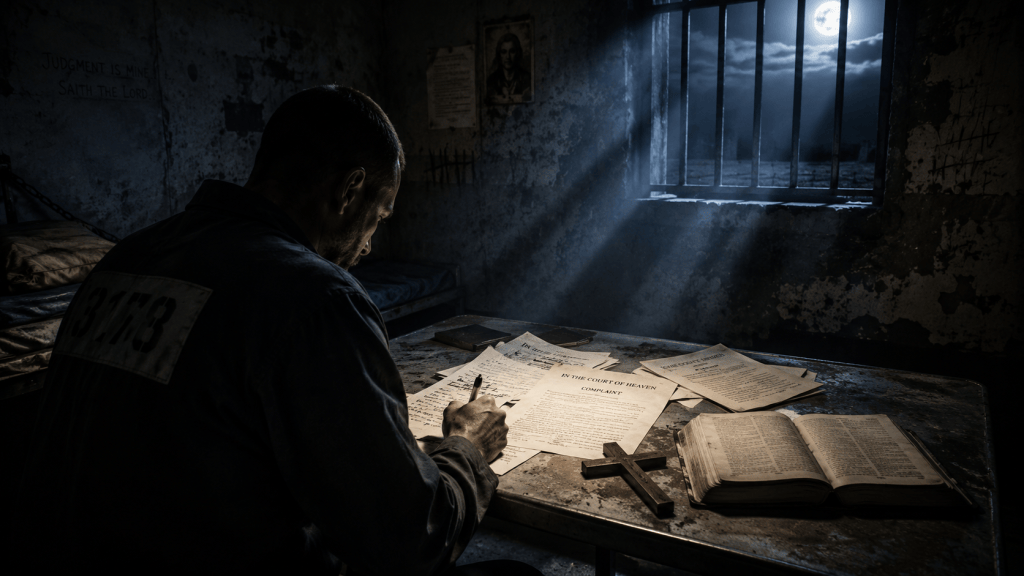
Somewhere behind the walls of Timișoara Penitentiary, in western Romania, a prisoner arrived at an extraordinary conclusion. The justice system had already decided who was responsible for the murder that had brought him there. He disagreed. Or, at least, he believed there was another party who should also be held accountable. That party was God. In October 2005, Pavel Mircea, a Romanian prisoner serving a 20-year sentence for murder, submitted a criminal complaint naming God as the accused. Contemporary Romanian reports described him as a man from Reșița imprisoned in Timișoara. The complaint was not a metaphor, a theological essay or merely an angry letter. It entered Romania’s legal machinery. And Mircea had an argument. He believed he had a contract.
A Contract Signed at Baptism The foundation of Mircea’s case reached all the way back to his baptism. According to contemporary Romanian reporting, he argued that through his baptism in the Orthodox Church he had effectively entered into an agreement with God. Under his interpretation of that agreement, God had undertaken to keep the Devil away from him and protect him from misfortune and evil. But Mircea was now sitting in prison for murder. Therefore, he reasoned, something had gone terribly wrong with the agreement. He maintained that God had failed to protect him from Satan and that the Devil had consequently been able to influence him toward the crime for which he had been convicted. Romanian newspaper Adevărul later summarized his argument in striking terms: the divine party to the baptismal “contract” had failed to keep its word. The logic was bizarre from a legal perspective. Yet internally, it followed an almost unsettling sequence: There was a promise. The promise involved protection from evil. Evil prevailed. Therefore the promise had been broken. And Mircea wanted someone held responsible.
The Defendant’s Address: Heaven Even the wording of the complaint seemed designed for a story that no novelist would dare make too obvious. Mircea sought criminal proceedings against: God, domiciled in Heaven. He identified the Romanian Orthodox Church as God’s representative in Romania and, locally, the Orthodox metropolitan authority in Timișoara. Once the supernatural defendant had been identified, Mircea proceeded as though he were accusing an ordinary earthly suspect. Contemporary reporting listed allegations corresponding to offences such as fraud, concealment, abuse of office, receiving undue benefits and influence peddling. And there was money involved. One 2005 Romanian report said Mircea demanded €2 million in damages. Later reporting stated that he also wanted back money he had spent on candles and religious services that, in his view, had failed to produce the promised protection. Suddenly the argument became stranger still. Prayer had become consideration. Baptism had become contract. Religious offerings had become payments. And divine protection had become a service which, according to the prisoner, had not been delivered.
The Prosecutors Had a Problem It would have been easy simply to throw the papers away. But a criminal complaint submitted to authorities could not necessarily be treated as though it had never existed. In October 2005, Florin Munteanu, then chief prosecutor attached to the Timișoara District Court, told Romanian media that the complaint would be registered and ultimately closed. He said prosecutors still had to provide the prisoner with an answer. Police representatives likewise described the complaint as impossible for state institutions to resolve. For almost two years, the story remained an extraordinary curiosity of the Romanian justice system. Then, in July 2007, it returned to the news. The file had finally been closed. According to Adevărul, prosecutors attached to the Timișoara District Court decided not to begin a criminal prosecution, giving a reason that would propel the case into headlines far beyond Romania: God was not a real person in the legal sense and had no domicile. The problem was brutally mundane. To prosecute someone, the legal system needs a legally recognizable defendant. And Heaven was not an address at which Romanian authorities could serve papers.
When the Story Escaped Romania. This was the moment the case became international. News agencies picked it up, and soon one of Romania’s strangest criminal complaints appeared on websites thousands of kilometres away. ABC News in Australia published the story under the headline “God escapes day in court.” Its AFP report described a Romanian murderer who had accused God of fraud and betrayal of trust after his prayers apparently failed to protect him from evil. South Africa’s Mail & Guardian carried essentially the same international agency report, describing the defendant as God, resident in Heaven and represented in Romania by the Orthodox Church. There was, however, an important difference between some international accounts and the Romanian reporting. The foreign stories often said that a court had dismissed a lawsuit against God. Romanian contemporary sources describe the procedure more precisely as a criminal complaint handled by prosecutors, ending with a decision not to begin criminal prosecution. That distinction hardly made the headline less remarkable. A Romanian prosecutor’s office had still been placed in the surreal position of having to determine what to do with a criminal accusation against the Creator of the universe.
But Pavel Mircea Was Not the First What happened in Timișoara feels unique until one begins searching through legal history. Then something unexpected appears. Human beings have tried, more than once, to drag supernatural beings into earthly courts. And each case reveals something peculiar about what happens when metaphysical claims collide with procedural law.
United States v. Satan — 1971 More than three decades before the Romanian complaint, another prisoner had selected an even less accessible defendant. Satan. In 1971, Gerald Mayo brought a case in the United States District Court for the Western District of Pennsylvania under the unforgettable title: United States ex rel. Gerald Mayo v. Satan and His Staff This case is not an urban legend. The federal court decision survives. Mayo alleged that Satan had caused him misery and threats, deliberately placed obstacles in his path and caused his downfall. He argued that these actions had deprived him of constitutional rights. Judge Gerald J. Weber found several problems. There were questions about whether the court had personal jurisdiction over Satan. Mayo had not alleged that Satan resided within the Western District of Pennsylvania. There were also problems with Mayo’s attempt to make the proceeding a class action. And then there was the question that would echo eerily through later supernatural lawsuits: How exactly was Satan supposed to be served with legal papers? The court noted that Mayo had failed to provide the U.S. Marshal with instructions for service of process. His request to proceed without paying court costs was denied. The judicial opinion even contained a piece of remarkable legal humor. Judge Weber referred to an “unofficial” account in which the same defendant had once appeared as a plaintiff in New Hampshire — an unmistakable allusion to the fictional tale The Devil and Daniel Webster. The law had met the Devil. And paperwork won.
Then a Senator Sued God Two years after Pavel Mircea’s complaint became international news, another case involving God attracted enormous attention in the United States. The plaintiff this time was not a prisoner. He was Nebraska state senator Ernie Chambers. On September 14, 2007, Chambers filed a petition in the District Court of Douglas County, Nebraska, asking for a permanent injunction against God. The surviving complaint literally identifies the parties as: State Senator Ernie Chambers, Plaintiff v. God, Defendant. Center for Agricultural Law and Taxation Chambers accused the defendant of causing catastrophic events and sought an order stopping harmful activities and terroristic threats. His filing attempted to solve the jurisdiction problem with wonderfully circular theological logic: because God was omnipresent, God was necessarily present in Douglas County, Nebraska — therefore the court had jurisdiction. The suit was not primarily an expression of religious grievance like Mircea’s. Chambers used the case to make a point about access to the courts and the ability of citizens to file lawsuits. Contemporary accounts characterized the filing as a demonstration of how broadly the courthouse doors were supposed to remain open. But once again, theology encountered procedure. The fundamental difficulty remained familiar: How do you legally notify God that God has been sued?
The Strange Pattern Behind These Cases Look at the three cases side by side and something fascinating emerges. Gerald Mayo blamed Satan for his downfall. Pavel Mircea blamed God for failing to prevent his. Ernie Chambers sued God partly to test a principle of human law. Different decades. Different countries. Different motives. Yet all three eventually collided with roughly the same wall: A court may entertain almost any allegation on paper, but a legal system operates through jurisdiction, legal personality, evidence and service of process. The supernatural is remarkably difficult to summon with a subpoena.
And that is where these stories stop being merely funny.
Who Is Responsible for Evil? Strip away the absurdity of Mircea’s complaint and underneath it sits one of humanity’s oldest philosophical problems. If an all-powerful and benevolent God exists, why is evil permitted? Philosophers and theologians have debated variations of that question for centuries. Pavel Mircea did something different. He tried to turn the question into a criminal file. Rather than asking: “Why did God allow evil?” his complaint effectively asked: “If God promised to protect me from evil and failed, can God be held responsible?” The transformation is extraordinary because it attempts to force a theological dilemma into the language of earthly accountability. Contract. Obligation. Failure. Damage. Compensation. But there is an uncomfortable element to the story as well. Mircea had been convicted of murder. His theory transferred responsibility for his actions away from himself and toward supernatural forces: God had failed him; Satan had influenced him. The criminal law could not accept that chain of reasoning merely because the prisoner believed it. Human courts judge human conduct. And so the cosmic question returned to Earth.
The One Defendant Who Could Not Be Summoned There was no courtroom confrontation in Timișoara. No lawyer stood up for Heaven. No representative of the Romanian Orthodox Church was required to defend the Creator against accusations of fraud. No witness was asked whether prayers constitute payment. No judge had to determine whether baptism creates an enforceable contract. The case ended before any such spectacle could occur. Romanian prosecutors closed the matter rather than beginning a criminal prosecution. Yet the complaint survived. It survived because it was strange enough to be reported in Romania in 2005. It survived because the decision resurfaced in 2007. It survived because international news agencies carried it across continents. And nearly two decades later, it remains one of those rare stories in which bureaucracy, religion, crime and philosophy briefly occupy the same page. Perhaps the most remarkable part is not that a prisoner tried to put God on trial. Humans have been putting God on trial in poetry, philosophy and private despair for thousands of years. Pavel Mircea simply attempted to obtain a case number for it. And somewhere inside the Romanian justice system, for a brief and astonishing moment, someone had to decide what to write in the file when the accused had only one known address: Heaven.
Sources & Further Reading ABC News Australia / AFP — “God escapes day in court”, July 12, 2007. Relates the international version of Pavel Mircea’s complaint against God and the decision to dismiss the case. ABC News Mail & Guardian / AFP — “Case against God dismissed in Romanian court”, July 11, 2007. Reports that Mircea was serving a 20-year sentence for murder and had named God, “who lives in the heavens,” as defendant. Mail & Guardian University of Georgia School of Law — United States ex rel. Gerald Mayo v. Satan and His Staff, 54 F.R.D. 282 (W.D. Pa. 1971). Original federal court decision concerning Gerald Mayo’s lawsuit against Satan. University of Georgia School of Law Texas Bar — Discussion of Mayo v. Satan and His Staff and the unusual procedural issues raised by attempting to sue a supernatural defendant. Texas Bar Ernie Chambers v. God, District Court of Douglas County, Nebraska, 2007 — court filing in which Nebraska State Senator Ernie Chambers named God as defendant and argued that an omnipresent deity was necessarily within the court’s jurisdiction.