
Tag: mental-health

  • P2 AND THE BOLOGNA MASSACRE: WHEN THE CONSPIRACY WAS NO LONGER JUST A THEORY (1)

    A secret lodge, intelligence officers, hidden membership lists, deliberate disinformation and one of the deadliest terrorist attacks in postwar Europe — the disturbing story of Propaganda Due is a reminder that occasionally the most frightening conspiracy is not the imaginary one, but the one that leaves documents behind.

    On the morning of August 2, 1980, Bologna Centrale was overflowing with travelers escaping the summer heat, families carrying suitcases toward holiday destinations, students crossing the station, railway employees moving through another apparently ordinary Saturday and passengers waiting for trains that would never leave as planned. At precisely 10:25 a.m., an explosive device detonated inside the second-class waiting room, tearing through the building with such violence that part of the station collapsed, debris was thrown across the platforms and rescuers were forced to transform taxis, private vehicles and even the city’s number 37 bus into improvised ambulances.
    Eighty-five people died and around two hundred were wounded, making Bologna the deadliest attack of Italy’s long and sinister period of political violence known as the Years of Lead. The station clock would become one of the enduring symbols of the massacre, its hands associated forever with 10:25, the moment when an ordinary summer morning became part of Italian history.
    For decades, however, the explosion itself was only the beginning of the mystery, because behind the convicted neo-fascist terrorists investigators encountered something even more disturbing: false trails, compromised intelligence officers, secret networks, mysterious financial movements and a clandestine organization whose members reached extraordinarily high levels of the Italian state.
    Its name was Propaganda Due — P2.
    And this is where history begins to resemble the kind of conspiracy story that most people would normally refuse to believe.


    THE LODGE THAT WAS NOT SUPPOSED TO EXIST
    Propaganda Due did not begin as the sinister organization it would eventually become. Its ancestry lay within Italian Freemasonry, particularly the Grande Oriente d’Italia, where a special lodge known as Propaganda had historically provided a discreet form of membership for prominent individuals whose public positions made ordinary lodge participation inconvenient.
    Under Licio Gelli, however, something changed.
    Even the official historical account published by the Grande Oriente d’Italia acknowledges that the organization gradually escaped normal control, becoming an unusual network populated by military officers, generals, politicians, senior civil servants, bankers, businessmen, journalists and other influential figures. The same source describes Gelli’s organization as eventually operating independently and acknowledges that its abnormal development caused immense damage to Italian Freemasonry as a whole.
    (Grande Oriente d’Italia – Sito Ufficiale +1)
    That distinction matters enormously, because P2 should not be confused with Freemasonry in general. Italian Masonic institutions themselves eventually expelled Gelli and have consistently argued that his network represented a degeneration of Masonic organization rather than ordinary Masonic activity.
    (Grande Oriente d’Italia – Sito Ufficiale +1)
    Yet whatever P2 had originally been, by the end of the 1970s it was becoming something very different.
    Something hidden even from many other Freemasons.


    MARCH 17, 1981: THE RAID THAT CHANGED EVERYTHING
    Sometimes history turns on the discovery of a document.
    On March 17, 1981, magistrates investigating financier Michele Sindona ordered searches connected to Licio Gelli. At Gelli’s property in Castiglion Fibocchi, near Arezzo, investigators found documents that would trigger one of the greatest political scandals in modern Italian history.
    Among them was a list containing 962 names associated with P2.
    The Parliamentary Commission later chaired by Tina Anselmi examined the material in extraordinary detail and concluded that the Castiglion Fibocchi lists were authentic documents representing the P2 organization, although the Commission also questioned whether they represented its complete membership. Its investigation found corroborating correspondence and even evidence from the ribbon of a seized typewriter supporting the circumstances in which the lists had been prepared.
    What made the discovery explosive was not simply the number of names.
    It was where those people worked.
    The list contained senior military figures, intelligence officials, politicians, businessmen, public administrators, journalists and other influential individuals, while subsequent investigations examined the extent to which the network penetrated institutions responsible for protecting the very Republic in which it operated.
    The Parliamentary Commission eventually concluded that Gelli had obtained effective control over P2 and that the organization could no longer reasonably be described merely as a discreet or confidential lodge, because its secrecy extended not only toward wider society but even toward the Masonic organization from which it had emerged.
    For anyone familiar with conspiracy literature, the resemblance is uncomfortable.
    A hidden membership network.
    Senior military officers.
    Intelligence officials.
    Bankers.
    Politicians.
    Media figures.
    And a leader maintaining relationships across these apparently separate worlds.
    The difference is that this time investigators had the files.


    THE PLAN FOR A “DEMOCRATIC REBIRTH”
    The discoveries surrounding P2 became even stranger when investigators examined documents associated with the so-called Piano di Rinascita Democratica — Plan for Democratic Rebirth.
    The title sounds almost reassuring.
    Its contents were considerably more unsettling.
    The parliamentary investigation examined proposals involving changes to political institutions, the press, trade unions and the machinery of government, within a broader philosophy that placed extraordinary importance on obtaining influence over key centers of power. The Commission’s final report devoted an entire section to the plan and to what it called the principle of control, while its conclusions emphasized how P2 had interfered across numerous areas of national life with influence that could be substantial and sometimes decisive.
    The document has sometimes been exaggerated by later conspiracy writers into a perfect blueprint explaining everything that subsequently happened in Italy, and that interpretation goes beyond what can responsibly be demonstrated. There was also substantial disagreement over its practical significance, while later criminal proceedings did not validate every sweeping accusation originally made against P2.
    That uncertainty, however, does not make the document imaginary.
    It existed.
    And so did the network surrounding the man associated with it.
    In January 1982, Italy enacted Law No. 17, explicitly dealing with secret associations and the dissolution of the organization called Loggia P2. The law defined prohibited secret associations partly in terms of organizations concealing their existence, purposes or membership while interfering with constitutional bodies, public administrations or essential public services.
    A supposed secret society had therefore reached the extraordinary point at which the Italian Republic passed legislation explicitly naming it.
    But the darkest part of the story had already occurred eighteen months earlier.


    THE BOMB AT BOLOGNA
    The Bologna massacre initially generated numerous competing theories, international leads and claims about who might have been responsible. After decades of investigation and trials, definitive convictions established responsibility among members of the neo-fascist terrorist milieu, including Valerio Fioravanti, Francesca Mambro and Luigi Ciavardini, while later proceedings added Gilberto Cavallini and Paolo Bellini to the judicial reconstruction of those responsible for the attack.
    Yet the most disturbing question was never merely who physically participated.
    It was whether other people had helped create, protect or conceal the operation.
    Because investigators discovered something almost unbelievable.
    Someone had been planting false evidence.


    WHEN THE CONSPIRACY BECAME A PROVEN COVER-UP
    In January 1981, several months after the Bologna bombing, a suitcase was placed aboard the Taranto–Milan train and made to appear as though it supported an international terrorist explanation for the massacre.
    Inside were weapons, explosives and airline tickets connected with foreign destinations.
    It looked like evidence.
    It was actually manufactured evidence.
    Court proceedings eventually established a deliberate operation intended to divert investigators toward false international leads. Among those convicted in connection with the Bologna investigation’s misdirection were Licio Gelli, intelligence-linked Francesco Pazienza and former SISMI officers Pietro Musumeci and Giuseppe Belmonte. The definitive 1995 Cassation judgment described attempts to redirect investigators away from Italian extremist organizations by fabricating indications pointing toward foreign terrorism.
    This is one of the most extraordinary aspects of the entire case, because it moves us beyond speculation about powerful individuals secretly protecting one another.
    A judicially established disinformation operation actually existed.
    The same judgment discussed P2’s penetration of the security apparatus and noted that senior officials in both SISMI and SISDE were affiliated with P2, together with other important intelligence personnel.
    Imagine hearing that claim before the investigations had exposed it.
    Imagine somebody saying that members of a secret network had reached the leadership of intelligence services and that people connected with those services were manipulating evidence after a mass-casualty terrorist attack.
    It would sound almost too perfect for a conspiracy novel.
    Yet significant elements of precisely that story became part of the judicial record.


    THE CASE THAT CHANGED AGAIN FOUR DECADES LATER
    For many years, the Bologna story remained incomplete, particularly regarding what Italian investigators often called the “second level” — the possible organizers, financiers and figures operating beyond those who physically carried out the attack.
    Then came the later prosecution of Paolo Bellini, a former member of the far-right Avanguardia Nazionale.
    In July 2025, Italy’s Court of Cassation made Bellini’s life sentence definitive. The reasoning subsequently published by the Court stated that the evidence established his voluntary contribution to the massacre and his awareness that his actions formed part of a broader criminal project.
    The implications went considerably further.
    In discussing the reconstruction adopted by the lower court, the Cassation judgment published in 2026 records the conclusion that Licio Gelli was considered the instigator-financier of the Bologna attack, while the operational terrorists were described as acting within a broader structure involving elements of diverted intelligence or other compromised state apparatuses.
    Contemporary reporting on the now-concluded trials similarly explains that the Bellini proceedings expanded the judicial picture toward the alleged organizers and financiers, identifying Gelli, Umberto Ortolani, Federico Umberto D’Amato and Mario Tedeschi within that reconstruction. Because those men were already dead, however, they could not themselves stand trial on those allegations.
    And that qualification is crucial.
    Saying that recent judicial findings identify Gelli as a financier or instigator within the reconstruction of the massacre is not the same thing as saying that Gelli was personally convicted of ordering the Bologna bombing. He was not tried and convicted for that role, because the later proceedings examining it took place after his death.
    The distinction makes the story slightly less sensational.
    It also makes it considerably more credible.


    WHAT HAS ACTUALLY BEEN PROVEN?
    After decades in which Bologna accumulated myths, counter-myths, propaganda and political accusations, several essential elements can now be separated from speculation.
    The massacre itself was the work of the neo-fascist terrorist environment identified by repeated criminal proceedings; Paolo Bellini’s conviction became definitive in 2025, while the Italian courts had already convicted other participants over preceding decades.
    P2 was a real clandestine network whose membership reached deeply into sectors of government, the military, intelligence, finance and media, while its structure and activities were investigated by a dedicated parliamentary commission.
    Licio Gelli and others were definitively convicted for activities connected with the deliberate misdirection of the Bologna investigation, including the construction of false leads.
    The later Bellini proceedings produced a judicial reconstruction in which Gelli and other deceased figures were identified as belonging to the level of organizers, financiers or instigators behind the massacre, although they could not themselves be tried on those accusations.
    (Supreme Court of Cassation +1)
    Those facts are already extraordinary enough.
    There is no need to add imaginary ones.


    WHAT HAS NOT BEEN PROVEN?
    This is where the story becomes equally important for anyone interested in conspiracy theories.
    The P2 scandal does not prove that Freemasonry as a worldwide institution secretly controls governments, that every person whose name appeared on a P2 list understood every activity of the network, or that every unexplained event in Italy during the Years of Lead can be traced back to Licio Gelli.
    Indeed, the Grande Oriente d’Italia has long argued that P2 became an abnormal organization divorced from legitimate Masonic practice, and its historical account emphasizes that later criminal proceedings did not sustain some of the broadest allegations originally made about a political conspiracy against the constitutional powers of the state.
    (Grande Oriente d’Italia – Sito Ufficiale)
    There is therefore a danger in moving from the statement “a secret network penetrated important institutions”, for which there is substantial documentation, to the much greater statement “one hidden organization controlled everything”, for which there is not.
    Reality is usually more complicated.
    And perhaps more disturbing.
    Because genuine covert power does not require omnipotence.
    It requires only enough influence in enough places at the right moment

    .
    THE MOST DISTURBING LESSON OF P2
    Conspiracy theories often imagine secret organizations as perfectly organized machines whose members know the complete plan and obey a central command, but real covert networks rarely operate so neatly. They consist instead of overlapping loyalties, private favors, compromised officials, political interests, financial relationships, ideological alliances and individuals who may know only a fraction of what others are doing.
    P2 is frightening precisely because it resembles that messier model.
    The story contains no supernatural ritual capable of changing history, no mysterious ancient bloodline and no omniscient brotherhood meeting beneath the earth.
    What it contains is arguably more unsettling: people with access.
    Access to intelligence.
    Access to politicians.
    Access to money.
    Access to newspapers.
    Access to military institutions.
    And, according to definitive judicial findings, access sufficient for individuals connected with this world to participate in an operation that deliberately attempted to mislead investigators after eighty-five people had been killed.
    The greatest mystery surrounding P2 may therefore not be whether some mythical secret society controls the world.
    It may be how much power a relatively small hidden network can acquire before ordinary democratic institutions realize that it exists.


    WHEN “CONSPIRACY THEORY” BECOMES THE WRONG QUESTION
    There is a habit in modern culture of dividing difficult stories into two categories: either something is an officially accepted fact or it is dismissed as a conspiracy theory.
    P2 demonstrates why that division can sometimes fail.
    In 1980, a traveler standing beneath the clock at Bologna station could not possibly have known that decades of trials would eventually expose convicted terrorists, compromised intelligence figures, deliberate false evidence, a clandestine Masonic-derived network and judicial findings concerning a higher level of organizers and financiers.
    The evidence emerged slowly.
    Some documents remained hidden.
    Some witnesses died.
    Some investigations went in the wrong direction.
    Some were deliberately pushed there.
    And some questions may never receive a complete answer.
    Yet by August 2026, after forty-six years of proceedings, the principal Bologna trials had reached their conclusion, while even the judge who presided over Bellini’s first-instance trial cautioned that although enormous progress had been made, the complete truth had still not necessarily been recovered.


    Perhaps that is the most unsettling conclusion of all.
    The P2 story does not teach us to believe every conspiracy theory.
    It teaches us something far more valuable.
    Sometimes we should examine the documents before deciding that a conspiracy is impossible.

    Sources

    – Italian Parliamentary Commission of Inquiry into the P2 Masonic Lodge — Final Report, chaired by Tina Anselmi, Italian Parliament, 1984. The investigation examined P2’s structure, membership, political influence, financial connections and penetration of Italian institutions.- Italian Republic — Law No. 17 of 25 January 1982 — Legislation concerning secret associations and the official dissolution of the organization known as Loggia P2.- Supreme Court of Cassation of Italy — Judicial findings concerning Paolo Bellini and the Bologna railway station massacre, including the reconstruction of the higher-level network surrounding the attack.- ANSA — The Bologna Massacre: The Judicial Truth After Decades of Investigations — Coverage of the definitive judicial findings concerning the neo-fascist perpetrators, P2, Licio Gelli, the financing of the massacre and decades of investigative obstruction.- Historical Archives of the Italian Senate — Records and proceedings of the Parliamentary Commission investigating Propaganda Due, including testimony, seized documents and material concerning intelligence officials and institutional connections.- Judicial records concerning the Bologna investigation and subsequent trials — Court proceedings documenting false leads, investigative obstruction and the roles of individuals connected with P2 and elements of the Italian intelligence apparatus.Further ReadingTina Anselmi Parliamentary Commission — Relazione conclusiva sulla Loggia massonica P2Italian Supreme Court of Cassation — Bologna Massacre / Paolo Bellini proceedingsItalian Parliament — Documents of the Commissione parlamentare d’inchiesta sulla Loggia massonica P2Law No. 17/1982 — Scioglimento della associazione denominata Loggia P2

    This is only the beginning.
    In the next episode, we uncover another case where secrecy, power, money, and hidden networks crossed paths — and where the truth proved stranger than the conspiracy.

    Continue the investigation here!

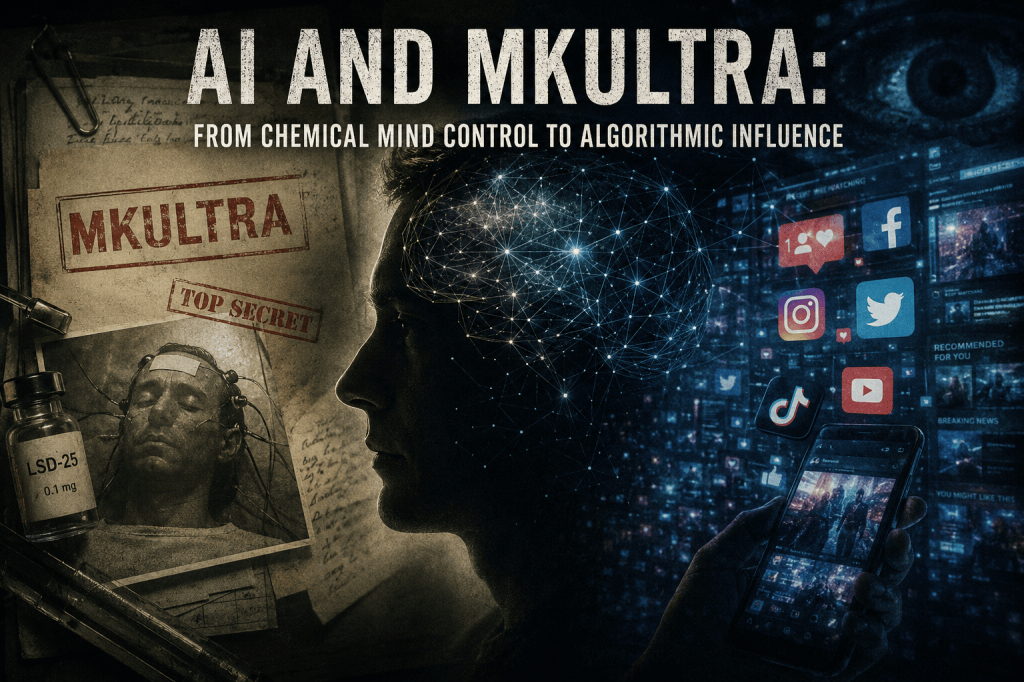
  • AI AND MKULTRA: FROM CHEMICAL MIND CONTROL TO ALGORITHMIC INFLUENCE

    There was a time when the suggestion that an intelligence agency might secretly experiment on human beings in an attempt to understand, disrupt or manipulate the mind sounded like the raw material of paranoid fiction, yet during the Cold War the United States Central Intelligence Agency created a research program whose surviving records would eventually reveal experiments involving psychoactive drugs, hypnosis, behavioral modification and unsuspecting human subjects, leaving behind one of the most disturbing questions in modern history: how far will institutions go when they become convinced that understanding the human mind is a matter of national security?
    More than seventy years later, the laboratories have changed almost beyond recognition, because the glass of LSD, the hidden safe house and the psychiatrist observing a confused patient through a one-way mirror belong to another technological age, while billions of people now spend hours every day inside digital environments where invisible systems decide which stories rise to the top of a screen, which disappear beneath thousands of others, which emotions receive the greatest amplification and which message appears at precisely the moment when a particular person may be most receptive to it.
    There is no credible evidence that artificial intelligence, social-media algorithms or today’s technology companies represent a secret continuation of MKUltra, and treating that claim as established fact would reduce a fascinating historical comparison to another conspiracy theory, but the absence of such a connection does not make the comparison meaningless, because MKUltra and the algorithmic age are separated by completely different technologies while remaining connected by a question that has never entirely disappeared: if human perception can be altered by changing what reaches the mind, how much influence can be exercised before the person being influenced realizes that anything unusual is happening at all?


    THE COLD WAR SEARCH FOR A DOORWAY INTO THE HUMAN MIND
    Project MKUltra emerged during an atmosphere of intense Cold War anxiety in which American intelligence officials feared that communist governments might have discovered sophisticated methods of interrogation, psychological conditioning or so-called brainwashing, and the possibility that Soviet or Chinese researchers possessed techniques capable of breaking resistance encouraged U.S. agencies to investigate drugs, hypnosis and other methods that might reveal whether human behavior could be deliberately modified.
    What began in 1953 was not one neatly organized experiment but a sprawling collection of projects that reached into universities, hospitals, research foundations and other institutions, often through funding arrangements designed to obscure the CIA’s involvement, while many researchers involved in individual studies apparently did not know who ultimately stood behind the money. When previously overlooked financial records were discovered during the 1970s, the U.S. Senate investigation identified 149 MKUltra subprojects, along with 185 nongovernmental researchers and assistants and 80 institutions associated with the recovered material, while the documents themselves referred to research involving behavioral modification, drug acquisition, human testing and the surreptitious administration of drugs.
    The numbers alone make the program remarkable, but they do not explain why MKUltra became so deeply embedded in modern conspiracy culture, because what transformed it from an obscure intelligence project into something almost legendary was the discovery that at least some people had become experimental subjects without knowing they were participating in an experiment at all.
    During the 1977 Senate hearings, CIA Director Stansfield Turner acknowledged evidence supporting unwitting testing in several of the recovered MKUltra subprojects, while testimony concerning CIA safe houses described individuals encountered in bars and subsequently brought to locations where drugs could be tested under covert observation; the surviving records were incomplete, and witnesses repeatedly warned senators not to infer more than the documentation could prove, yet the central fact was no longer disputable, because the CIA had conducted experiments in which unsuspecting people were exposed to drugs while their reactions were observed.


    WHEN LSD BECAME AN INTELLIGENCE TOOL
    Among the many substances explored during this period, LSD occupied a special place in the imagination of intelligence researchers because its ability to profoundly alter perception, emotion and a person’s sense of reality suggested possibilities that seemed extraordinary in an age obsessed with interrogation and psychological warfare, particularly if a chemical could produce confusion, weaken resistance or temporarily destabilize someone’s confidence in his own senses.
    The disturbing element was not simply that LSD was studied, because the substance was also the subject of legitimate psychiatric and scientific interest during the same era, but that the CIA wanted to understand what happened when a person received such a drug without knowing that it had been administered, a requirement that transformed some experiments from questionable research into profound violations of informed consent.
    The notorious CIA safe-house operations later associated with the name Operation Midnight Climax grew from this logic, because the agency wanted environments in which unwitting subjects could be observed while remaining unaware that anything resembling a government experiment was taking place, and testimony before the Senate described safe houses equipped for covert observation, including references to two-way mirrors and individuals brought in after contacts made in social settings. Although decades of retelling have added sensational claims that are not always supported by surviving documents, the official hearing record itself confirms enough to make embellishment unnecessary.
    The real horror of MKUltra therefore lies less in the mythology of a perfect mind-control drug, which the program never produced, than in a much more believable and historically documented process through which researchers gradually accepted the idea that the mind of another human being could become an experimental territory without that person’s knowledge.


    FRANK OLSON AND THE EXPERIMENT THAT ENDED IN A HOTEL WINDOW
    No episode illustrates the danger of that philosophy more powerfully than the death of Frank Olson, a U.S. Army scientist who worked in biological research and attended a gathering of Army and CIA personnel in November 1953, where LSD was secretly placed in a drink consumed by Olson and several other men as part of an experiment whose full purpose they had not been told in advance.
    According to the congressional record, colleagues described Olson before the experiment as professionally respected and apparently psychologically normal, yet after receiving LSD he became increasingly distressed, agitated and troubled, eventually requiring medical attention and traveling to New York with CIA-associated personnel for consultations with Harold Abramson, a physician experienced with LSD whose research had received indirect CIA support.
    During the early hours of November 28, after days of psychological turmoil, Olson went through the closed window of a tenth-floor room at New York’s Statler Hotel and fell to his death, while the CIA subsequently concealed important circumstances surrounding the experiment from his family and attempted to prevent the death from becoming connected publicly with the agency. The Senate investigation later reconstructed much of this sequence from internal memoranda and testimony, although arguments over whether Olson died by suicide or under more sinister circumstances continued for decades and produced theories that extend beyond what the surviving evidence can firmly establish.
    The case remains chilling precisely because one does not need to accept the most dramatic later theories to understand its significance, since the documented sequence is extraordinary enough: a scientist was unknowingly given a powerful hallucinogen during an intelligence experiment, his psychological condition deteriorated severely, and eight days later he was dead.


    DONALD EWEN CAMERON AND THE ATTEMPT TO BREAK PERSONALITY BEFORE REBUILDING IT
    If Frank Olson’s story reveals what could happen when an unsuspecting person encountered a psychoactive drug, the experiments associated with psychiatrist Donald Ewen Cameron at Montreal’s Allan Memorial Institute reveal an even more ambitious idea, because Cameron became interested in treatments intended to disrupt existing patterns of thought before attempting to construct new psychological responses.
    McGill University’s archival record describes the Montreal experiments conducted at the Allan Memorial Institute between 1957 and 1964 and identifies methods including “psychic driving,” drug-induced sleep, electroconvulsive therapy and sensory deprivation, while also confirming that the work received CIA funding as part of MKUltra.
    Cameron’s concept of psychic driving involved repeated recorded messages intended to influence patients after existing psychological patterns had been weakened through other intensive treatments, and although the work was presented within a psychiatric framework rather than as a cinematic attempt to create obedient agents, its connection with CIA behavioral research transformed it into one of the darkest chapters associated with MKUltra, particularly because many of the people subjected to these procedures were already vulnerable psychiatric patients who could not have understood the intelligence context surrounding the funding.
    The significance of Cameron’s work extends beyond the specific techniques used, because it demonstrates how the search for influence could move from drugs toward something conceptually broader: the attempt to alter the informational and psychological environment surrounding a human being until ordinary patterns of perception and response began to change.


    THE FILES THAT VANISHED AND THE MYSTERY THEY LEFT BEHIND
    Much of what the public now knows about MKUltra survived almost by accident, because extensive program records were destroyed in 1973, while the financial files later uncovered had escaped destruction largely because they had been stored separately from material researchers initially searched for during earlier investigations. The Senate hearing noted that the newly discovered folders were primarily financial records containing vouchers, approvals and accounting documents rather than complete operational reports, which meant investigators could reconstruct the scope of many projects without recovering every detail of what had occurred.
    This destruction created the perfect environment for mythmaking, because whenever documents disappear from a secret intelligence program, the missing pages can become more powerful in the public imagination than the pages that survived, allowing almost any later theory to be projected into the gaps.
    Yet those gaps should not tempt us to confuse possibility with evidence, because the strongest way to understand MKUltra is not to enlarge it into a universal explanation for every alleged mind-control story but to recognize that the documented history is already unsettling enough: institutions with enormous resources genuinely studied behavioral modification, secretly administered drugs to some people, concealed sponsorship of research and later destroyed significant portions of the record.


    WHEN THE LABORATORY MOVED FROM THE HOSPITAL TO THE SCREEN
    The modern world appears completely different until we examine what digital systems actually do, because social-media platforms and recommendation engines continuously alter the informational environment surrounding their users, selecting some material for visibility while allowing other material to disappear almost entirely, then measuring the behavioral consequences through clicks, pauses, shares, comments, watch time and countless other signals.
    Unlike MKUltra, this process generally has no secret intelligence officer slipping chemicals into a drink and no researcher attempting to erase personality, yet it possesses one capability Cold War experimenters could scarcely have imagined: the possibility of observing the reactions of millions of people simultaneously while changing what different groups see.
    A user might assume that scrolling is a passive activity, but every decision provides information from which a system can learn, because the video watched twice may reveal more than the video liked once, the article abandoned after five seconds says something different from the article read to the end, and the content that provokes anger, fascination or fear can become statistically distinguishable from material that produces indifference.
    This does not mean that an algorithm understands the human mind as a psychologist would, because it may have no concept of fear, ambition, loneliness or political identity in any human sense, yet it can still become increasingly effective at predicting which stimulus is likely to produce which response.
    At that point, the difference between predicting behavior and shaping the environment in which behavior occurs becomes surprisingly difficult to define.


    THE FACEBOOK EXPERIMENT THAT ALTERED 689,003 NEWS FEEDS
    One of the clearest demonstrations of this new experimental scale appeared in 2014, when researchers published the results of a Facebook study involving 689,003 users, whose News Feeds had been altered during one week in 2012 so that some participants encountered less positive emotional content while others encountered less negative emotional content.
    The researchers then measured the emotional language those users subsequently produced in their own posts and found small but statistically detectable changes corresponding to the emotional material they had been exposed to, providing experimental evidence that adjusting the emotional environment of a social-media feed could alter subsequent emotional expression even without direct face-to-face interaction.
    The effect itself was modest, and the experiment certainly did not demonstrate that Facebook could remotely control people’s emotions, but the ethical controversy surrounding the study revealed something historically interesting, because most participants had no ordinary understanding that their information environment had been altered for a psychological experiment.
    The comparison with MKUltra must remain proportionate, since reducing positive posts in a News Feed is obviously not equivalent to secretly administering LSD, yet the underlying question feels strangely familiar: what does informed consent mean when the subject does not know that the environment itself has been experimentally modified?


    CAMBRIDGE ANALYTICA AND THE VALUE OF KNOWING WHAT A PERSON IS LIKE
    The Cambridge Analytica scandal added another element to the emerging picture by demonstrating how apparently trivial digital behavior could be transformed into psychological profiles intended for political targeting, because according to the U.S. Federal Trade Commission, data collected through Aleksandr Kogan’s Facebook application was used to generate personality scores that were subsequently matched with American voter records for profiling and targeted advertising.
    The FTC alleged that the application collected information from hundreds of thousands of direct users and tens of millions of their Facebook friends, many of whom never interacted with the application themselves, while Cambridge Analytica sought to use Facebook information to predict personality traits and provide voter profiling and microtargeting services.
    Claims about Cambridge Analytica’s actual power were sometimes exaggerated after the scandal became famous, and there is no convincing evidence that its psychological profiling gave it a magical ability to determine election outcomes, but the larger lesson was difficult to dismiss: information that appears meaningless when considered individually can become extremely valuable when combined across millions of observations.
    A political consultant no longer needed to ask a voter directly what frightened, motivated or angered that person if enough behavioral data could be analyzed to make a useful prediction.


    THE ALGORITHM DOES NOT NEED TO TELL YOU WHAT TO BELIEVE
    The most powerful form of algorithmic influence may therefore have little resemblance to direct persuasion, because a system does not necessarily need to convince someone that the world is dangerous if it can repeatedly show that person dangerous events until danger begins to feel omnipresent.
    If stories about violent crime hold a user’s attention longer than stories about declining crime statistics, the algorithm may gradually provide more robberies, assaults and frightening footage without ever making the explicit statement that society is collapsing, while the person exposed to that stream of information may slowly develop a perception of the world based not on everything that exists but on everything the system has learned will keep that particular person watching.
    The same mechanism can operate around politics, immigration, war, health, conspiracy theories or social conflict, because algorithms optimized for engagement do not necessarily require ideological intentions when emotionally charged material happens to perform better than calm explanation.
    This creates an unsettling possibility in which nobody needs to sit inside a secret control room instructing the machine to amplify fear, anger or division, because those characteristics can emerge simply because they generate measurable reactions.


    THE 2026 X EXPERIMENT: WHAT HAPPENS WHEN THE FEED CHANGES?
    In February 2026, researchers publishing in Nature reported a seven-week field experiment involving active U.S. users of X who were randomly assigned to experience either an algorithmic feed or a chronological one, providing unusually direct evidence about what can happen when the mechanism selecting information is altered.
    Among participants who moved from a chronological feed to X’s algorithmic feed, the researchers observed increased engagement as well as measurable shifts toward more conservative positions on certain policy priorities, perceptions of criminal investigations involving Donald Trump and views concerning the war in Ukraine, while users exposed to the algorithmic feed also became more likely to follow conservative political activist accounts that could continue shaping their information environment afterward. The authors emphasized important limitations, including the fact that the findings concerned one platform during one specific period and did not demonstrate comparable effects on partisanship or every political attitude, but their broader conclusion was difficult to ignore: under some real-world conditions, changing the algorithm that chooses what people see can causally influence both online behavior and political opinion.
    A separate Nature study published later in 2026, involving approximately 2,000 participants using experimentally controlled feeds around the 2024 U.S. presidential election, found that engagement-based ranking amplified intergroup, moralized and emotional information and affected perceptions surrounding partisan hostility, reinforcing the idea that algorithms can alter not only which opinions become visible but also the emotional atmosphere through which people interpret the behavior of others.
    This distinction matters enormously because influence does not always require changing what someone believes directly; sometimes changing what that person believes everyone else believes can reshape the social reality in which future decisions are made.


    ARTIFICIAL INTELLIGENCE ADDS SOMETHING THE OLD ALGORITHMS COULD NOT DO
    Recommendation systems primarily decide which existing messages people encounter, while generative artificial intelligence introduces another possibility because an advanced language model can create the persuasive message itself, adapting arguments, vocabulary and tone with a speed that human persuaders could never reproduce at comparable scale.
    A 2025 study published in Nature Communications, based on three preregistered experiments involving 4,829 participants, found that people exposed to persuasive messages generated by large language models showed measurable shifts in their attitudes toward several public-policy questions compared with participants who received neutral messages, while the AI-generated persuasive material performed broadly similarly to messages produced by ordinary human writers. The effects were not enormous and did not demonstrate irresistible persuasion, yet the researchers emphasized an implication that becomes much more significant at scale: persuasive political messages can now be generated quickly, cheaply and in enormous quantities.
    The twentieth-century intelligence researcher dreamed of discovering a technique powerful enough to work on almost anyone, but artificial intelligence points toward a completely different model in which there may never need to be one universal persuasive formula, because a system could theoretically generate different messages for different psychological profiles and continuously adjust them according to how audiences respond.
    The old question was whether one could find the key to the human mind.
    The new question is whether millions of different keys can be manufactured automatically.


    MKULTRA AND AI ARE NOT THE SAME, WHICH IS EXACTLY WHY THE COMPARISON MATTERS
    It would be historically careless to describe social media or artificial intelligence as “MKUltra 2.0,” because MKUltra involved intelligence agencies, covert experimentation, psychoactive drugs and profound violations of consent that belong to a very specific historical context, while contemporary algorithms generally exist within commercial platforms whose primary purposes involve recommendation, advertising, communication and engagement.
    What makes the comparison meaningful is therefore not a secret institutional connection but a transformation in the philosophy of influence.
    MKUltra researchers explored whether the mind could be disrupted from the outside through chemical and psychological intervention, while modern digital systems increasingly learn by observing the mind indirectly through behavior, accumulating patterns until they can predict which information is most likely to attract, frighten, persuade or retain a particular person.
    One approach attempted to penetrate the mind by force.
    The other can surround the mind with a customized information environment.
    One searched for the perfect chemical.
    The other searches continuously for the next piece of content most likely to produce a measurable response.


    THE MOST DISTURBING POSSIBILITY MAY BE THAT THERE IS NO MASTER CONTROLLER
    Conspiracy theories often imagine control as something centralized, intentional and secret, with a small group sitting behind a curtain and directing the thoughts of millions, yet algorithmic systems introduce a stranger possibility because harmful patterns can emerge even when nobody has deliberately designed the final outcome.
    If a platform rewards engagement and the system discovers through billions of interactions that anger keeps users present longer than calm discussion, sensationalism spreads faster than careful uncertainty and frightening claims generate more comments than reassuring explanations, the algorithm can amplify precisely those characteristics without possessing a political ideology, a psychological theory or any conscious desire to manipulate society.
    This is why asking only “Who controls the algorithm?” may miss the more important question, because the answer may sometimes be less revealing than asking “What is the algorithm being rewarded for?”
    A system optimized for attention does not need to hate, deceive or believe anything in order to learn that particular emotional reactions are profitable.


    FROM THE GLASS OF LSD TO THE GLOWING SCREEN
    Frank Olson consumed a drink in 1953 without knowing that a chemical experiment was about to alter his experience of reality, while patients in Montreal entered psychiatric treatment without understanding the full intelligence context surrounding research that would later become connected publicly with MKUltra, and the surviving documents eventually revealed a world in which the pursuit of behavioral knowledge had crossed boundaries that now seem almost impossible to defend.
    The twenty-first century presents a profoundly different world in which most people voluntarily carry the experimental environment with them, willingly return to it dozens of times every day and continuously provide the behavioral signals from which increasingly sophisticated systems learn, yet voluntary participation does not automatically answer every ethical question when the mechanisms guiding attention remain largely invisible to those being guided.
    There is no LSD hidden inside the smartphone, no evidence that today’s AI companies secretly inherited MKUltra and no scientific basis for claiming that algorithms can transform human beings into programmable machines, but there is growing evidence that changing information feeds can influence emotional expression, alter perceptions, affect online behavior and, under certain conditions, shift political attitudes.
    Perhaps the Cold War researchers were therefore searching for something more dramatic than they needed when they imagined that control over the human mind would require a miraculous chemical or an irresistible psychological technique, because the more subtle form of influence may not involve taking control of the mind itself at all.
    It may be enough to control the sequence of reality placed in front of it.
    If one person repeatedly sees fear, another repeatedly sees outrage and a third repeatedly sees confirmation of everything he already believes, each may eventually inhabit a slightly different world while remaining convinced that the screen has merely shown reality as it exists.
    The laboratory has become invisible, the experiment may resemble ordinary life, and the person inside it does not necessarily feel controlled, manipulated or even observed.
    He simply opens the phone, begins to scroll, and waits to see what the algorithm has decided should exist next.


    SOURCES AND FURTHER READING
    The historical material concerning Project MKUltra, its recovered 149 subprojects, researchers, institutions, unwitting experiments, CIA safe houses, Frank Olson and the destruction of records is based primarily on the 1977 Joint Hearing of the U.S. Senate Select Committee on Intelligence and the Subcommittee on Health and Scientific Research.
    Information concerning Donald Ewen Cameron and the Montreal experiments is supported by the McGill University Archival Collections, which document the Allan Memorial Institute experiments and their relationship with CIA-funded MKUltra research.
    The Facebook emotional-contagion experiment is documented in the peer-reviewed 2014 study “Experimental Evidence of Massive-Scale Emotional Contagion Through Social Networks,” involving 689,003 users.
    Information concerning Cambridge Analytica’s Facebook data collection, personality profiling and political targeting is based on findings published by the U.S. Federal Trade Commission.
    The modern discussion of algorithmic influence draws on the 2026 Nature studies examining X’s feed algorithm and engagement-based social-media ranking.
    The discussion of AI-generated persuasion is based on the 2025 Nature Communications study “LLM-generated messages can persuade humans on policy issues,” involving 4,829 participants across three preregistered experiments.

    Fediverse Reactions
  • The Last Words of Erin Valenti: “We’re in the Matrix”

    On 7 October 2019, Erin Valenti, a 33-year-old technology executive from Utah, boarded a flight to California.

    The trip appeared routine. She was scheduled to attend a founders’ conference and a leadership seminar before returning home to her husband and her growing business.Five days later, she was found dead in the back seat of her rental car.

    Officially, the case was ruled a death from natural causes associated with an acute manic episode.

    Yet nearly six years later, the circumstances surrounding her final days continue to generate questions that have never been fully answered.

    Who Was Erin Valenti?

    Erin Valenti was the CEO of Tinker Ventures, a technology company focused on helping startups develop innovative software solutions. Colleagues described her as intelligent, energetic and ambitious. She frequently attended conferences, worked long hours and was well known within Utah’s entrepreneurial community.

    According to her family and husband, she had no documented history of bipolar disorder, psychosis, psychiatric hospitalization or substance abuse.That fact would later become central to the controversy surrounding her death.

    A Normal Business Trip

    During the first days of her California visit, nothing appeared unusual.She attended meetings.She met former colleagues.She participated in leadership events.She spoke regularly with her parents, as she often did while traveling.Family members later recalled that she sounded optimistic and excited about returning home. One conversation with a former employer reportedly focused on new business ideas and solutions to challenges she had recently faced.Nothing suggested that within twenty-four hours she would completely disappear.

    The Phone Calls

    Everything changed on Monday afternoon.Erin called her parents after experiencing difficulties returning her rental vehicle. At first, the conversation appeared ordinary.Moments later she called again.This time, according to her mother, something was profoundly wrong.

    Her speech became rapid and fragmented.Her thoughts appeared disconnected.

    Then she made a statement that would later become the defining phrase of the entire case.”It’s all a game. It’s a thought experiment. We’re in the Matrix.”

    Family members immediately realized that something was terribly wrong.Her father later described the conversation as completely unlike anything they had ever experienced.

    The woman speaking no longer sounded like Erin.

    The Disappearance

    After those phone calls, contact stopped.Her cellphone eventually became inactive.Friends and relatives were unable to reach her.Police began searching after she was officially reported missing.Meanwhile, her rental car remained parked on a quiet residential street in San Jose.For five days.No one appears to have noticed anything unusual.

    The Discovery

    On 12 October 2019, a volunteer assisting in the search located the rental vehicle near 6500 Bose Lane.Erin’s body was found inside.One detail immediately attracted attention.

    She was lying in the back seat, not behind the steering wheel.Investigators found no obvious evidence of violence.No indication of robbery.No signs of a struggle.The vehicle itself showed no evidence of a collision or forced entry.

    The Official Conclusion

    The Santa Clara County Medical Examiner ultimately concluded that Erin Valenti died from natural causes during an acute manic episode.According to medical experts, severe mania can produce profound sleep deprivation, dehydration, extreme psychological stress and dangerous physiological changes. In rare situations, these complications may contribute to sudden death.

    The conclusion surprised many observers.Although first episodes of mania can occur in adulthood, they often leave relatives struggling to understand how dramatic behavioral changes could emerge so suddenly.

    The Family’s Questions

    Erin’s husband, Harrison Weinstein, who is trained as a psychologist, publicly questioned whether the official explanation fully accounted for the circumstances.He emphasized that Erin had never been diagnosed with a psychiatric illness.Her parents expressed similar concerns.They were not necessarily rejecting the medical findings.Instead, they questioned whether investigators had successfully reconstructed everything that happened during the missing five days.

    Several questions remain unanswered.

    Why did she drive aimlessly for hours before disappearing?Why was the vehicle left where it was?Why was her body found in the rear seat?What happened during the period between her final phone call and her death?Publicly available records provide only partial answers.

    The “Matrix” Statement

    Perhaps no element of the case has generated more speculation than Erin’s final recorded words.Within hours of news reports becoming public, online forums connected her comments to simulation theory, artificial intelligence, secret technology projects and countless conspiracy theories.There is, however, no evidence supporting these claims.Mental health specialists note that individuals experiencing acute mania or psychosis sometimes express grand philosophical ideas, unusual beliefs or references to concepts drawn from popular culture.

    The word “Matrix” may therefore represent symbolism rather than hidden knowledge.Equally, no investigator has produced evidence that it meant anything beyond the state of mind Erin was experiencing during those final hours.

    What Can Be Established?

    Several facts are not disputed.

    Erin Valenti traveled to California for business.She suddenly began speaking in a confused and highly unusual manner.She disappeared shortly afterward.Five days later she was found deceased inside her rental vehicle.The official medical conclusion identified an acute manic episode as the underlying cause of the events leading to her death.Beyond those facts, certainty becomes increasingly difficult.

    An Unfinished Story

    The death of Erin Valenti illustrates how modern mysteries are often shaped not by hidden evidence but by missing information.Every unexplained gap invites speculation.Every unanswered question creates another theory.Yet responsible investigation requires distinguishing between what is known, what is probable and what remains entirely unknown.Today, Erin Valenti’s case occupies an unusual place between medical science, criminal investigation and internet mythology.It reminds us that not every mystery conceals a conspiracy.

    Sometimes the greatest challenge is accepting that even after years of investigation, some questions simply remain unanswered.

    Fediverse Reactions