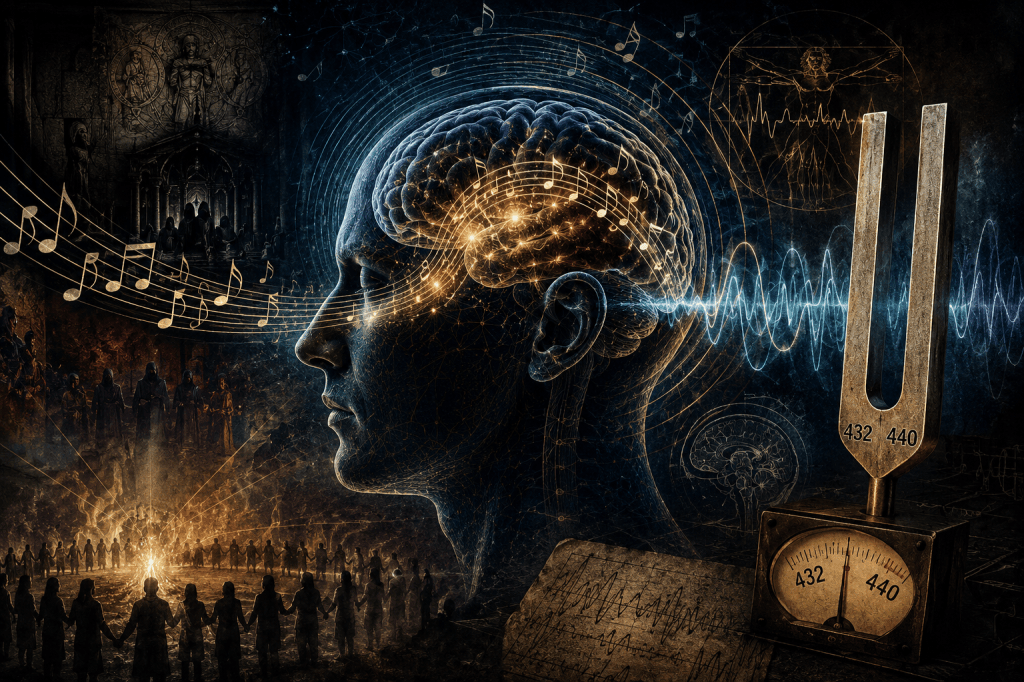
There is something profoundly strange about music that we rarely stop to consider, perhaps because it has accompanied humanity for so long that its presence feels natural. A sequence of vibrations moves through the air, enters the ear, is converted into electrical activity inside the nervous system, and within seconds a person may feel fear, longing, excitement, melancholy, desire, serenity or an almost unbearable sense of nostalgia, even though nothing tangible has happened around them.
No one has touched them. No argument has been presented. No drug has entered the bloodstream. No image may even be present.
And yet the body has changed.
The heart may accelerate, breathing may alter, memories may suddenly return, muscles may prepare to move, skin may produce goosebumps and an apparently meaningless sequence of acoustic frequencies may acquire enough emotional force to make someone cry.
This extraordinary ability has naturally produced a darker question.
If music can change what we feel, can it also change what we think?
And if it can change what we think, could someone deliberately use it to influence us without our realizing what is happening?
Behind those questions lies a world in which neuroscience, psychology, military history, advertising, ritual, politics and some of the internet’s most persistent conspiracy theories unexpectedly meet.
The answer is far more complicated than either extreme suggests. Music is not a magical remote control for the human mind, yet neither is it merely harmless decoration playing in the background of our lives.
Science has discovered that sound reaches remarkably deep into the machinery of the human brain.
And governments, armies, religions, political movements, filmmakers, advertisers and musicians have understood that power, in one form or another, for centuries.
THE INVISIBLE FORCE WE CALL SOUND
Sound begins as mechanical energy.
An object vibrates, creating changes in air pressure that travel outward as waves. When those waves reach the ear, the mechanical movement is eventually transformed by the auditory system into neural signals that the brain interprets as pitch, rhythm, timbre, location and meaning.
Music, however, is not simply one frequency entering the brain.
This distinction becomes extremely important when discussing theories surrounding frequencies such as 432 Hz and 440 Hz.
A violin concerto supposedly “at 440 Hz” is not producing a continuous 440 Hz tone. It contains thousands of changing frequencies, harmonics and overtones. The figure 440 Hz refers primarily to a reference pitch: the frequency assigned to the musical note A above middle C when instruments are tuned according to the modern A440 system. ISO 16 specifies A = 440 Hz as the international standard tuning reference.
Changing that reference to A = 432 Hz shifts the tuning of the entire musical system slightly downward, but it does not somehow transform every sound in a composition into a 432 Hz vibration.
That seemingly technical distinction dismantles many simplistic claims about frequency manipulation, but it does not make the larger mystery disappear, because the human nervous system genuinely does respond to acoustic structure in remarkable ways.
MUSIC DOES NOT SIMPLY ENTER THE EAR — THE BRAIN PREDICTS IT
One of the great discoveries of modern music neuroscience is that listening is not passive.
The brain is constantly attempting to predict what will happen next.
A melody establishes patterns. A rhythm establishes timing. Harmony creates expectations. The listener’s brain begins unconsciously constructing a model of what should follow, and composers can satisfy that expectation, postpone it, violate it or surprise the listener completely.
Researchers studying musical reward have shown that unexpected musical events can engage the nucleus accumbens, an important component of the brain’s reward circuitry. Experiments have found that musical prediction errors — moments when what happens differs intriguingly from what the listener expects — can engage reward mechanisms also involved in learning from other rewarding experiences.
This may partly explain one of music’s strangest paradoxes.
We enjoy being manipulated by it.
A composer builds tension because the brain expects resolution. The resolution is withheld. The listener remains suspended. Then, perhaps several seconds later, the expected chord finally arrives and produces a pleasure that would never have existed without the preceding uncertainty.
Nothing supernatural has happened.
Yet the emotional response is real.
And the mechanism is operating partly below conscious awareness.
MUSIC AND THE CHEMISTRY OF PLEASURE
Perhaps the most famous evidence for music’s biological power came from experiments investigating dopamine, the neurotransmitter heavily involved in motivation and reward.
In a landmark study published in Nature Neuroscience in 2011, researchers led by Valorie Salimpoor used PET imaging together with functional MRI while participants listened to music capable of producing intense emotional pleasure. They found evidence of dopamine release in the striatum, with different regions involved during the anticipation of a musical climax and during the experience of the emotional peak itself.
Later experiments went further. A 2019 pharmacological study manipulated dopamine transmission and found evidence supporting a causal role for dopamine in musical pleasure: altering dopaminergic activity changed both how pleasurable music felt and how much participants were willing to invest in obtaining it.
Consider what this means.
A pattern of organized sound, containing no food, no physical reward and no direct survival benefit, can nevertheless interact with neural circuitry deeply associated with reward.
The ancient intuition that music somehow “enters the soul” was not neuroscience, but it captured something humans had recognized long before brain scanners existed: music can reach emotional systems that rational argument often struggles to reach.
WHEN THE BODY BEGINS TO FOLLOW THE MUSIC
The effects do not stop at emotion.
Researchers have measured changes in cardiovascular and respiratory activity during music listening, and experiments have shown that tempo, rhythmic structure and musical crescendos can be accompanied by changes in breathing, heart rate and other autonomic responses. In work led by Luciano Bernardi, physiological variables were found to track musical phrases and rhythmic changes, demonstrating that the body can become partially synchronized with the temporal structure of music.
Even movement can become linked to external rhythm with astonishing ease.
Humans can synchronize their movements to auditory beats, and neurophysiological experiments have shown coupling between auditory and motor processes when people move in time with rhythmic sound. EEG studies have detected beat-related neural activity and interactions between sensory and motor systems during synchronization.
This is why a foot begins tapping before its owner consciously decides to move it, why thousands of people can clap together during a concert, and why marching songs have accompanied armies for millennia.
Rhythm provides an external clock.
And the nervous system is extraordinarily willing to follow it.
MUSIC CAN OPEN DOORS TO MEMORIES WE THOUGHT WERE LOST
There is another property of music that makes its influence unusually powerful: its connection with autobiographical memory.
A few notes from a song heard decades earlier can recreate an entire scene with astonishing precision — a room, a face, a summer evening, a lost relationship, even an emotional state that seemed to have disappeared permanently.
Neuroscientist Petr Janata demonstrated through functional neuroimaging that familiar music capable of evoking autobiographical memories engages brain regions involved in memory, self-referential processing and emotion. Other experimental work has continued to show that personally meaningful music can interact strongly with the networks involved in autobiographical recollection.
This makes music psychologically different from an ordinary sound.
A melody can become attached to identity.
And once that association exists, hearing the melody again may reactivate far more than the auditory memory itself.
It can reactivate part of the person who first heard it.
SO WHERE DOES INFLUENCE BECOME MANIPULATION?
This is where the subject becomes uncomfortable.
If music alters emotion, reward, physiological arousal, movement and memory, it is reasonable to ask whether those effects can be deliberately exploited.
They can.
But the word manipulation needs to be used carefully.
Music cannot normally insert a specific belief into an unwilling brain as though programming a computer. There is no established scientific evidence that a hidden frequency in an ordinary song can force a mentally competent listener to vote for a particular politician, purchase a specific object or commit an action against their will.
What music can do is something subtler.
It can alter the emotional environment in which decisions are made.
That difference matters enormously.
A frightening soundtrack does not need to tell us that a character is dangerous; it can make us feel danger before the character does anything. A triumphant anthem does not need to logically demonstrate the greatness of a nation; it can create the emotional sensation of greatness. A religious chant need not present a theological argument; repetition, collective singing, acoustic architecture and ritual can help produce a psychological state in which participants experience unity and transcendence.
The message does not always arrive as a proposition.
Sometimes the emotional state comes first.
The interpretation follows.
THE POWER OF SYNCHRONY
Music becomes even more interesting when experienced collectively.
Experimental psychology has found that synchronized movement can affect social behavior. In controlled experiments, people moving rhythmically in synchrony have sometimes demonstrated increased cooperation or social bonding compared with people moving asynchronously.
This gives an entirely natural explanation for something that political leaders, military commanders and religious traditions appear to have understood intuitively for centuries.
Humans who sing together, march together, dance together or chant together do not merely hear the same thing.
They begin doing the same thing at the same time.
Individual bodies become temporarily coordinated by an external rhythm.
That does not create mind control.
But it can help create group identity.
And once people experience themselves as part of a group, psychological dynamics can emerge that would not exist in isolation.
Perhaps the most effective collective music therefore does not tell a crowd what to think.
It first makes the crowd feel that it is one thing.
WHEN MUSIC BECAME AN INSTRUMENT OF COERCION
There are historical cases in which sound moved far beyond persuasion or entertainment.
Documents from U.S. government investigations into detention and interrogation practices after September 11 provide examples of detainees being exposed to loud music during interrogation. A Senate hearing reviewing Department of Defense detention operations recorded that one detainee at Guantánamo was repeatedly yelled at or subjected to loud music during interrogations between November 2002 and January 2003, conduct observed on occasions by FBI personnel.
The broader CIA detention and interrogation program was later examined in the U.S. Senate Select Committee on Intelligence’s extensive 2014 report.
Here the objective was not some mystical manipulation through a special musical frequency.
The mechanism was far more brutal and comprehensible: sensory stress, disruption, exhaustion, loss of environmental control and psychological pressure.
This is an important distinction because it reveals how easily two very different subjects become confused online.
Sound can be used coercively.
That is documented.
Therefore secret frequencies can remotely control thoughts.
That does not follow.
The first statement does not prove the second.
THE 440 HZ MYSTERY
Few subjects in modern alternative culture illustrate this confusion better than A = 440 Hz.
Search long enough online and an extraordinary story begins to appear.
According to various versions, humanity once tuned music to the supposedly natural or harmonious frequency of 432 Hz, until powerful organizations deliberately replaced it with 440 Hz. Some versions attribute the change to governments, others to financial interests, others to secret societies, and particularly dramatic versions connect 440 Hz to Nazi propaganda minister Joseph Goebbels, suggesting that the frequency was selected because it produced aggression, anxiety or psychological disconnection.
It is a compelling story.
There is just one major problem.
The documented historical record does not support the dramatic version.
The National Institute of Standards and Technology records that its U.S. radio station WWV began broadcasting a 440 Hz reference tone in 1936, at the request of music organizations, while international discussions about standardizing concert pitch culminated in an international conference in London in 1939. NIST states that A440 became the international standard for musical pitch from that period, and ISO eventually formalized the reference in ISO 16.
A contemporary report in Nature from 1939 also records the international conference on concert-pitch standardization, held under the auspices of the International Standards Association at BBC Broadcasting House.
Those records describe technical standardization.
They do not reveal a secret neurological experiment.
And there is another problem with the conspiracy story: musical pitch had never been perfectly universal before 440 Hz.
Different places, eras, orchestras and instrument makers used different reference pitches, which was precisely why standardization became desirable.
The historical story is therefore not that humanity lived peacefully at 432 Hz until somebody suddenly poisoned music with 440 Hz.
Reality was considerably messier.
BUT DOES 432 HZ ACTUALLY FEEL DIFFERENT?
Here the story takes another turn, because dismissing the conspiracy surrounding 440 Hz does not automatically prove that 432 Hz has no measurable effects.
Several small scientific studies have compared music tuned around these different reference pitches.
A 2019 study comparing the same music tuned to 440 Hz and 432 Hz reported differences in several physiological measurements and found a greater reduction in heart rate during the 432 Hz condition, while the researchers themselves emphasized that larger randomized trials were necessary.
Other experimental work has reported reductions in anxiety-related measures under certain 432 Hz conditions. For example, a study involving dental patients found that both 432 Hz and 440 Hz music were associated with lower clinical anxiety than a control condition, while salivary cortisol differed between the tuning conditions.
More recently, a randomized crossover trial published in 2025 compared sound interventions tuned to 432 Hz and 443 Hz in 43 cancer patients. Both conditions improved subjective psychological measures, while some cardiovascular parameters changed more under the 432 Hz condition. Importantly, the researchers cautioned that their study could not determine whether any difference resulted from something unique about exactly 432 Hz or simply from the slightly lower tuning being perceived differently.
That final point is crucial.
Suppose listeners consistently find a slightly lower tuning more relaxing.
That would be scientifically interesting.
But it would still not prove that 432 Hz is a cosmic healing frequency, that 440 Hz damages consciousness or that an international organization deliberately altered musical tuning to control humanity.
There is an enormous logical distance between “a measurable difference may exist” and “the frequency was selected as a weapon.”
Good investigation must resist the temptation to fill that distance with imagination.
THE STRANGE NUMEROLOGY OF 432
Part of the fascination with 432 does not come from neuroscience at all, but from mathematics, symbolism and the human tendency to search for hidden correspondences.
The number appears repeatedly in alternative literature alongside astronomical cycles, ancient monuments, sacred geometry, planetary measurements and numerological relationships, creating the impression that the universe itself may somehow be encoded around 432.
Some of these relationships are mathematically correct because numbers can genuinely share interesting ratios.
The difficult question is whether the relationship has physical significance.
A number appearing in two unrelated systems does not automatically mean those systems share a hidden causal connection, particularly when units, rounding conventions or measurement choices can be changed.
This is where numerology and experimental science separate.
Science does not merely ask whether two numbers resemble one another.
It asks what mechanism connects them, whether the relationship predicts something measurable, whether the result can be reproduced, and whether competing explanations have been eliminated.
For 432 Hz, that level of evidence has not established the extraordinary claims often attached to it.
Yet the smaller question — whether slightly different tuning systems can influence perception or physiology — remains scientifically legitimate.
And that is arguably more interesting than simply declaring one frequency “good” and another “evil.”
BINAURAL BEATS: A FREQUENCY THAT DOES NOT EXIST OUTSIDE YOUR HEAD
Binaural beats provide an even stranger example.
Imagine a listener wearing headphones. One ear receives one pure tone, while the other receives a slightly different tone. The auditory system can produce the perception of an additional rhythmic beating corresponding approximately to the difference between them.
The perceived beat is not simply a conventional external tone being played identically through both speakers.
It emerges from how the auditory system processes the two inputs.
This phenomenon has led to claims that binaural beats can synchronize brainwaves, induce meditation, improve memory, reduce anxiety, increase intelligence, produce altered states of consciousness and, in the most extravagant versions, act almost like digital psychoactive substances.
Again, reality refuses to fit neatly into either extreme.
Some experiments have reported genuine psychological effects.
A randomized controlled study published in 2005 involving patients awaiting surgery found a larger reduction in preoperative anxiety among participants exposed to audio containing binaural beats than among comparison groups.
However, evidence that binaural beats reliably “force the brain” into a particular global brainwave state is considerably less straightforward.
A 2025 randomized controlled trial involving surgical patients found that anxiety declined more in the binaural-beat group than in controls, but EEG results provided only limited evidence of differences in alpha-band activity, with no group effect on alpha power and only selected measures of connectivity differing. The researchers concluded that further investigation is needed to understand whether the effects exceed those of music and ordinary relaxation.
That is very different from the dramatic advertisements promising instant control of consciousness.
Something may be happening.
But exactly what is happening remains much less certain.
CAN SOUND “ENTRAIN” THE BRAIN?
The word entrainment deserves special attention because it appears constantly in discussions about frequency manipulation.
In its broad scientific sense, entrainment describes synchronization between oscillating systems.
It is unquestionably real in many biological contexts.
Humans synchronize movement to rhythm. Neural activity can show responses related to periodic auditory stimulation. Breathing and movement can become coupled to external timing.
But internet discussions often transform this limited concept into something much larger.
If neural activity can synchronize with an auditory rhythm, the argument goes, then a carefully selected sound could theoretically place the entire brain into whatever psychological state its creator desires.
That does not follow.
The brain is not one oscillator.
It contains enormous numbers of interacting neural populations operating across different spatial and temporal scales, while attention, expectation, memory, personality, hearing ability and context all influence auditory responses.
Neural entrainment is fascinating.
It is not evidence that consciousness possesses a hidden frequency dial that can simply be turned from the outside.
THE MYTH OF “LOW-FREQUENCY MUSIC” CREATING LOW CONSCIOUSNESS
The post that inspired this investigation makes another claim frequently encountered online: that particular genres, especially rap or hip-hop, supposedly keep listeners trapped in “lower states of consciousness” associated with fear, greed or aggression.
There is no accepted neuroscientific scale on which musical genres can be arranged from “low consciousness” to “high consciousness,” and no established evidence showing that rap, hip-hop or another genre inherently lowers human consciousness through its acoustic frequencies.
Lyrics can certainly convey ideas.
Extremely loud sound can produce physiological effects.
Tempo can affect arousal.
Personal associations matter.
Cultural meaning matters.
Repeated exposure may influence familiarity and preference.
But a musical genre is an enormous and heterogeneous cultural category, not a single neurological frequency.
To claim that one genre mechanically lowers consciousness therefore disguises a philosophical or cultural judgment as neuroscience.
That does not mean music is psychologically neutral.
It means the mechanism cannot be reduced to a label.
MUSIC AS PROPAGANDA WITHOUT A SECRET FREQUENCY
Perhaps the most revealing conclusion is that anyone attempting to manipulate people with music would not actually need a secret frequency.
Ordinary music already possesses more powerful psychological tools.
Repetition creates familiarity.
Rhythm encourages synchronization.
Harmony creates and releases tension.
Lyrics attach language to emotion.
Melodies become associated with people, places and ideas.
Group singing reinforces shared identity.
A familiar song can reactivate memories formed decades earlier.
Reward systems respond to anticipation and musical pleasure.
Those mechanisms are sufficient to explain why music has accompanied ceremonies, revolutions, armies, religions, advertising, cinema, political movements and collective celebrations throughout human history.
The great irony may therefore be that the search for an exotic hidden frequency distracts us from something much more obvious.
Music does influence us.
It simply does so through mechanisms far richer and more psychologically sophisticated than a single mysterious number.
THE MOST EFFECTIVE SOUNDTRACK IS THE ONE YOU DO NOT NOTICE
Consider cinema.
Remove the soundtrack from a horror scene and the monster may suddenly seem ridiculous. Change the music beneath the same facial expression and the audience may interpret the character as romantic, dangerous, heroic or tragic.
Nothing in the image changed.
The emotional frame changed.
The same principle operates in everyday life more subtly.
Music accompanies shopping, exercise, restaurants, political events, religious services, funerals, weddings, advertisements, sporting events and social-media videos. Most of the time we concentrate on the apparent message while barely noticing the emotional architecture beneath it.
That may be the closest ordinary music comes to influencing us “without conscious consent.”
Not because it secretly bypasses free will.
But because humans do not consciously analyze every influence acting upon them.
We rarely ask why a particular chord made a scene feel tragic.
We simply experience the tragedy.
CAN MUSIC CONTROL YOU?
At this point the distinction becomes clearer.
Music can influence emotion.
Yes.
Music can affect physiological arousal.
Yes.
Music can activate reward-related neural systems.
Yes.
Music can trigger autobiographical memories.
Yes.
Rhythm can synchronize movement and interact with neural timing.
Yes.
Sound and loud music have been deliberately employed in coercive interrogation environments.
Yes.
Some experiments suggest different tuning systems or auditory-beat techniques may produce modest physiological or psychological differences.
Yes.
But:
Can an ordinary musical frequency secretly take control of a healthy person’s mind and remove free will?
There is no convincing evidence that it can.
Has 440 Hz been demonstrated to be a frequency deliberately imposed upon humanity to produce aggression or spiritual disconnection?
No.
Has 432 Hz been scientifically established as the natural frequency of the universe or a universal healing frequency?
No.
And yet these answers do not make music less mysterious.
They make it more mysterious.
THE REAL MYSTERY MAY BE GREATER THAN THE CONSPIRACY
Perhaps we have been asking the wrong question.
The extraordinary thing is not whether someone discovered a secret frequency capable of manipulating consciousness.
The extraordinary thing is that consciousness is so responsive to organized vibration in the first place.
Why should an arrangement of pressure waves create sadness?
Why should anticipation of a chord release chemicals involved in reward?
Why can a melody heard at sixteen resurrect memories at sixty?
Why do human beings spontaneously synchronize their bodies to rhythmic sound?
Why can thousands of strangers sing the same melody and temporarily experience themselves as one group?
Physics can describe the wave.
Neuroscience can map some of the circuits.
Psychology can measure behavior.
But the subjective transformation — the moment when vibration becomes meaning — remains one of the most remarkable features of the human mind.
And perhaps this is why every civilization we know has surrounded music with ideas of magic, divinity, healing, danger and power.
Long before anyone knew what a hertz was, humanity already knew that sound could change us.
The ancients did not need brain scanners to discover that a drum could prepare people for battle, that a lament could deepen grief, that a chant could alter the atmosphere of a temple or that a melody could carry memory across generations.
Modern science has not destroyed that mystery.
It has merely shown us some of the machinery hidden behind it.
THE LINE BETWEEN SCIENCE AND CONSPIRACY
The most dangerous mistake when exploring subjects like this is believing that we must choose between two absolute positions: either every unusual claim is true, or anything associated with conspiracy culture must automatically be false.
History repeatedly teaches us that reality is less convenient.
Governments have conducted secret experiments.
Psychological manipulation exists.
Propaganda exists.
Sound has been deliberately used in coercive environments.
Music genuinely influences the brain and body.
At the same time, those facts cannot be used as blank checks to validate every theory about frequencies, subliminal control or hidden musical agendas.
Evidence must be examined one claim at a time.
The existence of MKUltra would not prove that 440 Hz controls the brain.
The use of loud music during interrogations does not prove that popular songs contain secret consciousness-altering frequencies.
A small experiment finding a difference between 432 Hz and another tuning does not prove that ancient civilizations possessed a lost universal frequency.
The mystery deserves something better than automatic belief.
It also deserves something better than automatic ridicule.
It deserves investigation.
PERHAPS THAT IS WHY MUSIC HAS ALWAYS FRIGHTENED POWER
Music occupies a peculiar territory between thought and sensation.
Words usually ask to be understood.
Music does not always need permission.
It can enter a room before we decide whether we want to interpret it, establish an emotional atmosphere before a conversation begins, resurrect a memory we had no intention of remembering and make the body move before the rational mind has formulated a reason.
That power is not supernatural.
But neither is it trivial.
Perhaps there is no single forbidden frequency hidden inside our music.
Perhaps there never was.
Perhaps the deeper secret has been playing openly around us for thousands of years:
human consciousness is profoundly responsive to sound, and anyone who understands emotion, rhythm, memory and expectation already possesses a remarkable instrument of influence.
The mystery is not that music can control the mind.
The mystery is how much of the mind has always been listening.
SOURCES AND FURTHER READING
International Organization for Standardization — ISO 16:1975, Standard Tuning Frequency. ISO specifies A above middle C at 440 Hz; the standard remains current after later review.
National Institute of Standards and Technology — History of Radio Station WWV. NIST documents the broadcast of the 440 Hz musical reference beginning in 1936 and the history of international musical-pitch standardization.
Salimpoor et al., Nature Neuroscience, 2011 — “Anatomically Distinct Dopamine Release During Anticipation and Experience of Peak Emotion to Music.” PET and fMRI evidence linking intense musical pleasure with dopamine release.
Ferreri et al., 2019 — “Dopamine Modulates the Reward Experiences Elicited by Music.” Pharmacological evidence supporting a causal relationship between dopamine and musical reward.
Bernardi et al., 2006 and 2009. Experimental research on cardiovascular, respiratory and autonomic responses to musical tempo and structure.
Janata, 2009 — “The Neural Architecture of Music-Evoked Autobiographical Memories.” Functional neuroimaging research into music and autobiographical memory.
Nozaradan et al., Cerebral Cortex — Sensorimotor Synchronization to the Beat. EEG evidence concerning neural entrainment and auditory-motor coupling.
U.S. Senate — Review of Department of Defense Detention Operations. Congressional evidence documenting exposure of detainees to loud music during interrogation.
U.S. Senate Select Committee on Intelligence, 2014 — Study of the CIA Detention and Interrogation Program. Official Senate investigation of CIA detention practices.
Calamassi & Pomponi, 2019 — Music Tuned to 440 Hz Versus 432 Hz and Health Effects. Small experimental study reporting physiological differences and explicitly calling for larger trials.
Hohneck et al., 2025 — Randomized Crossover Trial of 432 Hz versus 443 Hz. Both interventions produced effects, with some cardiovascular measures favoring the lower tuning while the researchers stressed that a unique effect of precisely 432 Hz could not be established.
Padmanabhan, Hildreth & Laws, 2005 — Binaural Beats and Preoperative Anxiety. Randomized controlled research reporting reduced preoperative anxiety during binaural-beat audio exposure.
Ostertag et al., 2025 — Binaural Beat Stimulation and Preoperative Anxiety. Randomized controlled study showing modest anxiety effects while finding limited evidence for broad EEG alpha entrainment.