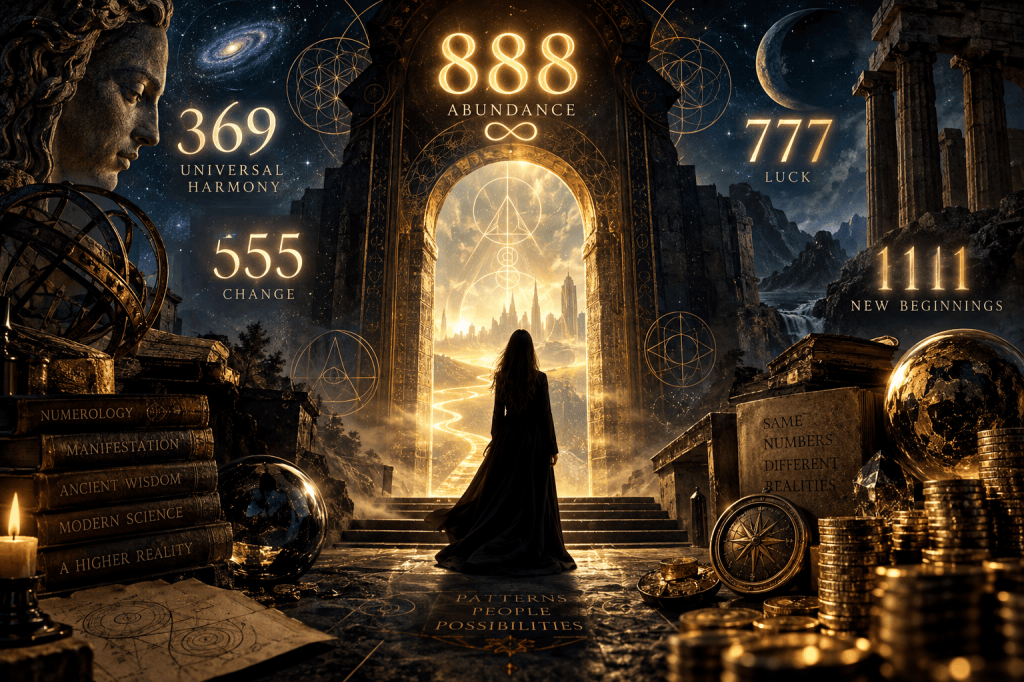
There is something strangely intimate about a number that refuses to leave you alone.
You glance at your phone and it is 8:08. Later, a receipt ends in 8.88. An invoice contains three eights, a hotel room carries the same digits, and then, just when you have almost forgotten about it, 888 appears again somewhere completely ordinary. For someone who has never attached meaning to numbers, this is little more than coincidence. For someone familiar with numerology, however, 888 carries a very different reputation: it is supposed to be the number of abundance, material flow, success and money.
Nearby in this strange numerical landscape are 555, usually associated with sudden change; 777, with fortune and spiritual alignment; 111 or 1111, with beginnings and manifestation; and the almost legendary combination 3–6–9, surrounded today by stories about Nikola Tesla, hidden mathematical laws and a supposed numerical architecture underlying reality itself.
Then another layer is added. Search online for these numbers and soon they cease to be merely numbers. They become frequencies. There are recordings labelled 888 Hz Money Frequency, 777 Hz Abundance Frequency, 555 Hz Transformation Frequency, often accompanied by promises of prosperity, energetic clearing or a dramatic shift in one’s financial life.
At this point an obvious question becomes difficult to avoid.
Where did all of this actually come from?
And perhaps the more unsettling question is not whether a number can magically deposit money into a bank account, but why human beings have been assigning power to numbers for thousands of years, long before YouTube manifestation videos, TikTok numerology and modern “angel numbers” ever existed.
Long Before 888 Meant Money, Numbers Were Already Mysterious
The belief that numbers possess qualities beyond simple counting is far older than the modern manifestation movement.
Among the Pythagoreans of ancient Greece, number was not merely a convenient human invention used to measure livestock, land or coins. Numerical relationships appeared to reveal something fundamental about reality itself. Early accounts of Pythagorean thought describe a worldview in which mathematical relationships were intimately connected with harmony, music, geometry and the structure of the cosmos, eventually giving rise to the famous idea commonly summarized as “all things are number.” Ancient Pythagorean speculation also attached symbolic qualities to particular numbers, although these associations should not be confused with today’s internet numerology.
This distinction matters because modern numerology often borrows the atmosphere of antiquity while adding meanings that are actually much more recent.
Pythagoras did not leave behind an ancient handbook announcing that seeing 888 on a supermarket receipt meant a financial breakthrough was approaching, nor did his followers teach that playing an 888-Hz tone would attract money into one’s life. What they did help establish was something more fundamental and, in a sense, more interesting: the idea that numbers might express qualities and relationships hidden beneath visible reality.
Once that door had been opened, later generations never completely closed it.
Numbers became entangled with theology, astrology, magic, architecture, music, calendars and divination. Seven became sacred in numerous traditions, three repeatedly appeared in religious structures, twelve organized heavens and calendars, and particular numerical combinations acquired meanings that changed according to culture and period.
The modern fascination with 111, 555, 777 and 888 belongs to this much larger human habit of turning quantity into meaning.
But the specific system most people encounter today is considerably younger than it appears.
888: How Eight Became the Number of Abundance
Within contemporary numerology, 8 has acquired an unusually material character. It is commonly associated with authority, ambition, achievement, organization, business, material power and the movement of resources; repeated three times, that symbolism becomes 888, now widely interpreted as abundance, prosperity or financial success.
The modern category known as “angel numbers”, however, should not be mistaken for an intact doctrine transmitted from antiquity. Repeating sequences such as 111, 222, 555 and 888 became especially prominent through modern New Age publishing and were popularized in their present form during the early twenty-first century, particularly through the work of author Doreen Virtue. Contemporary interpretations commonly describe 555 as major change and 888 as manifestation, success and prosperity.
That makes the story considerably stranger than the simplified version often encountered online.
The symbolism of numbers is ancient, but the tidy modern dictionary in which 111 means one thing, 555 another and 888 automatically means money is largely contemporary.
Yet 888 does contain an elegant numerical curiosity that helps explain why people drawn to numerology find it so appealing.
Add its digits:
8 + 8 + 8 = 24
Then reduce again:
2 + 4 = 6
So the numerological root of 888 is 6, traditionally interpreted in many modern systems as harmony, responsibility, balance, care and restoration.
Now perform exactly the same operation with 555:
5 + 5 + 5 = 15
1 + 5 = 6
The supposed number of dramatic change and the supposed number of abundance both return to 6.
This proves no supernatural mechanism whatsoever, because digital reduction is simply arithmetic. Yet symbolically it creates an irresistible narrative: movement and disruption represented by 555 eventually return to balance, while the material power represented by 888 must also return to balance.
Whether one calls that cosmic wisdom or a beautiful human interpretation depends entirely on where one stands.
555: The Number That Appears Before Everything Changes
If 888 is imagined as the vault, 555 is the door being forced open.
In contemporary angel-number traditions, 555 represents disruption, transition, movement and the collapse of an old pattern before another one can take its place. Financially, therefore, it is sometimes interpreted not as money itself but as the change that precedes a new source of income, a different career, an unexpected opportunity or the uncomfortable realization that an existing way of living is no longer sustainable.
There is something psychologically clever in this interpretation, because prosperity rarely arrives in real life without some degree of transformation. A person changes work, learns a skill, takes a risk, starts a business, abandons an unsuccessful project or notices an opportunity that had previously been ignored.
The number itself does not need to possess supernatural power for the symbolism to become personally powerful.
A person who begins using 555 as a reminder to ask What must change? may actually behave differently.
And that brings us dangerously close to the border where ritual, psychology and magic begin to resemble one another.
777: Luck, Mystery and the Number We Already Wanted to Believe In
Seven entered the symbolic imagination long before modern numerology discovered it.
It appears repeatedly in religious traditions, mythology, calendars and cultural symbolism, which gave it an aura that later systems could easily inherit. Modern angel-number interpretations typically connect 777 with spiritual insight, inner wisdom, good fortune or being somehow “in alignment.”
Its modern association with luck was strengthened further by popular culture and gambling imagery, particularly the familiar three sevens of slot machines, where 777 became visually synonymous with the jackpot.
This is worth remembering because symbolism rarely has a single origin. Meanings accumulate.
A number may begin with a religious association, acquire an occult meaning centuries later, be reinforced by popular entertainment and eventually return to social media disguised as an ancient universal code.
By the time we encounter it, the layers have become almost impossible to see.
Then There Is 369
Of all the numerical mysteries circulating online, 3–6–9 is probably the most seductive because its legend contains a real historical figure: Nikola Tesla.
A statement endlessly attributed to him claims that if humanity understood the magnificence of 3, 6 and 9, it would possess a key to the universe.
The problem is that a reliable primary source establishing that Tesla actually made this famous statement has never been convincingly produced.
What is documented is Tesla’s peculiar fixation on the number three and numbers divisible by three. Biographical accounts describe his preference for hotel rooms whose numbers were divisible by three, rituals involving counting, and his use of eighteen napkins at meals. Smithsonian’s account of Tesla’s later life also notes his fixation on three, while Tesla biographer Margaret Cheney, when asked by PBS about his “magic” number three, described it as apparently a superstition rather than a hidden scientific theory.
This does not make the 369 story less fascinating; in some ways, it makes it more so.
There really was a Tesla fascinated by numerical repetition.
There really are striking mathematical patterns involving digital roots and multiples of nine.
What appeared later was a mythology built around these facts.
For example, multiples of nine repeatedly return to nine when their digits are summed:
18 becomes 1 + 8 = 9.
27 becomes 2 + 7 = 9.
36 becomes 3 + 6 = 9.
108 becomes 1 + 0 + 8 = 9.
There is nothing paranormal about this property; it follows from arithmetic in base ten and modular mathematics. Yet visually and mentally, it is hypnotic, particularly when combined with other digital-root patterns that make 3, 6 and 9 appear to occupy distinctive positions.
From such patterns came later systems including what is popularly called “vortex mathematics,” along with manifestation practices instructing people to write an intention three times in the morning, six times during the day and nine times at night.
Tesla himself did not leave us such a manifestation ritual.
The internet did.
When a Number Suddenly Becomes a Frequency
There is another confusion hidden inside this subject, and it is responsible for much of the mythology surrounding “money frequencies.”
888 and 888 Hz are not the same thing.
The first is a number.
The second is a physical frequency representing 888 oscillations per second.
A sound wave at 888 Hz is perfectly real and measurable, just as 440 Hz or 528 Hz is measurable. What science does not establish is that the symbolic numerological meaning assigned to the digits 888 somehow transfers automatically to a sound wave oscillating 888 times per second.
That leap is philosophical or spiritual rather than physical.
Nevertheless, once modern spiritual culture began associating certain frequencies with meditation and transformation, it was almost inevitable that numerological sequences would enter the same world. Today one can easily find 888 Hz labelled as an abundance or money frequency, 777 Hz associated with luck or spiritual awakening and 555 Hz with transformation.
Their popularity can create the impression that these correspondences belong to an ancient system of sacred acoustics.
They do not.
The distinction becomes particularly important when these recordings are compared with the so-called Solfeggio frequencies, another modern spiritual system that is frequently presented online as if its exact Hertz values were inherited unchanged from medieval monks.
Historical solfeggio was indeed real, but it referred to a method of teaching musical intervals through syllables such as Ut, Re, Mi, Fa, Sol, La. The modern lists of supposedly healing frequencies are a different development.
That does not mean sound has no effect on us.
Quite the contrary.
It simply means that the effect must not be confused with the claims attached to the number printed in the video title.
What Sound Really Can Do
Music can influence human physiology and emotion in measurable ways.
A large meta-analysis of 104 randomized controlled trials involving 9,617 participants found significant overall effects of music interventions on both physiological and psychological stress-related outcomes. Other research has similarly explored effects on anxiety, heart rate, blood pressure, cortisol and emotional state.
There is even emerging research examining specific tunings. A randomized controlled study published in 2026 compared instrumental music at 528 Hz and 432 Hz with a no-music condition in 162 university students experiencing exam-related stress. Researchers reported differences in several salivary biomarkers after exposure, although cognitive performance on the Stroop test did not significantly differ between the groups. Interesting as those findings are, they do not demonstrate that a particular frequency possesses a universal healing power, much less that a frequency can attract money.
Science therefore leaves us in a more nuanced place than either believers or absolute skeptics sometimes prefer.
Sound can affect the human organism.
Music can influence stress and emotion.
Ritual can alter attention.
But there is currently no credible scientific evidence showing that listening to 888 Hz causes financial abundance, that 777 Hz changes luck, or that repeating 555 alters external events through an undiscovered energetic law.
And yet people continue reporting that these numbers seem to follow them.
Why?
The Moment You Learn 888, You Begin Seeing It Everywhere
There is a well-known psychological phenomenon called the frequency illusion, sometimes referred to as the Baader-Meinhof phenomenon.
Once something becomes personally significant, attention begins detecting it more readily. The object has not necessarily become more common; rather, the mind has begun selecting it from the enormous amount of information that was already present. Selective attention and confirmation bias can then reinforce the impression that the pattern is appearing with extraordinary frequency.
Imagine how many numbers pass through a person’s visual field during an ordinary week.
Clocks, prices, passwords, receipts, telephone numbers, addresses, vehicle registrations, social-media metrics, bank statements, page numbers, dates and notifications surround us constantly.
Most disappear without leaving any trace in memory.
But tell someone that 888 means money, and 888 is no longer ordinary information.
It has become a signal.
The next time it appears, the brain notices.
The appearance after that feels like confirmation.
After several repetitions, coincidence begins to resemble communication.
Research into repetition provides another intriguing piece of the puzzle. Experiments on the “illusory truth effect” have shown that repeated information can feel more truthful simply because it becomes more familiar and easier for the mind to process. In experiments where statements were presented multiple times, repeated claims were subsequently judged as more truthful than unfamiliar ones.
None of this proves that every experience of synchronicity can be reduced neatly to a cognitive bias.
It does, however, demonstrate that the human mind is extraordinarily capable of transforming repetition into significance.
Perhaps that ability is precisely why numerical mysticism has survived for so long.
But What If the Number Still Changes Something?
Here the story becomes more complicated, because dismissing the entire subject with the word “coincidence” misses something important.
Suppose a person chooses 888 as a private symbol of financial stability and writes it at the top of a notebook each morning. Beneath it, she records her income, expenses, unfinished projects and one action that could improve her financial position.
After several months she has earned more money.
Did 888 attract it?
There is no need to invoke an invisible monetary vibration to explain what happened. The ritual repeatedly directed attention toward financial decisions, opportunities and unfinished tasks. A symbol altered focus; focus influenced behaviour; behaviour altered outcomes.
From the outside, this looks psychological.
From the inside, it may feel like manifestation.
And somewhere between those two descriptions lies one of the oldest ambiguities in magic.
Rituals often work by changing the person performing them long before they change anything else.
The candle, symbol, prayer, sigil or repeated number may not command the universe, yet it can organize intention in a mind that was previously scattered. Once intention becomes consistent, behaviour can follow. Once behaviour changes, reality sometimes changes with it.
This does not validate every supernatural claim attached to manifestation, but neither does it make symbolic practices meaningless.
Symbols have always possessed power of a particular kind because human beings respond to them.
Money itself proves the point rather beautifully.
A banknote is paper.
A number displayed inside an online banking application is a pattern of pixels.
Yet entire lives can change because societies collectively agree that those symbols represent value.
Human civilization is already filled with numbers that possess enormous power, although the source of that power is not necessarily hidden cosmic vibration.
It is belief, agreement, attention and action.
So Is 888 Really the Frequency of Money?
If by “frequency” we mean a measurable physical phenomenon capable of attracting wealth, there is no good evidence that it is.
If we mean an ancient universal numerical law proving that 888 automatically produces abundance, history does not support that claim either.
But if we ask why 888 has become such a powerful symbol of abundance, the answer becomes considerably richer.
It stands at the meeting point of ancient numerical mysticism, modern numerology, New Age angel-number culture, digital repetition, the psychology of attention and a very old human desire to believe that chaos contains patterns.
555 tells us that something must change.
777 whispers that fortune may be nearby.
888 promises abundance.
369 suggests that somewhere beneath ordinary reality a mathematical mechanism might still be waiting to be discovered.
Perhaps none of these numbers opens a supernatural vault.
Yet perhaps that was never their most interesting power.
A number can make someone stop.
Notice.
Remember.
Change direction.
Take an opportunity seriously.
Ask a question that had been avoided.
And every now and then, after enough of those small changes, a person’s external life really does begin to look different.
The rational explanation would say that the mind changed first.
The occult explanation would say that the vibration changed first.
Between those two interpretations remains the narrow territory where Whisper Mysteries prefers to linger, because the strangest mysteries are not always those that can be proved or disproved cleanly.
Sometimes the mystery is why a simple sequence of digits can enter the human mind and refuse to leave.
And if you happen to see 888 shortly after reading this, remember one thing before deciding that the universe has sent you a message:
You now know exactly what to look for.
Whether that makes the next appearance coincidence, psychology or synchronicity is a question the number itself will never answer.
Sources
Stanford Encyclopedia of Philosophy — Pythagoras: pentru tradiția pitagoreică, semnificația numerelor și relația dintre număr, armonie și cosmos.
Pythagoras – Stanford Encyclopedia of Philosophy
Smithsonian Magazine — Nikola Tesla and the Tower That Became His “Million Dollar Folly”: confirmă documentarea istorică privind fascinația lui Tesla pentru cifra 3 și numerele divizibile cu trei.
PBS – Tesla: Master of Lightning: biografa Margaret Cheney spune că „numărul magic 3” al lui Tesla pare să fi fost o superstiție personală, nu o teorie științifică secretă.
Vogue — How to Decode Angel Numbers: utilă pentru istoria modernă a „angel numbers” și interpretările contemporane ale 111, 555, 777 și 888; articolul notează și popularizarea termenului de către Doreen Virtue.
Psychology Today — Frequency Illusion: explică de ce, după ce aflăm semnificația unui număr precum 888, putem începe să-l observăm aparent peste tot.
PubMed — Effects of Music Interventions on Stress-Related Outcomes: meta-analiză a 104 studii randomizate, cu 9.617 participanți, despre efectele muzicii asupra stresului fiziologic și psihologic.
PubMed – Music and Stress Meta-analysis
PubMed — Acute Music-Frequency Exposure, 2026: studiul randomizat cu 162 de participanți care a comparat muzica la 528 Hz, 432 Hz și lipsa muzicii.
PubMed – 528 Hz and 432 Hz Study