Tag: Unexplained Phenomena

  • Hoia-Baciu: The Romanian Forest Where Reality Seems to Misbehave

    Hoia-Baciu: The Romanian Forest Where Reality Seems to Misbehave

    UFO photographs, twisted trees, a strangely persistent clearing and decades of disturbing testimony have turned a forest outside Cluj-Napoca into one of Europe’s most enduring paranormal mysteries. Yet the deeper one looks into Hoia-Baciu, the more difficult it becomes to tell where documented history ends and legend begins.

    There are forests that become frightening because of what happened inside them, and there are others that seem unsettling long before anyone tells you a story.Hoia-Baciu belongs to the second kind.

    On the western edge of Cluj-Napoca, in Transylvania, the forest is close enough to the city that it should hardly feel isolated. Roads, houses and the ordinary rhythms of modern life are never impossibly far away.

    Parts of the surrounding area have genuine geological and botanical significance; the nearby Baciu Gorge, for example, is a protected natural area formed in Eocene limestone.

    Yet over the second half of the twentieth century, this otherwise accessible woodland acquired another identity entirely. It became a place associated with strange lights, photographs that seemed to contain things invisible to the photographer, unusual sensations, distorted trees and, most famously, one of Romania’s best-known UFO encounters.

    Today, Hoia-Baciu is repeatedly described as one of the world’s most haunted forests.

    That description is excellent tourism, but it also creates a problem: once a place becomes famous for the paranormal, every shadow begins to acquire a story.

    The real mystery of Hoia-Baciu is therefore not simply whether something unexplained happens there.It is whether we can still separate the original mystery from everything that was added afterward.

    Before the Ghost Stories Came the Photographs

    The modern history of the Hoia-Baciu mystery is closely connected with Alexandru Sift, a Cluj biologist whose work remains surprisingly important to the story.

    Long before paranormal tourism arrived, Sift was reportedly spending years observing unusual manifestations in the area around the forest. Adrian Pătruț’s later account states that by the time Sift entered public attention in 1974, he had already been systematically investigating unusual phenomena near Cluj for more than two decades.

    Sift was not simply a wandering occult enthusiast; records reproduced in Pătruț’s work describe him as having worked at a biological research centre, including research involving plant mutations produced by radiation.

    That background makes his story more interesting, although it does not automatically validate his conclusions.

    Sift reportedly photographed lights and unusual formations that sometimes appeared only after photographs were developed. His observations remained almost unknown outside a small circle until the Romanian magazine Flacăra published an article about him in May 1974.

    The article brought his investigations into public view and helped establish the idea that something unusual had been occurring around Hoia-Baciu long before the forest acquired its modern international reputation. But something even more dramatic had already happened six years earlier.

    18 August 1968On Sunday,

    18 August 1968, Emil Barnea was spending the day in the forest with three companions.According to the account later investigated and circulated by Romanian UFO researchers, the group noticed a bright, flattened object moving above the trees.

    Barnea had a camera with him and managed to take several photographs before the object disappeared.

    Three of the images became particularly famous and would eventually circulate far beyond Romania.

    The photographs show what appears to be a dark, disc-like object against the sky.And this is where Hoia-Baciu begins to become difficult.

    Within UFO literature, the photographs were treated with extraordinary seriousness and were subjected to analyses by researchers abroad. Romanian UFO organisations continue to regard them as an important historical case. Yet none of this establishes that the object was an extraterrestrial vehicle.

    The photographs document an object whose interpretation remains disputed; they do not tell us what the object actually was.

    This distinction is important because the legend has gradually simplified the incident.In many modern retellings, Barnea “photographed an alien spacecraft.”Historically, what we can say with confidence is narrower and more interesting: he photographed something in the sky that he and his companions considered unusual, and those photographs became one of the defining UFO cases of communist-era Romania.

    That alone was enough to change the forest forever.

    The Clearing at the Centre of the StoryAlmost every modern account of Hoia-Baciu eventually arrives at Poiana Rotundă, the Round Clearing.Seen from above, it creates precisely the type of image from which legends are born: woodland seems to open unexpectedly around an approximately circular patch of ground.

    Over time, the clearing has been described as a place where nothing grows, where trees refuse to take root, where electronic equipment behaves unpredictably and where strange physical sensations become more intense.But here the mythology has outrun the visible reality.

    The clearing is not literally sterile.

    Grass and other low vegetation can grow there. What is conspicuous is the absence of mature trees across the open area, not the complete absence of plant life.

    Describing Poiana Rotundă as an entirely barren circle is therefore misleading.

    That correction does not make the place visually ordinary.

    A rounded opening surrounded by woodland naturally produces a peculiar psychological effect, especially when viewed through photographs that flatten perspective and make the boundary appear more precise than it necessarily is on the ground.Humans are remarkably sensitive to geometry in nature.

    A nearly circular clearing invites intention. It seems designed even when no designer exists.

    And once a place has been presented as the centre of paranormal activity, expectation does something else: it changes the way we experience it.

    A sudden silence becomes significant.

    A headache becomes evidence.

    A camera error becomes an anomaly.

    A feeling of being watched stops being merely a feeling.

    This does not mean that witnesses are lying. In many cases they may be describing exactly what they experienced. The difficult question is what caused the experience.

    The Trees That Look as Though They Tried to Escape

    Then there are the trees.

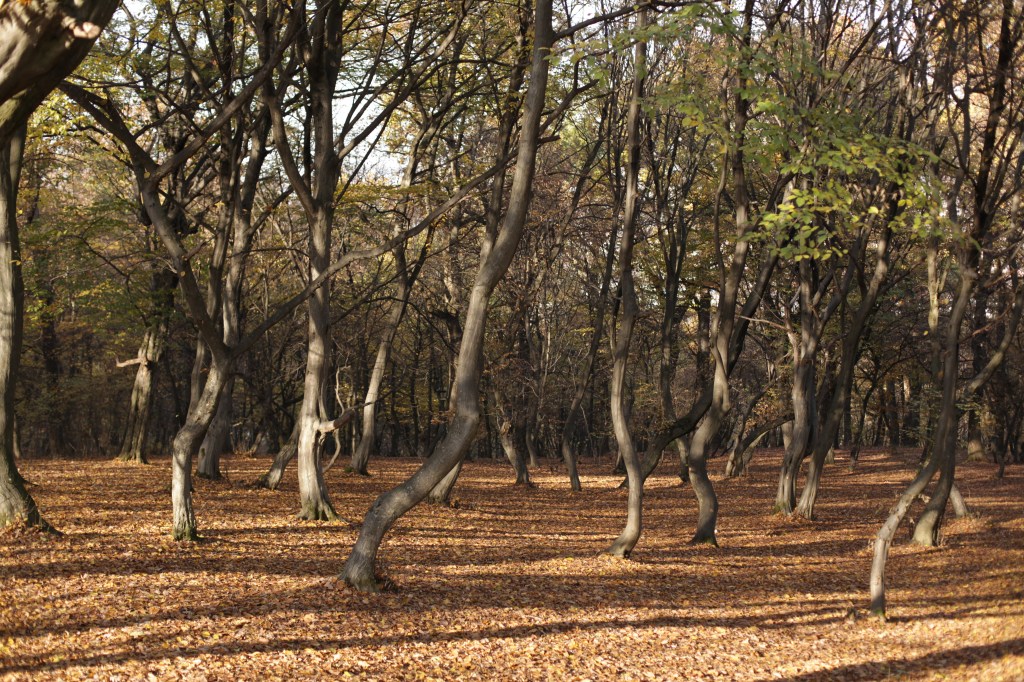
    Some photographs from Hoia-Baciu show trunks bending close to the ground before curving upward again, creating shapes that seem almost sculpted.

    Other trees grow at strange angles or form dramatic twists.These forms are real enough that even official tourism material mentions the unusual shapes of trees surrounding the Baciu area.

    They are also among the most visually persuasive elements of the legend because they require no belief in ghosts or UFOs. You can photograph them. You can stand beside them. You can touch the bark.

    The mistake comes when unusual biology is automatically transformed into evidence for an unknown force.Trees can become deformed for many reasons, including repeated physical damage during early growth, weather, competition for light, soil conditions or earlier human interference.

    Without careful dendrological analysis of individual specimens, their shape alone cannot demonstrate electromagnetic fields, radiation or paranormal influence.Yet there is something genuinely unsettling about seeing an entire photograph filled with trees that appear to have changed direction halfway through their lives.

    Even when nature has an explanation, nature does not always look natural.

    The Lost Archive of Alexandru Sift

    Perhaps one of the most intriguing parts of the Hoia-Baciu story has nothing supernatural about it at all.It concerns documentation.Alexandru Sift died in 1993.

    Accounts preserved by the Cluj County Library state that much of the documentary archive connected with his decades of observations was subsequently destroyed or lost under circumstances that have themselves become part of Hoia-Baciu folklore.

    This absence matters because Sift’s archive might have allowed later researchers to examine his photographs, dates, experimental procedures and observations systematically.Instead, we are left largely with selections, reconstructions and later testimony.

    Lost evidence is dangerous territory.It encourages two opposite mistakes.

    Believers may assume that whatever disappeared must have contained extraordinary proof, while sceptics may assume that nothing important could have been there.

    Neither conclusion follows from the loss itself.What disappeared is simply unavailable.And an unavailable archive cannot prove anything.Adrian Pătruț and Forty Years of Strange ObservationsIn 1995, Adrian Pătruț published Fenomenele de la Pădurea Hoia-Baciu, a monograph devoted to the forest and the observations associated with it. Bibliographic records confirm the volume was published in Cluj in 1995, while contemporary reporting described it as bringing together decades of photographs, testimony and investigations by several contributors.

    Pătruț approached the subject from the perspective of parapsychological investigation and regarded at least some of the phenomena as genuinely anomalous.Yet one detail attributed to him is particularly revealing.

    A Cluj County Library account of his work states that he believed only a small percentage of reports deserved serious investigation, with most being explainable as optical illusions or observations influenced by the desire to see something unusual. That observation deserves more attention than it usually receives.Because this is precisely how a legendary place evolves.

    Once thousands of people arrive hoping to encounter a phenomenon, the number of reported phenomena inevitably rises.Not necessarily because the forest has changed.Because the observer has.

    The Shepherd, the Missing Girl and the Problem With Perfect Legends

    The older folklore attached to Hoia-Baciu is considerably harder to document.One frequently repeated story claims that the name Baciu comes from a shepherd who entered the forest with approximately 200 sheep and vanished together with the entire flock.

    Another famous tale describes a young girl who disappeared in the forest and returned years later without having aged and without remembering what happened to her.Versions of these stories are repeated by paranormal-tourism sources and modern articles, but reliable contemporary documentation establishing that these events actually occurred is extremely difficult to find.

    Even the Hoia-Baciu Project presents the shepherd story explicitly as a legend. That does not make the stories worthless.Folklore tells us something different from police records.It tells us what a community feared, repeated and remembered.But there is an important difference between saying that a shepherd vanished with 200 sheep and saying that a legend developed in which a shepherd vanished with 200 sheep.For Whisper Mysteries, that distinction matters.Mystery becomes more powerful, not less powerful, when we know exactly where certainty stops.

    Missing Time, Voices and the Feeling of Being Watched

    Modern visitors have reported headaches, anxiety, nausea, sudden feelings of fear, unexplained lights, strange sounds, electronic malfunctions and an intense impression that someone or something is watching from between the trees.Some accounts go further and describe missing time.The difficulty is that these experiences are almost impossible to evaluate after the event.

    A person can genuinely experience fear without there being an external threatening presence. A battery can fail without an electromagnetic anomaly. A photograph can contain a lens reflection the photographer never noticed. An unfamiliar forest can distort our sense of distance and time more easily than we realise.

    Expectation can also influence perception enormously.If someone walks through an ordinary forest expecting an evening hike, the cracking of a branch means very little.If that same person enters a place described as one of the most haunted forests on Earth, the identical sound arrives carrying an entirely different meaning.None of this proves that every report from Hoia-Baciu has a mundane explanation.It means only that subjective experience cannot, by itself, tell us which explanation is correct.

    The Most Important Question Is Not Whether the Forest Is Haunted

    The temptation with Hoia-Baciu is to demand a verdict.

    Haunted or not haunted.UFO or hoax.Portal or clearing.

    Paranormal phenomenon or imagination.But perhaps that binary question has prevented us from seeing what makes the place genuinely fascinating.Hoia-Baciu contains several layers of reality occupying the same landscape.There is the physical forest with its trees, paths, clearings and geology.

    There is the historical forest of Emil Barnea, Alexandru Sift and decades of investigation.

    There is the folkloric forest filled with vanished shepherds and people returning from nowhere.There is the psychological forest carried inside every visitor who already knows the stories.And finally there is the digital forest, the one constructed from thousands of photographs, videos, television programmes and articles calling Hoia-Baciu the Romanian Bermuda Triangle.

    All of them now overlap.Perhaps this explains why entering Hoia-Baciu today can never reproduce what it might have felt like to enter the same woodland in 1950.The forest has acquired a memory.

    Not necessarily a supernatural memory, but something almost as powerful: a human one.Every person who walks beneath those trees carries fragments of all the previous stories with them.

    So What Really Happened at Hoia-Baciu?

    Something certainly happened.Emil Barnea really did take the photographs that became famous in 1968. Alexandru Sift really investigated unusual manifestations around the area. A 1974 article really brought those investigations before a wider Romanian audience. Adrian Pătruț really compiled a substantial volume devoted to decades of observations. The unusual-looking trees exist, and so does Poiana Rotundă.

    What has not been demonstrated is the extraordinary conclusion.There is no established scientific evidence that Hoia-Baciu is a portal, that extraterrestrial craft regularly visit it, that ghosts inhabit the forest or that known physical laws cease to operate there.But that does not make Hoia-Baciu uninteresting.

    Quite the opposite.The most disturbing mysteries are rarely those in which everything can be proved. They are the cases in which a small core of documented reality survives beneath decades of exaggeration, leaving just enough uncertainty that the story cannot be completely closed.Somewhere beneath the ghost tours, television documentaries and internet mythology there remains a real forest outside Cluj.

    A biologist spent years watching it.

    A man pointed a camera toward its sky in August 1968.

    Several photographs survived.Thousands of stories followed.And more than half a century later, people are still entering the trees hoping that, for a few seconds, Hoia-Baciu will show them something that should not be there.Perhaps the strangest thing about the forest is not that so many people claim to have seen the impossible.

    Perhaps it is that after all these years, we are still looking.
  • The Rosenheim Poltergeist: The Office Where Something Seemed to Bend the Rules of Reality

    The Rosenheim Poltergeist: The Office Where Something Seemed to Bend the Rules of Reality

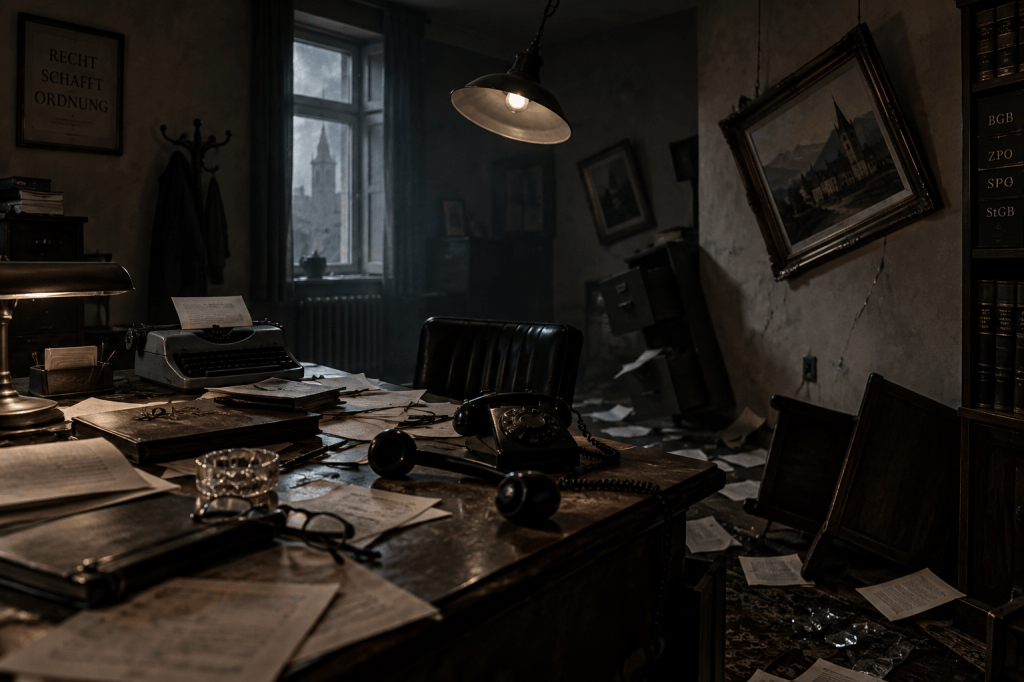
    There are haunted houses whose stories begin with footsteps in an empty corridor, a pale figure at the foot of a bed, or the whisper of a dead relative heard in the middle of the night. Rosenheim was different. There was no ruined castle, no forgotten cemetery beneath the floorboards and no ancient family curse waiting conveniently in the background. The disturbances began inside an ordinary German law office, among ringing telephones, filing cabinets, fluorescent lights, invoices and typewriters, which may be one reason the case still feels so uncomfortable more than half a century later.

    Because whatever happened there did not behave like the traditional ghost of folklore.

    It behaved, at least according to those who investigated it, almost as though something invisible had learned how to interfere with electricity, machinery and matter itself.

    In the autumn of 1967, strange disturbances began to be reported in the law office of attorney Sigmund Adam in Rosenheim, a Bavarian town southeast of Munich. Automatic fuses reportedly tripped without an obvious electrical cause, light bulbs burst, hanging lamps began swinging, loud cracks were heard in the rooms and the telephone system behaved in ways the staff could not explain. Calls appeared to have been registered that nobody remembered making, including repeated connections to the German telephone time service, then reached through the number 0119.

    At first, nobody needed a ghost.

    They needed an electrician.

    And that distinction matters, because the people involved did not immediately interpret the disturbances as paranormal. The obvious possibility was that something was wrong with the building’s electrical installation, so technicians from the Rosenheim municipal utility began examining the office. According to the contemporary technical account published the following year, investigations had already been underway for more than three weeks by the time physicists Friedbert Karger and Gerhard Zicha arrived. The electricity company installed recording instruments designed to monitor voltage and current, replaced or isolated parts of the electrical system and eventually supplied parts of the office through separate wiring and an emergency generator.

    Yet the reported disturbances continued.

    That is where the story begins to become difficult.

    The Machines Began Recording Something

    Voltage and current recorders installed in the office sometimes produced dramatic deflections. The investigators were interested in these events precisely because, unlike a frightened witness saying that a lamp had moved, an instrument left a physical trace.

    Karger and Zicha later published a technical investigation of the case in the Zeitschrift für Parapsychologie und Grenzgebiete der Psychologie. Their report described telephone disturbances, unexplained recorder deflections, loud noises, automatic circuit breakers switching off, exploding bulbs and lamps swinging with unusual force. They also noted that efforts by the local electricity utility — including separate lamps, wiring and an emergency power source — had not simply made the phenomenon disappear.

    This did not prove anything supernatural. An unexplained measurement is not the same thing as evidence for a spirit, and it is worth remembering that unusual electrical behaviour can arise from causes that are extremely difficult to locate.

    Nevertheless, Rosenheim had moved beyond the familiar territory of ghost stories told around a kitchen table. Technicians were now watching instruments, police were aware of the investigation, witnesses were being questioned and physicists were trying to understand why equipment appeared to be registering disturbances for which they could not find a satisfactory physical explanation.

    Then the pictures on the walls began to move.

    Hans Bender, one of Germany’s best-known researchers of alleged paranormal phenomena and at the time director of the Institute for Frontier Areas of Psychology and Mental Health in Freiburg, became involved. Bender’s own account described pictures rotating on their suspension points, sometimes falling from the walls, along with drawers and furniture apparently moving without an obvious hand pushing them. His team attempted to document events with an AMPEX video recorder, managing to record swinging lamps and noises, while some of the more dramatic events remained frustratingly unpredictable.

    One particular observation preserved in Bender’s report is difficult to forget.

    Paul Brunner, involved in the electrical investigation, reported standing near a floral picture when it suddenly rotated approximately 320 degrees, twisting its hanging wire around the hook. Another witness present at the time confirmed that he had seen the picture move from its resting position. Other technicians subsequently reported seeing pictures swing or turn.

    Whether those observations had a paranormal cause is another question entirely.

    But the witnesses themselves were real.

    The reports were real.

    And the investigation existed.

    Then They Noticed Annemarie

    Among the employees in the office was a nineteen-year-old apprentice, usually identified in accounts of the case as Annemarie Schaberl.

    As the investigation progressed, Bender’s group became convinced that the frequency of the disturbances was somehow associated with her presence. Their published summary claimed that the number of incidents appeared to decrease with increasing distance from the young woman and that the phenomena eventually stopped after she left the workplace.

    This detail transformed Rosenheim from an electrical mystery into something much stranger.

    Bender did not believe that Annemarie was possessed by a dead person. Nor did he necessarily imagine an invisible ghost wandering around the law office unscrewing bulbs and pushing pictures.

    He proposed something arguably even more disturbing.

    Spontaneous psychokinesis.

    Within parapsychology, this idea suggested that intense unconscious psychological states might somehow produce physical effects outside the body, particularly around certain individuals during periods of emotional strain. There is no accepted mechanism in modern physics demonstrating that human emotion can cause objects to move at a distance, and psychokinesis has never been established as a reproducible phenomenon under the standards required by mainstream experimental science.

    But Bender believed that poltergeist cases might not primarily concern the dead at all.

    They might concern the living.

    Instead of imagining a spirit entering a room, this interpretation asks us to imagine something hidden inside the human mind somehow escaping the ordinary boundaries of the nervous system and acting upon the surrounding world.

    It is a deeply unsettling idea because it changes the location of the haunting.

    The haunted place would not be the building.

    The haunted place would be the person.

    Bender used the concept of an emotional or “affective field” when discussing spontaneous phenomena, and the Rosenheim report linked the concentration of the disturbances with the apparent proximity of the young employee. His interpretation belonged to parapsychology rather than established physics, but it would become central to the legend of Rosenheim.

    There is something psychologically fascinating here even if one rejects the paranormal explanation completely. Human beings have always imagined hauntings as intrusions from outside ourselves — the dead returning, demons entering, invisible beings crossing some forbidden threshold — while the poltergeist tradition frequently reverses that image and places the source inside an emotionally disturbed living person.

    If that model were ever shown to be real, the implications would be extraordinary.

    There is presently no scientific basis for saying that it has been.

    And Rosenheim certainly did not settle the question.

    The Case Was Not as Clean as the Legend Suggests

    This is the part that many paranormal retellings quietly omit.

    Rosenheim became famous, and fame is rarely kind to an investigation.

    By 1969, illusionist Albin Neumann, known professionally as Allan, together with Herbert Schiff and Gert Günther Kramer, had published Falsche Geister – Echte Schwindler — roughly, False Ghosts, Real Swindlers. Their account challenged the paranormal interpretation and argued that at least some of the spectacular physical phenomena could have been produced through ordinary deception.

    The controversy became serious enough that the German newspaper Die Zeit revisited the case in April 1970 under the wonderfully appropriate title “Geister oder Nylon?” — “Ghosts or Nylon?” The article discussed allegations that fine nylon threads could have been used to move fixtures and objects inside the office.

    This cannot simply be brushed aside because it damages a good ghost story.

    If evidence of trickery existed, it matters enormously.

    Later sceptical critics also attacked the methodology of the investigation, arguing that the controls were not strong enough to exclude fraud reliably and questioning whether Bender’s publications presented every problematic detail of the case. Physicist John Taylor would later argue that some of the recorder traces might themselves have been produced mechanically and regarded expectation, misinterpretation and trickery as more plausible explanations than psychokinesis.

    At this point it would be tempting to close the file.

    Nylon thread was alleged, therefore there was no mystery.

    But that conclusion is also more convenient than the surviving evidence allows.

    Showing that a lamp could have been moved with a hidden thread does not automatically reconstruct every event reported over the preceding months, nor does it by itself account for every electrical disturbance, telephone irregularity or instrument reading described during the technical investigation. Conversely, the fact that technicians failed to explain something at the time cannot transform an unexplained event into evidence for psychokinesis.

    Rosenheim therefore occupies an uncomfortable space between two stories, neither of which can simply swallow the other.

    The paranormal version sometimes claims too much.

    The sceptical version can also become more certain than the evidence permits.

    And somewhere between them is what actually happened inside that Bavarian office.

    What Makes Rosenheim Different

    Most famous hauntings are built almost entirely from testimony. Someone saw a woman standing on the stairs. Someone heard footsteps in a locked room. Someone woke with scratches across their body.

    Rosenheim is stranger because technical people became involved before the story had finished unfolding.

    The municipal utility investigated. Electrical monitoring equipment was installed. Physicists wrote a technical paper. Witness statements were collected. Attempts were made to record the phenomena. Bender’s preliminary account and the Karger-Zicha physical investigation appeared in a 1968 journal issue devoted substantially to the case, and those documents remain accessible today through the University Library of Freiburg.

    That does not mean that scientists proved the paranormal.

    They did not.

    It means something subtler and, perhaps, more interesting: scientifically trained observers encountered a confusing collection of events, some of which they believed they could not explain using the physical causes they had examined.

    History contains many unexplained observations that later received ordinary explanations. Instruments fail. Witnesses make mistakes. People deceive investigators. Investigators become attached to their theories. Rare combinations of circumstances produce events that look impossible until somebody notices the missing variable.

    All of those possibilities belong inside Rosenheim.

    But there is another uncomfortable fact.

    Not every anomaly documented in a controversial case automatically vanishes because fraud has been demonstrated somewhere within that case.

    Human reality is often messier than that.

    A person can fake one incident after genuinely witnessing another that frightened them. A witness can misunderstand an event while accurately reporting something else. Investigators can correctly eliminate several explanations while overlooking the one explanation that matters. A case can contain deception, coincidence, faulty interpretation and genuinely unresolved events simultaneously.

    Perhaps that is exactly what happened in Rosenheim.

    Or perhaps something stranger occurred.

    Was Annemarie the Poltergeist?

    The strangest element remains the apparent relationship between the disturbances and the nineteen-year-old apprentice.

    Bender’s published summary stated that the phenomena diminished with distance from her and ceased when she changed workplaces.

    If this association was genuine, it still does not tell us why it existed.

    Perhaps Annemarie herself produced some of the disturbances deliberately.

    Perhaps other people did.

    Perhaps her presence created heightened expectations and witnesses began interpreting ordinary events differently.

    Perhaps the correlation was exaggerated afterward.

    Or perhaps Bender had encountered something for which our ordinary psychological vocabulary was inadequate.

    The difficulty is that Rosenheim took place in 1967, not inside a modern laboratory surrounded by synchronized high-resolution cameras, independent observers, tamper-proof sensors and continuous digital recording. The evidence that survives is substantial enough to make the story interesting but incomplete enough to prevent certainty.

    And certainty is precisely what both believers and sceptics often want most.

    The believer wants the final sentence to say that Rosenheim proves the mind can move matter.

    The sceptic wants it to say that nylon thread solved everything.

    The documents stubbornly refuse to give either side such an elegant ending.

    Perhaps the Most Disturbing Possibility Is Not a Ghost

    More than fifty years later, nothing in the Rosenheim material allows us responsibly to say that a supernatural entity haunted Sigmund Adam’s office.

    There is no verified ghost.

    There is no established physical mechanism for spontaneous psychokinesis.

    There are serious allegations of deception, methodological weaknesses and competing interpretations that prevent the case from being treated as scientific proof of the paranormal.

    And yet, after all of those qualifications have been made, Rosenheim does not become boring.

    Quite the opposite.

    Because beneath decades of sensational retelling remains an office in Bavaria where electricians installed equipment because something was repeatedly going wrong, where recording instruments produced unusual traces, where technicians and other witnesses described objects moving, where researchers arrived expecting to study an electrical anomaly and eventually began discussing psychokinesis, and where the disturbances appeared, according to the investigators, to orbit around one young woman.

    Then she left.

    And the office became quiet.

    Perhaps the explanation was entirely human.

    Perhaps some crucial technical defect was never discovered.

    Perhaps a mixture of tricks, anxiety, coincidence and expectation created one of the most famous poltergeist cases of the twentieth century.

    Or perhaps, hidden somewhere inside those old recorder traces and contradictory witness statements, there was a phenomenon for which the investigators simply did not possess the right language.

    That is why Rosenheim still matters.

    Not because it proves that ghosts exist, but because it leaves behind a question considerably more disturbing than a ghost story:

    If the source of a poltergeist is sometimes not a dead person at all, but something unconscious within the living human mind, what exactly are the limits of the mind we believe we understand?

    More than half a century later, Rosenheim has still not given us a reliable answer.

    And perhaps that unanswered space is where the real haunting begins.

    Sources and Further Reading

    Hans Bender, Der Rosenheimer Spuk – ein Fall spontaner Psychokinese, Zeitschrift für Parapsychologie und Grenzgebiete der Psychologie, Vol. 11, 1968.

    F. Karger & G. Zicha, Physikalische Untersuchung des Spukfalles in Rosenheim 1967, Zeitschrift für Parapsychologie und Grenzgebiete der Psychologie, Vol. 11, 1968.

    Institute for Frontier Areas of Psychology and Mental Health, historical information on Hans Bender and the institute.

    Alexander Adrion, Rosenheimer Spuk wieder vor Gericht: Geister oder Nylon?, Die Zeit, April 10, 1970.

    Allan [Albin Neumann], Herbert Schiff & Gert Günther Kramer, Falsche Geister – Echte Schwindler, Zsolnay, Vienna, 1969. Contemporary critical discussion of the book and the Rosenheim controversy appeared in Die Zeit.

  • The Devil’s Footprints: What Walked Across Devon on the Night of February 8, 1855?

    The Devil’s Footprints: What Walked Across Devon on the Night of February 8, 1855?

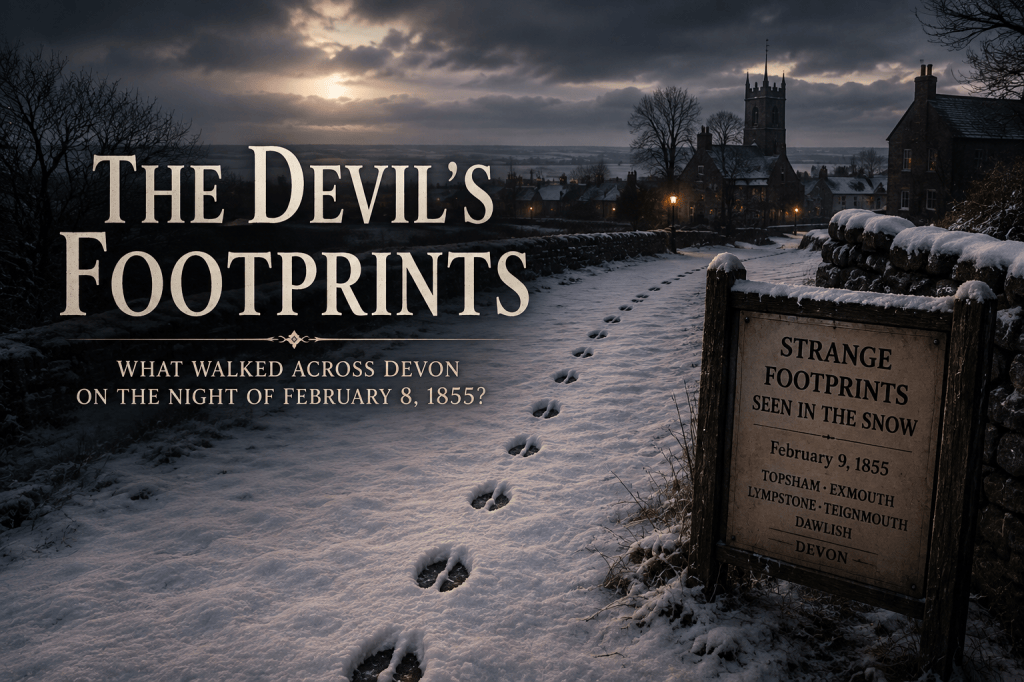
    On the morning of February 9, 1855, residents of several towns and villages in Devon awoke to a landscape transformed by snow and to a mystery that would outlive almost everyone who saw it. Across gardens, roads, fields and enclosed courtyards appeared lines of unusual impressions that many witnesses compared to the marks of a small hoof, although the creature that might have produced them was nowhere to be found.The tracks were reported around communities including Topsham, Lympstone, Exmouth, Teignmouth and Dawlish, and before long newspapers were describing them in places that seemed increasingly difficult to explain. They appeared in open countryside but were also said to continue into walled gardens, across narrow walls and, according to contemporary reports, even over the snow-covered tops of houses.What particularly disturbed observers was not simply the shape of the marks but the strange manner in which many of them seemed to proceed. Rather than displaying the alternating pattern expected from an ordinary four-legged animal, some trails appeared to consist of impressions following one another in an almost single line, separated by surprisingly regular intervals.Within days, naturalists, clergymen, journalists and ordinary residents were debating what could possibly have crossed the snowy Devon countryside.Some proposed badgers, birds, rodents, toads or an escaped kangaroo, while others suspected that several completely ordinary animals had produced different tracks that frightened observers subsequently combined into a single extraordinary mystery.Among the more superstitious inhabitants, however, another possibility began to circulate.Perhaps the tracks belonged to no ordinary animal at all.Perhaps, during that cold February night, the Devil himself had walked through Devon.

    A Snowfall That Left Something Behind

    The mystery began after snow fell across parts of southern Devon during the night of February 8–9, 1855. When residents emerged the following morning, they discovered unusual trails impressed into the fresh covering.The story spread remarkably quickly.

    On February 16, The Times reported that considerable excitement had been caused in Topsham, Lympstone, Exmouth, Teignmouth and Dawlish by the discovery of strange foot-tracks. The newspaper noted that the marks had been observed not only in ordinary fields and roads but in locations that appeared much more difficult for an animal to reach, including gardens and courtyards enclosed by walls and fences.

    The newspaper also recorded the supernatural interpretation already circulating among local people, reporting that some believed the marks might have belonged to Satan and that the mystery had generated enough interest to be discussed from the pulpit.The event was therefore not a legend invented generations afterward. Newspapers were discussing the strange tracks while the snow, the witnesses and the excitement surrounding them were still contemporary realities.Yet those same reports also reveal something important that later retellings sometimes obscure: people did not agree about exactly what they had seen.

    What Did the Footprints Actually Look Like?

    Modern illustrations often depict the Devil’s Footprints as a perfectly uniform trail of tiny cloven hooves stretching uninterrupted across Devon, but the surviving nineteenth-century descriptions are considerably messier and therefore considerably more interesting.Some witnesses compared the impressions to a donkey’s hoof or horseshoe, while others described them as divided or cloven. Measurements also varied from place to place, and drawings reproduced by the Illustrated London News showed different forms rather than one perfectly consistent mysterious footprint.One report described impressions roughly four inches long and less than three inches wide, separated by intervals of approximately eight inches, while accounts from other locations recorded different dimensions and shapes.This inconsistency is crucial.If every observer across Devon had recorded an identical footprint with precisely the same dimensions and stride, the case for a single mysterious source would be considerably stronger. Instead, the historical record suggests that several types of unusual marks may have been grouped together under one rapidly spreading story.The mystery may therefore have begun not with one impossible trail, but with many puzzling trails discovered after the same unusual weather.Once newspapers began connecting them, Devon suddenly seemed to have been crossed by a single invisible visitor.

    The Tracks That Seemed to Ignore Walls

    The most famous part of the story concerns the apparent ability of the tracks to continue through or across obstacles that should have interrupted the path of an ordinary animal.Contemporary reports described impressions on walls, rooftops and inside enclosed gardens. Residents sometimes claimed that the trail approached an obstacle and appeared again on the opposite side, creating the impression that whatever had made the marks had crossed barriers without changing its direction.This transformed a curious zoological puzzle into something far more unsettling.A fox could cross a field, a bird could land in a garden and a badger could leave unusual impressions in melting snow, but what kind of animal could apparently maintain the same mysterious trail over walls, roofs and fences?The newspapers themselves struggled with the question.Reports described local people gathering in groups to inspect the tracks, comparing theories and following trails through the landscape, while speculation grew with every new location in which unusual marks were discovered.Some residents treated the affair humorously, but others were genuinely frightened.The supernatural explanation had found ideal conditions in which to grow.

    When Devon Began Talking About the Devil

    Victorian England was living through enormous scientific and technological change, but traditional beliefs, folklore and religious interpretations remained deeply embedded in everyday culture. A strange trail appearing overnight after snowfall could therefore exist simultaneously as a natural-history puzzle, a newspaper curiosity and a supernatural warning.The nickname “Devil’s Footprints” captured the imagination because some of the impressions were interpreted as resembling a cloven hoof, a form long associated in European Christian imagery with demonic figures.Newspaper coverage demonstrates that the Satanic interpretation was already circulating in February 1855, although it would be misleading to imagine that everyone in Devon accepted it.Indeed, some journalists openly mocked the panic. Trewman’s Exeter Flying Post, reporting later that month, described the excitement in terms suggesting that it belonged more appropriately to the “dark ages,” while still acknowledging that the mysterious tracks had genuinely been observed across numerous locations.The disagreement itself tells us something important.Devon was not simply terrified by a supernatural event.Devon was arguing about one.

    The Kangaroo That Probably Never Escaped

    Among the most memorable explanations was the suggestion that a kangaroo had escaped from a private menagerie.To Victorian readers, the idea was not quite as ridiculous as it sounds today. Exotic animals were kept in private collections, and a kangaroo moving through snow could potentially produce unfamiliar tracks that local residents failed to recognize.The theory became associated with the Reverend G. M. Musgrave of Withycombe Raleigh, who discussed the possibility of an escaped kangaroo.There was, however, a problem.Musgrave later indicated that he had encouraged the kangaroo story largely because he wanted to divert frightened parishioners away from the belief that the Devil was roaming through Devon.In other words, one of the most famous explanations may itself have been deliberately promoted as a reassuring alternative to supernatural panic rather than as the result of evidence that an actual kangaroo had escaped.Even if a kangaroo had been loose, another difficulty remained: tracks were being reported across a broad area and on both sides of the Exe estuary.The hypothetical animal would have needed to undertake a remarkable winter journey.

    Richard Owen Suspected a Badger

    A considerably more serious zoological explanation came from Richard Owen, one of nineteenth-century Britain’s most prominent anatomists and the scientist who had coined the term “Dinosauria.”Writing to the Illustrated London News, Owen suggested that a badger could have produced at least some of the mysterious impressions.The theory had several advantages. Badgers were native to Britain, could travel considerable distances while searching for food and possessed feet capable of leaving marks that might appear unexpectedly hoof-like after snow had partially melted or distorted their original form.Owen also questioned the assumption that a single animal had produced every trail. If numerous badgers and other animals had been active across Devon during the same snowy conditions, witnesses in different communities might have discovered similar-looking but unrelated tracks.This possibility becomes especially important when we remember how quickly the newspaper story expanded.Once people knew that mysterious footprints were being reported elsewhere, almost any unusual trail in the snow could become part of the phenomenon.

    Could Mice Have Created the Devil’s Hooves?

    One of the most intriguing explanations involves an animal considerably smaller than a badger.A hopping mouse can bring its feet together during a leap, producing a combined impression that looks surprisingly different from the ordinary footprint people expect from a rodent. Under certain snow conditions, repeated jumps can create a neat series of marks resembling tiny hoof-like impressions.The possibility was already being discussed in 1855, when correspondence published by the Illustrated London News compared the mysterious Devon tracks with marks made by rodents and other small animals.Later researchers revisiting the case have considered mice particularly useful for explaining trails found in places such as rooftops, narrow walls and enclosed spaces, because rodents could reach locations that would seem extraordinary if observers imagined a much larger hoofed creature.Melting snow could then perform the final transformation.A small animal’s detailed footprint might lose the impressions of toes and claws as temperatures changed, leaving behind a larger, smoother depression whose original shape was no longer obvious.By the time a person discovered it, the mouse could be gone and its ordinary tracks could have become something that looked remarkably unfamiliar.

    Birds, Toads and Other Suspects

    The list of proposed culprits did not stop with badgers and mice.Contemporary correspondents suggested birds, particularly waders, whose footprints could change dramatically depending upon the depth and consistency of snow. Others considered otters, foxes and various small mammals.In March 1855, Trewman’s Exeter Flying Post even published an account from a man near Torquay who had followed strange tracks in his garden until he discovered a large toad beneath the stump of a tree. He believed that the animal’s impressions closely resembled illustrations of the mysterious Devon tracks.A toad obviously cannot explain every report scattered across southern Devon, but that is precisely the point.Perhaps nothing explains all of them because there was never a single phenomenon requiring one explanation.Badgers could have produced one trail, rodents another, birds another and melting snow could have altered all of them.A newspaper narrative could then do what newspapers, folklore and human memory frequently do extremely well: transform many separate incidents into one unforgettable story.

    Did One Creature Really Travel One Hundred Miles?

    One of the most repeated claims about the Devil’s Footprints is that a single trail extended for approximately one hundred miles during a single night.It is also one of the details that deserves the greatest caution.The surviving reports certainly describe unusual tracks across a broad region, but they do not establish an uninterrupted hundred-mile trail made by one creature. Locations, measurements and descriptions differ, and the idea of a single continuous journey appears stronger in later retellings than in the fragmented evidence left by witnesses and newspapers.The distinction fundamentally changes the mystery.A single animal leaving identical tracks for one hundred miles while crossing estuaries, roofs and walls would present an extraordinary physical problem.Numerous animals leaving superficially similar tracks across a snowy county would present a very different one.The second scenario may be less supernatural, but it reveals something equally fascinating about the way mysteries are created.People did not need to invent the footprints.They only needed to connect them.

    The Reverend Who Preserved the Evidence

    Much of what researchers know about the episode owes something to material associated with Henry Thomas Ellacombe, the vicar of Clyst St George.Documents connected with Ellacombe included correspondence about the tracks and drawings or tracings showing what witnesses believed they had seen. These materials became particularly important to later researchers because they demonstrated that the footprints were not described uniformly.Some were rounded, some appeared hoof-like, some suggested claws or toes, and their measurements varied.This surviving evidence creates an uncomfortable problem for the most spectacular version of the legend.The closer we move toward the original reports, the less the Devil’s Footprints resemble one perfectly consistent supernatural trail.Yet this does not make the story uninteresting.It makes it better.Instead of asking what impossible creature crossed Devon, we can ask how an entire region came to believe that many mysterious marks might belong to the same visitor.

    Weather May Have Been the Invisible Accomplice

    Snow is an unreliable recorder.A footprint impressed into fresh snow does not necessarily preserve the shape of the foot that created it. Temperature, wind, sunlight, freezing and thawing can enlarge or distort the original impression, sometimes removing fine details while preserving only the deepest part of the track.This process can produce a phenomenon sometimes described as enlargement through thawing, in which a small print gradually becomes larger and more rounded.A bird track can lose recognizable toes.A rodent’s clustered impressions can merge.A paw can begin to resemble something more like a hoof.If different animals crossed Devon during the night and their tracks subsequently underwent similar weathering, observers could have encountered impressions that looked more alike than the original footprints actually were.The snow, in other words, may not merely have preserved the mystery.It may have helped create it.

    Why the Mystery Survived

    The Devil’s Footprints endured because no explanation managed to account convincingly for every reported detail, particularly when those details were treated as parts of a single event.A badger explains some features but not every rooftop.Rodents can explain small single-file tracks and access to narrow surfaces but seem inadequate when applied indiscriminately to every witness account.Birds and toads can reproduce particular shapes but not the entire geographical legend.Weather explains distortion but still requires animals to have produced the original impressions.The mistake may be assuming that one solution is necessary.The historical evidence permits a much more complicated possibility in which several ordinary causes occurred simultaneously and were joined together by extraordinary circumstances: unusual snowfall, unfamiliar animal tracks, changing weather, frightened communities, religious imagery and newspapers eager to report a mystery that became more remarkable each time another town was added to the story.None of this requires the witnesses to have lied.They may genuinely have seen tracks they could not identify.What changed was the interpretation.

    So What Walked Across Devon?

    More than 170 years later, there is no surviving footprint that can be subjected to modern forensic examination, no photograph capable of settling the matter and no animal waiting to be identified from biological evidence.What remains are newspaper reports, letters, drawings, later recollections and a story that became larger than the snow in which it began.It is entirely possible that no single creature ever crossed Devon that night.Mice may have jumped across rooftops, badgers may have searched fields for food, birds may have crossed gardens and other animals may have left tracks that changed shape as the snow thawed. Residents who had already heard rumors about mysterious hoofprints would naturally examine every unusual mark more carefully, while newspapers connected reports separated by miles into one enormous trail.Yet there remains something wonderfully unsettling about returning to Devon on that February morning in imagination.The inhabitants did not possess our later theories. They opened their doors and discovered strange impressions where there had been fresh snow the night before, followed them toward walls and gardens, heard that identical marks had supposedly appeared in neighboring towns and discovered that nobody could tell them with certainty what had made them.By the time darkness returned, some residents were reportedly reluctant to venture outside.Whatever walked through Devon in February 1855 may therefore have been several animals, altered snow and a rapidly expanding rumor rather than a single impossible visitor.But for one winter morning, before explanations had time to catch up with imagination, something seemed to have crossed the sleeping countryside without respecting walls, roofs, rivers or locked gates.The snow eventually melted.The footprints disappeared with it.The mystery did not.—Sources & Further ReadingThe Times, February 16, 1855 — one of the important contemporary newspaper reports describing the unusual tracks around Topsham, Lympstone, Exmouth, Teignmouth and Dawlish, as well as the excitement and supernatural speculation they generated.The Illustrated London News, February–March 1855 — published drawings, correspondence and proposed explanations for the Devon tracks, including contributions discussing badgers, rodents and other animals.Trewman’s Exeter Flying Post, February–March 1855 — valuable local reporting that demonstrates both the extent of contemporary interest and the skepticism with which some observers treated the mystery.Henry Thomas Ellacombe papers — correspondence and tracings associated with the vicar of Clyst St George became important evidence for later researchers because they preserve differing descriptions of the tracks.Mike Dash, “The Devil’s Hoofmarks: Source Material on the Great Devon Mystery of 1855,” Fortean Studies — a detailed modern collection and analysis of primary and secondary material concerning the event.G. A. Household, The Devil’s Footprints: The Great Devon Mystery of 1855 — a collection of historical material concerning the newspaper reports and proposed explanations surrounding the case.

    Sources & Further Reading
    The Times, February 16, 1855 — one of the important contemporary newspaper reports describing the unusual tracks around Topsham, Lympstone, Exmouth, Teignmouth and Dawlish, as well as the excitement and supernatural speculation they generated.
    The Illustrated London News, February–March 1855 — published drawings, correspondence and proposed explanations for the Devon tracks, including contributions discussing badgers, rodents and other animals.
    Trewman’s Exeter Flying Post, February–March 1855 — valuable local reporting that demonstrates both the extent of contemporary interest and the skepticism with which some observers treated the mystery.
    Henry Thomas Ellacombe papers — correspondence and tracings associated with the vicar of Clyst St George became important evidence for later researchers because they preserve differing descriptions of the tracks.
    Mike Dash, “The Devil’s Hoofmarks: Source Material on the Great Devon Mystery of 1855,” Fortean Studies — a detailed modern collection and analysis of primary and secondary material concerning the event.
    G. A. Household, The Devil’s Footprints: The Great Devon Mystery of 1855 — a collection of historical material concerning the newspaper reports and proposed explanations surrounding the case.

    Fediverse Reactions
  • The Green Children of Woolpit: The Medieval Mystery That Has Never Been Fully Explained

    The Green Children of Woolpit: The Medieval Mystery That Has Never Been Fully Explained

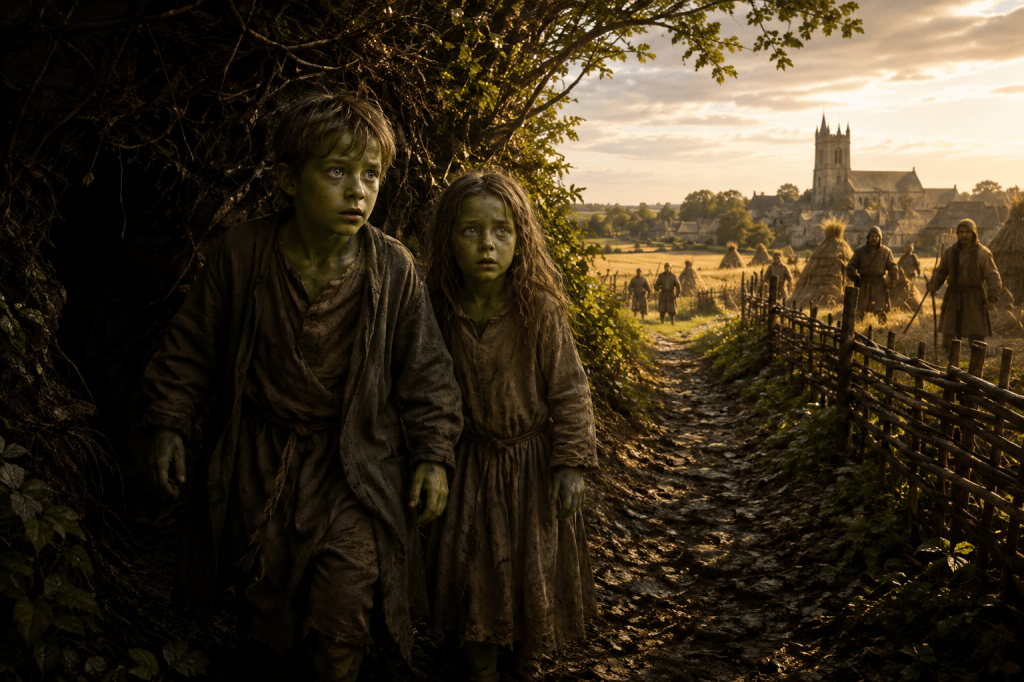
    Sometime during the twelfth century, while workers were gathering the harvest near the small English village of Woolpit in Suffolk, two children appeared in the countryside under circumstances so unusual that their story would survive for more than eight hundred years.

    They were a boy and a girl, apparently brother and sister, and according to the medieval chroniclers who recorded the event, there was immediately something extraordinary about them. Their clothes were made from material the local people did not recognize, the language they spoke could not be understood by anyone around them, and, most remarkably of all, their skin appeared to have a distinctly green coloration.

    The children seemed frightened and disoriented, and they were unable to explain where they had come from because nobody could understand their speech. They were eventually taken into the household of a local landowner, where another strange detail soon emerged: although food was placed before them, they refused almost everything they were offered.

    Then they saw beans.

    According to the medieval accounts, the children immediately became excited and searched desperately for the beans inside their stalks, apparently unfamiliar with the way the plants were presented to them. Once the beans themselves were produced, they ate eagerly.

    For some time, beans were reportedly almost the only food they would accept.

    Eventually their diet changed, their green coloration gradually disappeared, and the surviving child learned enough English to tell the people around her where she believed she had come from.

    Her explanation transformed an already unusual story into one of medieval England’s most enduring mysteries.

    She said that she and her brother had come from a place known as St Martin’s Land, a country where the sun did not shine as it did in England and where the world remained beneath a strange twilight.

    According to her account, everyone there was green.

    The Village Where the Children Appeared

    Woolpit is a real village in Suffolk, situated not far from Bury St Edmunds, and its unusual name has traditionally been connected with pits used for trapping wolves. The medieval form of the name is generally understood as deriving from something resembling “wolf pit,” which provided later storytellers with an appropriately mysterious landscape for the children’s appearance.

    One version of the story describes the children emerging near one of these pits during harvest time, where workers discovered them wandering in confusion.

    The event would probably have disappeared completely into local folklore had it not attracted the attention of two medieval chroniclers.

    The first was William of Newburgh, an Augustinian canon born around 1136 who wrote his Historia rerum Anglicarum, or History of English Affairs, toward the end of the twelfth century.

    William was not merely collecting fairy tales. His work was intended as a history of England beginning with the Norman Conquest, although, like many medieval historians, he also included accounts of wonders, supernatural events and phenomena that he considered sufficiently remarkable to record.

    When introducing the strange children, William himself acknowledged how difficult the story was to believe, yet indicated that the number and quality of the witnesses convinced him that something unusual had occurred.

    The second account comes from Ralph of Coggeshall, a monk and later abbot of Coggeshall Abbey in Essex, whose Chronicon Anglicanum also contains the story.

    Ralph’s account is particularly interesting because he claimed to have obtained information from Richard de Calne, the man whose household had reportedly taken in the children. If that statement is accurate, Ralph’s version brings us considerably closer to people associated with the original event than many legends of medieval Europe allow.

    The two chronicles differ in some details, but their central elements are remarkably similar: two strangely dressed children appeared near Woolpit, their skin had a green coloration, their language was unfamiliar, and initially they would eat little except beans.

    The Children Who Would Eat Only Beans

    Once the children had been brought into local care, attempts were made to feed them, but the food offered to them appeared unfamiliar or unacceptable.

    Then green beans were brought into their presence.

    The children reportedly reacted with intense interest, although one version of the story contains an intriguing detail: they initially searched the stalks rather than opening the pods, as though they recognized the food but did not understand where the beans were located on the plant before them.

    After someone showed them the pods, they ate eagerly.

    For a period afterward, beans remained their preferred food, although they gradually began eating other foods as they adapted to their new surroundings.

    At the same time, another transformation supposedly occurred.

    Their green skin began to fade.

    The boy, however, did not recover as successfully as his sister. Medieval accounts describe him as becoming increasingly weak or depressed, and he eventually died.

    The girl survived.

    She was baptized, remained in England and gradually learned the local language.

    Only then could anyone ask the question that must have occupied the villagers from the moment the children appeared.

    Where had they come from?

    The Land Where the Sun Never Fully Rose

    The girl’s answer was extraordinary.

    She reportedly said that she and her brother came from a place called St Martin’s Land, where the inhabitants were Christian and where churches existed, but the quality of daylight was completely different from that of England.

    The sun, she explained, did not shine brightly over their homeland.

    Instead, the country existed beneath something resembling perpetual twilight.

    In one version of the account, she described another luminous land visible beyond a considerable river, suggesting that her own country was separated from a brighter region by water.

    When asked how she and her brother had reached Woolpit, her explanation became even stranger.

    According to the story preserved by the chroniclers, the children had been tending their father’s animals when they entered or followed them into some kind of underground passage or cavern. Inside the darkness they heard the sound of bells, and after wandering through the passage for what seemed like a long time, they suddenly emerged into brilliant daylight.

    The intensity of the sunlight supposedly overwhelmed them because they had never experienced anything like it.

    Before they could find their way back, the harvest workers discovered them.

    The children had apparently crossed from one world into another without understanding how they had done it.

    At least, that was how medieval listeners could interpret the story.

    Was St Martin’s Land Somewhere on Earth?

    The obvious question is whether the girl’s mysterious homeland might have been a perfectly ordinary location whose description became distorted through language, fear and retelling.

    One modern hypothesis proposes that the children may have belonged to a Flemish community living in eastern England.

    Flemish settlers and textile workers were present in medieval England, and political conflict during the twelfth century created periods of hostility and violence involving Flemish communities and mercenaries.

    In 1173, during the rebellion against Henry II, fighting occurred at Fornham, not far from Bury St Edmunds. A later theory proposed by Paul Harris suggested that the children might have been displaced Flemish youngsters associated with Fornham St Martin, providing a possible explanation for the girl’s reference to “St Martin’s Land.”

    If the children spoke a Flemish dialect, their language could easily have sounded completely incomprehensible to rural English villagers.

    Their unfamiliar clothing might similarly have reflected cultural differences rather than anything supernatural.

    The theory is attractive because it potentially explains several pieces of the puzzle at once, but it remains a reconstruction rather than a demonstrated solution. Geographic and chronological difficulties remain, and historians do not possess independent evidence identifying the children as Flemish refugees.

    Why Were Their Faces Green?

    The most famous element of the story may also have one of the least supernatural explanations.

    Historical writers have suggested that the children’s appearance could have resulted from severe malnutrition or anemia. A condition historically called chlorosis was associated with a pale or greenish complexion, although applying a later medical diagnosis to two children known only through medieval chronicles is necessarily speculative.

    If the children had spent a prolonged period lost, displaced or surviving on an inadequate diet, their unusual complexion might have appeared even more striking to people encountering them for the first time.

    The fact that the girl’s green coloration reportedly disappeared after she began eating a more varied diet is one reason this explanation has remained attractive. Woolpit’s own historical account mentions severe nutritional deficiency as one possible explanation for the reported appearance.

    Yet this explanation creates another interesting question.

    If malnutrition explains the green color, what explains the strange language, unfamiliar clothing and story of the twilight homeland?

    Each mystery can perhaps be explained individually, but combining all of them into one convincing reconstruction becomes considerably more difficult.

    Or Was This a Medieval Story About Another World?

    There is another possibility that does not require the children to have existed exactly as described.

    Medieval chronicles were not written according to modern standards of historical reporting, and their authors frequently recorded miracles, omens, monsters, visions and other extraordinary events alongside political history.

    The boundary between history, theology, oral tradition and folklore was considerably more fluid than it is for modern historians.

    The Green Children may therefore belong partly to the enormous European tradition of stories about encounters with an Otherworld, a hidden realm existing alongside the ordinary human world.

    Several elements fit surprisingly well.

    The children emerge from an underground passage.

    Their homeland exists beneath unusual light.

    Their appearance is different from ordinary humans.

    They eat unusual food.

    They cannot initially communicate with the people who discover them.

    One of them eventually remains permanently in the human world.

    Green itself acquired powerful associations with nature, fairies, spirits and otherworldly beings in later European folklore, although we must be careful not to project later traditions automatically onto a twelfth-century account.

    The story could therefore represent a real event that accumulated folkloric details, an older folktale attached to a real village, or some combination of both.

    That uncertainty is precisely what makes Woolpit so fascinating.

    What Happened to the Surviving Girl?

    After learning English and adapting to local life, the girl reportedly remained in England.

    William of Newburgh wrote that she eventually lost the green coloration of her skin and lived for many years, while Ralph of Coggeshall associated her with the household of Richard de Calne.

    Later tradition sometimes gives the girl the name Agnes and claims that she married a man connected with King’s Lynn, but these details are considerably less secure than the central medieval accounts and should not be presented as established fact.

    What matters is that, according to the chroniclers, the surviving child did not disappear mysteriously back into St Martin’s Land.

    She stayed.

    This small detail makes the story unusually tantalizing because, if there really was a surviving girl who grew into adulthood in medieval England, she potentially represented a living connection to whatever event originally inspired the legend.

    Yet no surviving document has conclusively identified her.

    Her trail disappears into history.

    Two Chroniclers, One Extraordinary Story

    The existence of two medieval accounts is often presented online as though it proves that the Green Children must have existed exactly as described.

    It does not.

    The chroniclers were not eyewitnesses to the children’s appearance, and both recorded the story after the supposed event. Medieval information traveled through oral networks, monasteries, travelers and shared stories, which means that two written accounts do not necessarily represent two completely independent eyewitness traditions.

    Nevertheless, their existence matters.

    The Green Children were not invented by a nineteenth-century spiritualist, a twentieth-century UFO writer or a modern internet storyteller.

    Something resembling this extraordinary narrative was already circulating in medieval England strongly enough for two serious chroniclers to preserve it.

    That leaves us with several possibilities, none of which can now be proven.

    Perhaps two displaced foreign children really did wander into Woolpit, malnourished, frightened and unable to communicate, while bewildered villagers gradually transformed their tragedy into a supernatural story.

    Perhaps the narrative began as folklore and acquired real names and locations as it circulated.

    Perhaps an unusual historical incident and an older tradition of the Otherworld merged until separating fact from legend became impossible.

    Or perhaps something happened near Woolpit that does not fit comfortably into any explanation that has survived.

    More than eight centuries later, the village remains where it always was, the medieval chroniclers remain available to be read, and the children themselves have disappeared completely.

    We know what William of Newburgh and Ralph of Coggeshall wrote.

    We know what later generations believed.

    What we do not know is what two frightened children actually saw before they stepped into the sunlight near Woolpit.

    And somewhere between those three things — chronicle, legend and lost experience — the Green Children are still waiting.


    Sources & Further Reading

    William of Newburgh — Historia rerum Anglicarum (History of English Affairs)
    One of the two principal medieval accounts of the Green Children.

    Ralph of Coggeshall — Chronicon Anglicanum
    The second major medieval source; Ralph claimed information connected with Richard de Calne, whose household was associated with the children.

    Woolpit Village — Local History
    The village’s historical account preserves the local tradition and discusses possible explanations for the children’s appearance.

    Brian Haughton — “The Green Children of Woolpit”
    A useful overview comparing the medieval sources with later historical, medical and folkloric explanations.

    Fediverse Reactions