Tag: Ancient Mysteries

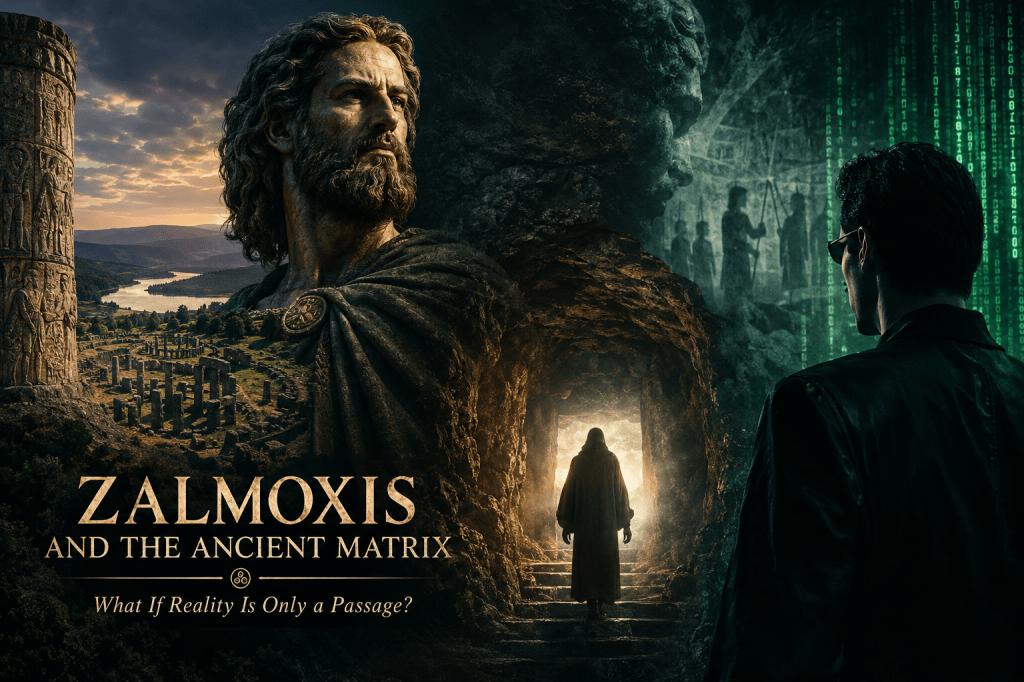
  • Zalmoxis and the Ancient Matrix: What If Reality Is Only a Passage?

    Zalmoxis and the Ancient Matrix: What If Reality Is Only a Passage?

    There is something unsettling about Zalmoxis even before we begin trying to understand who—or what—he was.

    He appears at the edge of recorded European history almost as if he had stepped out of a story that had already been told for centuries before anyone thought to write it down. A god to some, a man to others, perhaps a priest, perhaps a reformer, perhaps the distant memory of a real person whose identity dissolved into religion, he belonged to the world of the Getae north of the lower Danube, yet nearly everything we know about him was preserved by outsiders.

    That alone should make us cautious.

    It should also make us curious.

    The Getae left us no surviving sacred book explaining Zalmoxis in their own words. There is no Zalmoxian gospel hidden in a monastery, no authentic collection of his teachings waiting to be deciphered and no ancient manuscript that allows us to hear his voice directly. Instead, we find fragments scattered through Greek and Roman literature, each writer looking at the same strange tradition from a different angle.

    And yet, when those fragments are placed together, a remarkably persistent idea emerges.

    Human beings may be mistaken about what reality actually is.They may be mistaken even about death.That is where the story becomes far more interesting than a simple chapter of ancient religion, because behind Zalmoxis lies a question that humanity has never stopped asking.

    What if what we see is only the surface?

    The people who believed death was not an ending

    Our earliest substantial account comes from Herodotus, writing in the fifth century BC.

    While describing the Persian expansion into the lands around the Danube, Herodotus pauses to speak about the Getae. He calls them particularly courageous among the Thracian peoples, but it is their religious belief that captures his attention.

    According to him, the Getae believed that they did not truly die. A person who perished went instead to Zalmoxis—or, in the wording of the ancient account, to a divine figure Herodotus associates with Zalmoxis and also mentions under the name Gebeleizis.

    It is easy to read that sentence too quickly.

    Ancient cultures believed in afterlives everywhere, after all. Egyptians imagined the world beyond death, Greeks told stories about Hades, and later religions would place entire theological systems around the fate of the soul.

    But Herodotus describes something more concrete among the Getae.

    Once every five years, he says, they selected a messenger by lot. That man was entrusted with requests that he was supposed to carry to Zalmoxis. Then came the part that must have sounded shocking even to ancient readers: men held spears upright while the chosen messenger was thrown onto their points.

    If he died, the sacrifice was considered accepted. If he survived, the failure was blamed on the messenger and another could be selected.

    The ritual is brutal, and there is no reason to romanticize it. At the same time, its logic tells us something extraordinary about the world in which the ritual made sense.

    The messenger was not simply being killed.

    He was being sent.

    For the people performing the ritual, death was apparently a border that could be crossed, and on the other side of that border there was someone—or something—capable of receiving a message.Seen from that perspective, the sacrificed man was not merely a victim.

    He was a traveller into a reality inaccessible to the living.

    Whatever the Getae actually believed in all its complexity, Herodotus understood their religion as containing a radical conviction: the visible disappearance of a human being did not mean that the human being had ceased to exist.

    Then Herodotus tells another story, and this is where Zalmoxis becomes truly difficult to separate from mystery.

    The man who vanished underground

    Herodotus says that Greeks living around the Hellespont and the Black Sea told a different version of Zalmoxis’ origin.

    According to them, Zalmoxis had once been a mortal man associated with Pythagoras. In their story he had lived on Samos, learned from Greek thought, accumulated wealth and eventually returned to his homeland.

    There he gathered important men around him, entertained them and began teaching something astonishing: neither they, nor their descendants, nor Zalmoxis himself would truly die. Instead, they would go to another place where existence continued and where good things awaited them.

    Then he did something that sounds almost theatrical.

    He built an underground chamber.When it was ready, Zalmoxis disappeared into it.For three years, according to the story, nobody saw him. His people mourned him as dead.

    Then, in the fourth year, he emerged again.

    The man they believed had died had returned.

    And according to the Greek version preserved by Herodotus, that apparent return from death helped convince the Getae that his teaching had been true.It is precisely at this point that responsible history has to resist temptation.We cannot say that this event actually happened. We cannot even be certain that Zalmoxis was originally a historical person.

    Herodotus himself is surprisingly careful: he says that he neither completely believes nor completely rejects the tale of the underground chamber, and he doubts the chronology connecting Zalmoxis directly with Pythagoras. He even leaves open the basic question of whether Zalmoxis had been a man or a native Getic deity.

    That uncertainty does not weaken the story.In some ways it makes it more fascinating.Because whatever happened historically, somebody considered this story important enough to preserve: a teacher disappears beneath the earth, is mourned as dead, and then returns among the living.If this was an initiation drama rather than biography, what did it mean?

    If it was a myth, what truth was the myth trying to communicate?

    And if Zalmoxis was already a god before Greeks attempted to turn him into a former student of Pythagoras, why did the underground disappearance become such an important part of the story?

    We do not know.

    But we can see the structure.A man enters darkness.The world assumes he is gone.

    He returns possessing—or representing—knowledge about death that ordinary people do not possess.

    That structure has survived in religious myths, mystery traditions and philosophical stories across cultures because it touches a very old fear: perhaps human beings understand only the side of reality they happen to inhabit.

    Zalmoxis did not disappear from ancient literature

    Centuries later, Strabo tells another version.The Zalmoxis we meet in his Geography is less like a magician staging his own return from death and more like a sacred political figure, a man who acquires knowledge, becomes close to a ruler and eventually acts as an intermediary between divine authority and earthly power.

    Strabo says that Zalmoxis became a priest of the god most honoured among his people and was eventually himself treated as divine. He lived, according to the account, in an inaccessible cavernous place and met few people apart from the king and attendants. The mountain associated with this sacred retreat was called Cogaeonum in Strabo’s text.

    Again, we encounter withdrawal.

    Again, a sacred man is separated from ordinary society.Again, access to him is restricted.It is worth noticing how different this is from the modern image of a religious teacher speaking openly to crowds.

    Zalmoxis, as Strabo presents him, gains authority partly through distance. He occupies a space ordinary people cannot easily enter, and from that hidden space comes knowledge that affects the visible world outside it.Strabo even says that something of this religious-political institution continued later among the Getae. During the reign of Burebista, a comparable role was held by Decaeneus, the famous Deceneu of later Romanian historical tradition.This does not prove an unbroken secret order stretching across centuries, as modern esoteric stories sometimes suggest.

    The evidence simply does not allow that conclusion.

    Still, the repeated pattern is difficult to ignore.The ruler governs the visible world.The sacred figure interprets something beyond it.One possesses political power; the other possesses access to hidden knowledge.In a culture in which religion and political authority were deeply entangled, that distinction could have been enormously powerful.

    And then Plato enters the story.

    The strange physicians of Zalmoxis

    There is a passage in Plato’s Charmides that deserves far more attention than it usually receives when Zalmoxis is discussed.

    Socrates speaks of having learned from one of the Thracian physicians associated with Zalmoxis. The teaching attributed to them says, in essence, that you cannot properly treat the eyes without treating the head, nor the head without treating the body, and that you should not attempt to heal the body without considering the soul.

    The part cannot be healed while the whole is ignored.

    Plato presents Zalmoxis as both king and god within this story, and the medicine associated with him is explicitly holistic: body, soul and human character belong to the same reality and should not be artificially separated.

    Whether Plato is preserving an authentic Getic doctrine, reshaping an exotic tradition for philosophical purposes, or combining both is impossible to establish from the text alone.But something important has happened by this point.

    Zalmoxis is no longer merely the mysterious deity to whom the Getae send the dead.He has become associated with knowledge unavailable to ordinary perception.Death may not be what it seems.

    The body cannot be understood without the soul.The visible part cannot be fully understood without the invisible whole.That is an extraordinary collection of ideas to find around a figure standing in the mist between history and mythology.And this is where we can approach the Matrix—not by pretending that ancient Getae believed in computers, simulated universes or machines controlling humanity, but by recognising something much older beneath the modern language.

    The suspicion that reality has layers.

    Long before the red pill

    When people hear the word Matrix today, they often think immediately of a computer simulation.But the deeper philosophical idea behind the Matrix is much older than computers.

    The real shock is not discovering that machines exist.

    The real shock is discovering that your definition of reality was wrong.Neo begins inside a world that appears completely normal. Streets exist. Buildings exist. People go to work. Conversations happen. Food has taste. The world follows rules.Nothing initially appears artificial because Neo has never known anything against which to compare it.His prison works because it feels ordinary.

    That idea has an obvious philosophical ancestor in Plato’s Allegory of the Cave.

    Plato asks us to imagine human beings imprisoned underground from childhood, able to see only shadows projected before them. Since shadows constitute everything they have ever experienced, the prisoners naturally treat those shadows as reality.

    Only the person who turns around, leaves the cave and encounters another level of existence discovers how incomplete the former world was.

    Plato explicitly uses the image to distinguish the world apprehended through ordinary sight from a higher intelligible understanding.And here something curious happens.Plato gives us prisoners inside a cave, mistaking appearances for reality.The tradition about Zalmoxis gives us a sacred teacher who enters an underground chamber, disappears from ordinary human sight and returns carrying the authority of someone who supposedly knows what lies beyond death.The stories are not the same and should never be presented as though one copied the other.

    But place them beside one another and the resemblance of the questions becomes difficult to ignore.What can human senses actually tell us?How much of existence remains outside their range?If everybody around us agrees that something is real, does that agreement make it true?

    And what happens to the person who crosses the boundary between the accepted world and another understanding of it?These are not exclusively Greek, Getic or modern questions.They are human questions.

    Perhaps the real prison is certainty

    There is an uncomfortable reason why stories like these survive.Human beings need stable reality.We need to believe that the floor beneath us exists, that tomorrow will resemble today, that cause precedes effect and that the people around us inhabit roughly the same world we do.Without that agreement, ordinary life becomes almost impossible.Yet philosophy has always been dangerous to certainty.It asks whether seeing something is enough to know it.It asks whether consensus proves truth.It asks whether the limits of human perception have quietly become the limits of what we are willing to call real.Zalmoxis becomes fascinating in this context because the surviving traditions surrounding him attack the most absolute certainty of all.

    Death.

    A body falls.

    It stops breathing.It grows cold.It disappears into the earth.Every visible sign tells the observer that the person’s existence is over.And yet the Getic belief described by Herodotus says: you are interpreting what you see incorrectly.The person has gone somewhere.One does not have to accept that belief literally to understand its philosophical power.The senses provide evidence, but the doctrine tells the believer that the evidence is incomplete.That tension between appearance and hidden reality is precisely what gives both ancient initiation traditions and modern Matrix imagery their force.Not because they provide the same answer.Because they begin with the same doubt.

    What was inside the chamber?

    We will probably never know what Zalmoxis’ underground chamber looked like—if such a chamber existed at all.That missing information leaves a strange empty space at the centre of the story.

    Was it simply a hidden room in which a man lived for several years?Was it a ritual space connected with initiation?Did the story preserve a much older myth of a deity descending beneath the earth and returning?Was it a Greek attempt to rationalise a foreign god by turning him into a clever human teacher?

    Each possibility has been discussed in different forms, but the surviving evidence cannot settle the question.Modern scholarship also treats the Pythagorean connection cautiously.

    The story making Zalmoxis a former slave or follower of Pythagoras comes through Greek tradition, while Herodotus himself already doubted its chronology. Later analysis has continued to examine how legends linking Pythagoras with northern religious figures developed in Greek literature.This matters because Zalmoxis has accumulated an extraordinary amount of modern mythology.He has been called a prophet, a supreme god, a monotheistic reformer, a shaman, an initiate, a philosopher and the guardian of supposedly lost Dacian wisdom.

    Some of those interpretations may contain useful comparative ideas, while others go far beyond anything ancient sources actually tell us.The honest version is less comfortable and, I think, far more intriguing.

    We do not know exactly who he was.

    Herodotus did not know.

    Strabo inherited traditions centuries later.

    Plato knew the name and associated it with remarkable Thracian wisdom, yet he was using that tradition inside a philosophical dialogue rather than writing an ethnographic report.

    Zalmoxis stands precisely where evidence begins to thin and myth begins to breathe.

    And perhaps that is why he has never disappeared.

    The ancient Matrix was not a machine

    If we use the word Matrix here, we should use it carefully.There is no evidence that Zalmoxis taught that physical reality was false, that the world was artificially generated or that humanity was imprisoned inside anything resembling a technological simulation.The interesting parallel lies elsewhere.

    A Matrix can also be understood as a framework of reality that becomes invisible because we have lived inside it for too long.A culture tells us what life is.It tells us what death means.It teaches us which things are possible and which questions are absurd.

    Eventually we stop recognising those assumptions as assumptions. They become the walls of the world.The prisoner in Plato’s cave does not initially see a prison.Neo does not initially see a simulation.And the ordinary observer sees death and assumes that what has vanished from sight has vanished from existence.

    Zalmoxis enters this conversation not as proof that the ancients knew the secret structure of the universe, but as evidence of something more modest and perhaps more profound: thousands of years ago, human beings were already deeply uncomfortable with the possibility that visible reality might not be complete reality.That thought lies at the heart of our book Matrix as well.

    The question is not simply whether we live inside a computer program. That is only one modern version of a much older problem.The deeper question is what creates the reality in which we live.Our senses?Our society?Our language?Our memories?Our fears?Our education?The people who hold authority?Or something beyond all of them?Once that question is allowed into the mind, the Matrix changes shape.It no longer requires cables, machines or a digital sky.

    Sometimes the Matrix is simply everything we have been taught never to question.

    And perhaps this is why Zalmoxis still feels strangely modern

    More than two millennia separate us from the people Herodotus described.Their world has vanished. Their language has largely disappeared with them. Their sacred places survive mostly as archaeology, geography and conjecture, while their beliefs reach us through the imperfect filter of outsiders who were themselves trying to understand something foreign.

    Yet Zalmoxis remains.

    Not clearly enough for us to possess him, but not vaguely enough for us to forget him.A god who may have been a man.A man who may have become a god.A teacher associated with immortality who vanished beneath the earth.A sacred figure hidden in an inaccessible place.A tradition in which the soul mattered more than the body alone could explain.A people described as believing that death did not mean what everyone else assumed it meant.

    Perhaps there is no secret doctrine waiting to be recovered from these fragments.Perhaps there was never one.

    But imagine, just for a moment, the person standing outside the underground chamber after Zalmoxis had disappeared.Three years pass.Nothing.The man is dead. Everyone knows it.Then one day he walks out.What would collapse first?Belief in death?Belief in the evidence of your own eyes?Or the comforting certainty that the world works exactly as you have always been told?

    That is where Zalmoxis becomes more than an ancient mystery.

    Because every Matrix begins at exactly that point.

    Not when someone gives you the answer.But when, for the first time, you suspect that the reality you accepted without question may not be the whole story.
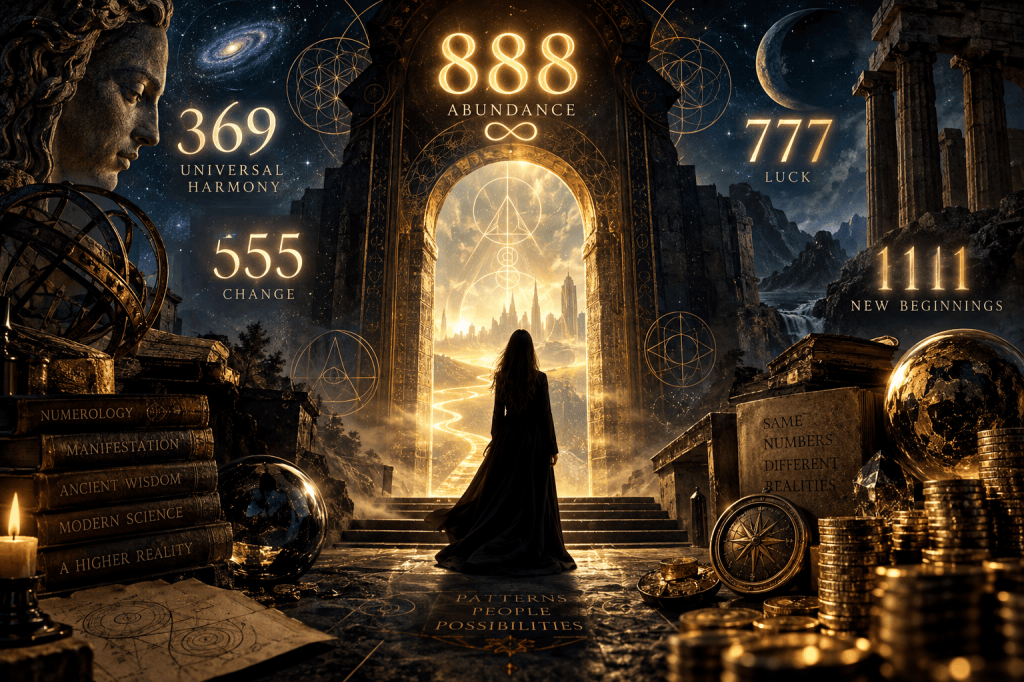
  • The Numbers of Abundance: Why 369, 555, 777 and 888 Keep Appearing in the Hidden Language of Money

    There is something strangely intimate about a number that refuses to leave you alone.

    You glance at your phone and it is 8:08. Later, a receipt ends in 8.88. An invoice contains three eights, a hotel room carries the same digits, and then, just when you have almost forgotten about it, 888 appears again somewhere completely ordinary. For someone who has never attached meaning to numbers, this is little more than coincidence. For someone familiar with numerology, however, 888 carries a very different reputation: it is supposed to be the number of abundance, material flow, success and money.

    Nearby in this strange numerical landscape are 555, usually associated with sudden change; 777, with fortune and spiritual alignment; 111 or 1111, with beginnings and manifestation; and the almost legendary combination 3–6–9, surrounded today by stories about Nikola Tesla, hidden mathematical laws and a supposed numerical architecture underlying reality itself.

    Then another layer is added. Search online for these numbers and soon they cease to be merely numbers. They become frequencies. There are recordings labelled 888 Hz Money Frequency, 777 Hz Abundance Frequency, 555 Hz Transformation Frequency, often accompanied by promises of prosperity, energetic clearing or a dramatic shift in one’s financial life.

    At this point an obvious question becomes difficult to avoid.

    Where did all of this actually come from?

    And perhaps the more unsettling question is not whether a number can magically deposit money into a bank account, but why human beings have been assigning power to numbers for thousands of years, long before YouTube manifestation videos, TikTok numerology and modern “angel numbers” ever existed.

    Long Before 888 Meant Money, Numbers Were Already Mysterious

    The belief that numbers possess qualities beyond simple counting is far older than the modern manifestation movement.

    Among the Pythagoreans of ancient Greece, number was not merely a convenient human invention used to measure livestock, land or coins. Numerical relationships appeared to reveal something fundamental about reality itself. Early accounts of Pythagorean thought describe a worldview in which mathematical relationships were intimately connected with harmony, music, geometry and the structure of the cosmos, eventually giving rise to the famous idea commonly summarized as “all things are number.” Ancient Pythagorean speculation also attached symbolic qualities to particular numbers, although these associations should not be confused with today’s internet numerology.

    This distinction matters because modern numerology often borrows the atmosphere of antiquity while adding meanings that are actually much more recent.

    Pythagoras did not leave behind an ancient handbook announcing that seeing 888 on a supermarket receipt meant a financial breakthrough was approaching, nor did his followers teach that playing an 888-Hz tone would attract money into one’s life. What they did help establish was something more fundamental and, in a sense, more interesting: the idea that numbers might express qualities and relationships hidden beneath visible reality.

    Once that door had been opened, later generations never completely closed it.

    Numbers became entangled with theology, astrology, magic, architecture, music, calendars and divination. Seven became sacred in numerous traditions, three repeatedly appeared in religious structures, twelve organized heavens and calendars, and particular numerical combinations acquired meanings that changed according to culture and period.

    The modern fascination with 111, 555, 777 and 888 belongs to this much larger human habit of turning quantity into meaning.

    But the specific system most people encounter today is considerably younger than it appears.

    888: How Eight Became the Number of Abundance

    Within contemporary numerology, 8 has acquired an unusually material character. It is commonly associated with authority, ambition, achievement, organization, business, material power and the movement of resources; repeated three times, that symbolism becomes 888, now widely interpreted as abundance, prosperity or financial success.

    The modern category known as “angel numbers”, however, should not be mistaken for an intact doctrine transmitted from antiquity. Repeating sequences such as 111, 222, 555 and 888 became especially prominent through modern New Age publishing and were popularized in their present form during the early twenty-first century, particularly through the work of author Doreen Virtue. Contemporary interpretations commonly describe 555 as major change and 888 as manifestation, success and prosperity.

    That makes the story considerably stranger than the simplified version often encountered online.

    The symbolism of numbers is ancient, but the tidy modern dictionary in which 111 means one thing, 555 another and 888 automatically means money is largely contemporary.

    Yet 888 does contain an elegant numerical curiosity that helps explain why people drawn to numerology find it so appealing.

    Add its digits:

    8 + 8 + 8 = 24

    Then reduce again:

    2 + 4 = 6

    So the numerological root of 888 is 6, traditionally interpreted in many modern systems as harmony, responsibility, balance, care and restoration.

    Now perform exactly the same operation with 555:

    5 + 5 + 5 = 15

    1 + 5 = 6

    The supposed number of dramatic change and the supposed number of abundance both return to 6.

    This proves no supernatural mechanism whatsoever, because digital reduction is simply arithmetic. Yet symbolically it creates an irresistible narrative: movement and disruption represented by 555 eventually return to balance, while the material power represented by 888 must also return to balance.

    Whether one calls that cosmic wisdom or a beautiful human interpretation depends entirely on where one stands.

    555: The Number That Appears Before Everything Changes

    If 888 is imagined as the vault, 555 is the door being forced open.

    In contemporary angel-number traditions, 555 represents disruption, transition, movement and the collapse of an old pattern before another one can take its place. Financially, therefore, it is sometimes interpreted not as money itself but as the change that precedes a new source of income, a different career, an unexpected opportunity or the uncomfortable realization that an existing way of living is no longer sustainable.

    There is something psychologically clever in this interpretation, because prosperity rarely arrives in real life without some degree of transformation. A person changes work, learns a skill, takes a risk, starts a business, abandons an unsuccessful project or notices an opportunity that had previously been ignored.

    The number itself does not need to possess supernatural power for the symbolism to become personally powerful.

    A person who begins using 555 as a reminder to ask What must change? may actually behave differently.

    And that brings us dangerously close to the border where ritual, psychology and magic begin to resemble one another.

    777: Luck, Mystery and the Number We Already Wanted to Believe In

    Seven entered the symbolic imagination long before modern numerology discovered it.

    It appears repeatedly in religious traditions, mythology, calendars and cultural symbolism, which gave it an aura that later systems could easily inherit. Modern angel-number interpretations typically connect 777 with spiritual insight, inner wisdom, good fortune or being somehow “in alignment.”

    Its modern association with luck was strengthened further by popular culture and gambling imagery, particularly the familiar three sevens of slot machines, where 777 became visually synonymous with the jackpot.

    This is worth remembering because symbolism rarely has a single origin. Meanings accumulate.

    A number may begin with a religious association, acquire an occult meaning centuries later, be reinforced by popular entertainment and eventually return to social media disguised as an ancient universal code.

    By the time we encounter it, the layers have become almost impossible to see.

    Then There Is 369

    Of all the numerical mysteries circulating online, 3–6–9 is probably the most seductive because its legend contains a real historical figure: Nikola Tesla.

    A statement endlessly attributed to him claims that if humanity understood the magnificence of 3, 6 and 9, it would possess a key to the universe.

    The problem is that a reliable primary source establishing that Tesla actually made this famous statement has never been convincingly produced.

    What is documented is Tesla’s peculiar fixation on the number three and numbers divisible by three. Biographical accounts describe his preference for hotel rooms whose numbers were divisible by three, rituals involving counting, and his use of eighteen napkins at meals. Smithsonian’s account of Tesla’s later life also notes his fixation on three, while Tesla biographer Margaret Cheney, when asked by PBS about his “magic” number three, described it as apparently a superstition rather than a hidden scientific theory.

    This does not make the 369 story less fascinating; in some ways, it makes it more so.

    There really was a Tesla fascinated by numerical repetition.

    There really are striking mathematical patterns involving digital roots and multiples of nine.

    What appeared later was a mythology built around these facts.

    For example, multiples of nine repeatedly return to nine when their digits are summed:

    18 becomes 1 + 8 = 9.

    27 becomes 2 + 7 = 9.

    36 becomes 3 + 6 = 9.

    108 becomes 1 + 0 + 8 = 9.

    There is nothing paranormal about this property; it follows from arithmetic in base ten and modular mathematics. Yet visually and mentally, it is hypnotic, particularly when combined with other digital-root patterns that make 3, 6 and 9 appear to occupy distinctive positions.

    From such patterns came later systems including what is popularly called “vortex mathematics,” along with manifestation practices instructing people to write an intention three times in the morning, six times during the day and nine times at night.

    Tesla himself did not leave us such a manifestation ritual.

    The internet did.

    When a Number Suddenly Becomes a Frequency

    There is another confusion hidden inside this subject, and it is responsible for much of the mythology surrounding “money frequencies.”

    888 and 888 Hz are not the same thing.

    The first is a number.

    The second is a physical frequency representing 888 oscillations per second.

    A sound wave at 888 Hz is perfectly real and measurable, just as 440 Hz or 528 Hz is measurable. What science does not establish is that the symbolic numerological meaning assigned to the digits 888 somehow transfers automatically to a sound wave oscillating 888 times per second.

    That leap is philosophical or spiritual rather than physical.

    Nevertheless, once modern spiritual culture began associating certain frequencies with meditation and transformation, it was almost inevitable that numerological sequences would enter the same world. Today one can easily find 888 Hz labelled as an abundance or money frequency, 777 Hz associated with luck or spiritual awakening and 555 Hz with transformation.

    Their popularity can create the impression that these correspondences belong to an ancient system of sacred acoustics.

    They do not.

    The distinction becomes particularly important when these recordings are compared with the so-called Solfeggio frequencies, another modern spiritual system that is frequently presented online as if its exact Hertz values were inherited unchanged from medieval monks.

    Historical solfeggio was indeed real, but it referred to a method of teaching musical intervals through syllables such as Ut, Re, Mi, Fa, Sol, La. The modern lists of supposedly healing frequencies are a different development.

    That does not mean sound has no effect on us.

    Quite the contrary.

    It simply means that the effect must not be confused with the claims attached to the number printed in the video title.

    What Sound Really Can Do

    Music can influence human physiology and emotion in measurable ways.

    A large meta-analysis of 104 randomized controlled trials involving 9,617 participants found significant overall effects of music interventions on both physiological and psychological stress-related outcomes. Other research has similarly explored effects on anxiety, heart rate, blood pressure, cortisol and emotional state.

    There is even emerging research examining specific tunings. A randomized controlled study published in 2026 compared instrumental music at 528 Hz and 432 Hz with a no-music condition in 162 university students experiencing exam-related stress. Researchers reported differences in several salivary biomarkers after exposure, although cognitive performance on the Stroop test did not significantly differ between the groups. Interesting as those findings are, they do not demonstrate that a particular frequency possesses a universal healing power, much less that a frequency can attract money.

    Science therefore leaves us in a more nuanced place than either believers or absolute skeptics sometimes prefer.

    Sound can affect the human organism.

    Music can influence stress and emotion.

    Ritual can alter attention.

    But there is currently no credible scientific evidence showing that listening to 888 Hz causes financial abundance, that 777 Hz changes luck, or that repeating 555 alters external events through an undiscovered energetic law.

    And yet people continue reporting that these numbers seem to follow them.

    Why?

    The Moment You Learn 888, You Begin Seeing It Everywhere

    There is a well-known psychological phenomenon called the frequency illusion, sometimes referred to as the Baader-Meinhof phenomenon.

    Once something becomes personally significant, attention begins detecting it more readily. The object has not necessarily become more common; rather, the mind has begun selecting it from the enormous amount of information that was already present. Selective attention and confirmation bias can then reinforce the impression that the pattern is appearing with extraordinary frequency.

    Imagine how many numbers pass through a person’s visual field during an ordinary week.

    Clocks, prices, passwords, receipts, telephone numbers, addresses, vehicle registrations, social-media metrics, bank statements, page numbers, dates and notifications surround us constantly.

    Most disappear without leaving any trace in memory.

    But tell someone that 888 means money, and 888 is no longer ordinary information.

    It has become a signal.

    The next time it appears, the brain notices.

    The appearance after that feels like confirmation.

    After several repetitions, coincidence begins to resemble communication.

    Research into repetition provides another intriguing piece of the puzzle. Experiments on the “illusory truth effect” have shown that repeated information can feel more truthful simply because it becomes more familiar and easier for the mind to process. In experiments where statements were presented multiple times, repeated claims were subsequently judged as more truthful than unfamiliar ones.

    None of this proves that every experience of synchronicity can be reduced neatly to a cognitive bias.

    It does, however, demonstrate that the human mind is extraordinarily capable of transforming repetition into significance.

    Perhaps that ability is precisely why numerical mysticism has survived for so long.

    But What If the Number Still Changes Something?

    Here the story becomes more complicated, because dismissing the entire subject with the word “coincidence” misses something important.

    Suppose a person chooses 888 as a private symbol of financial stability and writes it at the top of a notebook each morning. Beneath it, she records her income, expenses, unfinished projects and one action that could improve her financial position.

    After several months she has earned more money.

    Did 888 attract it?

    There is no need to invoke an invisible monetary vibration to explain what happened. The ritual repeatedly directed attention toward financial decisions, opportunities and unfinished tasks. A symbol altered focus; focus influenced behaviour; behaviour altered outcomes.

    From the outside, this looks psychological.

    From the inside, it may feel like manifestation.

    And somewhere between those two descriptions lies one of the oldest ambiguities in magic.

    Rituals often work by changing the person performing them long before they change anything else.

    The candle, symbol, prayer, sigil or repeated number may not command the universe, yet it can organize intention in a mind that was previously scattered. Once intention becomes consistent, behaviour can follow. Once behaviour changes, reality sometimes changes with it.

    This does not validate every supernatural claim attached to manifestation, but neither does it make symbolic practices meaningless.

    Symbols have always possessed power of a particular kind because human beings respond to them.

    Money itself proves the point rather beautifully.

    A banknote is paper.

    A number displayed inside an online banking application is a pattern of pixels.

    Yet entire lives can change because societies collectively agree that those symbols represent value.

    Human civilization is already filled with numbers that possess enormous power, although the source of that power is not necessarily hidden cosmic vibration.

    It is belief, agreement, attention and action.

    So Is 888 Really the Frequency of Money?

    If by “frequency” we mean a measurable physical phenomenon capable of attracting wealth, there is no good evidence that it is.

    If we mean an ancient universal numerical law proving that 888 automatically produces abundance, history does not support that claim either.

    But if we ask why 888 has become such a powerful symbol of abundance, the answer becomes considerably richer.

    It stands at the meeting point of ancient numerical mysticism, modern numerology, New Age angel-number culture, digital repetition, the psychology of attention and a very old human desire to believe that chaos contains patterns.

    555 tells us that something must change.

    777 whispers that fortune may be nearby.

    888 promises abundance.

    369 suggests that somewhere beneath ordinary reality a mathematical mechanism might still be waiting to be discovered.

    Perhaps none of these numbers opens a supernatural vault.

    Yet perhaps that was never their most interesting power.

    A number can make someone stop.

    Notice.

    Remember.

    Change direction.

    Take an opportunity seriously.

    Ask a question that had been avoided.

    And every now and then, after enough of those small changes, a person’s external life really does begin to look different.

    The rational explanation would say that the mind changed first.

    The occult explanation would say that the vibration changed first.

    Between those two interpretations remains the narrow territory where Whisper Mysteries prefers to linger, because the strangest mysteries are not always those that can be proved or disproved cleanly.

    Sometimes the mystery is why a simple sequence of digits can enter the human mind and refuse to leave.

    And if you happen to see 888 shortly after reading this, remember one thing before deciding that the universe has sent you a message:

    You now know exactly what to look for.

    Whether that makes the next appearance coincidence, psychology or synchronicity is a question the number itself will never answer.

    Sources
    Stanford Encyclopedia of Philosophy — Pythagoras: pentru tradiția pitagoreică, semnificația numerelor și relația dintre număr, armonie și cosmos.
    Pythagoras – Stanford Encyclopedia of Philosophy


    Smithsonian Magazine — Nikola Tesla and the Tower That Became His “Million Dollar Folly”: confirmă documentarea istorică privind fascinația lui Tesla pentru cifra 3 și numerele divizibile cu trei.

    PBS – Tesla: Master of Lightning: biografa Margaret Cheney spune că „numărul magic 3” al lui Tesla pare să fi fost o superstiție personală, nu o teorie științifică secretă.


    Vogue — How to Decode Angel Numbers: utilă pentru istoria modernă a „angel numbers” și interpretările contemporane ale 111, 555, 777 și 888; articolul notează și popularizarea termenului de către Doreen Virtue.

    Psychology Today — Frequency Illusion: explică de ce, după ce aflăm semnificația unui număr precum 888, putem începe să-l observăm aparent peste tot.

    PubMed — Effects of Music Interventions on Stress-Related Outcomes: meta-analiză a 104 studii randomizate, cu 9.617 participanți, despre efectele muzicii asupra stresului fiziologic și psihologic.
    PubMed – Music and Stress Meta-analysis

    PubMed — Acute Music-Frequency Exposure, 2026: studiul randomizat cu 162 de participanți care a comparat muzica la 528 Hz, 432 Hz și lipsa muzicii.
    PubMed – 528 Hz and 432 Hz Study