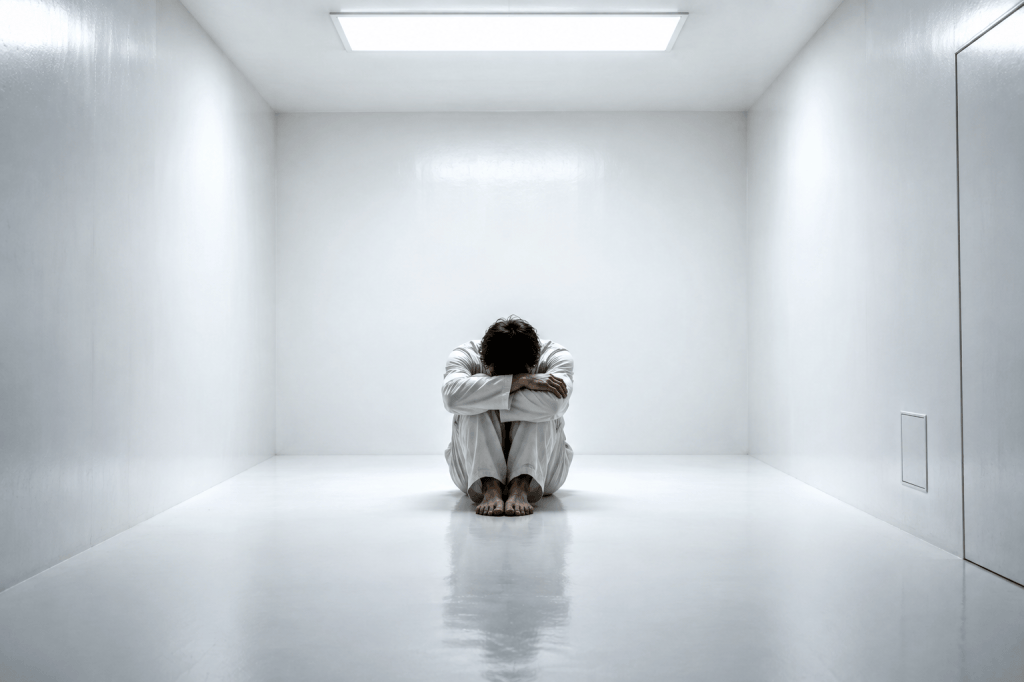
Imagine waking inside a room in which almost everything capable of telling you where you are, how long you have been there, or whether another human being still exists beyond the walls has gradually disappeared. There is no window through which daylight can announce morning, no clock capable of dividing existence into hours, no familiar voice, no changing landscape, no ordinary conversation, and perhaps not even the reassuring noises produced by footsteps approaching along a corridor. The walls appear white, the clothing is white, the food arrives without color, artificial light refuses to distinguish night from day, while silence becomes so complete that the faint sounds generated by your own body begin to occupy a space once filled by the external world.
Nothing visible may happen to you, yet something profound may begin happening inside you.
This disturbing environment has become popularly known as the White Room, although the historical reality behind the expression is more complicated than the internet legend suggests. In Iran, political prisoners, writers and human-rights organizations have used the expression “white torture” more broadly to describe extreme incommunicado solitary confinement, sometimes involving sensory deprivation, uninterrupted artificial lighting, blindfolding, silence and the deliberate destruction of normal temporal and social reference points. Human Rights Watch documented the term in a major 2004 investigation of detention practices in Iran, reporting that prisoners described absolute solitary confinement as psychologically devastating and, in some cases, worse than physical or verbal abuse.
Yet there is also a documented case that sounds uncannily close to the almost mythical white chamber described online.
His name was Amir Abbas Fakhravar.
The Prisoner Surrounded by White
In February 2004, Amnesty International issued an urgent report concerning Fakhravar, a young Iranian journalist who had been imprisoned and interrogated after allegedly being transferred to a detention facility known as Centre 125, controlled by the Revolutionary Guards. According to the information Amnesty received, his cell had no windows and was colored a creamy white, while the clothes he was required to wear were also white. His meals reportedly consisted of white rice served on white disposable plates, and when he needed to use the toilet he was required to slide a white piece of paper beneath the door. Even the guards, according to the account, wore footwear designed to suppress the sound of their movement.
The detail that makes the account particularly disturbing is not the color itself, because white walls are not neurologically poisonous and white clothing does not possess some mysterious power to erase personality. What matters is the systematic removal of difference, because human consciousness normally exists inside a constantly changing ocean of sensory information in which light alters, sounds approach and disappear, people speak, shadows move, temperatures fluctuate, objects acquire meaning through contrast, and time is inferred from thousands of tiny environmental events that we almost never consciously notice.
Amnesty described the conditions reported in Fakhravar’s case as extreme sensory deprivation capable of causing persistent suffering and stated that they appeared to amount to torture. The organization also reported another psychologically destabilizing element: he was allegedly released briefly and then taken back into custody, producing uncertainty about whether freedom itself could be trusted.
This is where the White Room stops being merely a sinister-looking prison cell and becomes something much more psychologically sophisticated.
The prisoner is not simply deprived of freedom.
He may gradually be deprived of the ordinary machinery by which the mind confirms reality.
White Torture Is Not Necessarily a White Room
One of the most important distinctions to make is that the expression white torture should not be interpreted as referring exclusively to a perfectly white chamber, because Human Rights Watch documented the Iranian usage as a term for prolonged incommunicado solitary confinement more generally. Prisoners could be kept in small underground cells under artificial light around the clock, separated from other detainees, attorneys, family members and health professionals while their principal human contact became the people interrogating them.
This distinction actually makes the phenomenon more disturbing rather than less, because it reveals that the fundamental weapon is not a particular color scheme but controlled isolation.
A prisoner who is beaten understands, however brutally, what is attacking him; there is an identifiable action, an identifiable source of pain and an event around which the mind can organize resistance. Extreme isolation can operate differently because the environment itself becomes the instrument, while silence, repetition, uncertainty and the absence of meaningful contact gradually alter the psychological landscape without necessarily producing a bruise that an outside observer can photograph.
Human Rights Watch reported in 2004 that such isolation had been used against political prisoners to weaken resistance, obtain information and secure recorded or signed confessions, while former detainees described the combination of constant artificial light and social isolation as exceptionally destructive.
The unsettling question therefore becomes not simply why isolation feels unpleasant, but why a brain surrounded by almost nothing can sometimes become increasingly unstable.
The answer begins with a misconception about the brain itself.
Your Brain Was Never a Passive Camera
We often imagine perception as though the brain were sitting quietly inside the skull waiting for information to arrive from the eyes, ears and skin, after which it simply displays an accurate internal copy of the world. Modern neuroscience paints a much more dynamic picture, because perception emerges from an interaction between incoming sensory signals and neural systems that continuously interpret, organize and predict what those signals mean.
This matters enormously when external stimulation is drastically reduced.
Studies and reviews of hallucination mechanisms suggest that when normal sensory input weakens, internally generated activity can acquire greater influence over perception, particularly when the brain becomes less able to distinguish between signals generated externally and those generated internally. Research on sensory loss has described this through deafferentation models, in which reduced sensory input alters the balance of excitation and inhibition within neural networks, potentially lowering thresholds for internally generated perceptual activity.
Neuroimaging studies of hallucinations likewise indicate that experiences such as hearing voices or seeing things without corresponding external stimuli can involve some of the same sensory-processing regions that normally respond to real sounds and images, alongside networks related to memory, self-representation and cognitive monitoring.
This does not mean that every person placed alone in a quiet room will hallucinate, nor does it mean that hallucinations generated under sensory deprivation operate through a single established mechanism. Individual susceptibility, duration, psychological state, expectation and the degree of deprivation all matter enormously.
What the evidence does suggest is far more intriguing: when the outside world becomes quiet enough, the brain does not necessarily become quiet with it.
Sometimes it begins supplying material of its own.
When Nothing Happens, the Brain Begins Searching for Something
One of the earliest systematic demonstrations of this phenomenon came from experiments conducted in the 1950s by psychologists including Woodburn Heron, W. H. Bexton and R. H. Scott at McGill University in Canada. Participants were exposed to environments designed not necessarily to eliminate sensation completely, which is extraordinarily difficult, but to reduce variation in sensory input through monotonous visual, auditory and tactile conditions.
The 1954 study became part of a growing scientific literature on restricted sensory environments, with subsequent researchers documenting unusual imagery, perceptual distortions and disturbances of thought under conditions of sensory deprivation.
Decades later, researchers again placed healthy volunteers in short-term sensory deprivation and found increases in unusual perceptual experiences, suspiciousness and other psychosis-like phenomena, with individuals already more prone to hallucinations showing stronger perceptual disturbances. The researchers discussed difficulties in source monitoring, the brain’s ability to determine whether an experience originated externally or internally, as one possible mechanism.
That possibility produces an eerie paradox.
Ordinarily, your environment constantly corrects you.
A sound occurs and you turn toward its source; daylight moves across a room and reminds you that hours have passed; another person’s face confirms a shared reality; objects remain in predictable locations; conversation repeatedly anchors memories, identity and sequence.
Remove enough of these corrections and consciousness may be forced to rely increasingly upon itself.
The mind becomes both observer and environment.
The Disappearance of Time
Among the first things that can become unstable in extreme confinement is something we normally experience as immutable: time.
Human beings do not perceive time through a single biological clock that functions independently of the world around us, because our sense of temporal order is continually reinforced by external signals such as daylight, darkness, meals, physical activity, conversations and social routines. Light is particularly important because it helps synchronize the circadian system that regulates sleep, hormones, alertness and numerous physiological processes.
When artificial light remains on continuously, when the prisoner does not know whether it is morning or midnight, and when every day contains almost exactly the same events, chronological time can lose much of its ordinary structure.
A modern review of sensory deprivation research published in 2026 describes evidence connecting severe or prolonged reductions in stimulation with circadian disruption, changes involving stress systems such as the hypothalamic-pituitary-adrenal axis, neurotransmitter adaptations and cognitive or perceptual disturbances. The authors also emphasize an essential qualification: duration, voluntariness and individual vulnerability matter greatly, meaning that voluntary short-term sensory restriction used therapeutically cannot simply be equated with coercive imprisonment.
That difference is crucial.
Floating peacefully in a controlled sensory-reduction environment from which you can leave whenever you wish is fundamentally different from not knowing whether anyone will ever open the door.
The nervous system does not respond only to silence.
It responds to helplessness, unpredictability and lack of control.
Narges Mohammadi and the War Against Solitary Confinement
One of the most prominent contemporary voices against prolonged solitary confinement is Iranian human-rights activist Narges Mohammadi, who received the Nobel Peace Prize in 2023.
Mohammadi did not encounter the mythical spotless white chamber of internet stories, yet her experience demonstrates why the term white torture has become associated with far more than wall color. Amnesty International documented that during one period beginning in 2021, she spent 64 days in solitary confinement in Section 209 of Evin Prison, where bright lights were reportedly kept on continuously, access to natural light and fresh air was severely restricted, and meaningful contact with other prisoners was almost entirely eliminated. Amnesty stated that these conditions caused severe distress and suffering.
Her campaigning subsequently focused heavily on the use of prolonged solitary confinement against political prisoners, while Human Rights Watch noted that she had repeatedly sought to expose the practice and its role in obtaining forced confessions.
Her testimony also illustrates an aspect of isolation that laboratory sensory-deprivation experiments cannot fully reproduce: the prisoner is not simply missing stimulation but is living inside an environment of uncertainty in which interrogation, punishment, release, medical care and contact with loved ones may all depend upon decisions made by unseen authorities.
The silence therefore has meaning.
It can mean abandonment.
It can mean that interrogation is coming.
It can mean nothing at all.
The prisoner cannot know which possibility is true, and uncertainty itself becomes part of the psychological pressure.
Why Human Contact Is More Than Conversation
There is another reason why extreme solitary confinement can become psychologically damaging that has little to do with vision or hearing.
Human beings are profoundly social organisms whose nervous systems develop and function through interaction with other people. Conversation provides information, but it also performs something more fundamental because another person’s reactions continuously confirm that we inhabit a shared world.
Someone speaks your name and confirms your identity.
Someone remembers an event and confirms your past.
Someone reacts to your words and confirms that your thoughts have reached another mind.
Remove meaningful human contact for long enough, particularly under involuntary and threatening conditions, and one of the ordinary external mirrors through which identity is stabilized begins to disappear.
This does not mean that personality literally evaporates after a predetermined number of days, because such dramatic claims cannot be scientifically justified. It does mean that studies of prolonged solitary confinement repeatedly associate the practice with anxiety, depression, perceptual disturbances, hostility, self-harm and broader psychological deterioration.
A 2020 systematic review and meta-analysis examined 13 studies involving 382,440 incarcerated people, approximately 23 percent of whom had experienced solitary confinement. The authors found that solitary confinement was associated with worsening psychological symptoms, self-harm and mortality, particularly suicide, while mood disturbances, psychotic symptoms and hostility showed measurable associations.
Another major meta-analysis examining self-harm in prisons found a particularly strong statistical association between solitary confinement and self-harm, although such associations should not be interpreted simplistically because people placed in isolation may already differ in important psychological and behavioral ways from the wider prison population.
The scientific picture is therefore not that isolation automatically destroys every mind.
It is that prolonged isolation substantially increases psychological danger.
The Cold War Discovered the Power of an Empty Environment
The history becomes darker when laboratory research is placed beside declassified interrogation documents from the Cold War.
In 1963, the CIA produced a classified interrogation manual known as KUBARK Counterintelligence Interrogation, a document later released under freedom-of-information procedures and published by the National Security Archive. Among the coercive techniques discussed in the manual was sensory deprivation through controlled environments and solitary confinement.
The significance of this document is not that it invented sensory deprivation, nor that every modern example of solitary confinement can be traced directly to CIA research. The historical relationships between psychological research, military interrogation, intelligence agencies and different national prison systems are far more complicated than such a claim would suggest.
What the document proves is narrower and more disturbing.
By the early 1960s, powerful institutions had explicitly recognized that disrupting a person’s ordinary relationship with time, space and sensory perception could be useful in coercive interrogation.
The National Security Archive also documents a later 1983 CIA training manual that drew heavily upon earlier material and discussed environmental manipulation designed to disrupt normal patterns of perception. After concerns over human-rights abuses, parts of the material were altered, and a 1992 Defense Department investigation concluded that several interrogation manuals contained objectionable material violating legal or policy standards.
Physical torture attacks the body directly.
Psychological coercion discovered that the environment could sometimes be turned into the weapon.
When Silence Becomes Loud
People often imagine silence as the absence of sound, but biologically there is almost never complete silence because the body itself produces noise. Breathing moves through the airways, the heart pulses, muscles shift, joints move, digestion continues, and the auditory system maintains its own spontaneous neural activity.
In ordinary life these signals disappear beneath environmental sound.
When external stimulation becomes extremely weak, however, internal sensations may become unusually prominent, particularly when attention has nowhere else to go.
This is consistent with broader theories of hallucination and sensory loss in which weakened external input gives internally generated signals proportionally greater influence.
A tiny sound can therefore become enormous.
A shadow can acquire significance.
A bodily sensation that would normally be ignored may begin demanding interpretation.
Memory itself may become increasingly intrusive because the mind has little new information with which to compete.
This is one reason the expression “nothing happens” is psychologically misleading.
Inside an isolated brain, enormous amounts may be happening precisely because so little is happening outside it.
Why Constant White Can Matter Without Being Magical
There is no evidence that the color white itself possesses a special ability to erase memory or destroy identity, and this distinction should remain clear because sensational accounts often turn the white room into something almost supernatural.
Its power lies in monotony.
A normal room contains edges, colors, objects, textures, shadows and points of visual reference that allow the eyes to move from one meaningful feature to another. A visually uniform environment provides fewer landmarks through which space and attention can be organized, particularly when combined with constant lighting and the absence of meaningful activity.
White surfaces can also intensify illumination and reduce visual contrast, creating an environment in which time appears visually static because nothing changes when morning becomes afternoon and afternoon becomes night.
When this visual monotony is combined with silence, social isolation and uncertainty, the important phenomenon is not whiteness but the systematic reduction of external variation.
The room becomes a world in which almost nothing announces change.
And because change is one of the ways the brain measures existence, repetition can begin to feel strangely timeless.
What Happens to Memory and Identity?
Popular accounts sometimes claim that a prisoner subjected to white torture inevitably forgets family members, loses all memories or permanently ceases to know who he is.
The evidence does not justify such universal claims.
Severe isolation can be associated with concentration problems, memory difficulties, dissociation, perceptual disturbances and altered emotional regulation, while extreme stress and sleep disruption can further impair cognitive performance. Modern reviews also discuss potential involvement of stress-related neurobiology and structures important for learning and memory, including the hippocampus, although findings come from a mixture of human, clinical and preclinical research and should not be treated as a precise neurological map of every prisoner exposed to isolation.
Identity is also not stored in one single location in the brain waiting to be switched off.
What we call identity emerges from autobiographical memory, social relationships, language, bodily awareness, goals, emotional continuity and the repeated confirmation that yesterday, today and tomorrow belong to the same person.
Extreme isolation can attack several of these supports simultaneously.
When nobody speaks your name, nobody confirms your memories, every day looks identical, sleep becomes irregular, attention turns inward and the outside world feels increasingly remote, the subjective sense of self can become less stable even though the brain has not literally forgotten who you are.
That distinction makes the phenomenon scientifically more accurate without making it any less frightening.
Fifteen Days
International standards now recognize how serious prolonged isolation can become.
Under the United Nations’ Nelson Mandela Rules, solitary confinement is generally understood as confinement for 22 hours or more per day without meaningful human contact, while prolonged solitary confinement refers to periods exceeding 15 consecutive days. United Nations bodies have repeatedly stated that solitary confinement should be used only exceptionally, as a last resort, for the shortest possible period and under independent review.
The fifteen-day threshold should not be misunderstood as though sixteen days automatically causes irreversible mental damage while fourteen days is harmless. Psychological responses vary enormously, and harmful symptoms can appear earlier.
The significance of the threshold is legal and protective: evidence concerning the risks of prolonged isolation became strong enough that international standards established a point beyond which the practice is considered unacceptable as prolonged solitary confinement.
A former UN Special Rapporteur on torture summarized scientific concerns including anxiety, depression, paranoia, perceptual distortions, psychotic symptoms and self-harm, noting that adverse effects can begin within days and generally increase with duration.
A wall need not contain a torture instrument if the entire architecture has become one.
The Most Frightening Part of the White Room
The most disturbing element of the White Room is therefore not the white paint, because the paint has become a symbol for something much larger.
It represents an environment in which ordinary reality is slowly removed.
First goes conversation.
Then variation.
Then natural light.
Then reliable sleep.
Then knowledge of time.
Then the reassuring confirmation that the world outside the door continues to exist exactly as you remember it.
What remains is the brain itself, still producing expectations, memories, fears and interpretations, yet receiving fewer signals with which to test them against the external world.
The prisoner may begin listening to himself because there is nobody else to hear.
He may begin watching the walls because there is nothing else to see.
He may begin measuring time through meals, footsteps or biological rhythms because clocks and daylight no longer exist.
The human mind is extraordinarily resilient, and many people survive prolonged imprisonment without losing their identity or their capacity to distinguish reality from imagination. Any responsible account of white torture must acknowledge this because suffering is not strengthened by exaggeration.
Yet resilience does not make the method benign.
The scientific literature, former prisoners’ testimonies, human-rights investigations and international standards converge on a troubling conclusion: depriving a person of meaningful sensory and social contact for prolonged periods can profoundly destabilize psychological functioning, especially when deprivation is involuntary, unpredictable and combined with fear.
A Torture Designed for an Age That Watches for Scars
Perhaps this is why white torture has such a disturbing place in the modern imagination.
For centuries, torture was visual.
The rack, the whip, the chain and the wound announced what had happened to a prisoner because violence wrote itself onto the body.
Psychological torture presents a different problem because suffering may exist without an obvious external signature.
A person can leave a room apparently intact while carrying anxiety, sleep disturbance, intrusive memories, hypersensitivity, depression or perceptual disturbances that no photograph can capture.
The absence of visible injury can even become part of the cruelty because outsiders may ask where the evidence is.
The evidence may be inside the nervous system.
The Final Mystery
The White Room reveals something uncomfortable about human consciousness that extends beyond prisons and interrogation centers.
We like to believe that the self is entirely internal, independent and sealed safely inside the brain, yet ordinary identity is continually supported by the outside world. We know morning has arrived because light enters the window, we know where we are because familiar objects surround us, we know who we are because other people remember us, and we know our thoughts correspond to reality because the environment repeatedly answers them.
Remove enough of those confirmations and the mind must perform an increasingly difficult task.
It must remain certain of itself without witnesses.
It must preserve time without clocks.
It must distinguish imagination from perception while sensory evidence becomes scarce.
It must remember an external world that no longer provides proof of its existence.
The White Room therefore does not demonstrate that the human mind is weak; if anything, the fact that people can survive such environments shows astonishing resilience. What it demonstrates is that consciousness was never designed to exist in perfect isolation, because the mind we experience as private and self-contained has always depended upon an endless dialogue with light, sound, movement, memory and other human beings.
Perhaps that is the darkest secret of the room.
The prisoner is not merely locked away from the world.
The world is slowly taken away from the prisoner, and the mind is left to discover how much of itself depended upon that world being there.
Sources and Further Reading
This investigation draws upon Amnesty International’s documentation of Amir Abbas Fakhravar and Narges Mohammadi; Human Rights Watch’s report Like the Dead in Their Coffins: Torture, Detention, and the Crushing of Dissent in Iran; the United Nations Nelson Mandela Rules and reports concerning prolonged solitary confinement; Bexton, Heron and Scott’s early research on restricted sensory environments; modern PubMed-indexed research on sensory deprivation, hallucinations and deafferentation; the 2020 systematic review and meta-analysis Shedding Light on “the Hole”; and the declassified KUBARK and Human Resource Exploitation interrogation materials preserved by the National Security Archive.