Tag: consciousness

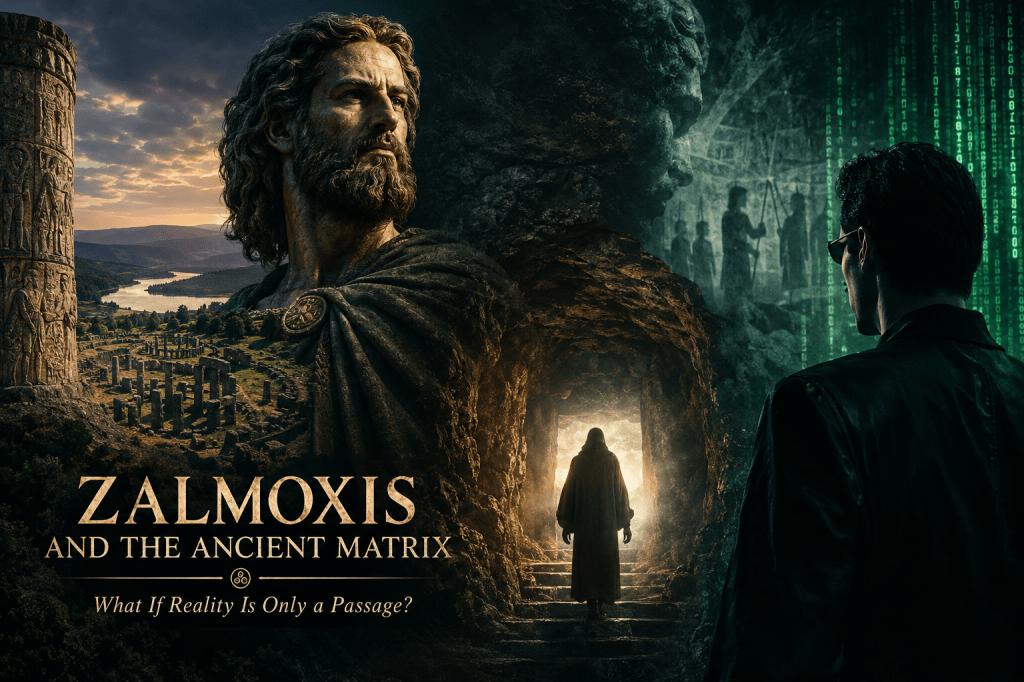
  • Zalmoxis and the Ancient Matrix: What If Reality Is Only a Passage?

    Zalmoxis and the Ancient Matrix: What If Reality Is Only a Passage?

    There is something unsettling about Zalmoxis even before we begin trying to understand who—or what—he was.

    He appears at the edge of recorded European history almost as if he had stepped out of a story that had already been told for centuries before anyone thought to write it down. A god to some, a man to others, perhaps a priest, perhaps a reformer, perhaps the distant memory of a real person whose identity dissolved into religion, he belonged to the world of the Getae north of the lower Danube, yet nearly everything we know about him was preserved by outsiders.

    That alone should make us cautious.

    It should also make us curious.

    The Getae left us no surviving sacred book explaining Zalmoxis in their own words. There is no Zalmoxian gospel hidden in a monastery, no authentic collection of his teachings waiting to be deciphered and no ancient manuscript that allows us to hear his voice directly. Instead, we find fragments scattered through Greek and Roman literature, each writer looking at the same strange tradition from a different angle.

    And yet, when those fragments are placed together, a remarkably persistent idea emerges.

    Human beings may be mistaken about what reality actually is.They may be mistaken even about death.That is where the story becomes far more interesting than a simple chapter of ancient religion, because behind Zalmoxis lies a question that humanity has never stopped asking.

    What if what we see is only the surface?

    The people who believed death was not an ending

    Our earliest substantial account comes from Herodotus, writing in the fifth century BC.

    While describing the Persian expansion into the lands around the Danube, Herodotus pauses to speak about the Getae. He calls them particularly courageous among the Thracian peoples, but it is their religious belief that captures his attention.

    According to him, the Getae believed that they did not truly die. A person who perished went instead to Zalmoxis—or, in the wording of the ancient account, to a divine figure Herodotus associates with Zalmoxis and also mentions under the name Gebeleizis.

    It is easy to read that sentence too quickly.

    Ancient cultures believed in afterlives everywhere, after all. Egyptians imagined the world beyond death, Greeks told stories about Hades, and later religions would place entire theological systems around the fate of the soul.

    But Herodotus describes something more concrete among the Getae.

    Once every five years, he says, they selected a messenger by lot. That man was entrusted with requests that he was supposed to carry to Zalmoxis. Then came the part that must have sounded shocking even to ancient readers: men held spears upright while the chosen messenger was thrown onto their points.

    If he died, the sacrifice was considered accepted. If he survived, the failure was blamed on the messenger and another could be selected.

    The ritual is brutal, and there is no reason to romanticize it. At the same time, its logic tells us something extraordinary about the world in which the ritual made sense.

    The messenger was not simply being killed.

    He was being sent.

    For the people performing the ritual, death was apparently a border that could be crossed, and on the other side of that border there was someone—or something—capable of receiving a message.Seen from that perspective, the sacrificed man was not merely a victim.

    He was a traveller into a reality inaccessible to the living.

    Whatever the Getae actually believed in all its complexity, Herodotus understood their religion as containing a radical conviction: the visible disappearance of a human being did not mean that the human being had ceased to exist.

    Then Herodotus tells another story, and this is where Zalmoxis becomes truly difficult to separate from mystery.

    The man who vanished underground

    Herodotus says that Greeks living around the Hellespont and the Black Sea told a different version of Zalmoxis’ origin.

    According to them, Zalmoxis had once been a mortal man associated with Pythagoras. In their story he had lived on Samos, learned from Greek thought, accumulated wealth and eventually returned to his homeland.

    There he gathered important men around him, entertained them and began teaching something astonishing: neither they, nor their descendants, nor Zalmoxis himself would truly die. Instead, they would go to another place where existence continued and where good things awaited them.

    Then he did something that sounds almost theatrical.

    He built an underground chamber.When it was ready, Zalmoxis disappeared into it.For three years, according to the story, nobody saw him. His people mourned him as dead.

    Then, in the fourth year, he emerged again.

    The man they believed had died had returned.

    And according to the Greek version preserved by Herodotus, that apparent return from death helped convince the Getae that his teaching had been true.It is precisely at this point that responsible history has to resist temptation.We cannot say that this event actually happened. We cannot even be certain that Zalmoxis was originally a historical person.

    Herodotus himself is surprisingly careful: he says that he neither completely believes nor completely rejects the tale of the underground chamber, and he doubts the chronology connecting Zalmoxis directly with Pythagoras. He even leaves open the basic question of whether Zalmoxis had been a man or a native Getic deity.

    That uncertainty does not weaken the story.In some ways it makes it more fascinating.Because whatever happened historically, somebody considered this story important enough to preserve: a teacher disappears beneath the earth, is mourned as dead, and then returns among the living.If this was an initiation drama rather than biography, what did it mean?

    If it was a myth, what truth was the myth trying to communicate?

    And if Zalmoxis was already a god before Greeks attempted to turn him into a former student of Pythagoras, why did the underground disappearance become such an important part of the story?

    We do not know.

    But we can see the structure.A man enters darkness.The world assumes he is gone.

    He returns possessing—or representing—knowledge about death that ordinary people do not possess.

    That structure has survived in religious myths, mystery traditions and philosophical stories across cultures because it touches a very old fear: perhaps human beings understand only the side of reality they happen to inhabit.

    Zalmoxis did not disappear from ancient literature

    Centuries later, Strabo tells another version.The Zalmoxis we meet in his Geography is less like a magician staging his own return from death and more like a sacred political figure, a man who acquires knowledge, becomes close to a ruler and eventually acts as an intermediary between divine authority and earthly power.

    Strabo says that Zalmoxis became a priest of the god most honoured among his people and was eventually himself treated as divine. He lived, according to the account, in an inaccessible cavernous place and met few people apart from the king and attendants. The mountain associated with this sacred retreat was called Cogaeonum in Strabo’s text.

    Again, we encounter withdrawal.

    Again, a sacred man is separated from ordinary society.Again, access to him is restricted.It is worth noticing how different this is from the modern image of a religious teacher speaking openly to crowds.

    Zalmoxis, as Strabo presents him, gains authority partly through distance. He occupies a space ordinary people cannot easily enter, and from that hidden space comes knowledge that affects the visible world outside it.Strabo even says that something of this religious-political institution continued later among the Getae. During the reign of Burebista, a comparable role was held by Decaeneus, the famous Deceneu of later Romanian historical tradition.This does not prove an unbroken secret order stretching across centuries, as modern esoteric stories sometimes suggest.

    The evidence simply does not allow that conclusion.

    Still, the repeated pattern is difficult to ignore.The ruler governs the visible world.The sacred figure interprets something beyond it.One possesses political power; the other possesses access to hidden knowledge.In a culture in which religion and political authority were deeply entangled, that distinction could have been enormously powerful.

    And then Plato enters the story.

    The strange physicians of Zalmoxis

    There is a passage in Plato’s Charmides that deserves far more attention than it usually receives when Zalmoxis is discussed.

    Socrates speaks of having learned from one of the Thracian physicians associated with Zalmoxis. The teaching attributed to them says, in essence, that you cannot properly treat the eyes without treating the head, nor the head without treating the body, and that you should not attempt to heal the body without considering the soul.

    The part cannot be healed while the whole is ignored.

    Plato presents Zalmoxis as both king and god within this story, and the medicine associated with him is explicitly holistic: body, soul and human character belong to the same reality and should not be artificially separated.

    Whether Plato is preserving an authentic Getic doctrine, reshaping an exotic tradition for philosophical purposes, or combining both is impossible to establish from the text alone.But something important has happened by this point.

    Zalmoxis is no longer merely the mysterious deity to whom the Getae send the dead.He has become associated with knowledge unavailable to ordinary perception.Death may not be what it seems.

    The body cannot be understood without the soul.The visible part cannot be fully understood without the invisible whole.That is an extraordinary collection of ideas to find around a figure standing in the mist between history and mythology.And this is where we can approach the Matrix—not by pretending that ancient Getae believed in computers, simulated universes or machines controlling humanity, but by recognising something much older beneath the modern language.

    The suspicion that reality has layers.

    Long before the red pill

    When people hear the word Matrix today, they often think immediately of a computer simulation.But the deeper philosophical idea behind the Matrix is much older than computers.

    The real shock is not discovering that machines exist.

    The real shock is discovering that your definition of reality was wrong.Neo begins inside a world that appears completely normal. Streets exist. Buildings exist. People go to work. Conversations happen. Food has taste. The world follows rules.Nothing initially appears artificial because Neo has never known anything against which to compare it.His prison works because it feels ordinary.

    That idea has an obvious philosophical ancestor in Plato’s Allegory of the Cave.

    Plato asks us to imagine human beings imprisoned underground from childhood, able to see only shadows projected before them. Since shadows constitute everything they have ever experienced, the prisoners naturally treat those shadows as reality.

    Only the person who turns around, leaves the cave and encounters another level of existence discovers how incomplete the former world was.

    Plato explicitly uses the image to distinguish the world apprehended through ordinary sight from a higher intelligible understanding.And here something curious happens.Plato gives us prisoners inside a cave, mistaking appearances for reality.The tradition about Zalmoxis gives us a sacred teacher who enters an underground chamber, disappears from ordinary human sight and returns carrying the authority of someone who supposedly knows what lies beyond death.The stories are not the same and should never be presented as though one copied the other.

    But place them beside one another and the resemblance of the questions becomes difficult to ignore.What can human senses actually tell us?How much of existence remains outside their range?If everybody around us agrees that something is real, does that agreement make it true?

    And what happens to the person who crosses the boundary between the accepted world and another understanding of it?These are not exclusively Greek, Getic or modern questions.They are human questions.

    Perhaps the real prison is certainty

    There is an uncomfortable reason why stories like these survive.Human beings need stable reality.We need to believe that the floor beneath us exists, that tomorrow will resemble today, that cause precedes effect and that the people around us inhabit roughly the same world we do.Without that agreement, ordinary life becomes almost impossible.Yet philosophy has always been dangerous to certainty.It asks whether seeing something is enough to know it.It asks whether consensus proves truth.It asks whether the limits of human perception have quietly become the limits of what we are willing to call real.Zalmoxis becomes fascinating in this context because the surviving traditions surrounding him attack the most absolute certainty of all.

    Death.

    A body falls.

    It stops breathing.It grows cold.It disappears into the earth.Every visible sign tells the observer that the person’s existence is over.And yet the Getic belief described by Herodotus says: you are interpreting what you see incorrectly.The person has gone somewhere.One does not have to accept that belief literally to understand its philosophical power.The senses provide evidence, but the doctrine tells the believer that the evidence is incomplete.That tension between appearance and hidden reality is precisely what gives both ancient initiation traditions and modern Matrix imagery their force.Not because they provide the same answer.Because they begin with the same doubt.

    What was inside the chamber?

    We will probably never know what Zalmoxis’ underground chamber looked like—if such a chamber existed at all.That missing information leaves a strange empty space at the centre of the story.

    Was it simply a hidden room in which a man lived for several years?Was it a ritual space connected with initiation?Did the story preserve a much older myth of a deity descending beneath the earth and returning?Was it a Greek attempt to rationalise a foreign god by turning him into a clever human teacher?

    Each possibility has been discussed in different forms, but the surviving evidence cannot settle the question.Modern scholarship also treats the Pythagorean connection cautiously.

    The story making Zalmoxis a former slave or follower of Pythagoras comes through Greek tradition, while Herodotus himself already doubted its chronology. Later analysis has continued to examine how legends linking Pythagoras with northern religious figures developed in Greek literature.This matters because Zalmoxis has accumulated an extraordinary amount of modern mythology.He has been called a prophet, a supreme god, a monotheistic reformer, a shaman, an initiate, a philosopher and the guardian of supposedly lost Dacian wisdom.

    Some of those interpretations may contain useful comparative ideas, while others go far beyond anything ancient sources actually tell us.The honest version is less comfortable and, I think, far more intriguing.

    We do not know exactly who he was.

    Herodotus did not know.

    Strabo inherited traditions centuries later.

    Plato knew the name and associated it with remarkable Thracian wisdom, yet he was using that tradition inside a philosophical dialogue rather than writing an ethnographic report.

    Zalmoxis stands precisely where evidence begins to thin and myth begins to breathe.

    And perhaps that is why he has never disappeared.

    The ancient Matrix was not a machine

    If we use the word Matrix here, we should use it carefully.There is no evidence that Zalmoxis taught that physical reality was false, that the world was artificially generated or that humanity was imprisoned inside anything resembling a technological simulation.The interesting parallel lies elsewhere.

    A Matrix can also be understood as a framework of reality that becomes invisible because we have lived inside it for too long.A culture tells us what life is.It tells us what death means.It teaches us which things are possible and which questions are absurd.

    Eventually we stop recognising those assumptions as assumptions. They become the walls of the world.The prisoner in Plato’s cave does not initially see a prison.Neo does not initially see a simulation.And the ordinary observer sees death and assumes that what has vanished from sight has vanished from existence.

    Zalmoxis enters this conversation not as proof that the ancients knew the secret structure of the universe, but as evidence of something more modest and perhaps more profound: thousands of years ago, human beings were already deeply uncomfortable with the possibility that visible reality might not be complete reality.That thought lies at the heart of our book Matrix as well.

    The question is not simply whether we live inside a computer program. That is only one modern version of a much older problem.The deeper question is what creates the reality in which we live.Our senses?Our society?Our language?Our memories?Our fears?Our education?The people who hold authority?Or something beyond all of them?Once that question is allowed into the mind, the Matrix changes shape.It no longer requires cables, machines or a digital sky.

    Sometimes the Matrix is simply everything we have been taught never to question.

    And perhaps this is why Zalmoxis still feels strangely modern

    More than two millennia separate us from the people Herodotus described.Their world has vanished. Their language has largely disappeared with them. Their sacred places survive mostly as archaeology, geography and conjecture, while their beliefs reach us through the imperfect filter of outsiders who were themselves trying to understand something foreign.

    Yet Zalmoxis remains.

    Not clearly enough for us to possess him, but not vaguely enough for us to forget him.A god who may have been a man.A man who may have become a god.A teacher associated with immortality who vanished beneath the earth.A sacred figure hidden in an inaccessible place.A tradition in which the soul mattered more than the body alone could explain.A people described as believing that death did not mean what everyone else assumed it meant.

    Perhaps there is no secret doctrine waiting to be recovered from these fragments.Perhaps there was never one.

    But imagine, just for a moment, the person standing outside the underground chamber after Zalmoxis had disappeared.Three years pass.Nothing.The man is dead. Everyone knows it.Then one day he walks out.What would collapse first?Belief in death?Belief in the evidence of your own eyes?Or the comforting certainty that the world works exactly as you have always been told?

    That is where Zalmoxis becomes more than an ancient mystery.

    Because every Matrix begins at exactly that point.

    Not when someone gives you the answer.But when, for the first time, you suspect that the reality you accepted without question may not be the whole story.
  • Time Has No Time

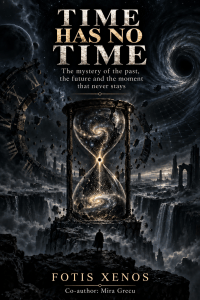
    TIME HAS NO TIME

    What if time does not pass at all… then what is actually passing?

    Look at the clock.

    The seconds move.

    The day ends.

    People grow older.

    The past seems lost, while the future appears not to exist yet.

    But what if this is only the version of reality that our minds are capable of perceiving?

    What if time does not flow at all?

    What if the past has never disappeared?

    What if the future already has a place within the structure of the Universe?

    What if the present — that elusive “now” we consider the only truly real moment — is merely a fragile construction of consciousness?

    TIME HAS NO TIME -enters one of the most disturbing mysteries of existence: time itself.

    From Chronos, Kairos, and ancient ideas of eternity to Einstein and relativity, from the Block Universe and time dilation to entropy, the butterfly effect, and the paradoxes of time travel, the book follows a question that becomes increasingly unsettling the further you go:Is time something that exists within the Universe… or something the mind creates in order to understand the Universe?

    And then things become even stranger.Memory does not preserve the past like a perfect recording — it reconstructs it.

    The brain does not perceive reality instantaneously — it assembles what we experience as the present.Relativity tells us that there is no single cosmic clock ticking identically for every observer.

    And that leads to a question very few people dare to follow all the way to its consequences:If there is no universal “now,” where is the past?

    Where does the future begin?

    And where are you within this structure?

    The book moves deeper, into territories where physics meets philosophy and consciousness: déjà vu, the Mandela Effect, dreams in which time behaves impossibly, free will in a universe where the future may already have a place, death, eternity, and finally the radical question that closes the circle:

    What if time does not exist at all in the way we think it does?

    This is not a book that tells you what to believe.It is a book that destroys the comfort of certainty.For readers who are not satisfied with simple answers.

    For those fascinated by physics, philosophy, consciousness, and the hidden architecture of reality.

    For minds willing to accept that sometimes the most disturbing discovery is not the answer……but the possibility that we have been asking the wrong question from the beginning.

    TIME HAS NO TIME

    The Mystery of the Past, the Future, and the Moment That Never Stays

    By Fotis Xenos

    Co-author: Mira Grecu

    Perhaps time does not pass.

    Perhaps we are the ones passing through it.

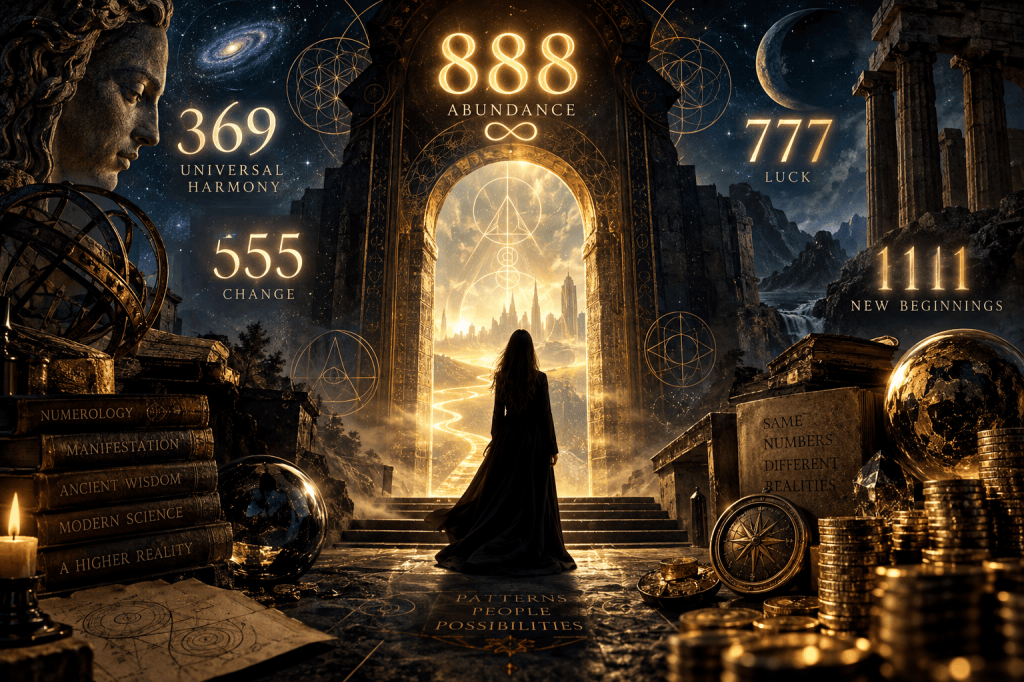
  • The Numbers of Abundance: Why 369, 555, 777 and 888 Keep Appearing in the Hidden Language of Money

    There is something strangely intimate about a number that refuses to leave you alone.

    You glance at your phone and it is 8:08. Later, a receipt ends in 8.88. An invoice contains three eights, a hotel room carries the same digits, and then, just when you have almost forgotten about it, 888 appears again somewhere completely ordinary. For someone who has never attached meaning to numbers, this is little more than coincidence. For someone familiar with numerology, however, 888 carries a very different reputation: it is supposed to be the number of abundance, material flow, success and money.

    Nearby in this strange numerical landscape are 555, usually associated with sudden change; 777, with fortune and spiritual alignment; 111 or 1111, with beginnings and manifestation; and the almost legendary combination 3–6–9, surrounded today by stories about Nikola Tesla, hidden mathematical laws and a supposed numerical architecture underlying reality itself.

    Then another layer is added. Search online for these numbers and soon they cease to be merely numbers. They become frequencies. There are recordings labelled 888 Hz Money Frequency, 777 Hz Abundance Frequency, 555 Hz Transformation Frequency, often accompanied by promises of prosperity, energetic clearing or a dramatic shift in one’s financial life.

    At this point an obvious question becomes difficult to avoid.

    Where did all of this actually come from?

    And perhaps the more unsettling question is not whether a number can magically deposit money into a bank account, but why human beings have been assigning power to numbers for thousands of years, long before YouTube manifestation videos, TikTok numerology and modern “angel numbers” ever existed.

    Long Before 888 Meant Money, Numbers Were Already Mysterious

    The belief that numbers possess qualities beyond simple counting is far older than the modern manifestation movement.

    Among the Pythagoreans of ancient Greece, number was not merely a convenient human invention used to measure livestock, land or coins. Numerical relationships appeared to reveal something fundamental about reality itself. Early accounts of Pythagorean thought describe a worldview in which mathematical relationships were intimately connected with harmony, music, geometry and the structure of the cosmos, eventually giving rise to the famous idea commonly summarized as “all things are number.” Ancient Pythagorean speculation also attached symbolic qualities to particular numbers, although these associations should not be confused with today’s internet numerology.

    This distinction matters because modern numerology often borrows the atmosphere of antiquity while adding meanings that are actually much more recent.

    Pythagoras did not leave behind an ancient handbook announcing that seeing 888 on a supermarket receipt meant a financial breakthrough was approaching, nor did his followers teach that playing an 888-Hz tone would attract money into one’s life. What they did help establish was something more fundamental and, in a sense, more interesting: the idea that numbers might express qualities and relationships hidden beneath visible reality.

    Once that door had been opened, later generations never completely closed it.

    Numbers became entangled with theology, astrology, magic, architecture, music, calendars and divination. Seven became sacred in numerous traditions, three repeatedly appeared in religious structures, twelve organized heavens and calendars, and particular numerical combinations acquired meanings that changed according to culture and period.

    The modern fascination with 111, 555, 777 and 888 belongs to this much larger human habit of turning quantity into meaning.

    But the specific system most people encounter today is considerably younger than it appears.

    888: How Eight Became the Number of Abundance

    Within contemporary numerology, 8 has acquired an unusually material character. It is commonly associated with authority, ambition, achievement, organization, business, material power and the movement of resources; repeated three times, that symbolism becomes 888, now widely interpreted as abundance, prosperity or financial success.

    The modern category known as “angel numbers”, however, should not be mistaken for an intact doctrine transmitted from antiquity. Repeating sequences such as 111, 222, 555 and 888 became especially prominent through modern New Age publishing and were popularized in their present form during the early twenty-first century, particularly through the work of author Doreen Virtue. Contemporary interpretations commonly describe 555 as major change and 888 as manifestation, success and prosperity.

    That makes the story considerably stranger than the simplified version often encountered online.

    The symbolism of numbers is ancient, but the tidy modern dictionary in which 111 means one thing, 555 another and 888 automatically means money is largely contemporary.

    Yet 888 does contain an elegant numerical curiosity that helps explain why people drawn to numerology find it so appealing.

    Add its digits:

    8 + 8 + 8 = 24

    Then reduce again:

    2 + 4 = 6

    So the numerological root of 888 is 6, traditionally interpreted in many modern systems as harmony, responsibility, balance, care and restoration.

    Now perform exactly the same operation with 555:

    5 + 5 + 5 = 15

    1 + 5 = 6

    The supposed number of dramatic change and the supposed number of abundance both return to 6.

    This proves no supernatural mechanism whatsoever, because digital reduction is simply arithmetic. Yet symbolically it creates an irresistible narrative: movement and disruption represented by 555 eventually return to balance, while the material power represented by 888 must also return to balance.

    Whether one calls that cosmic wisdom or a beautiful human interpretation depends entirely on where one stands.

    555: The Number That Appears Before Everything Changes

    If 888 is imagined as the vault, 555 is the door being forced open.

    In contemporary angel-number traditions, 555 represents disruption, transition, movement and the collapse of an old pattern before another one can take its place. Financially, therefore, it is sometimes interpreted not as money itself but as the change that precedes a new source of income, a different career, an unexpected opportunity or the uncomfortable realization that an existing way of living is no longer sustainable.

    There is something psychologically clever in this interpretation, because prosperity rarely arrives in real life without some degree of transformation. A person changes work, learns a skill, takes a risk, starts a business, abandons an unsuccessful project or notices an opportunity that had previously been ignored.

    The number itself does not need to possess supernatural power for the symbolism to become personally powerful.

    A person who begins using 555 as a reminder to ask What must change? may actually behave differently.

    And that brings us dangerously close to the border where ritual, psychology and magic begin to resemble one another.

    777: Luck, Mystery and the Number We Already Wanted to Believe In

    Seven entered the symbolic imagination long before modern numerology discovered it.

    It appears repeatedly in religious traditions, mythology, calendars and cultural symbolism, which gave it an aura that later systems could easily inherit. Modern angel-number interpretations typically connect 777 with spiritual insight, inner wisdom, good fortune or being somehow “in alignment.”

    Its modern association with luck was strengthened further by popular culture and gambling imagery, particularly the familiar three sevens of slot machines, where 777 became visually synonymous with the jackpot.

    This is worth remembering because symbolism rarely has a single origin. Meanings accumulate.

    A number may begin with a religious association, acquire an occult meaning centuries later, be reinforced by popular entertainment and eventually return to social media disguised as an ancient universal code.

    By the time we encounter it, the layers have become almost impossible to see.

    Then There Is 369

    Of all the numerical mysteries circulating online, 3–6–9 is probably the most seductive because its legend contains a real historical figure: Nikola Tesla.

    A statement endlessly attributed to him claims that if humanity understood the magnificence of 3, 6 and 9, it would possess a key to the universe.

    The problem is that a reliable primary source establishing that Tesla actually made this famous statement has never been convincingly produced.

    What is documented is Tesla’s peculiar fixation on the number three and numbers divisible by three. Biographical accounts describe his preference for hotel rooms whose numbers were divisible by three, rituals involving counting, and his use of eighteen napkins at meals. Smithsonian’s account of Tesla’s later life also notes his fixation on three, while Tesla biographer Margaret Cheney, when asked by PBS about his “magic” number three, described it as apparently a superstition rather than a hidden scientific theory.

    This does not make the 369 story less fascinating; in some ways, it makes it more so.

    There really was a Tesla fascinated by numerical repetition.

    There really are striking mathematical patterns involving digital roots and multiples of nine.

    What appeared later was a mythology built around these facts.

    For example, multiples of nine repeatedly return to nine when their digits are summed:

    18 becomes 1 + 8 = 9.

    27 becomes 2 + 7 = 9.

    36 becomes 3 + 6 = 9.

    108 becomes 1 + 0 + 8 = 9.

    There is nothing paranormal about this property; it follows from arithmetic in base ten and modular mathematics. Yet visually and mentally, it is hypnotic, particularly when combined with other digital-root patterns that make 3, 6 and 9 appear to occupy distinctive positions.

    From such patterns came later systems including what is popularly called “vortex mathematics,” along with manifestation practices instructing people to write an intention three times in the morning, six times during the day and nine times at night.

    Tesla himself did not leave us such a manifestation ritual.

    The internet did.

    When a Number Suddenly Becomes a Frequency

    There is another confusion hidden inside this subject, and it is responsible for much of the mythology surrounding “money frequencies.”

    888 and 888 Hz are not the same thing.

    The first is a number.

    The second is a physical frequency representing 888 oscillations per second.

    A sound wave at 888 Hz is perfectly real and measurable, just as 440 Hz or 528 Hz is measurable. What science does not establish is that the symbolic numerological meaning assigned to the digits 888 somehow transfers automatically to a sound wave oscillating 888 times per second.

    That leap is philosophical or spiritual rather than physical.

    Nevertheless, once modern spiritual culture began associating certain frequencies with meditation and transformation, it was almost inevitable that numerological sequences would enter the same world. Today one can easily find 888 Hz labelled as an abundance or money frequency, 777 Hz associated with luck or spiritual awakening and 555 Hz with transformation.

    Their popularity can create the impression that these correspondences belong to an ancient system of sacred acoustics.

    They do not.

    The distinction becomes particularly important when these recordings are compared with the so-called Solfeggio frequencies, another modern spiritual system that is frequently presented online as if its exact Hertz values were inherited unchanged from medieval monks.

    Historical solfeggio was indeed real, but it referred to a method of teaching musical intervals through syllables such as Ut, Re, Mi, Fa, Sol, La. The modern lists of supposedly healing frequencies are a different development.

    That does not mean sound has no effect on us.

    Quite the contrary.

    It simply means that the effect must not be confused with the claims attached to the number printed in the video title.

    What Sound Really Can Do

    Music can influence human physiology and emotion in measurable ways.

    A large meta-analysis of 104 randomized controlled trials involving 9,617 participants found significant overall effects of music interventions on both physiological and psychological stress-related outcomes. Other research has similarly explored effects on anxiety, heart rate, blood pressure, cortisol and emotional state.

    There is even emerging research examining specific tunings. A randomized controlled study published in 2026 compared instrumental music at 528 Hz and 432 Hz with a no-music condition in 162 university students experiencing exam-related stress. Researchers reported differences in several salivary biomarkers after exposure, although cognitive performance on the Stroop test did not significantly differ between the groups. Interesting as those findings are, they do not demonstrate that a particular frequency possesses a universal healing power, much less that a frequency can attract money.

    Science therefore leaves us in a more nuanced place than either believers or absolute skeptics sometimes prefer.

    Sound can affect the human organism.

    Music can influence stress and emotion.

    Ritual can alter attention.

    But there is currently no credible scientific evidence showing that listening to 888 Hz causes financial abundance, that 777 Hz changes luck, or that repeating 555 alters external events through an undiscovered energetic law.

    And yet people continue reporting that these numbers seem to follow them.

    Why?

    The Moment You Learn 888, You Begin Seeing It Everywhere

    There is a well-known psychological phenomenon called the frequency illusion, sometimes referred to as the Baader-Meinhof phenomenon.

    Once something becomes personally significant, attention begins detecting it more readily. The object has not necessarily become more common; rather, the mind has begun selecting it from the enormous amount of information that was already present. Selective attention and confirmation bias can then reinforce the impression that the pattern is appearing with extraordinary frequency.

    Imagine how many numbers pass through a person’s visual field during an ordinary week.

    Clocks, prices, passwords, receipts, telephone numbers, addresses, vehicle registrations, social-media metrics, bank statements, page numbers, dates and notifications surround us constantly.

    Most disappear without leaving any trace in memory.

    But tell someone that 888 means money, and 888 is no longer ordinary information.

    It has become a signal.

    The next time it appears, the brain notices.

    The appearance after that feels like confirmation.

    After several repetitions, coincidence begins to resemble communication.

    Research into repetition provides another intriguing piece of the puzzle. Experiments on the “illusory truth effect” have shown that repeated information can feel more truthful simply because it becomes more familiar and easier for the mind to process. In experiments where statements were presented multiple times, repeated claims were subsequently judged as more truthful than unfamiliar ones.

    None of this proves that every experience of synchronicity can be reduced neatly to a cognitive bias.

    It does, however, demonstrate that the human mind is extraordinarily capable of transforming repetition into significance.

    Perhaps that ability is precisely why numerical mysticism has survived for so long.

    But What If the Number Still Changes Something?

    Here the story becomes more complicated, because dismissing the entire subject with the word “coincidence” misses something important.

    Suppose a person chooses 888 as a private symbol of financial stability and writes it at the top of a notebook each morning. Beneath it, she records her income, expenses, unfinished projects and one action that could improve her financial position.

    After several months she has earned more money.

    Did 888 attract it?

    There is no need to invoke an invisible monetary vibration to explain what happened. The ritual repeatedly directed attention toward financial decisions, opportunities and unfinished tasks. A symbol altered focus; focus influenced behaviour; behaviour altered outcomes.

    From the outside, this looks psychological.

    From the inside, it may feel like manifestation.

    And somewhere between those two descriptions lies one of the oldest ambiguities in magic.

    Rituals often work by changing the person performing them long before they change anything else.

    The candle, symbol, prayer, sigil or repeated number may not command the universe, yet it can organize intention in a mind that was previously scattered. Once intention becomes consistent, behaviour can follow. Once behaviour changes, reality sometimes changes with it.

    This does not validate every supernatural claim attached to manifestation, but neither does it make symbolic practices meaningless.

    Symbols have always possessed power of a particular kind because human beings respond to them.

    Money itself proves the point rather beautifully.

    A banknote is paper.

    A number displayed inside an online banking application is a pattern of pixels.

    Yet entire lives can change because societies collectively agree that those symbols represent value.

    Human civilization is already filled with numbers that possess enormous power, although the source of that power is not necessarily hidden cosmic vibration.

    It is belief, agreement, attention and action.

    So Is 888 Really the Frequency of Money?

    If by “frequency” we mean a measurable physical phenomenon capable of attracting wealth, there is no good evidence that it is.

    If we mean an ancient universal numerical law proving that 888 automatically produces abundance, history does not support that claim either.

    But if we ask why 888 has become such a powerful symbol of abundance, the answer becomes considerably richer.

    It stands at the meeting point of ancient numerical mysticism, modern numerology, New Age angel-number culture, digital repetition, the psychology of attention and a very old human desire to believe that chaos contains patterns.

    555 tells us that something must change.

    777 whispers that fortune may be nearby.

    888 promises abundance.

    369 suggests that somewhere beneath ordinary reality a mathematical mechanism might still be waiting to be discovered.

    Perhaps none of these numbers opens a supernatural vault.

    Yet perhaps that was never their most interesting power.

    A number can make someone stop.

    Notice.

    Remember.

    Change direction.

    Take an opportunity seriously.

    Ask a question that had been avoided.

    And every now and then, after enough of those small changes, a person’s external life really does begin to look different.

    The rational explanation would say that the mind changed first.

    The occult explanation would say that the vibration changed first.

    Between those two interpretations remains the narrow territory where Whisper Mysteries prefers to linger, because the strangest mysteries are not always those that can be proved or disproved cleanly.

    Sometimes the mystery is why a simple sequence of digits can enter the human mind and refuse to leave.

    And if you happen to see 888 shortly after reading this, remember one thing before deciding that the universe has sent you a message:

    You now know exactly what to look for.

    Whether that makes the next appearance coincidence, psychology or synchronicity is a question the number itself will never answer.

    Sources
    Stanford Encyclopedia of Philosophy — Pythagoras: pentru tradiția pitagoreică, semnificația numerelor și relația dintre număr, armonie și cosmos.
    Pythagoras – Stanford Encyclopedia of Philosophy


    Smithsonian Magazine — Nikola Tesla and the Tower That Became His “Million Dollar Folly”: confirmă documentarea istorică privind fascinația lui Tesla pentru cifra 3 și numerele divizibile cu trei.

    PBS – Tesla: Master of Lightning: biografa Margaret Cheney spune că „numărul magic 3” al lui Tesla pare să fi fost o superstiție personală, nu o teorie științifică secretă.


    Vogue — How to Decode Angel Numbers: utilă pentru istoria modernă a „angel numbers” și interpretările contemporane ale 111, 555, 777 și 888; articolul notează și popularizarea termenului de către Doreen Virtue.

    Psychology Today — Frequency Illusion: explică de ce, după ce aflăm semnificația unui număr precum 888, putem începe să-l observăm aparent peste tot.

    PubMed — Effects of Music Interventions on Stress-Related Outcomes: meta-analiză a 104 studii randomizate, cu 9.617 participanți, despre efectele muzicii asupra stresului fiziologic și psihologic.
    PubMed – Music and Stress Meta-analysis

    PubMed — Acute Music-Frequency Exposure, 2026: studiul randomizat cu 162 de participanți care a comparat muzica la 528 Hz, 432 Hz și lipsa muzicii.
    PubMed – 528 Hz and 432 Hz Study

  • The White Room: The Torture That Leaves No Scars but Can Break the Human Mind

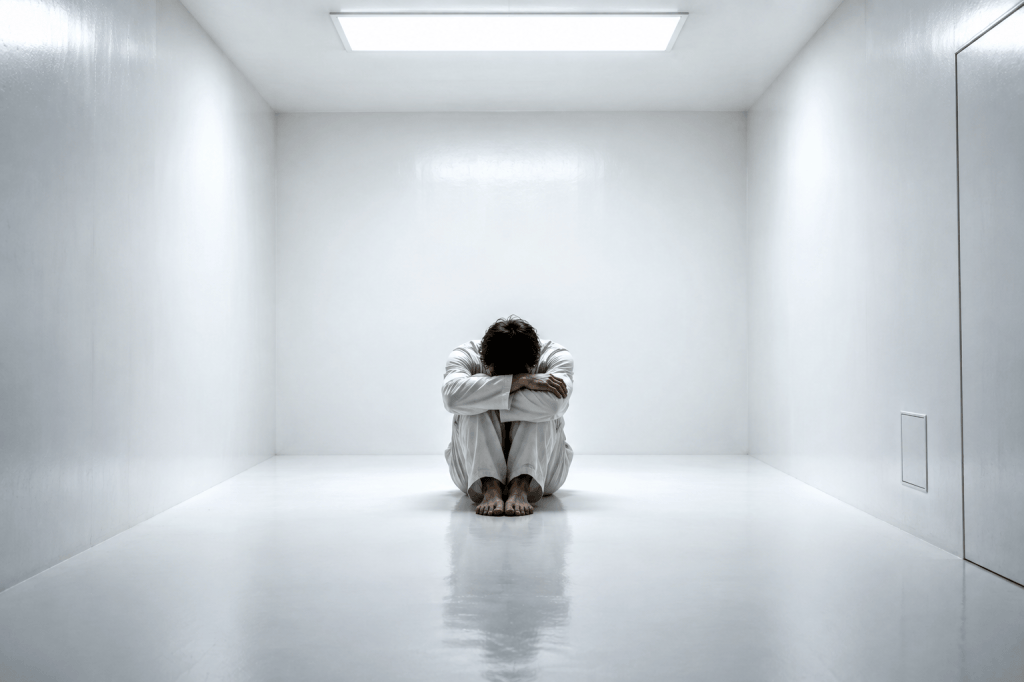
    Imagine waking inside a room in which almost everything capable of telling you where you are, how long you have been there, or whether another human being still exists beyond the walls has gradually disappeared. There is no window through which daylight can announce morning, no clock capable of dividing existence into hours, no familiar voice, no changing landscape, no ordinary conversation, and perhaps not even the reassuring noises produced by footsteps approaching along a corridor. The walls appear white, the clothing is white, the food arrives without color, artificial light refuses to distinguish night from day, while silence becomes so complete that the faint sounds generated by your own body begin to occupy a space once filled by the external world.

    Nothing visible may happen to you, yet something profound may begin happening inside you.

    This disturbing environment has become popularly known as the White Room, although the historical reality behind the expression is more complicated than the internet legend suggests. In Iran, political prisoners, writers and human-rights organizations have used the expression “white torture” more broadly to describe extreme incommunicado solitary confinement, sometimes involving sensory deprivation, uninterrupted artificial lighting, blindfolding, silence and the deliberate destruction of normal temporal and social reference points. Human Rights Watch documented the term in a major 2004 investigation of detention practices in Iran, reporting that prisoners described absolute solitary confinement as psychologically devastating and, in some cases, worse than physical or verbal abuse.

    Yet there is also a documented case that sounds uncannily close to the almost mythical white chamber described online.

    His name was Amir Abbas Fakhravar.

    The Prisoner Surrounded by White

    In February 2004, Amnesty International issued an urgent report concerning Fakhravar, a young Iranian journalist who had been imprisoned and interrogated after allegedly being transferred to a detention facility known as Centre 125, controlled by the Revolutionary Guards. According to the information Amnesty received, his cell had no windows and was colored a creamy white, while the clothes he was required to wear were also white. His meals reportedly consisted of white rice served on white disposable plates, and when he needed to use the toilet he was required to slide a white piece of paper beneath the door. Even the guards, according to the account, wore footwear designed to suppress the sound of their movement.

    The detail that makes the account particularly disturbing is not the color itself, because white walls are not neurologically poisonous and white clothing does not possess some mysterious power to erase personality. What matters is the systematic removal of difference, because human consciousness normally exists inside a constantly changing ocean of sensory information in which light alters, sounds approach and disappear, people speak, shadows move, temperatures fluctuate, objects acquire meaning through contrast, and time is inferred from thousands of tiny environmental events that we almost never consciously notice.

    Amnesty described the conditions reported in Fakhravar’s case as extreme sensory deprivation capable of causing persistent suffering and stated that they appeared to amount to torture. The organization also reported another psychologically destabilizing element: he was allegedly released briefly and then taken back into custody, producing uncertainty about whether freedom itself could be trusted.

    This is where the White Room stops being merely a sinister-looking prison cell and becomes something much more psychologically sophisticated.

    The prisoner is not simply deprived of freedom.

    He may gradually be deprived of the ordinary machinery by which the mind confirms reality.


    White Torture Is Not Necessarily a White Room

    One of the most important distinctions to make is that the expression white torture should not be interpreted as referring exclusively to a perfectly white chamber, because Human Rights Watch documented the Iranian usage as a term for prolonged incommunicado solitary confinement more generally. Prisoners could be kept in small underground cells under artificial light around the clock, separated from other detainees, attorneys, family members and health professionals while their principal human contact became the people interrogating them.

    This distinction actually makes the phenomenon more disturbing rather than less, because it reveals that the fundamental weapon is not a particular color scheme but controlled isolation.

    A prisoner who is beaten understands, however brutally, what is attacking him; there is an identifiable action, an identifiable source of pain and an event around which the mind can organize resistance. Extreme isolation can operate differently because the environment itself becomes the instrument, while silence, repetition, uncertainty and the absence of meaningful contact gradually alter the psychological landscape without necessarily producing a bruise that an outside observer can photograph.

    Human Rights Watch reported in 2004 that such isolation had been used against political prisoners to weaken resistance, obtain information and secure recorded or signed confessions, while former detainees described the combination of constant artificial light and social isolation as exceptionally destructive.

    The unsettling question therefore becomes not simply why isolation feels unpleasant, but why a brain surrounded by almost nothing can sometimes become increasingly unstable.

    The answer begins with a misconception about the brain itself.


    Your Brain Was Never a Passive Camera

    We often imagine perception as though the brain were sitting quietly inside the skull waiting for information to arrive from the eyes, ears and skin, after which it simply displays an accurate internal copy of the world. Modern neuroscience paints a much more dynamic picture, because perception emerges from an interaction between incoming sensory signals and neural systems that continuously interpret, organize and predict what those signals mean.

    This matters enormously when external stimulation is drastically reduced.

    Studies and reviews of hallucination mechanisms suggest that when normal sensory input weakens, internally generated activity can acquire greater influence over perception, particularly when the brain becomes less able to distinguish between signals generated externally and those generated internally. Research on sensory loss has described this through deafferentation models, in which reduced sensory input alters the balance of excitation and inhibition within neural networks, potentially lowering thresholds for internally generated perceptual activity.

    Neuroimaging studies of hallucinations likewise indicate that experiences such as hearing voices or seeing things without corresponding external stimuli can involve some of the same sensory-processing regions that normally respond to real sounds and images, alongside networks related to memory, self-representation and cognitive monitoring.

    This does not mean that every person placed alone in a quiet room will hallucinate, nor does it mean that hallucinations generated under sensory deprivation operate through a single established mechanism. Individual susceptibility, duration, psychological state, expectation and the degree of deprivation all matter enormously.

    What the evidence does suggest is far more intriguing: when the outside world becomes quiet enough, the brain does not necessarily become quiet with it.

    Sometimes it begins supplying material of its own.


    When Nothing Happens, the Brain Begins Searching for Something

    One of the earliest systematic demonstrations of this phenomenon came from experiments conducted in the 1950s by psychologists including Woodburn Heron, W. H. Bexton and R. H. Scott at McGill University in Canada. Participants were exposed to environments designed not necessarily to eliminate sensation completely, which is extraordinarily difficult, but to reduce variation in sensory input through monotonous visual, auditory and tactile conditions.

    The 1954 study became part of a growing scientific literature on restricted sensory environments, with subsequent researchers documenting unusual imagery, perceptual distortions and disturbances of thought under conditions of sensory deprivation.

    Decades later, researchers again placed healthy volunteers in short-term sensory deprivation and found increases in unusual perceptual experiences, suspiciousness and other psychosis-like phenomena, with individuals already more prone to hallucinations showing stronger perceptual disturbances. The researchers discussed difficulties in source monitoring, the brain’s ability to determine whether an experience originated externally or internally, as one possible mechanism.

    That possibility produces an eerie paradox.

    Ordinarily, your environment constantly corrects you.

    A sound occurs and you turn toward its source; daylight moves across a room and reminds you that hours have passed; another person’s face confirms a shared reality; objects remain in predictable locations; conversation repeatedly anchors memories, identity and sequence.

    Remove enough of these corrections and consciousness may be forced to rely increasingly upon itself.

    The mind becomes both observer and environment.


    The Disappearance of Time

    Among the first things that can become unstable in extreme confinement is something we normally experience as immutable: time.

    Human beings do not perceive time through a single biological clock that functions independently of the world around us, because our sense of temporal order is continually reinforced by external signals such as daylight, darkness, meals, physical activity, conversations and social routines. Light is particularly important because it helps synchronize the circadian system that regulates sleep, hormones, alertness and numerous physiological processes.

    When artificial light remains on continuously, when the prisoner does not know whether it is morning or midnight, and when every day contains almost exactly the same events, chronological time can lose much of its ordinary structure.

    A modern review of sensory deprivation research published in 2026 describes evidence connecting severe or prolonged reductions in stimulation with circadian disruption, changes involving stress systems such as the hypothalamic-pituitary-adrenal axis, neurotransmitter adaptations and cognitive or perceptual disturbances. The authors also emphasize an essential qualification: duration, voluntariness and individual vulnerability matter greatly, meaning that voluntary short-term sensory restriction used therapeutically cannot simply be equated with coercive imprisonment.

    That difference is crucial.

    Floating peacefully in a controlled sensory-reduction environment from which you can leave whenever you wish is fundamentally different from not knowing whether anyone will ever open the door.

    The nervous system does not respond only to silence.

    It responds to helplessness, unpredictability and lack of control.


    Narges Mohammadi and the War Against Solitary Confinement

    One of the most prominent contemporary voices against prolonged solitary confinement is Iranian human-rights activist Narges Mohammadi, who received the Nobel Peace Prize in 2023.

    Mohammadi did not encounter the mythical spotless white chamber of internet stories, yet her experience demonstrates why the term white torture has become associated with far more than wall color. Amnesty International documented that during one period beginning in 2021, she spent 64 days in solitary confinement in Section 209 of Evin Prison, where bright lights were reportedly kept on continuously, access to natural light and fresh air was severely restricted, and meaningful contact with other prisoners was almost entirely eliminated. Amnesty stated that these conditions caused severe distress and suffering.

    Her campaigning subsequently focused heavily on the use of prolonged solitary confinement against political prisoners, while Human Rights Watch noted that she had repeatedly sought to expose the practice and its role in obtaining forced confessions.

    Her testimony also illustrates an aspect of isolation that laboratory sensory-deprivation experiments cannot fully reproduce: the prisoner is not simply missing stimulation but is living inside an environment of uncertainty in which interrogation, punishment, release, medical care and contact with loved ones may all depend upon decisions made by unseen authorities.

    The silence therefore has meaning.

    It can mean abandonment.

    It can mean that interrogation is coming.

    It can mean nothing at all.

    The prisoner cannot know which possibility is true, and uncertainty itself becomes part of the psychological pressure.


    Why Human Contact Is More Than Conversation

    There is another reason why extreme solitary confinement can become psychologically damaging that has little to do with vision or hearing.

    Human beings are profoundly social organisms whose nervous systems develop and function through interaction with other people. Conversation provides information, but it also performs something more fundamental because another person’s reactions continuously confirm that we inhabit a shared world.

    Someone speaks your name and confirms your identity.

    Someone remembers an event and confirms your past.

    Someone reacts to your words and confirms that your thoughts have reached another mind.

    Remove meaningful human contact for long enough, particularly under involuntary and threatening conditions, and one of the ordinary external mirrors through which identity is stabilized begins to disappear.

    This does not mean that personality literally evaporates after a predetermined number of days, because such dramatic claims cannot be scientifically justified. It does mean that studies of prolonged solitary confinement repeatedly associate the practice with anxiety, depression, perceptual disturbances, hostility, self-harm and broader psychological deterioration.

    A 2020 systematic review and meta-analysis examined 13 studies involving 382,440 incarcerated people, approximately 23 percent of whom had experienced solitary confinement. The authors found that solitary confinement was associated with worsening psychological symptoms, self-harm and mortality, particularly suicide, while mood disturbances, psychotic symptoms and hostility showed measurable associations.

    Another major meta-analysis examining self-harm in prisons found a particularly strong statistical association between solitary confinement and self-harm, although such associations should not be interpreted simplistically because people placed in isolation may already differ in important psychological and behavioral ways from the wider prison population.

    The scientific picture is therefore not that isolation automatically destroys every mind.

    It is that prolonged isolation substantially increases psychological danger.


    The Cold War Discovered the Power of an Empty Environment

    The history becomes darker when laboratory research is placed beside declassified interrogation documents from the Cold War.

    In 1963, the CIA produced a classified interrogation manual known as KUBARK Counterintelligence Interrogation, a document later released under freedom-of-information procedures and published by the National Security Archive. Among the coercive techniques discussed in the manual was sensory deprivation through controlled environments and solitary confinement.

    The significance of this document is not that it invented sensory deprivation, nor that every modern example of solitary confinement can be traced directly to CIA research. The historical relationships between psychological research, military interrogation, intelligence agencies and different national prison systems are far more complicated than such a claim would suggest.

    What the document proves is narrower and more disturbing.

    By the early 1960s, powerful institutions had explicitly recognized that disrupting a person’s ordinary relationship with time, space and sensory perception could be useful in coercive interrogation.

    The National Security Archive also documents a later 1983 CIA training manual that drew heavily upon earlier material and discussed environmental manipulation designed to disrupt normal patterns of perception. After concerns over human-rights abuses, parts of the material were altered, and a 1992 Defense Department investigation concluded that several interrogation manuals contained objectionable material violating legal or policy standards.

    Physical torture attacks the body directly.

    Psychological coercion discovered that the environment could sometimes be turned into the weapon.


    When Silence Becomes Loud

    People often imagine silence as the absence of sound, but biologically there is almost never complete silence because the body itself produces noise. Breathing moves through the airways, the heart pulses, muscles shift, joints move, digestion continues, and the auditory system maintains its own spontaneous neural activity.

    In ordinary life these signals disappear beneath environmental sound.

    When external stimulation becomes extremely weak, however, internal sensations may become unusually prominent, particularly when attention has nowhere else to go.

    This is consistent with broader theories of hallucination and sensory loss in which weakened external input gives internally generated signals proportionally greater influence.

    A tiny sound can therefore become enormous.

    A shadow can acquire significance.

    A bodily sensation that would normally be ignored may begin demanding interpretation.

    Memory itself may become increasingly intrusive because the mind has little new information with which to compete.

    This is one reason the expression “nothing happens” is psychologically misleading.

    Inside an isolated brain, enormous amounts may be happening precisely because so little is happening outside it.


    Why Constant White Can Matter Without Being Magical

    There is no evidence that the color white itself possesses a special ability to erase memory or destroy identity, and this distinction should remain clear because sensational accounts often turn the white room into something almost supernatural.

    Its power lies in monotony.

    A normal room contains edges, colors, objects, textures, shadows and points of visual reference that allow the eyes to move from one meaningful feature to another. A visually uniform environment provides fewer landmarks through which space and attention can be organized, particularly when combined with constant lighting and the absence of meaningful activity.

    White surfaces can also intensify illumination and reduce visual contrast, creating an environment in which time appears visually static because nothing changes when morning becomes afternoon and afternoon becomes night.

    When this visual monotony is combined with silence, social isolation and uncertainty, the important phenomenon is not whiteness but the systematic reduction of external variation.

    The room becomes a world in which almost nothing announces change.

    And because change is one of the ways the brain measures existence, repetition can begin to feel strangely timeless.


    What Happens to Memory and Identity?

    Popular accounts sometimes claim that a prisoner subjected to white torture inevitably forgets family members, loses all memories or permanently ceases to know who he is.

    The evidence does not justify such universal claims.

    Severe isolation can be associated with concentration problems, memory difficulties, dissociation, perceptual disturbances and altered emotional regulation, while extreme stress and sleep disruption can further impair cognitive performance. Modern reviews also discuss potential involvement of stress-related neurobiology and structures important for learning and memory, including the hippocampus, although findings come from a mixture of human, clinical and preclinical research and should not be treated as a precise neurological map of every prisoner exposed to isolation.

    Identity is also not stored in one single location in the brain waiting to be switched off.

    What we call identity emerges from autobiographical memory, social relationships, language, bodily awareness, goals, emotional continuity and the repeated confirmation that yesterday, today and tomorrow belong to the same person.

    Extreme isolation can attack several of these supports simultaneously.

    When nobody speaks your name, nobody confirms your memories, every day looks identical, sleep becomes irregular, attention turns inward and the outside world feels increasingly remote, the subjective sense of self can become less stable even though the brain has not literally forgotten who you are.

    That distinction makes the phenomenon scientifically more accurate without making it any less frightening.


    Fifteen Days

    International standards now recognize how serious prolonged isolation can become.

    Under the United Nations’ Nelson Mandela Rules, solitary confinement is generally understood as confinement for 22 hours or more per day without meaningful human contact, while prolonged solitary confinement refers to periods exceeding 15 consecutive days. United Nations bodies have repeatedly stated that solitary confinement should be used only exceptionally, as a last resort, for the shortest possible period and under independent review.

    The fifteen-day threshold should not be misunderstood as though sixteen days automatically causes irreversible mental damage while fourteen days is harmless. Psychological responses vary enormously, and harmful symptoms can appear earlier.

    The significance of the threshold is legal and protective: evidence concerning the risks of prolonged isolation became strong enough that international standards established a point beyond which the practice is considered unacceptable as prolonged solitary confinement.

    A former UN Special Rapporteur on torture summarized scientific concerns including anxiety, depression, paranoia, perceptual distortions, psychotic symptoms and self-harm, noting that adverse effects can begin within days and generally increase with duration.

    A wall need not contain a torture instrument if the entire architecture has become one.


    The Most Frightening Part of the White Room

    The most disturbing element of the White Room is therefore not the white paint, because the paint has become a symbol for something much larger.

    It represents an environment in which ordinary reality is slowly removed.

    First goes conversation.

    Then variation.

    Then natural light.

    Then reliable sleep.

    Then knowledge of time.

    Then the reassuring confirmation that the world outside the door continues to exist exactly as you remember it.

    What remains is the brain itself, still producing expectations, memories, fears and interpretations, yet receiving fewer signals with which to test them against the external world.

    The prisoner may begin listening to himself because there is nobody else to hear.

    He may begin watching the walls because there is nothing else to see.

    He may begin measuring time through meals, footsteps or biological rhythms because clocks and daylight no longer exist.

    The human mind is extraordinarily resilient, and many people survive prolonged imprisonment without losing their identity or their capacity to distinguish reality from imagination. Any responsible account of white torture must acknowledge this because suffering is not strengthened by exaggeration.

    Yet resilience does not make the method benign.

    The scientific literature, former prisoners’ testimonies, human-rights investigations and international standards converge on a troubling conclusion: depriving a person of meaningful sensory and social contact for prolonged periods can profoundly destabilize psychological functioning, especially when deprivation is involuntary, unpredictable and combined with fear.


    A Torture Designed for an Age That Watches for Scars

    Perhaps this is why white torture has such a disturbing place in the modern imagination.

    For centuries, torture was visual.

    The rack, the whip, the chain and the wound announced what had happened to a prisoner because violence wrote itself onto the body.

    Psychological torture presents a different problem because suffering may exist without an obvious external signature.

    A person can leave a room apparently intact while carrying anxiety, sleep disturbance, intrusive memories, hypersensitivity, depression or perceptual disturbances that no photograph can capture.

    The absence of visible injury can even become part of the cruelty because outsiders may ask where the evidence is.

    The evidence may be inside the nervous system.


    The Final Mystery

    The White Room reveals something uncomfortable about human consciousness that extends beyond prisons and interrogation centers.

    We like to believe that the self is entirely internal, independent and sealed safely inside the brain, yet ordinary identity is continually supported by the outside world. We know morning has arrived because light enters the window, we know where we are because familiar objects surround us, we know who we are because other people remember us, and we know our thoughts correspond to reality because the environment repeatedly answers them.

    Remove enough of those confirmations and the mind must perform an increasingly difficult task.

    It must remain certain of itself without witnesses.

    It must preserve time without clocks.

    It must distinguish imagination from perception while sensory evidence becomes scarce.

    It must remember an external world that no longer provides proof of its existence.

    The White Room therefore does not demonstrate that the human mind is weak; if anything, the fact that people can survive such environments shows astonishing resilience. What it demonstrates is that consciousness was never designed to exist in perfect isolation, because the mind we experience as private and self-contained has always depended upon an endless dialogue with light, sound, movement, memory and other human beings.

    Perhaps that is the darkest secret of the room.

    The prisoner is not merely locked away from the world.

    The world is slowly taken away from the prisoner, and the mind is left to discover how much of itself depended upon that world being there.

    Sources and Further Reading

    This investigation draws upon Amnesty International’s documentation of Amir Abbas Fakhravar and Narges Mohammadi; Human Rights Watch’s report Like the Dead in Their Coffins: Torture, Detention, and the Crushing of Dissent in Iran; the United Nations Nelson Mandela Rules and reports concerning prolonged solitary confinement; Bexton, Heron and Scott’s early research on restricted sensory environments; modern PubMed-indexed research on sensory deprivation, hallucinations and deafferentation; the 2020 systematic review and meta-analysis Shedding Light on “the Hole”; and the declassified KUBARK and Human Resource Exploitation interrogation materials preserved by the National Security Archive.

    Fediverse Reactions
  • THE SECRET MEANING OF BIRTHMARKS: ANCIENT BELIEFS, REINCARNATION CASES AND THE OCCULT MAP OF THE SKIN

    Are Birthmarks Merely Biological Accidents — or Could the Body Remember Something the Mind Has Forgotten?

    Most of us enter the world carrying no visible evidence of where we have come from, yet some arrive already marked, bearing upon the skin an oval patch, a red stain, an irregular constellation of pigment, a shape resembling a leaf, a flame, a wing, a flower or, in the strangest cases, something disturbingly similar to an old wound.

    Modern medicine has names for these marks, and those names matter, because birthmarks are real biological structures rather than supernatural objects floating outside the laws of the body. Dermatology generally distinguishes between vascular birthmarks, involving blood vessels, and pigmented birthmarks, involving pigment-producing cells, while congenital melanocytic nevi, port-wine stains, hemangiomas and dermal melanocytosis all have their own biological characteristics, appearances and clinical significance. For many birthmarks, medicine can describe remarkably well what the tissue is doing, even though the precise cause of every type is not always known.

    Yet throughout history another question has persisted beside the medical one, quieter and considerably more unsettling.

    Why there?

    Why that particular shape?

    Why does one person arrive bearing a mark over the heart, another along the spine, another upon the hand, the throat, the thigh or the face, while most human beings emerge without anything comparable at all?

    Science can examine the mechanism by which pigment cells or blood vessels form a mark, but the occult imagination asks a different kind of question, not necessarily because science has failed, but because human beings have always searched for meaning in patterns that biology merely describes. From ancient Greek divination to Renaissance medicine, from folk traditions surrounding maternal impressions to twentieth-century investigations of alleged past-life memories, the birthmark has repeatedly occupied a strange borderland where flesh, symbolism, destiny and memory seem to touch.

    Perhaps that is why the skin has never been merely skin in the esoteric imagination.

    It is the frontier where the hidden becomes visible.

    And if the old occultists were right about even a fraction of what they suspected, some birthmarks may be more than imperfections in the parchment.

    They may be writing.


    THE SKIN AS THE FIRST SACRED TEXT

    Long before human beings carved prayers into stone, painted symbols upon temple walls or bound sacred words between covers, the body itself was interpreted as a text, because the face, hands, eyes, scars, moles and peculiarities of the flesh appeared to ancient observers as signs through which the invisible order of existence might occasionally reveal itself.

    This idea does not belong to one culture alone, nor does it require us to assume that every bodily feature possesses a supernatural meaning, because its real historical importance lies in something deeper: human beings repeatedly imagined the body as a microcosm, a miniature world in which celestial, moral and spiritual realities could somehow leave traces.

    The Hermetic principle traditionally summarized as “as above, so below” encouraged precisely this kind of correspondence, because if the human being reflected the larger cosmos, then the body could theoretically become a map upon which greater forces expressed themselves. Medieval and Renaissance physiognomy extended such reasoning into elaborate systems, while astrology associated portions of the body with planets and zodiacal influences, alchemy turned bodily transformation into a metaphor for spiritual transmutation, and magical traditions regarded certain unusual physical features as signs of destiny, protection, danger or inherited power.

    The concept of birthmarks as an occult alphabet therefore did not emerge from nowhere, although the elaborate interpretations found in modern esoteric literature should not automatically be projected backwards and called ancient Hermetic doctrine.

    What history actually gives us is more interesting.

    It gives us fragments.

    And fragments are often where mysteries begin.


    AN ANCIENT GREEK MAP OF THE MARKED BODY

    Among the surviving works associated with the legendary Greek seer Melampus is a brief text known as Peri Elaion tou Somatos, usually translated as On the Moles of the Body or interpreted more broadly as a treatise concerning bodily marks. The work survives within an ancient tradition of divination in which the location of a mark could be read as an omen, and a sixteenth-century English edition preserved the text as “a little treatise” concerning the significance of moles attributed to the Greek Melampus. Modern cataloguing by the Folger Shakespeare Library confirms that this tradition circulated in early modern Europe alongside works on physiognomy.

    The surviving material is strange because it treats the human body almost as though geography itself possessed meaning, connecting particular locations with particular outcomes and sometimes distinguishing between the left and right sides of the body. Historians do not regard this as scientific anatomy, of course, but its existence tells us something important: the idea that a bodily mark might carry meaning according to its exact position is not a recent invention created by social media mysticism.

    People were asking this question more than two thousand years ago.

    The Greek text does not give us the elaborate chakra-like map sometimes presented online today, nor should we pretend that it does, but it reveals an enduring occult instinct: position matters, because a mark on the mouth seems symbolically different from a mark upon the foot, just as a scar across the heart carries a different psychological meaning from one upon the hand.

    Whether the universe actually intended such distinctions remains impossible to establish.

    The fact that human beings have perceived them for centuries is indisputable.


    PARACELSUS AND THE MYSTERIOUS “IMPRESSIONS”

    The story becomes considerably stranger when we reach Paracelsus, the sixteenth-century physician, alchemist and medical revolutionary whose writings exist in the uncomfortable territory between observation, medicine, theology, astrology and occult philosophy.

    Paracelsus lived in a world in which imagination was not regarded merely as private fantasy. Within his cosmology, imagination could function almost like a force, capable of influencing matter under particular conditions, and when discussing pregnancy he described unusual marks upon the unborn child as “impressions,” comparing the process to a seal being pressed into something capable of receiving its form.

    In an English translation of his writings, he describes influences becoming impressed upon the fetus “as though one should impress a seal or stamp a piece of money,” after which the resulting birthmarks were called “impressions.” Elsewhere in the same body of writings, he discusses what were once called maternal or uterine marks and connects outward bodily signs with an “art of signature,” according to which visible forms were thought capable of revealing invisible qualities.

    His biological explanation does not survive modern scientific scrutiny, and there is no good evidence that an unsatisfied craving or a powerful maternal image literally stamps a corresponding symbol onto the fetus, yet the metaphor he chose remains remarkable.

    A seal.

    An impression.

    Something invisible pressing itself into visible matter.

    If we temporarily remove Paracelsus’s obsolete embryology and retain only the symbolic architecture of his thought, we arrive at one of the most evocative occult ideas surrounding congenital marks: perhaps the body does not simply grow, but receives impressions while it grows.

    The question then becomes infinitely more dangerous.

    Impressions from what?


    THE ASTRAL BODY AND THE MOMENT OF DESCENT

    In a modern esoteric synthesis drawing upon Hermeticism, Neoplatonism, alchemy, astrology and later occult traditions, we can imagine the formation of a human being as something more complicated than a soul suddenly dropped into a finished biological machine.

    Instead, consciousness would gradually descend through levels of increasing density until it became attached to physical existence, passing symbolically from the invisible toward the visible, from possibility toward form, from what the alchemists might have called subtle substance into the heavy kingdom of matter.

    We might call the hypothetical pattern carried through that descent the Morphe Astralis, not as an authenticated ancient Hermetic term, but as a useful modern name for the occult idea that consciousness possesses a subtle architecture before its physical expression becomes complete.

    Within this symbolic system, a birthmark could be imagined as Stigmata Hermetica, a “Hermetic impression” where something belonging to the subtle history of the person has coincided with the construction of the physical body.

    Such a model cannot presently be demonstrated scientifically, and it should not be confused with embryology, but occult philosophy has never restricted itself to asking only how matter behaves. It also asks whether meaning can precede matter, whether consciousness can leave physical traces, whether memory can exist outside ordinary neurological recall and whether the body may occasionally preserve information that the waking mind cannot access.

    These questions move us directly toward one of the most controversial researchers of the twentieth century.


    IAN STEVENSON AND THE CHILDREN WHO WERE BORN WITH WOUNDS

    Ian Stevenson was not an occultist writing by candlelight in a forgotten monastery, but a psychiatrist associated with the University of Virginia who spent decades investigating young children who spontaneously reported what appeared to be memories of previous lives.

    The University of Virginia’s Division of Perceptual Studies reports that its researchers have collected more than 2,500 cases of the “reincarnation type,” and approximately 30 percent of those cases involve a birthmark and/or birth defect.

    That figure is often distorted online into the claim that Stevenson “proved reincarnation through thousands of birthmarks,” which he did not, and the actual material is considerably more interesting when presented accurately.

    In a published summary concerning 895 children said to remember previous lives, Stevenson reported that 309 cases, approximately 35 percent, included a birthmark or birth defect attributed by the families to the previous personality. He subsequently investigated hundreds of such cases more closely, attempting, when circumstances permitted, to compare the child’s physical anomaly with information about injuries suffered by the deceased person.

    For some cases his research involved autopsy reports, medical records, police documentation or eyewitness accounts, rather than relying exclusively upon family stories, and his later two-volume work Reincarnation and Biology assembled an enormous collection of these reports.

    Among the cases described in the literature were children born with abnormalities allegedly corresponding to amputations, surgical wounds or fatal injuries associated with the deceased individuals whose lives they claimed to remember, although every individual case presents methodological difficulties and alternative explanations must remain part of any serious evaluation.

    This is precisely where the mystery should be allowed to remain a mystery.

    Stevenson’s cases do not establish that a bullet wound suffered by one person magically reappears as a birthmark upon another body, and mainstream biology has no accepted mechanism through which such a transfer could occur.

    But if even a small number of carefully documented correspondences resist ordinary explanations, an uncomfortable possibility appears at the edge of the discussion.

    What if memory is not always confined to the brain?

    And what, exactly, would a body remember if consciousness had existed before it?


    THE OCCULT GEOMETRY OF BIRTHMARKS

    Once we enter the symbolic territory rather than the medical one, the shape of a birthmark becomes as significant as its location, although we should immediately resist the temptation to create an absolute dictionary in which every circle means one thing and every triangular mark inevitably predicts another.

    Occult symbolism is strongest when understood as a language of correspondences rather than a mechanical code, because the same symbol may transform its meaning according to location, colour, orientation, personal history and even the associations spontaneously produced in the person who carries it.

    An oval or egg-shaped mark, for example, naturally evokes one of humanity’s oldest symbols of latent creation, because the egg contains an entire living form that has not yet revealed itself. In an alchemical reading, such a mark may therefore symbolize concentrated potential, an ability, memory or unfinished transformation that has remained enclosed rather than manifested, especially when the person repeatedly experiences the sensation that some important capacity exists within them without ever having been fully expressed.

    A circle traditionally evokes wholeness, enclosure, eternity and recurrence, because it possesses neither obvious beginning nor end, while alchemical imagery frequently uses circular forms to represent cycles of dissolution and regeneration. A circular birthmark could consequently be contemplated as the image of a cycle that has closed, or perhaps one that continues to repeat until its internal pattern is understood.

    A mark resembling a star, radiant point or small explosion belongs naturally to the symbolism of fire and illumination, particularly if its shape suggests energy moving outward from a centre. Within an occult reading, this could represent initiation, revelation, knowledge struggling toward expression or an old experience of visibility so powerful that the person in this life simultaneously seeks and fears being seen.

    A crescent, tear or drop-shaped mark invites lunar and aquatic associations, connecting it symbolically with memory, receptivity, intuition, mourning and the hidden movements of emotional life, while an organic mark resembling a flower or unopened bud might represent spiritual development that is incomplete rather than absent, something that has already begun beneath the surface but has not yet opened completely into the world.

    A leaf, branch or tree-like formation naturally belongs to the symbolism of ancestry, continuity and the Earth, because trees join what lies beneath the ground with what reaches toward the sky, making them among the oldest possible symbols of mediation between worlds.

    A mark resembling a bird, feather or wing, meanwhile, lends itself to the symbolism of separation, transcendence and freedom, perhaps becoming especially meaningful for someone whose life repeatedly revolves around departure, exile, escape, confinement or an almost irrational refusal to remain where others expect them to stay.

    None of these interpretations can tell you objectively what a birthmark “means.”

    What they can do is provide a symbolic mirror.

    Sometimes mirrors reveal things that dictionaries cannot.


    THE OCCULT MAP OF THE BODY

    If shape tells us something about the quality of the symbol, location tells us where its story may be unfolding, and this is the principle underlying almost every historical system that interprets bodily signs.

    THE HEAD, FACE AND THROAT — IDENTITY, PERCEPTION AND THE WORD

    A mark upon the forehead, particularly near the space between the eyes, has naturally acquired associations with perception, judgment and hidden sight because this region occupies the symbolic frontier between ordinary vision and what later mystical traditions described as interior vision.

    An occult interpretation would not mean that someone with such a birthmark automatically possesses clairvoyance, because that would reduce symbolism to superstition, but it might suggest a life organized around seeing what others overlook, questioning appearances or becoming painfully conscious of contradictions other people find easier to ignore.

    A mark around the mouth or lips belongs to another powerful territory because the mouth receives food, gives kisses, utters promises, tells lies, reveals secrets and transforms thought into sound. Such a mark could symbolically be explored through questions concerning speech, forbidden expression, broken vows, persuasion, desire or words that were never spoken when they should have been.

    The throat intensifies this symbolism because it is both a passageway and a vulnerable constriction between head and body, making it an obvious occult location for themes involving suppressed truth, testimony, command, silence or the terrifying consequences that can follow from saying the wrong thing at the wrong moment.

    THE SHOULDERS, ARMS AND HANDS — WILL MADE VISIBLE

    The arms are where intention becomes action, because thought may conceive a thing but the hands must eventually build it, touch it, write it, destroy it, heal it or release it.

    A mark upon the shoulder or upper arm may therefore be contemplated in relation to burden, responsibility and strength, particularly in people who repeatedly find themselves carrying obligations that technically belong to others.

    The forearm occupies an especially intriguing symbolic position because it is the bridge between the body’s central strength and the precision of the hand, making it suitable for what we might call the Seal of Craft, an association with learned skill, healing, writing, construction, artistic work or any ability through which invisible intention becomes physical result.

    A mark upon the wrist or palm naturally evokes older traditions surrounding the magical hand, because hands bless, swear oaths, exchange money, perform ritual gestures, feel the sick, wield weapons and leave fingerprints, which are themselves unique biological signatures.

    The occultist might therefore ask not “Does this mark prove that I was a healer or magician?” but rather, “What do my hands repeatedly attempt to do in this life, and why does this particular part of my body feel symbolically charged?”

    That question is considerably more useful.

    And considerably harder to answer.


    THE CHEST AND HEART — LOVE, SACRIFICE AND THE UNFINISHED VOW

    Few locations invite stronger interpretation than a congenital mark close to the heart, because the chest is simultaneously anatomical protection and emotional symbol, shielding the organs that keep us alive while becoming, across cultures, the imagined home of courage, grief, love, loyalty and betrayal.

    An occult reading of a birthmark here might therefore concern an unresolved bond, a sacrifice, a devotion that outlived its circumstances or a recurring pattern in which love becomes inseparable from suffering.

    In the darker language of esoteric symbolism, it might be called the Seal of the Vow, not because every mark on the chest records some literal oath from a former incarnation, but because the person carrying it may discover that promises, loyalty and emotional debts dominate their life with unusual intensity.

    If reincarnation were ever demonstrated to involve the transfer of more than personality, the heart would be exactly the kind of place in which human imagination expects an old story to survive.

    Whether nature shares our symbolism is another matter entirely.


    THE ABDOMEN AND SOLAR PLEXUS — INSTINCT, FEAR AND THE BODY THAT KNOWS FIRST

    Human beings often say that they “feel something in the gut” long before they can explain what is wrong, an expression that has physiological dimensions as well as symbolic ones because the nervous system, stress response and gastrointestinal system are deeply interconnected.

    Occult traditions transformed this visceral territory into something even larger, interpreting the abdomen as a region of instinctive power, appetite, fear, courage and emotional digestion.

    A birthmark upon the abdomen can therefore be contemplated as a symbol of experiences that must be digested rather than merely understood intellectually, particularly when the person repeatedly encounters circumstances that produce strong instinctive reactions before conscious reasoning catches up.

    In symbolic terms, this is the territory where life is swallowed.

    And where life sometimes refuses to be digested.


    THE BACK AND SPINE — WHAT WE CARRY WITHOUT SEEING

    The back is perhaps the most psychologically suggestive territory of all because it exists largely outside our ordinary field of vision, allowing us to carry wounds, scars and marks that other people may observe more easily than we can.

    A congenital mark between the shoulder blades can therefore be read as an emblem of inherited burdens, obligations or stories that seem to have been placed upon a person without their conscious choice, making this area particularly suited to reflection upon family patterns and transgenerational identity.

    The lower back and sacral region belong to another symbolic world involving support, survival, sexuality, ancestry and the physical capacity to remain upright beneath pressure.

    Later esoteric systems influenced by Indian traditions might associate this region with kundalini and foundational life energy, although it would be historically inaccurate to describe kundalini doctrine itself as ancient Hermetic teaching.

    The more interesting possibility is that multiple spiritual traditions independently recognized the lower trunk and spine as profound symbols of incarnation because this is literally where the human body balances itself against gravity.

    A mark there may therefore invite the question: What keeps me rooted in this world, and what repeatedly threatens to uproot me?


    THE THIGHS, KNEES, LEGS AND FEET — THE MEMORY OF THE ROAD

    If the hands represent what we do, the legs represent where we go, which is why marks upon the lower body naturally lend themselves to interpretations involving endurance, movement, exile, pilgrimage and the direction of one’s life.

    The thighs, massive engines of movement and support, suggest resilience and stored power, particularly when life repeatedly requires a person to rise after experiences that should have left them unable to continue.

    The knees introduce a different symbolism because bending the knee can signify humility, defeat, reverence or strategic flexibility, making a congenital mark there suitable for contemplation of pride, submission and the ability to yield without surrendering one’s identity.

    The calves and lower legs belong to forward motion and persistence, while marks upon the ankles or feet inevitably evoke paths, journeys and contact with the Earth itself.

    In an occult reading, a marked foot might be called the Seal of the Road, particularly for someone whose existence has been shaped by migration, repeated relocation, an inability to remain in one place or the persistent intuition that there is somewhere they are still supposed to go.

    Perhaps some people inherit houses.

    Perhaps others inherit journeys.


    RIGHT AND LEFT — THE ANCIENT MYSTERY OF POLARITY

    The distinction between the right and left sides of the body appears in numerous historical symbolic systems, including traditions of divination, and the old Greek material associated with bodily marks sometimes distinguishes between sides rather than treating the body as perfectly symmetrical in meaning.

    A modern occult synthesis can develop this further through the language of polarity, provided we understand that we are constructing symbolism rather than recovering a single ancient doctrine.

    The right side can be treated as the solar, active or outward-facing current, connected with action, projection, decision, creation and the forces we impose upon the world, while the left side can be treated as lunar, receptive and inward-facing, connected with memory, intuition, inheritance and the forces the world impresses upon us.

    Thus, a mark upon the right hand might invite reflection on what a person is meant to accomplish, while a similar mark upon the left could invite questions concerning what they have received, inherited or carried.

    The symbolism becomes even more interesting when the person’s actual temperament seems reversed, because a strongly passive individual bearing an unusual mark on the traditionally active side might contemplate whether the mark symbolizes precisely the quality that remains undeveloped.

    An occult symbol does not always describe what you are.

    Sometimes it describes what you have not yet become.


    THE WOUND THAT DID NOT DISAPPEAR

    Alchemy rarely treats wounds as meaningless because the entire Great Work depends upon transformation, and transformation begins with something imperfect, divided, impure or incomplete.

    The alchemist does not begin with gold.

    He begins with matter that must pass through darkness, separation, dissolution and recombination before another state becomes possible.

    For that reason, the most profound occult interpretation of a birthmark is not that it proves a violent death in another lifetime, nor that it condemns the person to repeat an ancient tragedy, but that it may be used symbolically as the location where an unfinished story has become visible.

    This is where the old alchemical metaphor of lead becoming gold becomes useful.

    The “lead” is not the mark itself.

    It is whatever fear, attachment, inherited pattern, unexpressed ability or repeated conflict the mark comes to represent within the person’s interior life.

    The “gold” appears when the symbol ceases to be a sentence pronounced upon the individual and becomes instead an instrument of self-knowledge.

    A mark over the heart does not mean you are destined to suffer for love.

    A mark upon the throat does not mean someone once killed you for speaking.

    A mark upon the hand does not prove that you possessed magical abilities.

    Those are stories, and stories become dangerous when possibility hardens into certainty.

    But if a particular symbol repeatedly opens the same psychological door, if contemplating it produces memories, dreams, fears or associations that are strangely consistent across years, then the occultist does not necessarily dismiss the experience.

    The occultist watches.


    HOW TO READ YOUR OWN BIRTHMARK WITHOUT INVENTING A DESTINY

    The worst way to interpret a birthmark is to search for a rigid online dictionary that tells you that a mark three centimetres above the left knee means you were a priestess in Atlantis or murdered by a jealous lover in 1742.

    The deeper method begins without an answer.

    Study the shape without deciding what it resembles, because human perception is exceptionally skilled at finding familiar forms in ambiguous patterns, a phenomenon that can transform an irregular patch of pigment into a bird, a sword, a continent, a face or almost anything else once expectation has taken control.

    Then ask what you saw before anyone else suggested an interpretation.

    Consider its location and your relationship with that part of the body, while paying attention to recurring dreams, inexplicable emotional reactions, lifelong fears, unusual abilities and patterns that seem to gather around the same symbolic territory.

    You may place a hand gently over the mark, close your eyes and ask three questions, not as an attempt to summon an objective supernatural answer, but as a contemplative exercise capable of revealing associations hidden beneath ordinary thought:

    What force does this part of my body represent in my life?

    Does the shape seem to speak of containment, expansion, movement, protection, injury, growth or transformation?

    If this mark were not a defect but a message written in a symbolic language, what part of myself would I suspect I had forgotten?

    Then resist answering too quickly.

    The first answer often comes from expectation.

    The more interesting one sometimes arrives later.


    THE MOST DANGEROUS POSSIBILITY

    It would be easy to end this investigation by declaring either that birthmarks are purely biological accidents and therefore meaningless, or that they are indisputable seals from former incarnations and therefore proof that the soul survives death.

    Neither conclusion is justified by the evidence we possess.

    Medicine demonstrates that birthmarks have physical structures and developmental mechanisms, and unusual or changing marks should always be evaluated medically when appropriate, because symbolic interpretation must never replace dermatological care. MedlinePlus notes that most birthmarks are harmless while some types require observation, particularly if they change, bleed, itch or develop other concerning features.

    History, however, demonstrates something equally undeniable: people have contemplated bodily marks as meaningful signs for centuries, from Greek mole divination to Renaissance theories of signatures and Paracelsian “impressions.”

    And the investigations associated with Ian Stevenson leave us with a third category, neither accepted proof nor easily disposable mythology, consisting of cases in which children reportedly displayed both unusual physical marks and detailed claims concerning deceased individuals, sometimes allowing comparisons against records that existed independently of the child’s body.

    Perhaps all such cases will eventually receive conventional explanations.

    Perhaps memory is stranger than we currently understand.

    Perhaps the human impulse to interpret birthmarks is simply an extraordinary example of our species’ refusal to accept randomness.

    Or perhaps the mistake lies in assuming that biology and meaning must cancel one another out.

    A page is made of paper, ink and chemical compounds, yet none of those facts tells you what the words written upon it mean.

    Could the same principle ever apply to the body?

    We do not know.

    That uncertainty is the real mystery.

    Because before you were old enough to write your name, before you learned your family’s stories, before anyone taught you what a soul was supposed to be, your body had already written something upon itself.

    Maybe it was nothing more than biology following an ancient molecular choreography.

    Maybe it was an accident of pigment and blood vessels.

    Maybe it was an echo carried through some mechanism we have not discovered.

    Or perhaps, as the occultists might whisper, the body is not merely the vessel into which consciousness arrives.

    Perhaps it is the final page of a book that began somewhere else.

    And perhaps a birthmark is one sentence that was never completely erased.

    Your skin may be the first sacred manuscript you were ever given, and the marks with which you entered this world may be letters from an alphabet that the body knew before the mind learned how to read.


    SOURCES AND FURTHER READING

    Ian Stevenson, Reincarnation and Biology: A Contribution to the Etiology of Birthmarks and Birth Defects, Praeger, 1997.

    University of Virginia, Division of Perceptual Studies, research archive on children who report memories of previous lives. The division reports more than 2,500 investigated cases and notes that roughly 30 percent contain a birthmark and/or birth defect.

    Ian Stevenson, “Birthmarks and Birth Defects Corresponding to Wounds on Deceased Persons,” Journal of Scientific Exploration, 1993.

    Paracelsus, The Hermetic and Alchemical Writings of Paracelsus, translated and edited by Arthur Edward Waite, including passages concerning congenital “impressions,” maternal marks and the art of signature.

    Pseudo-Melampus, Peri Elaion tou Somatos (On the Moles/Marks of the Body), preserved within the ancient and later European tradition of bodily divination; the work is catalogued in the Folger Shakespeare Library within Thomas Hill’s 1571 The Contemplation of Mankinde.

    MedlinePlus, U.S. National Library of Medicine, medical information concerning vascular and pigmented birthmarks, congenital nevi and related conditions.

    Thank you for subscribing!

    Please check your email to confirming your subscription.

    Fediverse Reactions