Tag: strange history

  • The Great Emu War: The Day Australia Sent Soldiers to Fight Birds — and the Birds Refused to Surrender

    There are wars that begin over borders, religion, dynasties, resources or political ambition, and then there is the peculiar Australian episode of 1932, when armed soldiers carrying Lewis machine guns were sent into the wheat-growing country of Western Australia to deal with an enemy that had no government, no commander, no territorial demands and, as far as anyone could tell, absolutely no respect for military authority.
    The enemy was the emu.
    Large, fast, remarkably difficult to intimidate and apparently unimpressed by the technological achievements of Homo sapiens, thousands of these flightless birds had wandered into farming districts looking for food and water, trampling crops and damaging fences along the way. The farmers were desperate, the government became involved, the military arrived, machine guns were prepared, and what followed entered Australian folklore under the irresistible name The Great Emu War.
    It was not technically a war, of course. No declaration of hostilities was delivered to an emu ambassador, and no peace treaty was eventually signed beneath a eucalyptus tree. It was a military wildlife-control operation. Yet once you read what actually happened, calling it a war somehow feels entirely appropriate, particularly because the humans possessed the machine guns while the emus possessed, among other useful qualities, the ability to run away.
    And for a while, running away proved surprisingly effective.
    The Problem Began With Wheat, Drought and About 20,000 Uninvited Guests
    Western Australia in the early 1930s was not an easy place to be a farmer. Australia was suffering through the economic pressures of the Great Depression, and many of the men trying to make a living from the land were veterans of the First World War who had settled on farms under government-supported settlement schemes.
    Then came the emus.
    After breeding inland, large numbers of birds migrated toward the coast, as they naturally did in search of food and water. Unfortunately for the farmers around places such as Campion and Walgoolan, their wheat fields looked less like private agricultural property and more like an enormous complimentary buffet.
    Estimates commonly put the number of emus moving into the farming district at around 20,000. The birds ate crops, flattened plants and pushed through fences, sometimes leaving openings through which rabbits could enter as well. For farmers already struggling economically, watching several enormous birds stroll through a wheat field with the confidence of landowners inspecting their estate was not especially amusing.
    The farmers wanted help.
    Some of them were former soldiers, and a rather logical idea emerged: if ordinary methods were failing and there were thousands of birds, perhaps machine guns could solve the problem.
    On paper, this probably looked wonderfully efficient.
    History was about to demonstrate the danger of making plans on paper when your opponent can run at roughly 50 kilometres per hour.
    Enter Major Meredith and the Lewis Guns
    The Australian government approved military assistance under Defence Minister Sir George Pearce, whose political and defence career is well documented in the collections of the Australian War Memories


    The operation was placed under the command of Major G. P. W. Meredith of the Royal Australian Artillery. He was accompanied by soldiers equipped with two Lewis machine guns and thousands of rounds of ammunition.
    The plan was beautifully simple.
    Find emus.
    Point machine guns at emus.
    Fire.
    Problem solved.
    Unfortunately, nobody had explained the plan to the emus.
    The operation began in early November 1932, after rain had delayed the soldiers’ arrival. Almost immediately, one fundamental difficulty became obvious: an emu is not a military formation. It does not politely advance in a straight line toward a machine-gun position while somebody gives the order to fire.
    Emus scatter.
    And they scatter extremely well.
    The First Battle Did Not Go According to Plan
    When soldiers encountered groups of birds, the emus tended to break apart and run in different directions, making them frustratingly difficult targets. Attempts to approach closely enough for concentrated machine-gun fire frequently ended with the birds simply moving away.
    Then came one of the most famous episodes of the campaign.
    Near a dam, Meredith’s men encountered a large concentration of emus and decided that this was finally their opportunity. Instead of wasting ammunition on scattered individuals, they would wait until the birds were within effective range and then unleash the Lewis gun.
    Hundreds of emus approached.
    The soldiers waited.
    The birds came closer.
    This was it.
    The machine gun opened fire — and after only a brief burst, it jammed.
    One can only imagine the silence.
    The emus dispersed.
    Somewhere in Western Australia, natural selection was having an excellent afternoon.
    The Army Tried Putting a Machine Gun on a Truck
    At some point during the operation, someone had another idea that must have sounded magnificent before anyone actually attempted it.
    Mount a machine gun on a truck.
    Chase the emus.
    Shoot while moving.
    The difficulty was that rural Western Australia was not a billiard table. The vehicle bounced over rough ground while the birds ran rapidly across terrain they understood considerably better than the men pursuing them.
    Accurate shooting from the moving truck proved extremely difficult, while the emus apparently had no comparable problem with running.
    The technological contest had therefore reached an unusual stage.
    Australia had a motor vehicle and a machine gun.
    The emus had legs.
    The advantage remained unclear.
    Major Meredith Began to Sound Almost Respectful
    The strangest part of the story is that the military men themselves appear to have developed a grudging admiration for their feathered opponents.
    Meredith was later quoted in the press comparing the emus’ ability to withstand gunfire and disperse under attack to highly effective soldiers. Another famous remark attributed to him suggested that, if Australia had a military division with the emus’ capacity to absorb punishment, it could face virtually any army.
    There was also something genuinely fascinating behind the comedy. Emus did not behave as a single frightened herd. When threatened, groups could scatter rapidly, which made concentrated fire much less effective than expected. A weapon designed to fire into masses of human soldiers was an absurdly clumsy answer to a collection of fast-moving birds refusing to remain conveniently grouped together.
    In other words, the machine gun was enormously powerful.
    The emus simply declined to stand in front of it.
    Parliament Eventually Had to Discuss the Emus
    By this point, the affair was becoming public entertainment as well as agricultural policy.
    Newspapers reported on the operation, and contemporary Australian press coverage confirms that the machine-gun campaign was resumed after an interruption; The Argus, for example, reported from Canberra on 11 November that the attack against emus damaging Western Australian crops had begun again.

    Once politicians became involved, the story acquired the final ingredient required for historical comedy.
    Someone had to ask who was winning.
    The operation attracted criticism, questions were raised about the use of military weapons against wildlife, and the spectacle of the Australian Army apparently struggling to defeat large birds was simply too good for newspapers to ignore.
    It is worth correcting one modern exaggeration, however. Australia did not mobilize an army against the emus in the conventional sense, nor was the country literally at war with them. This was a small military detachment conducting a pest-control operation at the request of farmers.
    But “A Small Government-Supported Wildlife Management Operation Experiencing Unexpected Tactical Difficulties” would have been a terrible title.


    The Great Emu War was destined to win.


    The Second Campaign Was More Successful — Sort Of


    After the embarrassing early encounters, operations resumed and the soldiers eventually became more effective. Rather than expecting enormous groups of birds to present themselves for destruction, they adjusted their tactics, and substantially more emus were killed during the later phase.
    The numbers vary somewhat between historical accounts, which is worth remembering whenever dramatic statistics about the Emu War circulate online. Contemporary reporting and later retellings do not always agree perfectly about ammunition expenditure, birds killed or the precise sequence of encounters, and the story has accumulated considerable folklore during the last nine decades.
    What is not really disputed is the larger result.
    The machine-gun operation did not eliminate the emu problem.
    The soldiers eventually withdrew in December 1932, while the birds remained in Western Australia doing what emus had presumably intended to do all along: being emus.
    No surrender was obtained.
    No emu leader was captured.
    No occupied territory was returned.
    And, perhaps most humiliatingly, not a single emu appears to have acknowledged that Australia had won anything.
    The Government Eventually Found a Better Weapon: Money
    The long-term response to the emu problem was far less cinematic.
    Rather than soldiers chasing birds through wheat fields with Lewis guns, authorities increasingly relied on measures such as bounties and improved fencing, approaches that lacked the dramatic charm of military operations but made considerably more sense as wildlife management.
    This is perhaps the funniest lesson hidden inside the entire affair. The Australian government briefly tried one of the most sophisticated infantry weapons of its era against an ecological and agricultural problem, only to discover that fences and economic incentives were rather more practical.
    There is a philosophical lesson in there somewhere.
    There is also an emu, probably walking through a fence while we search for it.
    Did the Emus Really “Win the War”?
    This is where history and internet mythology need to be separated.
    The popular version says that Australia declared war on emus and lost. That is wonderfully funny, but not literally what happened. Australia never formally declared war, the operation involved only a small number of military personnel, and soldiers did kill a significant number of birds.
    So if we are being strictly historical, the emus did not defeat the Australian Army in battle.
    But if victory means achieving your strategic objective while preventing your opponent from achieving his, the question becomes considerably more entertaining.
    The humans wanted the emu problem solved.
    The emu problem was not solved.
    The humans withdrew.
    The emus stayed.
    You may award the medal yourself.
    Why the Great Emu War Is More Interesting Than the Joke
    Behind the absurdity lies a surprisingly revealing little episode of Australian history. The conflict happened during the Great Depression, involved struggling farmers and First World War veterans, reflected the difficulties of transforming marginal land into productive agriculture, and exposed something governments have repeatedly discovered throughout history: nature has an irritating habit of refusing to behave like an administrative problem.
    The emus were not invading Australia. They were Australian wildlife following migration patterns in a landscape that humans had dramatically altered through farming and fencing. From the farmers’ perspective they were destructive pests threatening already precarious livelihoods; from the emus’ perspective, if we may risk imagining one, somebody had simply planted an astonishing quantity of food along their traditional route.
    That tension makes the story much better than the meme.
    It was never really Man versus Bird.
    It was human planning colliding with ecology, economics, geography and several thousand extremely fast animals that had absolutely no intention of cooperating.
    And the Winner Is…
    Ninety years later, almost nobody remembers the operation because of its agricultural significance. We remember it because the image is irresistible: professional soldiers arriving with machine guns to confront enormous flightless birds, discovering that the birds would not remain conveniently in range, trying to pursue them with a truck, watching a gun jam at precisely the wrong moment and eventually leaving while the supposed enemy continued wandering through the countryside.
    Perhaps the emus did not technically win.
    But history has been remarkably kind to their propaganda department.
    Today the episode survives as one of Australia’s strangest historical anecdotes, endlessly retold because it contains that rare combination of genuine hardship, bureaucratic optimism, military overconfidence and complete absurdity.
    And somewhere, metaphorically at least, an emu is still looking back over its shoulder at Major Meredith and running.
    Sources & Further Reading
    For the final WordPress version, I would ground the historical notes in the Australian War Memorial collections and official-record guides, particularly its material concerning Defence Minister George Pearce and Australian military records. The Memorial confirms that its collections preserve government and military operational records, correspondence and other primary material useful for reconstructing episodes of Australian military history.


    Contemporary newspaper evidence is especially valuable because the story has been embellished heavily online. The Argus of 12 November 1932 contains a contemporary report titled “Attack on Emus”, noting that the machine-gun operation against emus damaging Western Australian crops had resumed.

    For archival research, the Australian War Memorial explains how official records, operational reports and related military material are preserved and how the National Archives’ RecordSearch catalogue can be used to locate them.
  • The Devil’s Footprints: What Walked Across Devon on the Night of February 8, 1855?

    The Devil’s Footprints: What Walked Across Devon on the Night of February 8, 1855?

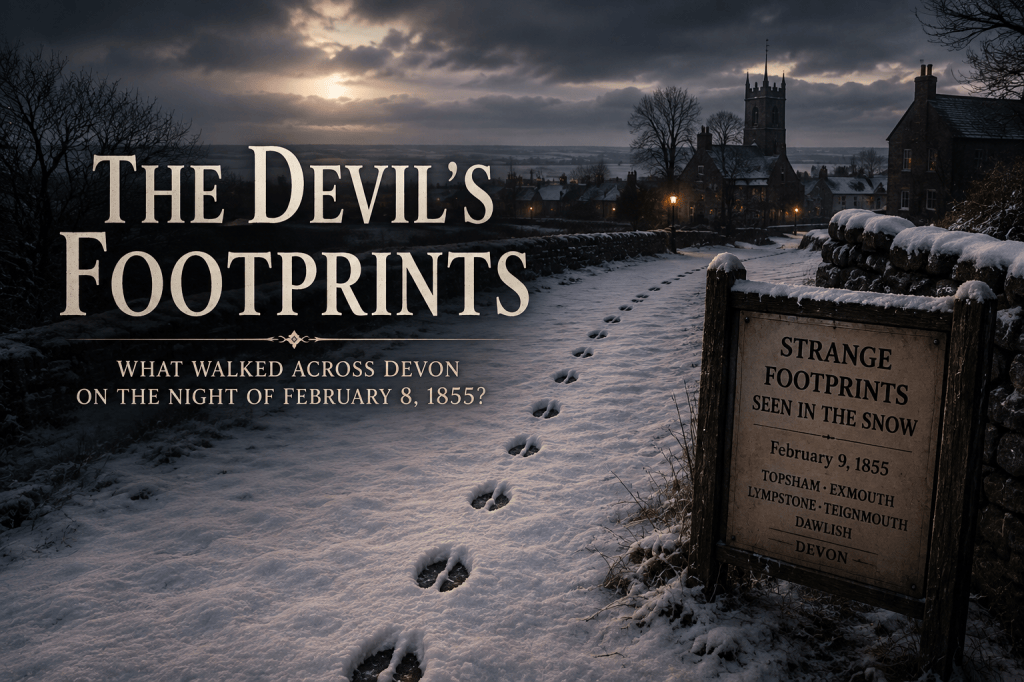
    On the morning of February 9, 1855, residents of several towns and villages in Devon awoke to a landscape transformed by snow and to a mystery that would outlive almost everyone who saw it. Across gardens, roads, fields and enclosed courtyards appeared lines of unusual impressions that many witnesses compared to the marks of a small hoof, although the creature that might have produced them was nowhere to be found.The tracks were reported around communities including Topsham, Lympstone, Exmouth, Teignmouth and Dawlish, and before long newspapers were describing them in places that seemed increasingly difficult to explain. They appeared in open countryside but were also said to continue into walled gardens, across narrow walls and, according to contemporary reports, even over the snow-covered tops of houses.What particularly disturbed observers was not simply the shape of the marks but the strange manner in which many of them seemed to proceed. Rather than displaying the alternating pattern expected from an ordinary four-legged animal, some trails appeared to consist of impressions following one another in an almost single line, separated by surprisingly regular intervals.Within days, naturalists, clergymen, journalists and ordinary residents were debating what could possibly have crossed the snowy Devon countryside.Some proposed badgers, birds, rodents, toads or an escaped kangaroo, while others suspected that several completely ordinary animals had produced different tracks that frightened observers subsequently combined into a single extraordinary mystery.Among the more superstitious inhabitants, however, another possibility began to circulate.Perhaps the tracks belonged to no ordinary animal at all.Perhaps, during that cold February night, the Devil himself had walked through Devon.

    A Snowfall That Left Something Behind

    The mystery began after snow fell across parts of southern Devon during the night of February 8–9, 1855. When residents emerged the following morning, they discovered unusual trails impressed into the fresh covering.The story spread remarkably quickly.

    On February 16, The Times reported that considerable excitement had been caused in Topsham, Lympstone, Exmouth, Teignmouth and Dawlish by the discovery of strange foot-tracks. The newspaper noted that the marks had been observed not only in ordinary fields and roads but in locations that appeared much more difficult for an animal to reach, including gardens and courtyards enclosed by walls and fences.

    The newspaper also recorded the supernatural interpretation already circulating among local people, reporting that some believed the marks might have belonged to Satan and that the mystery had generated enough interest to be discussed from the pulpit.The event was therefore not a legend invented generations afterward. Newspapers were discussing the strange tracks while the snow, the witnesses and the excitement surrounding them were still contemporary realities.Yet those same reports also reveal something important that later retellings sometimes obscure: people did not agree about exactly what they had seen.

    What Did the Footprints Actually Look Like?

    Modern illustrations often depict the Devil’s Footprints as a perfectly uniform trail of tiny cloven hooves stretching uninterrupted across Devon, but the surviving nineteenth-century descriptions are considerably messier and therefore considerably more interesting.Some witnesses compared the impressions to a donkey’s hoof or horseshoe, while others described them as divided or cloven. Measurements also varied from place to place, and drawings reproduced by the Illustrated London News showed different forms rather than one perfectly consistent mysterious footprint.One report described impressions roughly four inches long and less than three inches wide, separated by intervals of approximately eight inches, while accounts from other locations recorded different dimensions and shapes.This inconsistency is crucial.If every observer across Devon had recorded an identical footprint with precisely the same dimensions and stride, the case for a single mysterious source would be considerably stronger. Instead, the historical record suggests that several types of unusual marks may have been grouped together under one rapidly spreading story.The mystery may therefore have begun not with one impossible trail, but with many puzzling trails discovered after the same unusual weather.Once newspapers began connecting them, Devon suddenly seemed to have been crossed by a single invisible visitor.

    The Tracks That Seemed to Ignore Walls

    The most famous part of the story concerns the apparent ability of the tracks to continue through or across obstacles that should have interrupted the path of an ordinary animal.Contemporary reports described impressions on walls, rooftops and inside enclosed gardens. Residents sometimes claimed that the trail approached an obstacle and appeared again on the opposite side, creating the impression that whatever had made the marks had crossed barriers without changing its direction.This transformed a curious zoological puzzle into something far more unsettling.A fox could cross a field, a bird could land in a garden and a badger could leave unusual impressions in melting snow, but what kind of animal could apparently maintain the same mysterious trail over walls, roofs and fences?The newspapers themselves struggled with the question.Reports described local people gathering in groups to inspect the tracks, comparing theories and following trails through the landscape, while speculation grew with every new location in which unusual marks were discovered.Some residents treated the affair humorously, but others were genuinely frightened.The supernatural explanation had found ideal conditions in which to grow.

    When Devon Began Talking About the Devil

    Victorian England was living through enormous scientific and technological change, but traditional beliefs, folklore and religious interpretations remained deeply embedded in everyday culture. A strange trail appearing overnight after snowfall could therefore exist simultaneously as a natural-history puzzle, a newspaper curiosity and a supernatural warning.The nickname “Devil’s Footprints” captured the imagination because some of the impressions were interpreted as resembling a cloven hoof, a form long associated in European Christian imagery with demonic figures.Newspaper coverage demonstrates that the Satanic interpretation was already circulating in February 1855, although it would be misleading to imagine that everyone in Devon accepted it.Indeed, some journalists openly mocked the panic. Trewman’s Exeter Flying Post, reporting later that month, described the excitement in terms suggesting that it belonged more appropriately to the “dark ages,” while still acknowledging that the mysterious tracks had genuinely been observed across numerous locations.The disagreement itself tells us something important.Devon was not simply terrified by a supernatural event.Devon was arguing about one.

    The Kangaroo That Probably Never Escaped

    Among the most memorable explanations was the suggestion that a kangaroo had escaped from a private menagerie.To Victorian readers, the idea was not quite as ridiculous as it sounds today. Exotic animals were kept in private collections, and a kangaroo moving through snow could potentially produce unfamiliar tracks that local residents failed to recognize.The theory became associated with the Reverend G. M. Musgrave of Withycombe Raleigh, who discussed the possibility of an escaped kangaroo.There was, however, a problem.Musgrave later indicated that he had encouraged the kangaroo story largely because he wanted to divert frightened parishioners away from the belief that the Devil was roaming through Devon.In other words, one of the most famous explanations may itself have been deliberately promoted as a reassuring alternative to supernatural panic rather than as the result of evidence that an actual kangaroo had escaped.Even if a kangaroo had been loose, another difficulty remained: tracks were being reported across a broad area and on both sides of the Exe estuary.The hypothetical animal would have needed to undertake a remarkable winter journey.

    Richard Owen Suspected a Badger

    A considerably more serious zoological explanation came from Richard Owen, one of nineteenth-century Britain’s most prominent anatomists and the scientist who had coined the term “Dinosauria.”Writing to the Illustrated London News, Owen suggested that a badger could have produced at least some of the mysterious impressions.The theory had several advantages. Badgers were native to Britain, could travel considerable distances while searching for food and possessed feet capable of leaving marks that might appear unexpectedly hoof-like after snow had partially melted or distorted their original form.Owen also questioned the assumption that a single animal had produced every trail. If numerous badgers and other animals had been active across Devon during the same snowy conditions, witnesses in different communities might have discovered similar-looking but unrelated tracks.This possibility becomes especially important when we remember how quickly the newspaper story expanded.Once people knew that mysterious footprints were being reported elsewhere, almost any unusual trail in the snow could become part of the phenomenon.

    Could Mice Have Created the Devil’s Hooves?

    One of the most intriguing explanations involves an animal considerably smaller than a badger.A hopping mouse can bring its feet together during a leap, producing a combined impression that looks surprisingly different from the ordinary footprint people expect from a rodent. Under certain snow conditions, repeated jumps can create a neat series of marks resembling tiny hoof-like impressions.The possibility was already being discussed in 1855, when correspondence published by the Illustrated London News compared the mysterious Devon tracks with marks made by rodents and other small animals.Later researchers revisiting the case have considered mice particularly useful for explaining trails found in places such as rooftops, narrow walls and enclosed spaces, because rodents could reach locations that would seem extraordinary if observers imagined a much larger hoofed creature.Melting snow could then perform the final transformation.A small animal’s detailed footprint might lose the impressions of toes and claws as temperatures changed, leaving behind a larger, smoother depression whose original shape was no longer obvious.By the time a person discovered it, the mouse could be gone and its ordinary tracks could have become something that looked remarkably unfamiliar.

    Birds, Toads and Other Suspects

    The list of proposed culprits did not stop with badgers and mice.Contemporary correspondents suggested birds, particularly waders, whose footprints could change dramatically depending upon the depth and consistency of snow. Others considered otters, foxes and various small mammals.In March 1855, Trewman’s Exeter Flying Post even published an account from a man near Torquay who had followed strange tracks in his garden until he discovered a large toad beneath the stump of a tree. He believed that the animal’s impressions closely resembled illustrations of the mysterious Devon tracks.A toad obviously cannot explain every report scattered across southern Devon, but that is precisely the point.Perhaps nothing explains all of them because there was never a single phenomenon requiring one explanation.Badgers could have produced one trail, rodents another, birds another and melting snow could have altered all of them.A newspaper narrative could then do what newspapers, folklore and human memory frequently do extremely well: transform many separate incidents into one unforgettable story.

    Did One Creature Really Travel One Hundred Miles?

    One of the most repeated claims about the Devil’s Footprints is that a single trail extended for approximately one hundred miles during a single night.It is also one of the details that deserves the greatest caution.The surviving reports certainly describe unusual tracks across a broad region, but they do not establish an uninterrupted hundred-mile trail made by one creature. Locations, measurements and descriptions differ, and the idea of a single continuous journey appears stronger in later retellings than in the fragmented evidence left by witnesses and newspapers.The distinction fundamentally changes the mystery.A single animal leaving identical tracks for one hundred miles while crossing estuaries, roofs and walls would present an extraordinary physical problem.Numerous animals leaving superficially similar tracks across a snowy county would present a very different one.The second scenario may be less supernatural, but it reveals something equally fascinating about the way mysteries are created.People did not need to invent the footprints.They only needed to connect them.

    The Reverend Who Preserved the Evidence

    Much of what researchers know about the episode owes something to material associated with Henry Thomas Ellacombe, the vicar of Clyst St George.Documents connected with Ellacombe included correspondence about the tracks and drawings or tracings showing what witnesses believed they had seen. These materials became particularly important to later researchers because they demonstrated that the footprints were not described uniformly.Some were rounded, some appeared hoof-like, some suggested claws or toes, and their measurements varied.This surviving evidence creates an uncomfortable problem for the most spectacular version of the legend.The closer we move toward the original reports, the less the Devil’s Footprints resemble one perfectly consistent supernatural trail.Yet this does not make the story uninteresting.It makes it better.Instead of asking what impossible creature crossed Devon, we can ask how an entire region came to believe that many mysterious marks might belong to the same visitor.

    Weather May Have Been the Invisible Accomplice

    Snow is an unreliable recorder.A footprint impressed into fresh snow does not necessarily preserve the shape of the foot that created it. Temperature, wind, sunlight, freezing and thawing can enlarge or distort the original impression, sometimes removing fine details while preserving only the deepest part of the track.This process can produce a phenomenon sometimes described as enlargement through thawing, in which a small print gradually becomes larger and more rounded.A bird track can lose recognizable toes.A rodent’s clustered impressions can merge.A paw can begin to resemble something more like a hoof.If different animals crossed Devon during the night and their tracks subsequently underwent similar weathering, observers could have encountered impressions that looked more alike than the original footprints actually were.The snow, in other words, may not merely have preserved the mystery.It may have helped create it.

    Why the Mystery Survived

    The Devil’s Footprints endured because no explanation managed to account convincingly for every reported detail, particularly when those details were treated as parts of a single event.A badger explains some features but not every rooftop.Rodents can explain small single-file tracks and access to narrow surfaces but seem inadequate when applied indiscriminately to every witness account.Birds and toads can reproduce particular shapes but not the entire geographical legend.Weather explains distortion but still requires animals to have produced the original impressions.The mistake may be assuming that one solution is necessary.The historical evidence permits a much more complicated possibility in which several ordinary causes occurred simultaneously and were joined together by extraordinary circumstances: unusual snowfall, unfamiliar animal tracks, changing weather, frightened communities, religious imagery and newspapers eager to report a mystery that became more remarkable each time another town was added to the story.None of this requires the witnesses to have lied.They may genuinely have seen tracks they could not identify.What changed was the interpretation.

    So What Walked Across Devon?

    More than 170 years later, there is no surviving footprint that can be subjected to modern forensic examination, no photograph capable of settling the matter and no animal waiting to be identified from biological evidence.What remains are newspaper reports, letters, drawings, later recollections and a story that became larger than the snow in which it began.It is entirely possible that no single creature ever crossed Devon that night.Mice may have jumped across rooftops, badgers may have searched fields for food, birds may have crossed gardens and other animals may have left tracks that changed shape as the snow thawed. Residents who had already heard rumors about mysterious hoofprints would naturally examine every unusual mark more carefully, while newspapers connected reports separated by miles into one enormous trail.Yet there remains something wonderfully unsettling about returning to Devon on that February morning in imagination.The inhabitants did not possess our later theories. They opened their doors and discovered strange impressions where there had been fresh snow the night before, followed them toward walls and gardens, heard that identical marks had supposedly appeared in neighboring towns and discovered that nobody could tell them with certainty what had made them.By the time darkness returned, some residents were reportedly reluctant to venture outside.Whatever walked through Devon in February 1855 may therefore have been several animals, altered snow and a rapidly expanding rumor rather than a single impossible visitor.But for one winter morning, before explanations had time to catch up with imagination, something seemed to have crossed the sleeping countryside without respecting walls, roofs, rivers or locked gates.The snow eventually melted.The footprints disappeared with it.The mystery did not.—Sources & Further ReadingThe Times, February 16, 1855 — one of the important contemporary newspaper reports describing the unusual tracks around Topsham, Lympstone, Exmouth, Teignmouth and Dawlish, as well as the excitement and supernatural speculation they generated.The Illustrated London News, February–March 1855 — published drawings, correspondence and proposed explanations for the Devon tracks, including contributions discussing badgers, rodents and other animals.Trewman’s Exeter Flying Post, February–March 1855 — valuable local reporting that demonstrates both the extent of contemporary interest and the skepticism with which some observers treated the mystery.Henry Thomas Ellacombe papers — correspondence and tracings associated with the vicar of Clyst St George became important evidence for later researchers because they preserve differing descriptions of the tracks.Mike Dash, “The Devil’s Hoofmarks: Source Material on the Great Devon Mystery of 1855,” Fortean Studies — a detailed modern collection and analysis of primary and secondary material concerning the event.G. A. Household, The Devil’s Footprints: The Great Devon Mystery of 1855 — a collection of historical material concerning the newspaper reports and proposed explanations surrounding the case.

    Sources & Further Reading
    The Times, February 16, 1855 — one of the important contemporary newspaper reports describing the unusual tracks around Topsham, Lympstone, Exmouth, Teignmouth and Dawlish, as well as the excitement and supernatural speculation they generated.
    The Illustrated London News, February–March 1855 — published drawings, correspondence and proposed explanations for the Devon tracks, including contributions discussing badgers, rodents and other animals.
    Trewman’s Exeter Flying Post, February–March 1855 — valuable local reporting that demonstrates both the extent of contemporary interest and the skepticism with which some observers treated the mystery.
    Henry Thomas Ellacombe papers — correspondence and tracings associated with the vicar of Clyst St George became important evidence for later researchers because they preserve differing descriptions of the tracks.
    Mike Dash, “The Devil’s Hoofmarks: Source Material on the Great Devon Mystery of 1855,” Fortean Studies — a detailed modern collection and analysis of primary and secondary material concerning the event.
    G. A. Household, The Devil’s Footprints: The Great Devon Mystery of 1855 — a collection of historical material concerning the newspaper reports and proposed explanations surrounding the case.

    Fediverse Reactions
  • The Green Children of Woolpit: The Medieval Mystery That Has Never Been Fully Explained

    The Green Children of Woolpit: The Medieval Mystery That Has Never Been Fully Explained

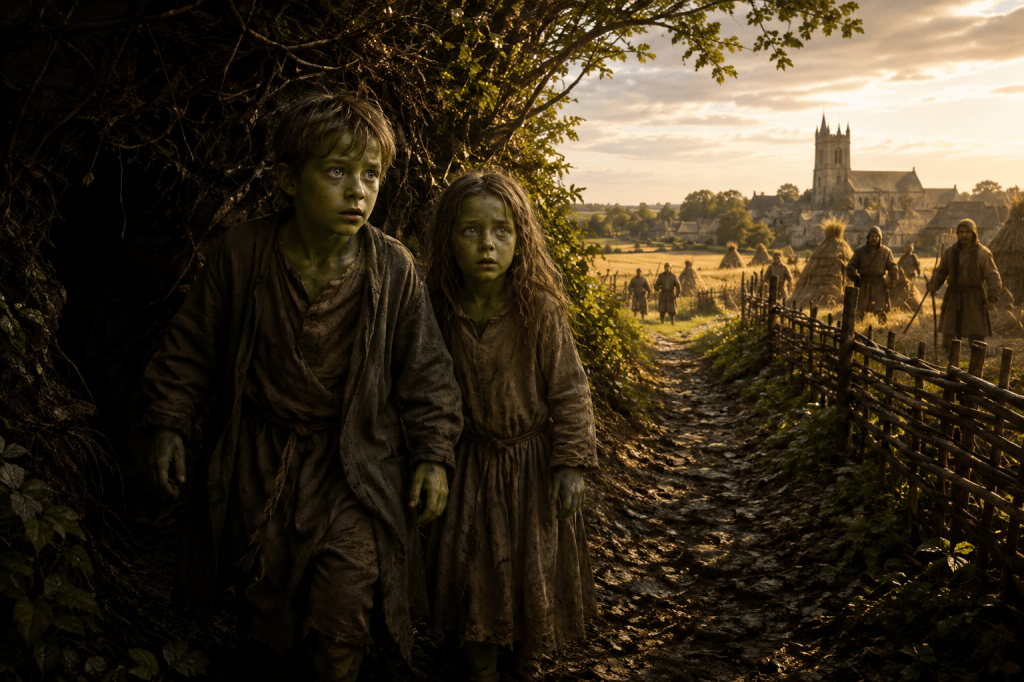
    Sometime during the twelfth century, while workers were gathering the harvest near the small English village of Woolpit in Suffolk, two children appeared in the countryside under circumstances so unusual that their story would survive for more than eight hundred years.

    They were a boy and a girl, apparently brother and sister, and according to the medieval chroniclers who recorded the event, there was immediately something extraordinary about them. Their clothes were made from material the local people did not recognize, the language they spoke could not be understood by anyone around them, and, most remarkably of all, their skin appeared to have a distinctly green coloration.

    The children seemed frightened and disoriented, and they were unable to explain where they had come from because nobody could understand their speech. They were eventually taken into the household of a local landowner, where another strange detail soon emerged: although food was placed before them, they refused almost everything they were offered.

    Then they saw beans.

    According to the medieval accounts, the children immediately became excited and searched desperately for the beans inside their stalks, apparently unfamiliar with the way the plants were presented to them. Once the beans themselves were produced, they ate eagerly.

    For some time, beans were reportedly almost the only food they would accept.

    Eventually their diet changed, their green coloration gradually disappeared, and the surviving child learned enough English to tell the people around her where she believed she had come from.

    Her explanation transformed an already unusual story into one of medieval England’s most enduring mysteries.

    She said that she and her brother had come from a place known as St Martin’s Land, a country where the sun did not shine as it did in England and where the world remained beneath a strange twilight.

    According to her account, everyone there was green.

    The Village Where the Children Appeared

    Woolpit is a real village in Suffolk, situated not far from Bury St Edmunds, and its unusual name has traditionally been connected with pits used for trapping wolves. The medieval form of the name is generally understood as deriving from something resembling “wolf pit,” which provided later storytellers with an appropriately mysterious landscape for the children’s appearance.

    One version of the story describes the children emerging near one of these pits during harvest time, where workers discovered them wandering in confusion.

    The event would probably have disappeared completely into local folklore had it not attracted the attention of two medieval chroniclers.

    The first was William of Newburgh, an Augustinian canon born around 1136 who wrote his Historia rerum Anglicarum, or History of English Affairs, toward the end of the twelfth century.

    William was not merely collecting fairy tales. His work was intended as a history of England beginning with the Norman Conquest, although, like many medieval historians, he also included accounts of wonders, supernatural events and phenomena that he considered sufficiently remarkable to record.

    When introducing the strange children, William himself acknowledged how difficult the story was to believe, yet indicated that the number and quality of the witnesses convinced him that something unusual had occurred.

    The second account comes from Ralph of Coggeshall, a monk and later abbot of Coggeshall Abbey in Essex, whose Chronicon Anglicanum also contains the story.

    Ralph’s account is particularly interesting because he claimed to have obtained information from Richard de Calne, the man whose household had reportedly taken in the children. If that statement is accurate, Ralph’s version brings us considerably closer to people associated with the original event than many legends of medieval Europe allow.

    The two chronicles differ in some details, but their central elements are remarkably similar: two strangely dressed children appeared near Woolpit, their skin had a green coloration, their language was unfamiliar, and initially they would eat little except beans.

    The Children Who Would Eat Only Beans

    Once the children had been brought into local care, attempts were made to feed them, but the food offered to them appeared unfamiliar or unacceptable.

    Then green beans were brought into their presence.

    The children reportedly reacted with intense interest, although one version of the story contains an intriguing detail: they initially searched the stalks rather than opening the pods, as though they recognized the food but did not understand where the beans were located on the plant before them.

    After someone showed them the pods, they ate eagerly.

    For a period afterward, beans remained their preferred food, although they gradually began eating other foods as they adapted to their new surroundings.

    At the same time, another transformation supposedly occurred.

    Their green skin began to fade.

    The boy, however, did not recover as successfully as his sister. Medieval accounts describe him as becoming increasingly weak or depressed, and he eventually died.

    The girl survived.

    She was baptized, remained in England and gradually learned the local language.

    Only then could anyone ask the question that must have occupied the villagers from the moment the children appeared.

    Where had they come from?

    The Land Where the Sun Never Fully Rose

    The girl’s answer was extraordinary.

    She reportedly said that she and her brother came from a place called St Martin’s Land, where the inhabitants were Christian and where churches existed, but the quality of daylight was completely different from that of England.

    The sun, she explained, did not shine brightly over their homeland.

    Instead, the country existed beneath something resembling perpetual twilight.

    In one version of the account, she described another luminous land visible beyond a considerable river, suggesting that her own country was separated from a brighter region by water.

    When asked how she and her brother had reached Woolpit, her explanation became even stranger.

    According to the story preserved by the chroniclers, the children had been tending their father’s animals when they entered or followed them into some kind of underground passage or cavern. Inside the darkness they heard the sound of bells, and after wandering through the passage for what seemed like a long time, they suddenly emerged into brilliant daylight.

    The intensity of the sunlight supposedly overwhelmed them because they had never experienced anything like it.

    Before they could find their way back, the harvest workers discovered them.

    The children had apparently crossed from one world into another without understanding how they had done it.

    At least, that was how medieval listeners could interpret the story.

    Was St Martin’s Land Somewhere on Earth?

    The obvious question is whether the girl’s mysterious homeland might have been a perfectly ordinary location whose description became distorted through language, fear and retelling.

    One modern hypothesis proposes that the children may have belonged to a Flemish community living in eastern England.

    Flemish settlers and textile workers were present in medieval England, and political conflict during the twelfth century created periods of hostility and violence involving Flemish communities and mercenaries.

    In 1173, during the rebellion against Henry II, fighting occurred at Fornham, not far from Bury St Edmunds. A later theory proposed by Paul Harris suggested that the children might have been displaced Flemish youngsters associated with Fornham St Martin, providing a possible explanation for the girl’s reference to “St Martin’s Land.”

    If the children spoke a Flemish dialect, their language could easily have sounded completely incomprehensible to rural English villagers.

    Their unfamiliar clothing might similarly have reflected cultural differences rather than anything supernatural.

    The theory is attractive because it potentially explains several pieces of the puzzle at once, but it remains a reconstruction rather than a demonstrated solution. Geographic and chronological difficulties remain, and historians do not possess independent evidence identifying the children as Flemish refugees.

    Why Were Their Faces Green?

    The most famous element of the story may also have one of the least supernatural explanations.

    Historical writers have suggested that the children’s appearance could have resulted from severe malnutrition or anemia. A condition historically called chlorosis was associated with a pale or greenish complexion, although applying a later medical diagnosis to two children known only through medieval chronicles is necessarily speculative.

    If the children had spent a prolonged period lost, displaced or surviving on an inadequate diet, their unusual complexion might have appeared even more striking to people encountering them for the first time.

    The fact that the girl’s green coloration reportedly disappeared after she began eating a more varied diet is one reason this explanation has remained attractive. Woolpit’s own historical account mentions severe nutritional deficiency as one possible explanation for the reported appearance.

    Yet this explanation creates another interesting question.

    If malnutrition explains the green color, what explains the strange language, unfamiliar clothing and story of the twilight homeland?

    Each mystery can perhaps be explained individually, but combining all of them into one convincing reconstruction becomes considerably more difficult.

    Or Was This a Medieval Story About Another World?

    There is another possibility that does not require the children to have existed exactly as described.

    Medieval chronicles were not written according to modern standards of historical reporting, and their authors frequently recorded miracles, omens, monsters, visions and other extraordinary events alongside political history.

    The boundary between history, theology, oral tradition and folklore was considerably more fluid than it is for modern historians.

    The Green Children may therefore belong partly to the enormous European tradition of stories about encounters with an Otherworld, a hidden realm existing alongside the ordinary human world.

    Several elements fit surprisingly well.

    The children emerge from an underground passage.

    Their homeland exists beneath unusual light.

    Their appearance is different from ordinary humans.

    They eat unusual food.

    They cannot initially communicate with the people who discover them.

    One of them eventually remains permanently in the human world.

    Green itself acquired powerful associations with nature, fairies, spirits and otherworldly beings in later European folklore, although we must be careful not to project later traditions automatically onto a twelfth-century account.

    The story could therefore represent a real event that accumulated folkloric details, an older folktale attached to a real village, or some combination of both.

    That uncertainty is precisely what makes Woolpit so fascinating.

    What Happened to the Surviving Girl?

    After learning English and adapting to local life, the girl reportedly remained in England.

    William of Newburgh wrote that she eventually lost the green coloration of her skin and lived for many years, while Ralph of Coggeshall associated her with the household of Richard de Calne.

    Later tradition sometimes gives the girl the name Agnes and claims that she married a man connected with King’s Lynn, but these details are considerably less secure than the central medieval accounts and should not be presented as established fact.

    What matters is that, according to the chroniclers, the surviving child did not disappear mysteriously back into St Martin’s Land.

    She stayed.

    This small detail makes the story unusually tantalizing because, if there really was a surviving girl who grew into adulthood in medieval England, she potentially represented a living connection to whatever event originally inspired the legend.

    Yet no surviving document has conclusively identified her.

    Her trail disappears into history.

    Two Chroniclers, One Extraordinary Story

    The existence of two medieval accounts is often presented online as though it proves that the Green Children must have existed exactly as described.

    It does not.

    The chroniclers were not eyewitnesses to the children’s appearance, and both recorded the story after the supposed event. Medieval information traveled through oral networks, monasteries, travelers and shared stories, which means that two written accounts do not necessarily represent two completely independent eyewitness traditions.

    Nevertheless, their existence matters.

    The Green Children were not invented by a nineteenth-century spiritualist, a twentieth-century UFO writer or a modern internet storyteller.

    Something resembling this extraordinary narrative was already circulating in medieval England strongly enough for two serious chroniclers to preserve it.

    That leaves us with several possibilities, none of which can now be proven.

    Perhaps two displaced foreign children really did wander into Woolpit, malnourished, frightened and unable to communicate, while bewildered villagers gradually transformed their tragedy into a supernatural story.

    Perhaps the narrative began as folklore and acquired real names and locations as it circulated.

    Perhaps an unusual historical incident and an older tradition of the Otherworld merged until separating fact from legend became impossible.

    Or perhaps something happened near Woolpit that does not fit comfortably into any explanation that has survived.

    More than eight centuries later, the village remains where it always was, the medieval chroniclers remain available to be read, and the children themselves have disappeared completely.

    We know what William of Newburgh and Ralph of Coggeshall wrote.

    We know what later generations believed.

    What we do not know is what two frightened children actually saw before they stepped into the sunlight near Woolpit.

    And somewhere between those three things — chronicle, legend and lost experience — the Green Children are still waiting.


    Sources & Further Reading

    William of Newburgh — Historia rerum Anglicarum (History of English Affairs)
    One of the two principal medieval accounts of the Green Children.

    Ralph of Coggeshall — Chronicon Anglicanum
    The second major medieval source; Ralph claimed information connected with Richard de Calne, whose household was associated with the children.

    Woolpit Village — Local History
    The village’s historical account preserves the local tradition and discusses possible explanations for the children’s appearance.

    Brian Haughton — “The Green Children of Woolpit”
    A useful overview comparing the medieval sources with later historical, medical and folkloric explanations.

    Fediverse Reactions
  • The Pope Who Was Put on Trial After His Death: The Terrifying Cadaver Synod of 897

    The Pope Who Was Put on Trial After His Death: The Terrifying Cadaver Synod of 897

    In the winter of 897, Rome witnessed a spectacle so disturbing that, more than eleven centuries later, it remains one of the most infamous episodes in the history of the papacy. Inside the Lateran Basilica, where ecclesiastical disputes were normally decided among living men, bishops and clergy gathered for a trial whose defendant had already been dead and buried for approximately nine months.

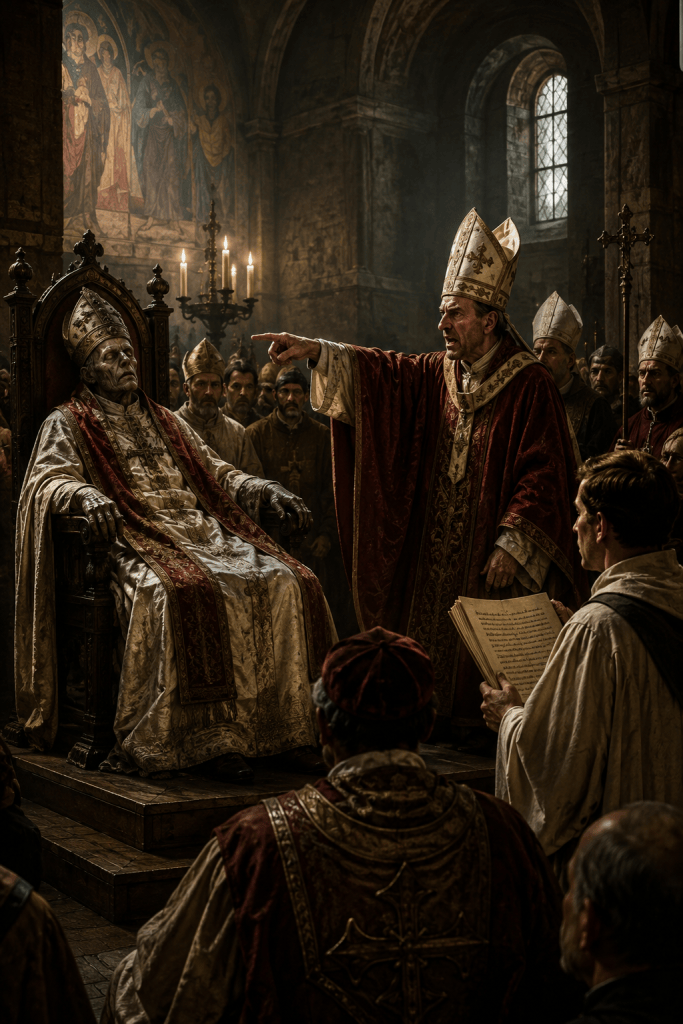
    The man being judged was Pope Formosus, but he was not represented merely by documents, witnesses or memories of his pontificate. His body had been removed from its tomb, dressed once again in papal vestments and brought into the basilica, where it was reportedly placed upon a seat before the assembled clergy. According to later accounts of the proceedings, a deacon was assigned the extraordinary task of answering on behalf of the dead pope while Pope Stephen VI presided over the accusations against his predecessor.

    The episode would become known as the Cadaver Synod, and later tradition would remember it under the chilling Latin designation Synodus Horrenda, the Horrible Synod. Although its most sensational details sound as though they belong to a Gothic novel rather than to ecclesiastical history, the trial itself was very real, and its purpose becomes considerably more understandable once the violent political struggles surrounding the papacy at the end of the ninth century are brought into view.

    The corpse on the throne was horrifying, but the real struggle concerned the living.

    Before the Corpse, There Was a Powerful Churchman

    Long before his body was brought into a courtroom, Formosus had been one of the most prominent and controversial churchmen of his generation. Born around the beginning of the ninth century, he eventually became bishop of Porto, an important episcopal see near Rome, and acquired a reputation as an able missionary and diplomat whose ecclesiastical career brought him into contact with some of the most significant political conflicts of his age.

    His abilities did not protect him from enemies. During the pontificate of Pope John VIII, Formosus became involved in a serious dispute with papal authorities and was accused of abandoning his diocese, conspiring against the pope and aspiring improperly to the Roman see. He was excommunicated and compelled to swear that he would never return to Rome or resume his episcopal functions, although changing political circumstances eventually allowed him to be restored to communion and to return to his position.

    When Formosus was elected pope in October 891, therefore, he arrived at the papal throne carrying both considerable experience and a history that his enemies would later use against him. One particularly important canonical problem concerned his position as bishop of Porto, because church law strongly discouraged the transfer of a bishop from one episcopal see to another, and his eventual election as Bishop of Rome provided his opponents with an argument that could later be transformed into an accusation of illegitimacy.

    Had this been merely a technical ecclesiastical dispute, Formosus might never have become the defendant in history’s most famous posthumous trial. What transformed the controversy into something far more dangerous was the struggle for political control of Italy and the imperial crown.

    A Pope Caught Between Rival Rulers

    The political landscape of late ninth-century Italy was extraordinarily unstable. The Carolingian order that had once provided a measure of imperial unity was disintegrating, powerful aristocratic families competed for territory and influence, and the papacy frequently found itself caught between rulers whose military strength could determine who controlled Rome itself.

    Among the most powerful forces in Italy was the house of Spoleto. Formosus initially recognized its position and crowned Lambert of Spoleto as co-emperor, but relations deteriorated, and the pope eventually sought assistance from Arnulf of Carinthia, the East Frankish king whose intervention offered the possibility of breaking Spoletan dominance.

    Arnulf crossed into Italy and entered Rome in 896, after which Formosus crowned him emperor. The decision was politically explosive because it represented a rejection of the interests of Lambert and his powerful mother, Ageltrude, while simultaneously tying the papacy to Arnulf’s military fortunes.

    Those fortunes changed almost immediately. Arnulf became seriously ill during his Italian campaign and was forced to withdraw, leaving the political situation unresolved, while Formosus himself died on 4 April 896. The pope was buried according to the customs of his office, and under ordinary circumstances his participation in the struggle might have ended there.

    Instead, the political balance shifted again, the Spoletan faction recovered its influence, and Formosus’s enemies discovered that death did not necessarily prevent them from attacking the legitimacy of everything he had done.

    Nine Months After Burial, the Grave Was Opened

    Following Formosus came the extremely brief pontificate of Boniface VI, whose reign lasted only a matter of days, and then Stephen VI became pope. During Stephen’s pontificate, probably in January 897, an extraordinary decision was made: Formosus would be prosecuted formally despite the inconvenient fact that he had been dead for months.

    His grave was opened and the corpse was removed.

    Historical accounts describe the body being dressed again in papal vestments and brought into the Lateran Basilica, where an ecclesiastical assembly had been convened. The dead pope was positioned before the court as though his physical presence were necessary for the proceedings, while Stephen VI assumed the role of his accuser and judge.

    Later narrative sources describe a deacon standing beside Formosus and answering questions on his behalf, creating an almost surreal scene in which the forms of a conventional ecclesiastical hearing were maintained even though the defendant was incapable of hearing the charges, understanding the proceedings or defending himself.

    It would be easy to dismiss the entire spectacle as nothing more than an eruption of medieval superstition or personal madness, yet doing so would obscure the political calculation behind it. Stephen and the enemies of Formosus were not interested merely in humiliating a corpse; they wanted to destroy the legal and ecclesiastical consequences of Formosus’s pontificate.

    To accomplish that, they first had to establish that he should never have been pope at all.

    What Could a Dead Pope Be Accused Of?

    The accusations revived controversies that had followed Formosus during his lifetime, particularly those involving his earlier position as bishop of Porto and the canonical restrictions concerning the transfer of bishops between sees. His opponents argued, in effect, that he had occupied the Roman see illegitimately and had therefore exercised papal authority that he should never have possessed.

    Other accusations concerned the oaths and obligations arising from his earlier conflict with John VIII, but the significance of the proceedings extended far beyond Formosus’s personal reputation. If his election to the papacy could be declared invalid, then the decisions he had made while occupying the office could also be challenged, including his ecclesiastical appointments and the ordinations he had performed.

    This was where the trial became politically useful, because Formosus had created networks of authority through the bishops and clergy he had ordained. Invalidating those acts could weaken men whose positions depended upon him while strengthening their rivals, which meant that the prosecution of a dead pope could have very real consequences for powerful living churchmen.

    The corpse could not defend itself, and the verdict was hardly in doubt.

    Formosus was condemned.

    Punishing a Man Who Could No Longer Feel Punishment

    Once the court had declared Formosus guilty, the proceedings entered their most macabre phase. His papal vestments were stripped from the corpse, and the acts associated with his pontificate were declared invalid. According to the traditional accounts, three fingers of his right hand, associated with the gesture of papal blessing, were cut away, an act whose symbolism was far more important than any physical punishment that could obviously no longer be inflicted upon the dead man.

    Everything about the treatment of the body communicated the same message: the authority Formosus had exercised as pope was being erased symbolically from his remains.

    His body was subsequently buried in a common grave rather than being allowed to retain the honor associated with papal burial. Later accounts state that it was then removed once more and thrown into the River Tiber, transforming a former pope, bishop and imperial kingmaker into a mutilated corpse discarded in the water flowing through Rome.

    Some of the vivid details of the trial survive through chroniclers writing after the event, which means that historians must distinguish carefully between the firmly established outline of the Cadaver Synod and dramatic elements preserved by later narrative tradition. There is no serious doubt, however, that Formosus was exhumed and subjected to a posthumous ecclesiastical trial under Stephen VI, nor that subsequent popes considered the proceedings sufficiently serious to overturn their consequences.

    Whatever Stephen hoped to achieve, the spectacle did not bring stability to Rome.

    It helped produce the opposite.

    The Living Judge Soon Followed the Dead Defendant

    The reaction against Stephen VI was rapid and severe. His political position collapsed during the months following the Cadaver Synod, and he was eventually deposed, imprisoned and strangled in the summer of 897.

    The reversal is one of the most striking features of the entire episode. At the beginning of the year, Stephen had possessed enough authority to order the exhumation and condemnation of a former pope; only months later, he himself was a prisoner whose pontificate had ended violently.

    Formosus, meanwhile, began an extraordinary posthumous rehabilitation.

    Tradition records that his body was recovered after being thrown into the Tiber, and later in 897 Pope Theodore II convened a synod that annulled the judgment against him and recognized the validity of his ordinations. His remains were restored to an honorable papal burial, reversing the humiliation imposed during Stephen’s pontificate.

    Theodore II occupied the papal throne for only a short period, but his actions were followed by those of John IX, who continued the rehabilitation of Formosus and convened synods that rejected the Cadaver Synod and attempted to prevent similar proceedings from occurring again. At Ravenna in 898, the measures against Formosus were overturned, while records associated with the grotesque trial were ordered destroyed.

    The dead pope, in effect, had received an appeal and won.

    Why the Ordinations of a Dead Pope Could Threaten the Living

    The controversy did not disappear simply because Formosus was returned to his tomb, because the question of his legitimacy created a theological and legal problem with potentially enormous consequences.

    A pope ordained bishops, and those bishops could subsequently ordain priests, consecrate other bishops and perform sacramental acts whose legitimacy depended upon their own ecclesiastical authority. If the ordinations performed by Formosus were invalid because he had supposedly occupied the papal office illegitimately, then doubts could spread through an expanding chain of clergy whose authority ultimately traced back to him.

    The problem therefore resembled a crack moving through the foundations of a building. What began as an attack on one dead pope could destabilize the status of numerous living churchmen and create uncertainty about sacraments and appointments that had already taken place.

    Writers defending Formosus consequently argued vigorously for the validity of his ordinations, while the controversy continued to influence papal politics after the principal participants were dead. Pope Sergius III, who became pope in 904, was associated with renewed hostility toward the Formosan position, demonstrating how difficult it was to bury a dispute that had already survived the man at its center.

    The Cadaver Synod was therefore never simply an absurd trial of a corpse. It represented an attempt to use canon law, ritual and physical humiliation to rewrite the legal consequences of an earlier pontificate.

    Was Stephen VI Insane?

    Modern retellings sometimes explain the episode by portraying Stephen VI as a deranged pope whose hatred of Formosus drove him to an act of grotesque irrationality. The temptation is understandable, because exhuming a decomposing predecessor and placing him before an ecclesiastical tribunal certainly appears incomprehensible when viewed outside its historical setting.

    There is, however, no reliable basis for diagnosing Stephen’s mental state more than eleven centuries after his death, and the political context provides motives that do not require such speculation. Formosus had supported Arnulf of Carinthia against the interests of the Spoletan faction, while his ecclesiastical acts had created positions and loyalties that remained important after his death. Declaring his pontificate illegitimate could therefore serve political interests by weakening the authority of his supporters and strengthening those who wanted his legacy destroyed.

    Seen in this context, the trial becomes more disturbing rather than less, because it suggests that the grotesque treatment of the corpse was not necessarily meaningless madness. It could function as calculated political theater in which the body of a dead pope became an instrument for changing the balance of power among living men.

    The courtroom was merely the stage.

    The real struggle was taking place throughout Rome and Italy.

    The Painting That Gave the Trial a Face

    Almost a thousand years after the Cadaver Synod, French painter Jean-Paul Laurens created one of the most memorable visual interpretations of the episode. His 1870 painting Le Pape Formose et Étienne VI depicts the dead Formosus seated rigidly before Stephen, surrounded by clergy inside a dark architectural space whose theatrical lighting intensifies the horror of the confrontation.

    The painting should not be mistaken for a reconstruction based on eyewitness evidence, because Laurens was creating a nineteenth-century historical drama rather than documenting the precise appearance of the Lateran in 897. Nevertheless, his composition captures something fundamental about the episode: the dead figure appears strangely passive and almost dignified while the living men surrounding him generate the violence and menace of the scene.

    Perhaps this is why the image remains so effective. The corpse is not really the frightening part.

    The frightening part is what the living are willing to do with it.

    A Trial That Was Never Really About the Dead

    The Cadaver Synod continues to fascinate because it violated an expectation that seems almost universal: whatever conflicts surround a person during life, death eventually removes that person from the immediate struggle for power.

    Formosus was denied even that final separation.

    His enemies could no longer force him to surrender authority, retract his decisions or answer accusations, so they attacked the surviving structures of his pontificate instead. By removing his body from the grave and placing it physically before a tribunal, they transformed a legal dispute into an extraordinary ritual in which the dead were temporarily dragged back into the political world of the living.

    For a brief moment in Rome in 897, the boundaries between courtroom and tomb, punishment and memory, law and political revenge became almost impossible to distinguish. A dead pope was dressed in the clothing of the office he had once occupied, a living pope demanded answers that the defendant could never provide, and an ecclesiastical assembly pronounced judgment upon a man whose earthly punishment had already been completed by death.

    Yet the final irony belongs to Formosus.

    The judgment against him was overturned, his ordinations were defended, his remains were restored to honorable burial and the spectacle intended to destroy his legacy instead ensured that his name would be remembered for more than a thousand years.

    Stephen VI, who had attempted to place a dead predecessor permanently among the condemned, was himself deposed, imprisoned and strangled only months after the trial.

    Formosus returned to his tomb.

    The Cadaver Synod entered history.

    And perhaps that is the most unsettling part of the entire story, because beneath the decomposing body, the papal robes and the macabre courtroom lies something far more recognizable than medieval superstition: the ancient human desire to rewrite the past when controlling the present is no longer enough.

    Sources & Further Reading

    Liudprand of Cremona, Antapodosis — an important later narrative source for the episode, although it was written decades afterward and its dramatic details must therefore be approached critically.

    Horace K. Mann, The Lives of the Popes in the Early Middle Ages — provides historical context for Formosus, Stephen VI and the political struggles surrounding the late ninth-century papacy.

    Catholic Encyclopedia, “Pope Formosus” — useful for the ecclesiastical career of Formosus, the Cadaver Synod and his subsequent rehabilitation.

    Bilal, M. and Tubbs, R. S., “Popes Convict Dead Pope Twice! The Unbelievable Cadaver Synod,” Clinical Anatomy (2017) — a modern scholarly discussion of the treatment of Formosus’s corpse and the extraordinary posthumous proceedings.

    Encyclopaedia Britannica, entries concerning Formosus and the ninth-century papacy — useful for the broader political and ecclesiastical context.

    Fediverse Reactions