Tag: books

  • LIBER JURATUS HONORII

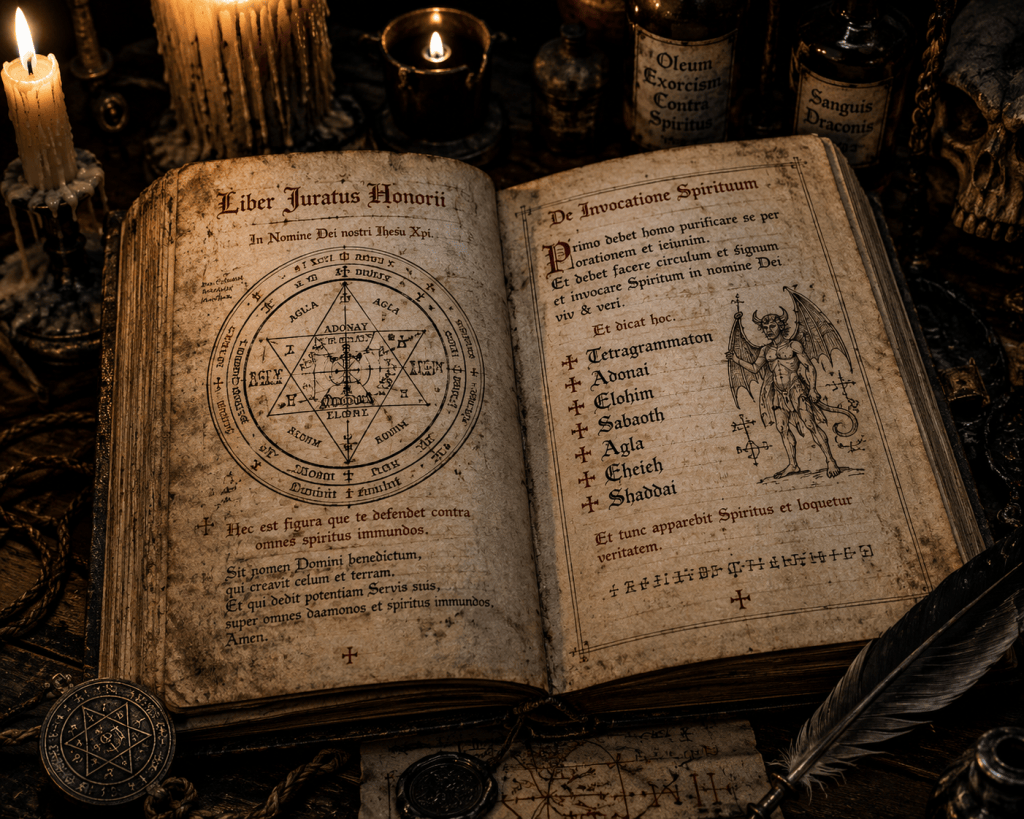
    Liber Juratus Honorii (The Sworn Book of Honorius) is one of the best-known medieval grimoires. The manuscript Royal MS 17 A XLII, preserved at the British Library, dates from the 15th century.
    The Forbidden Book That Was Never Meant for Everyone

    Among the many medieval grimoires that have survived the centuries, few are surrounded by as much mystery as the Liber Juratus, also known as The Sworn Book of Honorius.

    Unlike many famous grimoires, its greatest secret is not hidden in unusual symbols or elaborate diagrams.

    It is hidden in its intended audience.

    The title itself offers the first clue. The word Juratus means “sworn.” According to the introduction preserved in medieval manuscripts, the book was intended only for individuals who had taken a solemn oath to protect its contents. Whether this account reflects historical events or serves as a literary device is uncertain, but it reveals how exceptional and restricted the text was meant to appear.

    This immediately sets the Liber Juratus apart from many other medieval works.

    Rather than presenting knowledge as something anyone could possess, it portrays wisdom as something that required discipline, discretion, and moral responsibility.

    Another fascinating aspect is that the manuscript focuses less on material gain than many later grimoires. Modern readers often expect medieval occult books to revolve around treasure, power, or supernatural control. The Liber Juratus is different.

    Much of its content reflects a search for divine wisdom, contemplation, and a deeper understanding of creation. Historians generally view it as a product of medieval religious and intellectual traditions, where prayer, symbolism, and philosophy were often intertwined.

    One detail that is rarely mentioned is the extraordinary effort required to produce a manuscript like this.

    Every copy was written entirely by hand. Before the invention of the printing press, creating a single manuscript demanded months—sometimes years—of careful work by trained scribes. As a result, no two surviving copies are exactly alike. Differences in wording, additions, omissions, and annotations reveal that the text evolved as it was copied across generations.

    In many ways, each manuscript became a historical document in its own right.

    This is one reason why scholars continue to study the Liber Juratus today. They are not only interested in what the book says but also in how it changed over time, what those changes reveal about medieval Europe, and how ideas traveled across different regions and cultures.

    Perhaps the greatest lesson of the Liber Juratus is not that it contains hidden secrets.

    Its real value lies in showing us how knowledge was regarded nearly eight centuries ago—not as entertainment or instant information, but as something precious, demanding patience, study, and personal responsibility.

    That may be why this remarkable manuscript continues to fascinate historians, collectors, and curious readers today.

    Sometimes, the greatest mystery is not the book itself.

    It is the world that believed such a book was worth protecting with an oath.
    Fediverse Reactions
  • The Last Words of Erin Valenti: “We’re in the Matrix”

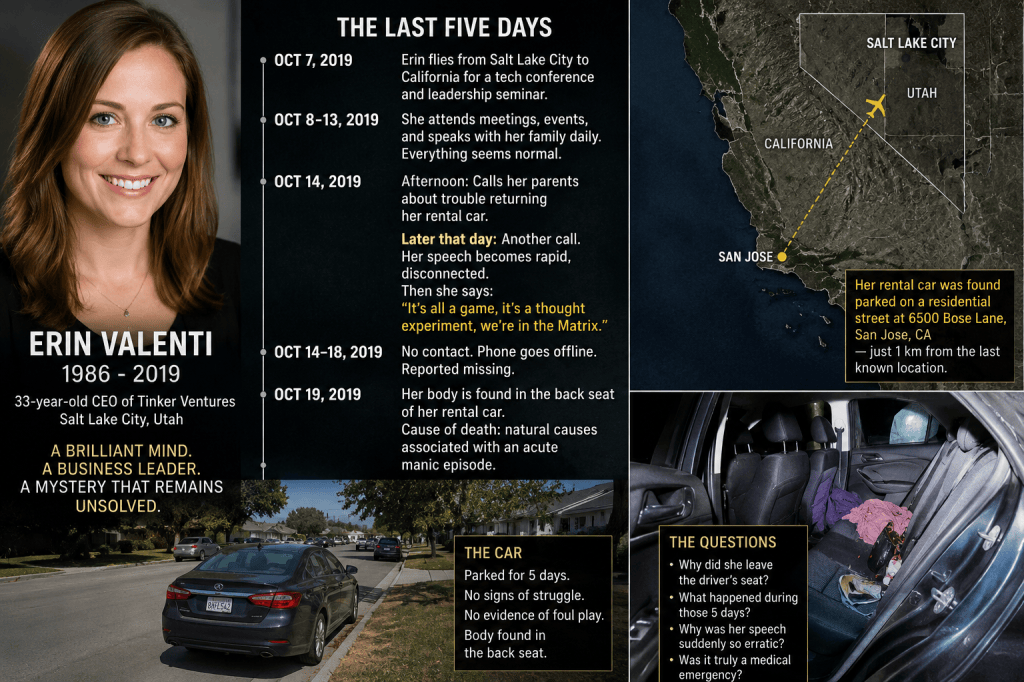
    On 7 October 2019, Erin Valenti, a 33-year-old technology executive from Utah, boarded a flight to California.

    The trip appeared routine. She was scheduled to attend a founders’ conference and a leadership seminar before returning home to her husband and her growing business.Five days later, she was found dead in the back seat of her rental car.

    Officially, the case was ruled a death from natural causes associated with an acute manic episode.

    Yet nearly six years later, the circumstances surrounding her final days continue to generate questions that have never been fully answered.

    Who Was Erin Valenti?

    Erin Valenti was the CEO of Tinker Ventures, a technology company focused on helping startups develop innovative software solutions. Colleagues described her as intelligent, energetic and ambitious. She frequently attended conferences, worked long hours and was well known within Utah’s entrepreneurial community.

    According to her family and husband, she had no documented history of bipolar disorder, psychosis, psychiatric hospitalization or substance abuse.That fact would later become central to the controversy surrounding her death.

    A Normal Business Trip

    During the first days of her California visit, nothing appeared unusual.She attended meetings.She met former colleagues.She participated in leadership events.She spoke regularly with her parents, as she often did while traveling.Family members later recalled that she sounded optimistic and excited about returning home. One conversation with a former employer reportedly focused on new business ideas and solutions to challenges she had recently faced.Nothing suggested that within twenty-four hours she would completely disappear.

    The Phone Calls

    Everything changed on Monday afternoon.Erin called her parents after experiencing difficulties returning her rental vehicle. At first, the conversation appeared ordinary.Moments later she called again.This time, according to her mother, something was profoundly wrong.

    Her speech became rapid and fragmented.Her thoughts appeared disconnected.

    Then she made a statement that would later become the defining phrase of the entire case.”It’s all a game. It’s a thought experiment. We’re in the Matrix.”

    Family members immediately realized that something was terribly wrong.Her father later described the conversation as completely unlike anything they had ever experienced.

    The woman speaking no longer sounded like Erin.

    The Disappearance

    After those phone calls, contact stopped.Her cellphone eventually became inactive.Friends and relatives were unable to reach her.Police began searching after she was officially reported missing.Meanwhile, her rental car remained parked on a quiet residential street in San Jose.For five days.No one appears to have noticed anything unusual.

    The Discovery

    On 12 October 2019, a volunteer assisting in the search located the rental vehicle near 6500 Bose Lane.Erin’s body was found inside.One detail immediately attracted attention.

    She was lying in the back seat, not behind the steering wheel.Investigators found no obvious evidence of violence.No indication of robbery.No signs of a struggle.The vehicle itself showed no evidence of a collision or forced entry.

    The Official Conclusion

    The Santa Clara County Medical Examiner ultimately concluded that Erin Valenti died from natural causes during an acute manic episode.According to medical experts, severe mania can produce profound sleep deprivation, dehydration, extreme psychological stress and dangerous physiological changes. In rare situations, these complications may contribute to sudden death.

    The conclusion surprised many observers.Although first episodes of mania can occur in adulthood, they often leave relatives struggling to understand how dramatic behavioral changes could emerge so suddenly.

    The Family’s Questions

    Erin’s husband, Harrison Weinstein, who is trained as a psychologist, publicly questioned whether the official explanation fully accounted for the circumstances.He emphasized that Erin had never been diagnosed with a psychiatric illness.Her parents expressed similar concerns.They were not necessarily rejecting the medical findings.Instead, they questioned whether investigators had successfully reconstructed everything that happened during the missing five days.

    Several questions remain unanswered.

    Why did she drive aimlessly for hours before disappearing?Why was the vehicle left where it was?Why was her body found in the rear seat?What happened during the period between her final phone call and her death?Publicly available records provide only partial answers.

    The “Matrix” Statement

    Perhaps no element of the case has generated more speculation than Erin’s final recorded words.Within hours of news reports becoming public, online forums connected her comments to simulation theory, artificial intelligence, secret technology projects and countless conspiracy theories.There is, however, no evidence supporting these claims.Mental health specialists note that individuals experiencing acute mania or psychosis sometimes express grand philosophical ideas, unusual beliefs or references to concepts drawn from popular culture.

    The word “Matrix” may therefore represent symbolism rather than hidden knowledge.Equally, no investigator has produced evidence that it meant anything beyond the state of mind Erin was experiencing during those final hours.

    What Can Be Established?

    Several facts are not disputed.

    Erin Valenti traveled to California for business.She suddenly began speaking in a confused and highly unusual manner.She disappeared shortly afterward.Five days later she was found deceased inside her rental vehicle.The official medical conclusion identified an acute manic episode as the underlying cause of the events leading to her death.Beyond those facts, certainty becomes increasingly difficult.

    An Unfinished Story

    The death of Erin Valenti illustrates how modern mysteries are often shaped not by hidden evidence but by missing information.Every unexplained gap invites speculation.Every unanswered question creates another theory.Yet responsible investigation requires distinguishing between what is known, what is probable and what remains entirely unknown.Today, Erin Valenti’s case occupies an unusual place between medical science, criminal investigation and internet mythology.It reminds us that not every mystery conceals a conspiracy.

    Sometimes the greatest challenge is accepting that even after years of investigation, some questions simply remain unanswered.

    Fediverse Reactions
  • The Horned Beings of Brazil: Did the Military Capture Something Beyond Human Understanding?

    Some mysteries begin with a whisper.

    Others begin with a scream.

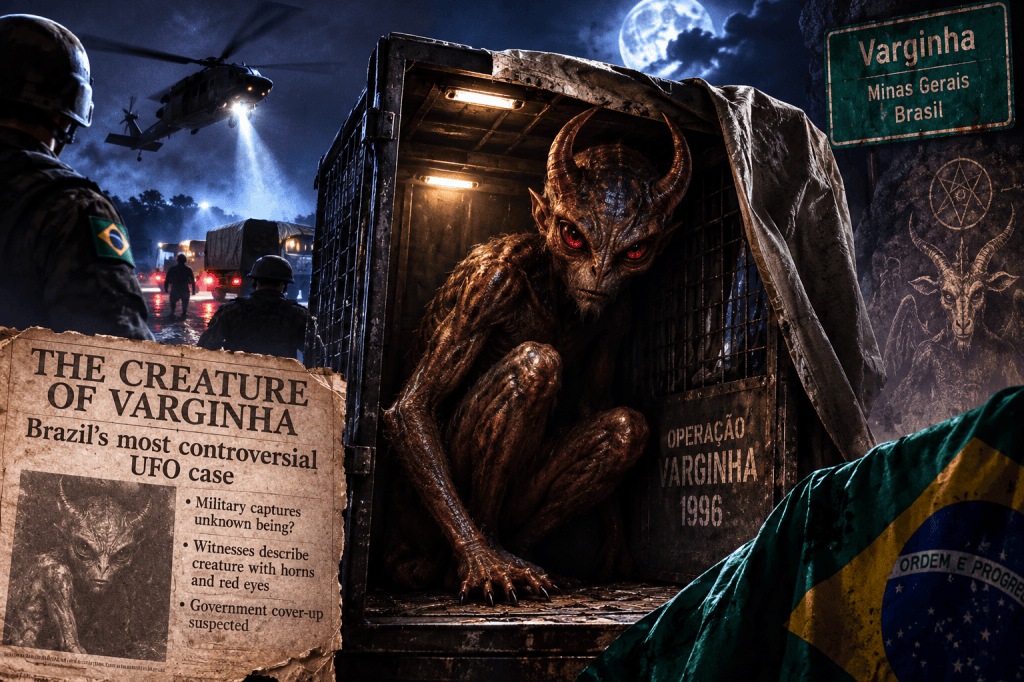
    In January 1996, the quiet Brazilian city of Varginha became the center of one of the most controversial incidents in modern UFO history. Within days, stories spread through the streets of frightened witnesses, mysterious military convoys, strange creatures, and an operation so secretive that many believed the truth had been hidden forever.

    Nearly two decades later, the mystery took an even darker turn.

    In 2014, filmmaker David Vose released a documentary claiming that the creatures reported in Brazil were not extraterrestrials at all. According to the film, they were something far older, far more disturbing, and perhaps deeply connected to humanity’s oldest religious traditions.

    Could the beings described by witnesses have been what ancient civilizations once called demons?

    Or had imagination transformed an already extraordinary story into modern mythology?

    The Day Everything Changed

    On an ordinary afternoon in January 1996, several young women walking through a vacant lot in Varginha claimed they encountered a strange creature unlike anything they had ever seen.

    According to their descriptions, it was approximately five feet tall, with oily brown skin, disproportionately large eyes, and an oversized head. Some witnesses also reported small horn-like protrusions on its head, giving it an appearance that frightened them so deeply that they ran home in panic.

    Within hours, rumors spread across the city.

    Residents reported unusual military activity.

    Army trucks were allegedly seen moving through the streets.

    Some claimed that soldiers had captured an unknown being alive.

    Others insisted that more than one creature had been recovered.

    No official confirmation ever followed.

    Yet the story refused to disappear.

    The Documentary That Changed the Narrative

    Years later, David Vose proposed a far more controversial interpretation.

    His documentary argued that the creatures described in Brazil shared remarkable similarities with ancient descriptions of demonic beings rather than visitors from another planet.

    The alleged creatures were described as possessing:

    • dark, rough skin;
    • glowing red eyes;
    • horn-like structures;
    • an overwhelming sulfur-like odor;
    • unusual physical abilities.

    To supporters of the theory, these details seemed strangely familiar.

    Throughout history, many cultures have described supernatural beings with horns, glowing eyes, and terrifying appearances.

    Was this merely coincidence?

    Or had humanity been describing the same entities for thousands of years under different names?

    Demons… or Visitors?

    One of the documentary’s central arguments is both fascinating and controversial.

    It suggests that ancient people interpreted mysterious encounters according to the language of their own time.

    A medieval monk might have described an unknown entity as a demon.

    A Roman could have called it a spirit.

    An ancient Greek might have believed it was a divine messenger or a creature from the Underworld.

    Today, many people would simply call it an alien.

    Perhaps, the documentary suggests, the phenomenon has remained the same while human interpretations have changed.

    It is an intriguing idea.

    But it remains only a theory.

    The Government Conspiracy

    As with many famous UFO cases, allegations of a military cover-up quickly emerged.

    Witnesses claimed they saw military vehicles transporting unusual containers.

    Others alleged that hospitals suddenly became restricted areas.

    One persistent story even claimed that a soldier involved in handling one of the creatures later died from a mysterious infection.

    These accounts have fueled decades of speculation.

    However, despite countless investigations by journalists, researchers, and UFO enthusiasts, no verifiable evidence has ever confirmed that non-human beings were captured.

    The official explanations ranged from misunderstandings and rumors to misidentified individuals and ordinary military activity.

    For believers, those explanations seem insufficient.

    For skeptics, they remain the most likely answer.

    Why Horns?

    Perhaps the most striking feature of the story is the repeated mention of horn-like structures.

    Across human history, horns have symbolized power, divinity, fertility, fear, and the supernatural.

    Ancient gods wore them.

    Kings placed horned crowns upon their heads.

    Later religious traditions often associated horns with demons.

    Yet biology offers another possibility.

    If such a creature existed, small bony protrusions might simply be part of its anatomy rather than symbols of evil.

    The human mind naturally interprets unfamiliar forms through familiar ideas.

    Sometimes, symbolism speaks louder than reality.

    Between Myth and Memory

    The Varginha incident has become one of the world’s most enduring modern mysteries.

    For some, it represents compelling evidence that governments conceal encounters with non-human intelligences.

    For others, it is a fascinating example of how rumors, fear, media attention, and sincere eyewitness testimony can combine to create a legend.

    The truth may lie somewhere between those extremes.

    History is filled with stories that were dismissed for centuries before new evidence emerged.

    It is equally filled with legends that grew larger every time they were retold.

    The Mystery Remains

    No authenticated photographs of a captured creature have ever surfaced.

    No physical remains have been independently examined.

    No official documents confirm that the Brazilian military recovered a non-human being.

    And yet…

    More than thirty years after the incident, people still travel to Varginha searching for answers.

    The story refuses to disappear because it speaks to something deeper than a simple UFO report.

    It asks an ancient question that humanity has never stopped asking.

    If something truly unknown stood before us…

    Would we recognize it for what it is?

    Or would we simply give it the oldest name we know?

    Perhaps an alien.

    Perhaps a demon.

    Or perhaps something for which human language has never possessed the right words.

    Fediverse Reactions
  • The Sea Peoples: The Mystery That Destroyed an Age

    History remembers the rise of great civilizations.

    But it rarely remembers the strangers who brought them to an end.Around 1200 BC, the ancient world was thriving.

    The mighty Hittite Empire dominated Anatolia. Mycenaean kingdoms flourished across Greece. Rich cities traded from Cyprus to the Levant, while Egypt stood as one of the greatest powers on Earth.

    Then, within only a few decades…Everything changed. Cities that had stood for centuries were reduced to ashes. Palaces burned. Trade routes disappeared. Entire kingdoms vanished from history.Ancient records blamed a mysterious enemy known only as the Sea Peoples.

    But who were they?

    The Enemy from the Sea

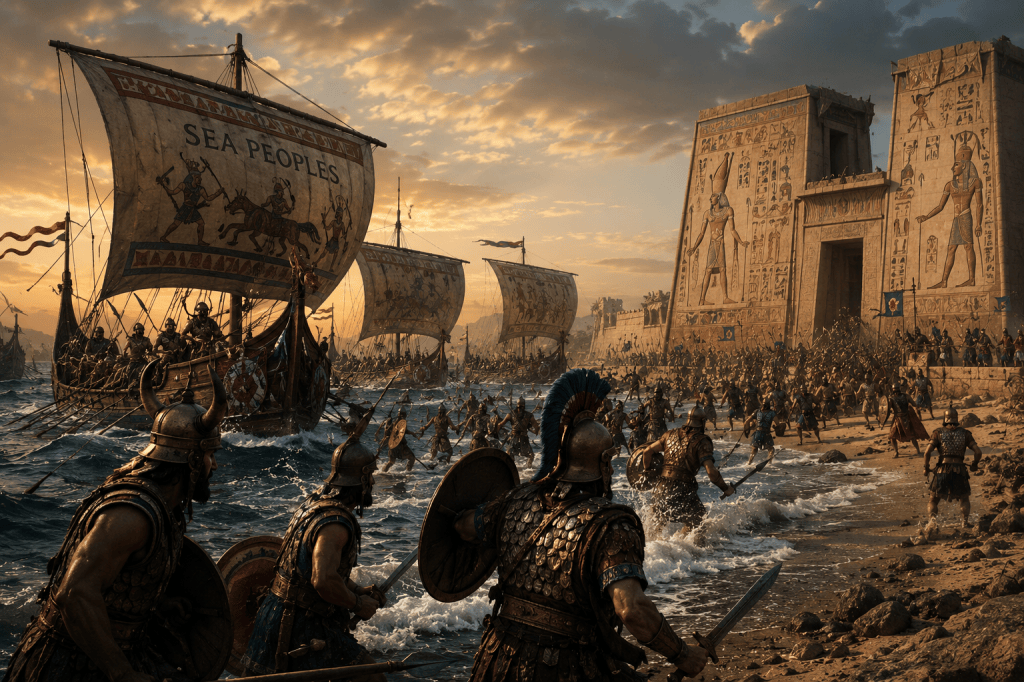
    The most detailed account comes from the reign of Pharaoh Ramesses III.

    His temple at Medinet Habu depicts enormous naval battles unlike anything seen before. Ships crashed together as archers filled the sky with arrows. Warriors wearing unusual feathered helmets stepped onto Egyptian soil with families, wagons, and possessions.

    These were not ordinary pirates.They appeared to be entire populations on the move. Ramesses claimed victory, but even his triumph carried a warning:”The foreign countries made a conspiracy in their islands… No land could stand before their arms.

    “Whether those words were meant as history or royal propaganda, one fact remains undeniable.The ancient world was collapsing.

    A Civilization Falls Silent

    One of the greatest victims was the Hittite Empire.

    For centuries it had rivaled Egypt itself, ruling vast territories and commanding powerful armies.Then it simply disappeared.Its capital, Hattusa, was abandoned.Its archives fell silent. Its kings vanished from history.No single explanation has ever satisfied historians.

    Was it invasion?Civil war?Famine?Climate change?

    Or did the arrival of the Sea Peoples push an already fragile world beyond its breaking point?

    Who Were They?

    This is where history becomes mystery.

    No ancient text clearly identifies their homeland.

    Over the centuries, scholars have proposed dozens of possibilities. Some believe they came from the Aegean islands. Others point toward western Anatolia. Some connect them to Sardinia or Sicily.

    A few even suggest they were survivors of kingdoms destroyed elsewhere, forced to migrate in search of new lands.

    Perhaps they were not one nation at all.

    Perhaps they were an alliance born from desperation. A moving civilization rather than a single people.

    The End of the Bronze Age

    The arrival of the Sea Peoples coincided with one of history’s greatest turning points—the collapse of the Bronze Age.

    International trade disappeared.

    Writing systems were forgotten.Entire cities remained abandoned for generations.Knowledge itself seemed to vanish.When the darkness finally lifted, the ancient world had become something entirely different.

    The age of mighty Bronze Age kingdoms was over.

    A new world would slowly emerge from the ruins. A Mystery Still UnsolvedModern archaeology has uncovered burnt cities, abandoned fortresses, and shattered kingdoms.

    It has reconstructed trade networks stretching across the Mediterranean.It has analyzed climate records and ancient DNA. Yet one question continues to resist every answer. Who were the Sea Peoples?Were they conquerors…Refugees…Mercenaries…Or the survivors of a forgotten catastrophe whose own homeland has long since disappeared beneath history?

    Perhaps the answer still lies buried beneath the sands of Egypt, the ruins of Anatolia, or the depths of the Mediterranean Sea.

    Until that day comes, the Sea Peoples remain one of history’s greatest mysteries—not because they conquered an empire……but because they helped erase an entire age.

    Fediverse Reactions
  • Voinich Manuscript

    The Voynich Manuscript: The Book That Refuses to Be Read


    Some books preserve knowledge.Others preserve stories.
    But one book appears to preserve a secret.
    Hidden today inside Yale University’s Beinecke Library lies a manuscript that has defied scholars, cryptographers, linguists, historians, artificial intelligence, and even some of the greatest codebreakers of the twentieth century.
    For more than six centuries, no one has convincingly read a single sentence from it. Despite countless attempts, the Voynich Manuscript remains silent.Yet perhaps the greatest mystery is not what it says……but whether it was ever meant to be understood.

    A Book Without a Voice

    Radiocarbon dating places the parchment between 1404 and 1438, making the manuscript undeniably medieval. Its pages are filled with elegant illustrations of impossible plants, strange constellations, mysterious circular diagrams, alchemical-looking vessels, and groups of women immersed in interconnected pools of green liquid.

    None of these images fully resemble anything found in known medieval books.The text itself is even stranger.
    Nearly 40,000 words flow across its pages in a beautiful script that resembles a real language. It follows statistical patterns found in genuine human languages, yet no known alphabet matches it. Every proposed translation has eventually collapsed under careful examination.Imagine opening a book that clearly wants to communicate……while refusing every attempt to understand it.


    The Secret Hidden in the Plants


    At first glance, the manuscript appears to be a herbal encyclopedia.Look closer.Most of the plants do not exist.Some resemble familiar herbs, while others seem to combine leaves, roots, and flowers from entirely different species.
    Was the artist inventing imaginary plants?
    Or were these illustrations intentionally altered to conceal real medicinal knowledge?Several historians have suggested that changing botanical details would have been an effective way to hide valuable medical information from outsiders. The reader would need the “key” before recognizing the true plant.Perhaps the illustrations are not mistakes.Perhaps they are camouflage.


    The Women in the Green Water


    One section has fascinated researchers more than any other.Dozens of unclothed women appear connected by intricate tubes and pools, as though flowing through an enormous hidden mechanism. Some scholars believe these represent medieval bathing therapies or women’s medicine. Others argue they symbolize alchemical transformation rather than anatomy.But there is another possibility rarely discussed.What if these women are not human at all?Throughout medieval Europe, sacred springs were believed to be inhabited by spirits capable of healing, revealing visions, or granting forbidden knowledge. Could these strange figures represent beings from forgotten folklore rather than ordinary people?No one knows.

    A Language That Doesn’t Want to Be Broken


    The Voynich Manuscript has attracted some of history’s greatest minds.Professional cryptographers.Military codebreakers.Linguists.Computer scientists.Artificial intelligence.None has produced a translation accepted by the academic world. Even today, the manuscript officially remains unread.That failure has inspired an uncomfortable question.What if we are trying to solve the wrong puzzle?Perhaps the symbols are not letters.Perhaps the illustrations themselves form the true language.Or perhaps the manuscript requires a tradition that disappeared centuries ago—a missing way of reading that vanished with its last keeper.

    The Forgotten Theory


    Among the many theories, one remains strangely overlooked.Suppose the manuscript was never intended for ordinary readers.Imagine a secret circle where every initiate already knew the spoken teachings. The book would then serve only as a memory device—its symbols acting as reminders rather than complete explanations.Without belonging to that tradition, every modern reader would be attempting to read half of a conversation.The other half would already be lost.

    A Door Still Closed


    Every generation believes it will finally solve the Voynich Manuscript.

    Every generation leaves with more questions than answers.
    Perhaps one day a forgotten archive will reveal the missing key.
    Perhaps a hidden diary will identify its creator.
    Or perhaps the manuscript was designed to ensure that only those who already possessed the knowledge could ever understand it.

    Until that day arrives, the Voynich Manuscript remains what it has always been:Not simply an unread book……but one of history’s greatest invitations to wonder.

    The secrets of the Voynich Manuscript may never be fully revealed… but your own journey into ancient wisdom can begin today.

    Fediverse Reactions