Category: Biblical Mysteries

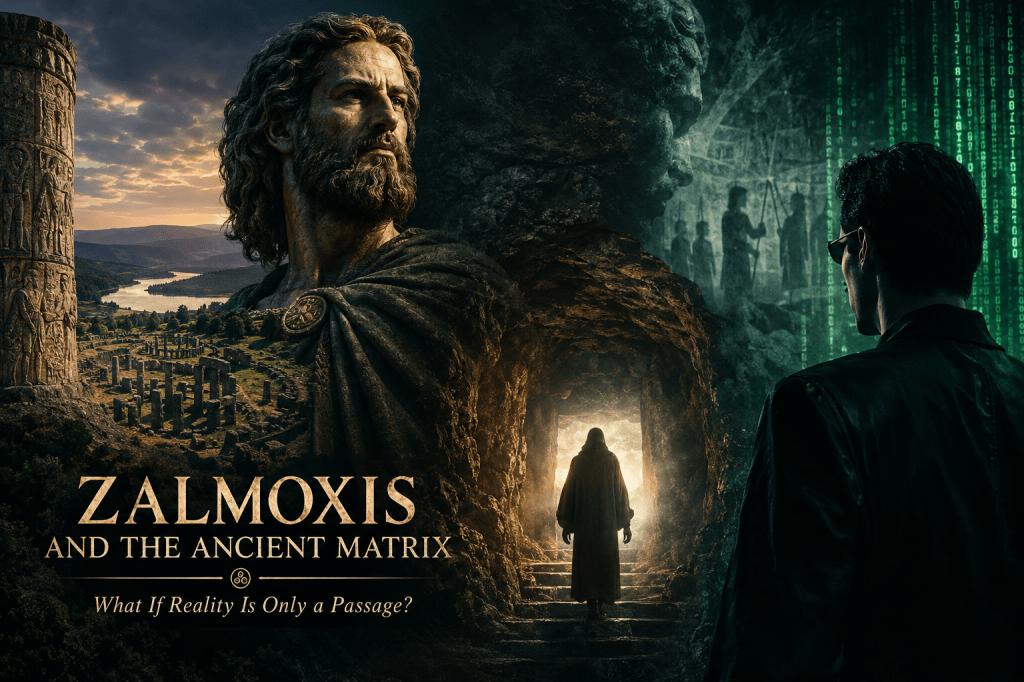
  • Zalmoxis and the Ancient Matrix: What If Reality Is Only a Passage?

    Zalmoxis and the Ancient Matrix: What If Reality Is Only a Passage?

    There is something unsettling about Zalmoxis even before we begin trying to understand who—or what—he was.

    He appears at the edge of recorded European history almost as if he had stepped out of a story that had already been told for centuries before anyone thought to write it down. A god to some, a man to others, perhaps a priest, perhaps a reformer, perhaps the distant memory of a real person whose identity dissolved into religion, he belonged to the world of the Getae north of the lower Danube, yet nearly everything we know about him was preserved by outsiders.

    That alone should make us cautious.

    It should also make us curious.

    The Getae left us no surviving sacred book explaining Zalmoxis in their own words. There is no Zalmoxian gospel hidden in a monastery, no authentic collection of his teachings waiting to be deciphered and no ancient manuscript that allows us to hear his voice directly. Instead, we find fragments scattered through Greek and Roman literature, each writer looking at the same strange tradition from a different angle.

    And yet, when those fragments are placed together, a remarkably persistent idea emerges.

    Human beings may be mistaken about what reality actually is.They may be mistaken even about death.That is where the story becomes far more interesting than a simple chapter of ancient religion, because behind Zalmoxis lies a question that humanity has never stopped asking.

    What if what we see is only the surface?

    The people who believed death was not an ending

    Our earliest substantial account comes from Herodotus, writing in the fifth century BC.

    While describing the Persian expansion into the lands around the Danube, Herodotus pauses to speak about the Getae. He calls them particularly courageous among the Thracian peoples, but it is their religious belief that captures his attention.

    According to him, the Getae believed that they did not truly die. A person who perished went instead to Zalmoxis—or, in the wording of the ancient account, to a divine figure Herodotus associates with Zalmoxis and also mentions under the name Gebeleizis.

    It is easy to read that sentence too quickly.

    Ancient cultures believed in afterlives everywhere, after all. Egyptians imagined the world beyond death, Greeks told stories about Hades, and later religions would place entire theological systems around the fate of the soul.

    But Herodotus describes something more concrete among the Getae.

    Once every five years, he says, they selected a messenger by lot. That man was entrusted with requests that he was supposed to carry to Zalmoxis. Then came the part that must have sounded shocking even to ancient readers: men held spears upright while the chosen messenger was thrown onto their points.

    If he died, the sacrifice was considered accepted. If he survived, the failure was blamed on the messenger and another could be selected.

    The ritual is brutal, and there is no reason to romanticize it. At the same time, its logic tells us something extraordinary about the world in which the ritual made sense.

    The messenger was not simply being killed.

    He was being sent.

    For the people performing the ritual, death was apparently a border that could be crossed, and on the other side of that border there was someone—or something—capable of receiving a message.Seen from that perspective, the sacrificed man was not merely a victim.

    He was a traveller into a reality inaccessible to the living.

    Whatever the Getae actually believed in all its complexity, Herodotus understood their religion as containing a radical conviction: the visible disappearance of a human being did not mean that the human being had ceased to exist.

    Then Herodotus tells another story, and this is where Zalmoxis becomes truly difficult to separate from mystery.

    The man who vanished underground

    Herodotus says that Greeks living around the Hellespont and the Black Sea told a different version of Zalmoxis’ origin.

    According to them, Zalmoxis had once been a mortal man associated with Pythagoras. In their story he had lived on Samos, learned from Greek thought, accumulated wealth and eventually returned to his homeland.

    There he gathered important men around him, entertained them and began teaching something astonishing: neither they, nor their descendants, nor Zalmoxis himself would truly die. Instead, they would go to another place where existence continued and where good things awaited them.

    Then he did something that sounds almost theatrical.

    He built an underground chamber.When it was ready, Zalmoxis disappeared into it.For three years, according to the story, nobody saw him. His people mourned him as dead.

    Then, in the fourth year, he emerged again.

    The man they believed had died had returned.

    And according to the Greek version preserved by Herodotus, that apparent return from death helped convince the Getae that his teaching had been true.It is precisely at this point that responsible history has to resist temptation.We cannot say that this event actually happened. We cannot even be certain that Zalmoxis was originally a historical person.

    Herodotus himself is surprisingly careful: he says that he neither completely believes nor completely rejects the tale of the underground chamber, and he doubts the chronology connecting Zalmoxis directly with Pythagoras. He even leaves open the basic question of whether Zalmoxis had been a man or a native Getic deity.

    That uncertainty does not weaken the story.In some ways it makes it more fascinating.Because whatever happened historically, somebody considered this story important enough to preserve: a teacher disappears beneath the earth, is mourned as dead, and then returns among the living.If this was an initiation drama rather than biography, what did it mean?

    If it was a myth, what truth was the myth trying to communicate?

    And if Zalmoxis was already a god before Greeks attempted to turn him into a former student of Pythagoras, why did the underground disappearance become such an important part of the story?

    We do not know.

    But we can see the structure.A man enters darkness.The world assumes he is gone.

    He returns possessing—or representing—knowledge about death that ordinary people do not possess.

    That structure has survived in religious myths, mystery traditions and philosophical stories across cultures because it touches a very old fear: perhaps human beings understand only the side of reality they happen to inhabit.

    Zalmoxis did not disappear from ancient literature

    Centuries later, Strabo tells another version.The Zalmoxis we meet in his Geography is less like a magician staging his own return from death and more like a sacred political figure, a man who acquires knowledge, becomes close to a ruler and eventually acts as an intermediary between divine authority and earthly power.

    Strabo says that Zalmoxis became a priest of the god most honoured among his people and was eventually himself treated as divine. He lived, according to the account, in an inaccessible cavernous place and met few people apart from the king and attendants. The mountain associated with this sacred retreat was called Cogaeonum in Strabo’s text.

    Again, we encounter withdrawal.

    Again, a sacred man is separated from ordinary society.Again, access to him is restricted.It is worth noticing how different this is from the modern image of a religious teacher speaking openly to crowds.

    Zalmoxis, as Strabo presents him, gains authority partly through distance. He occupies a space ordinary people cannot easily enter, and from that hidden space comes knowledge that affects the visible world outside it.Strabo even says that something of this religious-political institution continued later among the Getae. During the reign of Burebista, a comparable role was held by Decaeneus, the famous Deceneu of later Romanian historical tradition.This does not prove an unbroken secret order stretching across centuries, as modern esoteric stories sometimes suggest.

    The evidence simply does not allow that conclusion.

    Still, the repeated pattern is difficult to ignore.The ruler governs the visible world.The sacred figure interprets something beyond it.One possesses political power; the other possesses access to hidden knowledge.In a culture in which religion and political authority were deeply entangled, that distinction could have been enormously powerful.

    And then Plato enters the story.

    The strange physicians of Zalmoxis

    There is a passage in Plato’s Charmides that deserves far more attention than it usually receives when Zalmoxis is discussed.

    Socrates speaks of having learned from one of the Thracian physicians associated with Zalmoxis. The teaching attributed to them says, in essence, that you cannot properly treat the eyes without treating the head, nor the head without treating the body, and that you should not attempt to heal the body without considering the soul.

    The part cannot be healed while the whole is ignored.

    Plato presents Zalmoxis as both king and god within this story, and the medicine associated with him is explicitly holistic: body, soul and human character belong to the same reality and should not be artificially separated.

    Whether Plato is preserving an authentic Getic doctrine, reshaping an exotic tradition for philosophical purposes, or combining both is impossible to establish from the text alone.But something important has happened by this point.

    Zalmoxis is no longer merely the mysterious deity to whom the Getae send the dead.He has become associated with knowledge unavailable to ordinary perception.Death may not be what it seems.

    The body cannot be understood without the soul.The visible part cannot be fully understood without the invisible whole.That is an extraordinary collection of ideas to find around a figure standing in the mist between history and mythology.And this is where we can approach the Matrix—not by pretending that ancient Getae believed in computers, simulated universes or machines controlling humanity, but by recognising something much older beneath the modern language.

    The suspicion that reality has layers.

    Long before the red pill

    When people hear the word Matrix today, they often think immediately of a computer simulation.But the deeper philosophical idea behind the Matrix is much older than computers.

    The real shock is not discovering that machines exist.

    The real shock is discovering that your definition of reality was wrong.Neo begins inside a world that appears completely normal. Streets exist. Buildings exist. People go to work. Conversations happen. Food has taste. The world follows rules.Nothing initially appears artificial because Neo has never known anything against which to compare it.His prison works because it feels ordinary.

    That idea has an obvious philosophical ancestor in Plato’s Allegory of the Cave.

    Plato asks us to imagine human beings imprisoned underground from childhood, able to see only shadows projected before them. Since shadows constitute everything they have ever experienced, the prisoners naturally treat those shadows as reality.

    Only the person who turns around, leaves the cave and encounters another level of existence discovers how incomplete the former world was.

    Plato explicitly uses the image to distinguish the world apprehended through ordinary sight from a higher intelligible understanding.And here something curious happens.Plato gives us prisoners inside a cave, mistaking appearances for reality.The tradition about Zalmoxis gives us a sacred teacher who enters an underground chamber, disappears from ordinary human sight and returns carrying the authority of someone who supposedly knows what lies beyond death.The stories are not the same and should never be presented as though one copied the other.

    But place them beside one another and the resemblance of the questions becomes difficult to ignore.What can human senses actually tell us?How much of existence remains outside their range?If everybody around us agrees that something is real, does that agreement make it true?

    And what happens to the person who crosses the boundary between the accepted world and another understanding of it?These are not exclusively Greek, Getic or modern questions.They are human questions.

    Perhaps the real prison is certainty

    There is an uncomfortable reason why stories like these survive.Human beings need stable reality.We need to believe that the floor beneath us exists, that tomorrow will resemble today, that cause precedes effect and that the people around us inhabit roughly the same world we do.Without that agreement, ordinary life becomes almost impossible.Yet philosophy has always been dangerous to certainty.It asks whether seeing something is enough to know it.It asks whether consensus proves truth.It asks whether the limits of human perception have quietly become the limits of what we are willing to call real.Zalmoxis becomes fascinating in this context because the surviving traditions surrounding him attack the most absolute certainty of all.

    Death.

    A body falls.

    It stops breathing.It grows cold.It disappears into the earth.Every visible sign tells the observer that the person’s existence is over.And yet the Getic belief described by Herodotus says: you are interpreting what you see incorrectly.The person has gone somewhere.One does not have to accept that belief literally to understand its philosophical power.The senses provide evidence, but the doctrine tells the believer that the evidence is incomplete.That tension between appearance and hidden reality is precisely what gives both ancient initiation traditions and modern Matrix imagery their force.Not because they provide the same answer.Because they begin with the same doubt.

    What was inside the chamber?

    We will probably never know what Zalmoxis’ underground chamber looked like—if such a chamber existed at all.That missing information leaves a strange empty space at the centre of the story.

    Was it simply a hidden room in which a man lived for several years?Was it a ritual space connected with initiation?Did the story preserve a much older myth of a deity descending beneath the earth and returning?Was it a Greek attempt to rationalise a foreign god by turning him into a clever human teacher?

    Each possibility has been discussed in different forms, but the surviving evidence cannot settle the question.Modern scholarship also treats the Pythagorean connection cautiously.

    The story making Zalmoxis a former slave or follower of Pythagoras comes through Greek tradition, while Herodotus himself already doubted its chronology. Later analysis has continued to examine how legends linking Pythagoras with northern religious figures developed in Greek literature.This matters because Zalmoxis has accumulated an extraordinary amount of modern mythology.He has been called a prophet, a supreme god, a monotheistic reformer, a shaman, an initiate, a philosopher and the guardian of supposedly lost Dacian wisdom.

    Some of those interpretations may contain useful comparative ideas, while others go far beyond anything ancient sources actually tell us.The honest version is less comfortable and, I think, far more intriguing.

    We do not know exactly who he was.

    Herodotus did not know.

    Strabo inherited traditions centuries later.

    Plato knew the name and associated it with remarkable Thracian wisdom, yet he was using that tradition inside a philosophical dialogue rather than writing an ethnographic report.

    Zalmoxis stands precisely where evidence begins to thin and myth begins to breathe.

    And perhaps that is why he has never disappeared.

    The ancient Matrix was not a machine

    If we use the word Matrix here, we should use it carefully.There is no evidence that Zalmoxis taught that physical reality was false, that the world was artificially generated or that humanity was imprisoned inside anything resembling a technological simulation.The interesting parallel lies elsewhere.

    A Matrix can also be understood as a framework of reality that becomes invisible because we have lived inside it for too long.A culture tells us what life is.It tells us what death means.It teaches us which things are possible and which questions are absurd.

    Eventually we stop recognising those assumptions as assumptions. They become the walls of the world.The prisoner in Plato’s cave does not initially see a prison.Neo does not initially see a simulation.And the ordinary observer sees death and assumes that what has vanished from sight has vanished from existence.

    Zalmoxis enters this conversation not as proof that the ancients knew the secret structure of the universe, but as evidence of something more modest and perhaps more profound: thousands of years ago, human beings were already deeply uncomfortable with the possibility that visible reality might not be complete reality.That thought lies at the heart of our book Matrix as well.

    The question is not simply whether we live inside a computer program. That is only one modern version of a much older problem.The deeper question is what creates the reality in which we live.Our senses?Our society?Our language?Our memories?Our fears?Our education?The people who hold authority?Or something beyond all of them?Once that question is allowed into the mind, the Matrix changes shape.It no longer requires cables, machines or a digital sky.

    Sometimes the Matrix is simply everything we have been taught never to question.

    And perhaps this is why Zalmoxis still feels strangely modern

    More than two millennia separate us from the people Herodotus described.Their world has vanished. Their language has largely disappeared with them. Their sacred places survive mostly as archaeology, geography and conjecture, while their beliefs reach us through the imperfect filter of outsiders who were themselves trying to understand something foreign.

    Yet Zalmoxis remains.

    Not clearly enough for us to possess him, but not vaguely enough for us to forget him.A god who may have been a man.A man who may have become a god.A teacher associated with immortality who vanished beneath the earth.A sacred figure hidden in an inaccessible place.A tradition in which the soul mattered more than the body alone could explain.A people described as believing that death did not mean what everyone else assumed it meant.

    Perhaps there is no secret doctrine waiting to be recovered from these fragments.Perhaps there was never one.

    But imagine, just for a moment, the person standing outside the underground chamber after Zalmoxis had disappeared.Three years pass.Nothing.The man is dead. Everyone knows it.Then one day he walks out.What would collapse first?Belief in death?Belief in the evidence of your own eyes?Or the comforting certainty that the world works exactly as you have always been told?

    That is where Zalmoxis becomes more than an ancient mystery.

    Because every Matrix begins at exactly that point.

    Not when someone gives you the answer.But when, for the first time, you suspect that the reality you accepted without question may not be the whole story.
  • Did Jesus Survive the Crucifixion? The Templar Legend That Refuses to Die

    Part II – The Tomb in Kashmir, the Templar Secret and the Search for Evidence

    Did Jesus Survive the Crucifixion? The Templar Legend That Refuses to Die

    Part II – The Tomb in Kashmir, the Templar Secret and the Search for Evidence

    The first part of this investigation examined the historical evidence for the crucifixion of Jesus, the medical improbability of surviving a Roman execution, and the controversial nineteenth-century claims that Jesus may have traveled eastward during the undocumented years of his early life. Those theories become considerably more complicated, however, when the story moves beyond Tibet and into Kashmir, where an old tomb in the city of Srinagar has become the center of one of the most persistent alternative narratives in modern religious history.

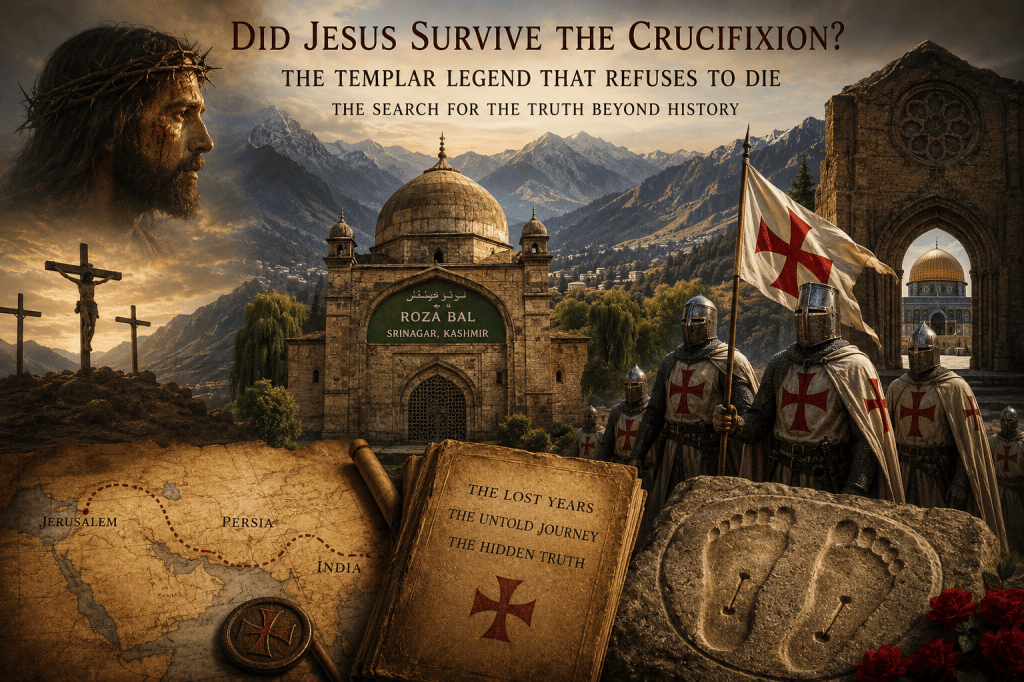
    The building is known as Roza Bal, a modest shrine located in the Khanyar district of Srinagar. For generations it was associated locally with a figure known as Yuz Asaf, traditionally remembered as a holy man. During the late nineteenth and twentieth centuries, however, writers began advancing a far more extraordinary interpretation: Yuz Asaf, they claimed, was actually Jesus of Nazareth, who had survived the crucifixion, traveled east and eventually died in Kashmir at an advanced age.

    It is a remarkable proposition. It is also one for which mainstream historians find no convincing contemporary evidence.

    Understanding why the theory became so influential requires separating several layers of history that have gradually been combined into a single narrative.

    Roza Bal: The Tomb at the Center of the Mystery

    Roza Bal existed long before it became internationally associated with Jesus. The shrine contains a tomb traditionally connected with Yuz Asaf and another Muslim holy figure. Local traditions surrounding the site developed over centuries, but establishing precisely when individual elements of those traditions originated is difficult.

    The identification of Yuz Asaf with Jesus became particularly influential through the writings of Mirza Ghulam Ahmad, founder of the Ahmadiyya movement, toward the end of the nineteenth century. Ahmad argued that Jesus had survived crucifixion, traveled east in search of the Lost Tribes of Israel and eventually settled in Kashmir.

    In this interpretation, the crucifixion did occur, but it did not end Jesus’ earthly life.

    Instead, it marked the beginning of another journey.

    The theory later attracted independent authors, travelers and researchers who attempted to connect various Asian legends with the life of Jesus.

    Yet the historical problem is substantial: there is an enormous chronological gap between the first century, when Jesus lived, and the much later sources used to establish the connection between Jesus and Yuz Asaf.

    No securely dated first-century inscription at Roza Bal identifies the person buried there as Jesus of Nazareth.

    No contemporary Roman, Jewish or Indian document records Jesus arriving in Kashmir after the crucifixion.

    That absence does not logically prove that such a journey could never have occurred, but it prevents historians from treating it as established history.

    Who Was Yuz Asaf?

    The identity of Yuz Asaf is itself complicated.

    Various versions of the name appear in later Persian, Arabic and South Asian traditions. Some writers describe him as a prophet or holy man who came from the West. Others connect the tradition to stories that circulated across Asia through centuries of religious and cultural exchange.

    This has created a tempting historical puzzle.

    If Yuz Asaf was a foreign religious teacher, could his story preserve a distant memory of Jesus?

    The difficulty is that names and legends change dramatically as they move between languages and cultures. Stories can merge with other stories, historical figures can acquire characteristics belonging to entirely different people, and religious narratives can survive for centuries while changing their original meaning.

    Historians therefore require more than similarities between legends.

    They require evidence capable of connecting a specific person, place and period.

    That connection has never been conclusively established at Roza Bal.

    The Mysterious Footprints

    One of the most frequently cited pieces of evidence involves carved impressions traditionally interpreted as footprints associated with the tomb.

    Some proponents of the Jesus-in-Kashmir theory have claimed that markings on these impressions correspond to wounds caused by crucifixion nails.

    If genuine and demonstrably connected with the individual buried at Roza Bal, such evidence would certainly be intriguing.

    But several problems immediately appear.

    The age and original purpose of the footprints have not established the identity of the person buried there. Even if the markings were intended to represent wounds, symbolic representations of injured or sacred feet occur in multiple religious traditions.

    An image is not a biological identification.

    Without independently authenticated first-century material connecting those footprints specifically to Jesus, they cannot function as proof of survival from the crucifixion.

    They remain part of the tradition surrounding the shrine rather than forensic evidence.

    What About the Lost Tribes of Israel?

    Another important element of the theory attempts to explain why Jesus would have traveled to Kashmir at all.

    Supporters argue that populations descended from the Lost Tribes of Israel migrated eastward following ancient Assyrian deportations. Jesus, according to this hypothesis, traveled through Afghanistan and northern India in search of these dispersed communities.

    Certain similarities between Kashmiri and Jewish customs have occasionally been cited in support of the idea.

    Yet cultural resemblance alone is notoriously unreliable evidence for common ancestry. Trade, migration, conquest and religious exchange can produce similarities between societies without demonstrating direct descent.

    Modern historical and genetic research has not established the extraordinary chain of events required to demonstrate that Jesus traveled to Kashmir specifically to find Israelite descendants.

    Once again, an interesting possibility becomes something very different when subjected to the standards required for historical proof.

    Enter the Knights Templar

    The story becomes even more dramatic when the Knights Templar enter the narrative.

    The Templars were founded in the early twelfth century, initially to protect Christian pilgrims traveling through the Holy Land. Over the following two centuries, the order became wealthy, politically influential and surrounded by secrecy.

    Their headquarters were established on Jerusalem’s Temple Mount, an association that later generated enormous speculation.

    What did the Templars discover beneath Jerusalem?

    Did they find ancient manuscripts?

    Documents relating to Jesus?

    The Ark of the Covenant?

    The Holy Grail?

    Evidence capable of undermining the authority of medieval Christianity?

    These possibilities have become central to modern Templar mythology.

    The historical record, however, is far less dramatic.

    There is no authenticated Templar document stating that Jesus survived the crucifixion. Nor is there reliable medieval evidence demonstrating that the order possessed secret records tracing Jesus to India or Kashmir.

    The association largely belongs to much later esoteric literature and modern alternative-history theories.

    The Templars undoubtedly possessed secrets in the ordinary sense: financial information, military plans, internal ceremonies and political agreements. Secretive institutions naturally attract speculation, particularly when their destruction is as dramatic as that of the Templars.

    But secrecy itself is not evidence of a hidden gospel.

    Why Were the Templars Destroyed?

    This question is crucial because it is often used to support the theory.

    On Friday, 13 October 1307, King Philip IV of France ordered the arrest of Templars throughout his kingdom. They were accused of heresy, idolatry, obscene initiation rituals and numerous other offenses.

    Some confessed under interrogation and torture.

    The spectacular accusations eventually helped create the image of an organization guarding forbidden knowledge.

    The political and financial context provides a less mysterious explanation.

    Philip IV was heavily indebted to the Templars and had strong reasons to eliminate an organization whose wealth and independence had become politically inconvenient. Pope Clement V eventually dissolved the order in 1312.

    Nothing in the surviving evidence demonstrates that the Templars were destroyed because they possessed proof that Jesus survived the crucifixion.

    That interpretation appeared much later.

    From History to Alternative History

    The Jesus-survival theory demonstrates how powerful alternative histories are created.

    Several genuine historical mysteries exist at its foundation.

    We know remarkably little about Jesus’ life between childhood and approximately age thirty.

    Ancient trade routes genuinely connected the Mediterranean with India.

    The Templars genuinely operated from Jerusalem and developed extraordinary wealth and influence.

    Roza Bal genuinely exists.

    Yuz Asaf genuinely belongs to traditions associated with the shrine.

    These are historical elements.

    The controversial step occurs when separate facts are connected by assumptions for which evidence is missing.

    A gap in the historical record becomes a journey.

    A mysterious holy man becomes Jesus.

    A medieval military order becomes the guardian of the secret.

    Once those elements are assembled, they create a compelling story.

    But a compelling story and a demonstrated historical sequence are not the same thing.

    Could Jesus Have Survived Crucifixion?

    Returning to the original question requires confronting the strongest evidence available.

    Roman crucifixion was designed to kill.

    The canonical Gospels explicitly state that Jesus died.

    Early Christian writings are built around his death and resurrection.

    Tacitus independently confirms that Christus was executed under Pontius Pilate.

    There is no surviving first-century source stating that Jesus survived and traveled to India.

    From the standpoint of mainstream historical scholarship, therefore, the conclusion is clear: Jesus was crucified and died as a consequence of the execution.

    The survival hypothesis requires several extraordinary assumptions for which contemporary evidence is absent.

    That does not make studying the legend meaningless.

    Quite the opposite.

    Why the Legend Refuses to Die

    The continuing fascination with the theory reveals something important about the way people approach history.

    Unanswered questions are uncomfortable.

    When the historical record becomes silent, imagination naturally enters the empty space.

    The missing years of Jesus invite speculation because we want to know what happened.

    The mysterious traditions of Kashmir attract attention because they appear to offer an answer.

    The Templars fascinate us because their dramatic destruction suggests that something important disappeared with them.

    Put these mysteries together and an irresistible narrative emerges.

    Yet responsible historical investigation requires resisting the temptation to turn possibility into evidence.

    At present, there is no reliable historical proof that Jesus survived the crucifixion, traveled to Kashmir, died at Roza Bal or entrusted knowledge of his survival to the Knights Templar.

    There are traditions.

    There are disputed interpretations.

    There are remarkable coincidences.

    And there are unanswered questions.

    Those things deserve investigation, but they should not be confused with conclusions.

    Perhaps that distinction is what makes this story genuinely fascinating. The mystery is not simply whether Jesus traveled to India. The deeper mystery is how fragments of history, religion and legend separated by thousands of kilometers and many centuries became woven together into a story powerful enough to survive into the modern world.

    The tomb at Roza Bal still stands.

    The Templars are gone.

    The ancient sources remain incomplete.

    And nearly two thousand years after the crucifixion, the question continues to be asked—not because history has provided convincing evidence for an alternative ending, but because humanity has never stopped searching for what might exist beyond the parts of the story we already know.

    Fediverse Reactions
  • The Gospel of Thomas: Was It Hidden by the Church… or Simply Never Accepted?

    Part I – The Discovery That Challenged Biblical History

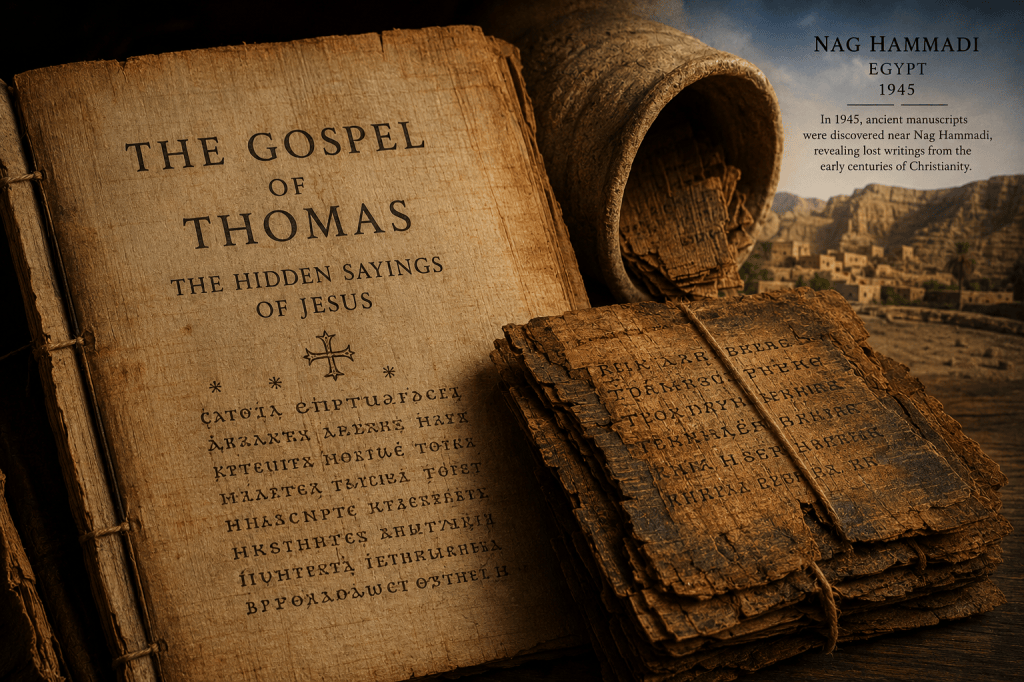
    In December 1945, two Egyptian brothers searching for natural fertilizer near the cliffs of Jabal al-Tarif, close to the town of Nag Hammadi, made a discovery that would become one of the most significant archaeological finds in the history of early Christianity. Buried inside a sealed earthenware jar were thirteen leather-bound papyrus codices containing more than fifty ancient Christian and Gnostic writings. Some of these texts had never been seen by modern scholars, while others had survived only through brief quotations preserved by early Church Fathers.
    Among them was a document that would soon become one of the most debated texts in biblical scholarship: The Gospel of Thomas.
    Unlike the four canonical Gospels, this text contains no account of Jesus’ birth, no miracles, no crucifixion, no resurrection, and no narrative describing His ministry.

    Instead, it presents 114 sayings attributed to Jesus, many of which resemble passages found in Matthew, Mark, Luke, and John, while others appear entirely unfamiliar.
    Its opening sentence immediately sets the tone:
    “These are the secret sayings that the living Jesus spoke and Didymus Judas Thomas wrote down.”
    The word secret has fascinated readers for decades.
    Was this merely a literary device?
    Or did the author genuinely believe he was preserving teachings intended only for a select group of followers?
    The answer remains one of the central questions surrounding the Gospel of Thomas.


    The Discovery at Nag Hammadi
    The discovery of the Nag Hammadi Library transformed the study of early Christianity.
    Before 1945, historians knew that many alternative Christian writings had existed because influential theologians such as Irenaeus, Hippolytus, and Origen had written against them during the second and third centuries. However, most of the original documents had disappeared. Scholars knew these texts only through the criticisms of those who opposed them.
    Nag Hammadi changed everything.
    For the first time, historians could examine these writings directly instead of relying on hostile descriptions.
    The codices contained works such as the Gospel of Philip, the Apocryphon of John, the Gospel of Truth, and the Gospel of Thomas. Together, they revealed a remarkably diverse Christian landscape during the first centuries after Jesus’ death.
    Rather than representing a single unified movement, early Christianity consisted of numerous communities that sometimes held very different beliefs about Jesus, salvation, and the nature of God.
    Who Wrote the Gospel of Thomas?
    The text attributes itself to Didymus Judas Thomas.
    In Aramaic, Thomas means “twin.”
    In Greek, Didymus also means “twin.”
    Whether this title refers to the apostle traditionally known as Thomas or carries symbolic meaning remains uncertain.
    Most biblical scholars do not believe that the Apostle Thomas personally wrote the document.
    Linguistic analysis, theological vocabulary, and historical context generally suggest that the surviving text reached its present form sometime during the second century AD, although several researchers argue that some individual sayings preserved within it could be considerably older.
    This distinction is important.
    The age of the document itself is not necessarily identical to the age of every tradition it contains.
    Some sayings may preserve authentic early Christian traditions.
    Others appear to reflect theological developments that emerged generations later.
    Separating those layers remains one of the greatest challenges facing modern scholarship.


    A Gospel Unlike Any Other
    The Gospel of Thomas reads very differently from the New Testament.
    Instead of telling a story, it resembles a collection of wisdom sayings.
    Many begin with familiar phrases:
    “Jesus said…”
    Each statement stands almost independently.
    Some closely parallel verses found in the canonical Gospels.
    Others expand upon familiar teachings.
    Still others appear mysterious, symbolic, and difficult to interpret.
    Consider one of its best-known sayings:
    “The Kingdom is inside you, and it is outside you. When you know yourselves, then you will be known…”
    This emphasis on self-knowledge differs from the narrative focus of the canonical Gospels.
    Rather than describing historical events, the Gospel of Thomas repeatedly encourages readers to seek understanding through insight and interpretation.
    This characteristic has led many scholars to associate the text with traditions later described as Gnostic, although the extent of that connection remains debated.
    Was It Really Suppressed?
    Popular books and documentaries often claim that the Church deliberately hid the Gospel of Thomas because it contained dangerous truths.
    The historical evidence paints a more complex picture.
    During the first three centuries of Christianity, there was no universally accepted New Testament.
    Different Christian communities used different collections of writings.
    Some texts were widely accepted across the Roman Empire.
    Others circulated only within particular regions or theological movements.
    The process of recognizing the books that would eventually form the New Testament developed gradually over several centuries.
    When bishops and theologians evaluated Christian writings, they generally considered three principal questions.
    Could the text reasonably be connected to the apostles?
    Was it widely used in Christian worship across diverse communities?
    Did its theology agree with what churches had already received as apostolic teaching?
    The Gospel of Thomas encountered difficulties on all three points.
    Its authorship remained uncertain.
    Its circulation appears to have been limited compared with the canonical Gospels.
    Some of its teachings differed significantly from emerging orthodox theology.
    For these reasons, most historians conclude that the text was not removed from the Bible after once belonging to it.
    Instead, it was never accepted into the developing New Testament canon.


    The Most Controversial Sayings
    The fascination surrounding the Gospel of Thomas comes largely from several enigmatic sayings that have inspired centuries of interpretation.
    Some appear remarkably similar to the teachings found in Matthew and Luke.
    Others have no clear parallel anywhere else.
    One of the most famous declares:
    “Whoever discovers the interpretation of these sayings will not taste death.”
    Unlike the canonical Gospels, where salvation is closely connected to Jesus’ death and resurrection, the Gospel of Thomas repeatedly emphasizes understanding, insight, and discovering hidden meaning.
    For some readers, this reflects an ancient tradition centered on spiritual wisdom.
    For others, it represents a theology fundamentally different from mainstream Christianity.
    The debate continues.
    Why Does It Still Matter?
    The importance of the Gospel of Thomas does not depend upon whether every saying originated with Jesus.
    Its value lies elsewhere.
    It demonstrates that early Christianity was far more intellectually and spiritually diverse than many people imagine.
    Different communities preserved different memories.
    Different teachers emphasized different aspects of Jesus’ message.
    Some focused on faith.
    Others emphasized wisdom.
    Some proclaimed salvation through Christ’s death and resurrection.
    Others concentrated on inner transformation and spiritual knowledge.
    The Gospel of Thomas offers a rare window into one of those forgotten voices.
    Whether one accepts its authority or not, it remains one of the most important discoveries ever made for understanding the first centuries of Christian history.


    To Be Continued…
    Part II will examine the most controversial question of all.
    Was the Gospel of Thomas rejected because it contradicted orthodox Christianity, or because it preserved ideas that Church leaders considered dangerous? We will also explore its relationship with Gnosticism, analyze several of its most debated sayings, and examine what leading biblical scholars conclude after decades of research.
    The answers may be more surprising—and far more nuanced—than either believers or skeptics often expect.

  • Did Jesus Survive the Crucifixion? The Templar Legend That Refuses to Die

    Part I – The Origins of One of History’s Most Controversial Theories

    Few events in human history have shaped civilization as profoundly as the crucifixion of Jesus of Nazareth. For nearly two thousand years, Christians have regarded the crucifixion, death, and resurrection of Jesus as the foundation of their faith. The event has been examined by theologians, historians, archaeologists, physicians, and philosophers, becoming one of the most extensively studied episodes in the ancient world.
    Yet alongside the traditional account exists another story—one that refuses to disappear despite centuries of criticism and debate.
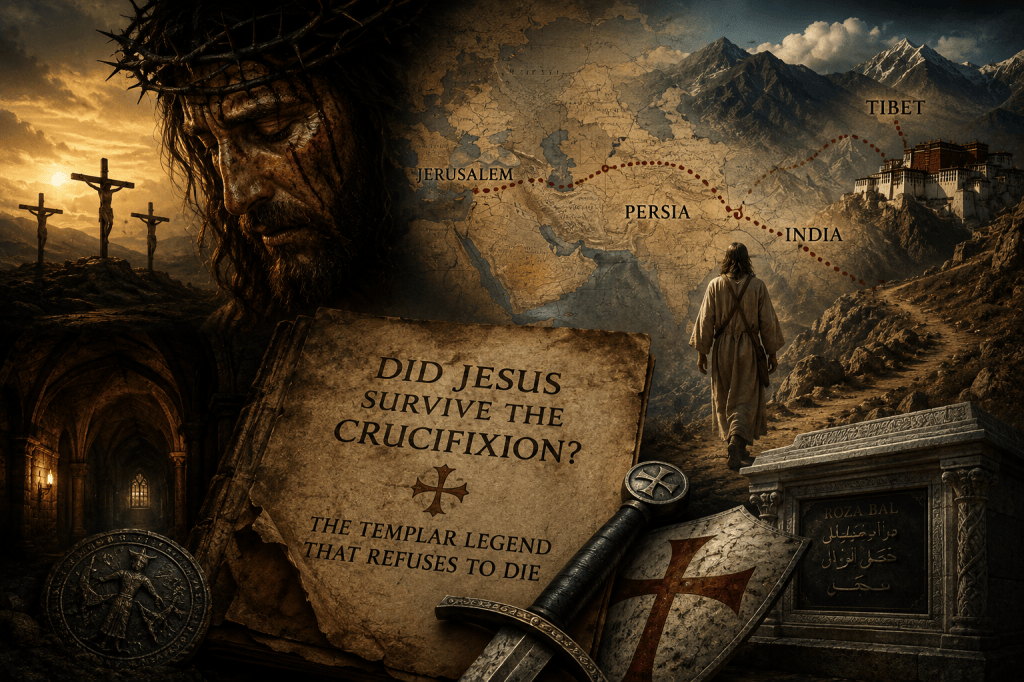
    According to this alternative tradition, Jesus did not die on the cross. Instead, he survived the crucifixion, recovered from his injuries, left Judea, and traveled east through Persia before eventually reaching India, Tibet, and, according to some versions of the legend, even southern France.
    It is an extraordinary claim.
    The question is not whether it is fascinating—it undoubtedly is.
    The real question is whether history provides any evidence to support it.
    What Do the Earliest Historical Sources Say?
    The earliest written accounts of Jesus’ death are found in the New Testament, particularly the four canonical Gospels. Although they differ in certain details, all four describe the same essential sequence of events: Jesus was arrested, tried by the Roman governor Pontius Pilate, sentenced to crucifixion, died on the cross, and was placed in a tomb by Joseph of Arimathea.
    Outside Christian writings, several ancient historians also mention Jesus.
    The Jewish historian Flavius Josephus, writing near the end of the first century, refers to Jesus and states that he was condemned under Pontius Pilate. Although parts of the passage are believed to have been modified by later Christian copyists, most historians agree that Josephus originally mentioned Jesus’ execution.
    The Roman historian Tacitus, writing in the early second century, independently recorded that Christus suffered the “extreme penalty” during the reign of Emperor Tiberius under Pontius Pilate. His account is particularly significant because Tacitus had little sympathy for Christianity and was not attempting to promote Christian beliefs.
    Taken together, these early sources strongly support the historical conclusion that Jesus was crucified.
    Whether he died during the crucifixion, however, became the focus of later debate.
    Could Someone Survive Crucifixion?
    Crucifixion was one of the most brutal methods of execution ever devised.
    Its purpose was not only to kill but to prolong suffering for as long as possible. Victims often died from a combination of blood loss, shock, dehydration, respiratory failure, and cardiac complications. Death sometimes required many hours and, in some cases, several days.
    Medical researchers who have studied Roman crucifixion generally conclude that survival would have been extremely unlikely, particularly after severe scourging and prolonged suspension on a cross.
    Nevertheless, supporters of the “survival theory” point to several details recorded in the Gospels.
    They note that Jesus appeared to die sooner than expected, prompting surprise from Pontius Pilate. They also emphasize that his legs were not broken, unlike those of the two men crucified beside him, because Roman soldiers believed he was already dead. Finally, they cite the treatment of his body with a mixture of myrrh and aloes, suggesting these substances may have possessed healing properties.
    Most historians and medical experts interpret these details differently. They argue that Roman executioners were highly experienced and that failing to ensure a prisoner’s death would have carried severe consequences. Furthermore, the spear thrust described in the Gospel of John has traditionally been understood as confirmation that death had already occurred.
    Thus, while the survival theory remains possible in the abstract, it is not supported by the consensus of historical or medical research.
    The Birth of an Extraordinary Legend
    For nearly eighteen centuries, few people suggested that Jesus had traveled to India after the crucifixion.
    The idea entered public discussion in the late nineteenth century through the writings of Nicolas Notovitch, a Russian journalist who claimed that while visiting the Hemis Monastery in Ladakh, Tibet, he had discovered ancient manuscripts describing the life of a man named Issa.
    According to Notovitch, these texts stated that Jesus had spent many of his “lost years” in India before returning to Judea—and, in some versions of the story, returned there again after surviving the crucifixion.
    His book attracted enormous attention throughout Europe.
    If genuine, the manuscripts would have transformed the study of Christian history.
    The problem was verification.
    When respected scholars later visited the monastery, they reported that the monks denied any knowledge of the manuscripts or of Notovitch’s account. Some researchers concluded that he had misunderstood local traditions; others accused him of inventing the story entirely.
    To this day, no original manuscript matching Notovitch’s description has been independently authenticated.
    Why India?
    The connection between Jesus and India did not arise entirely by chance.
    Ancient trade routes linked the Roman Empire with Persia and the Indian subcontinent. Merchants, travelers, and religious teachers moved across these routes for centuries, carrying goods as well as ideas.
    The “lost years” of Jesus—roughly the period between his childhood and the beginning of his public ministry—have long fascinated historians because the canonical Gospels say very little about them.
    This silence created space for speculation.
    Could he have traveled east?
    Could he have encountered Buddhist teachers?
    Could similarities between certain ethical teachings reflect contact between distant cultures?
    These questions continue to be debated.
    While some scholars acknowledge that cultural exchanges between the Mediterranean and South Asia certainly occurred during the first century, no reliable historical evidence demonstrates that Jesus himself ever made such a journey.
    The absence of evidence does not necessarily prove the journey impossible.
    It simply means that historians cannot presently confirm it.
    Faith, History, and the Search for Evidence
    The enduring popularity of the India theory reveals something important about human nature.
    History is rarely satisfied with unanswered questions.
    Whenever gaps appear in the historical record, alternative explanations often emerge to fill them. Some eventually become accepted after new discoveries. Others remain fascinating legends that reflect the hopes, beliefs, and imagination of later generations more than the events themselves.
    The story of Jesus in India stands precisely at that intersection.
    It combines genuine historical mysteries with disputed documents, religious traditions, and centuries of speculation.
    Separating those elements requires careful examination rather than quick conclusions.


    To Be Continued…
    In Part II, we will investigate the most controversial claims surrounding this legend: the mysterious Roza Bal tomb in Kashmir, traditions placing Jesus in Tibet after the crucifixion, the alleged connection with the Knights Templar, and what modern historians, archaeologists, and biblical scholars conclude after examining the available evidence.
    Did one of history’s greatest secrets survive for two thousand years?
    Or did an intriguing legend gradually grow into one of the world’s most enduring historical mysteries?