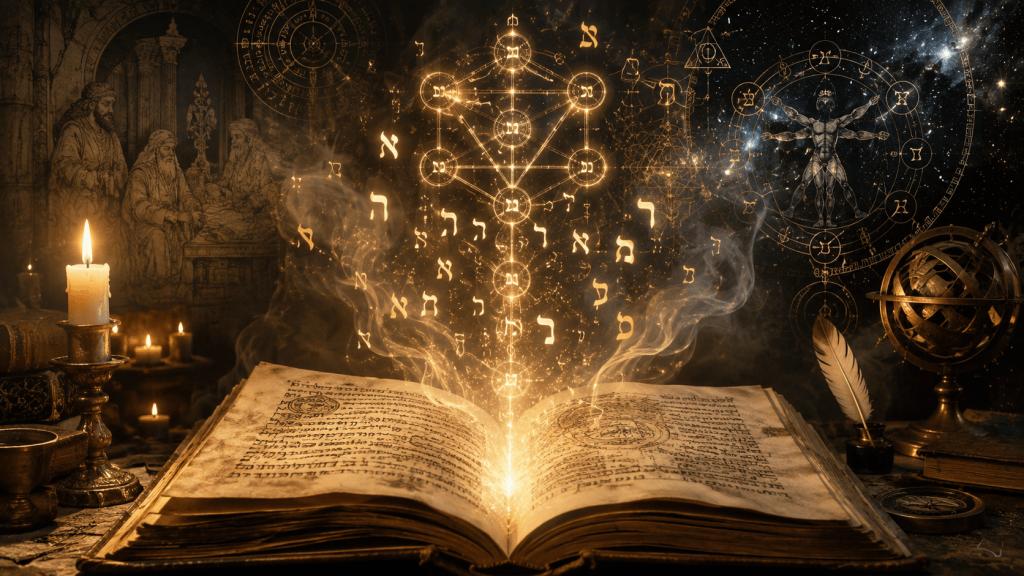
The Strange Journey from Kabbalah to Western Magic
From Sacred Alphabet to Grimoires: How Jewish Mysticism Entered the Hidden Language of European Magic
Open an old European grimoire and, sooner or later, something unexpected appears among the planetary seals, concentric circles, mysterious names, pentacles and diagrams intended to represent forces that cannot be seen. There, written from right to left, are Hebrew letters. Sometimes they form names of God; sometimes they identify angels; sometimes they are placed around geometric figures whose meaning is far removed from anything a modern reader would immediately associate with Judaism. To someone encountering such pages without historical context, the conclusion can seem almost inevitable: perhaps Hebrew itself was once a secret magical language, perhaps these symbols belonged to forbidden rituals, perhaps the alphabet concealed something that ordinary religion never wished to reveal.
The truth is more complicated, and considerably more fascinating.
Hebrew letters did not enter Western occultism because Judaism was secretly a religion of black magic, nor because the alphabet was designed for conjuring spirits. They entered the occult imagination through a centuries-long transformation in which Jewish mystical speculation about language, creation and divine names passed into Renaissance Christian thought, was reinterpreted by theologians and magicians, absorbed into ceremonial magic, combined with astrology and alchemy, and eventually inherited by nineteenth-century occult societies whose symbols still dominate popular ideas about magic today.
What looks like a single ancient tradition is actually the result of many layers placed one over another, and when those layers are separated, a remarkable journey emerges: from sacred language to cosmic mathematics, from biblical exegesis to Renaissance magic, from the hidden names of God to the pentacles of grimoires, and finally from Jewish Kabbalah to what the modern West came to call Hermetic Qabalah.
The First Mystery: What If Letters Were More Than Letters?
To understand why Hebrew eventually appeared inside magical diagrams, we have to begin long before the famous occultists of Renaissance Europe, because within Jewish mystical speculation the alphabet could represent far more than a practical method of writing.
One of the most enigmatic texts in this history is Sefer Yetzirah, usually translated as The Book of Formation or Book of Creation. Its precise date remains debated, although scholars generally place its development somewhere in late antiquity, centuries before the mature medieval Kabbalah of the Zohar. What makes the work extraordinary is its vision of creation: the universe is described through thirty-two mysterious paths of wisdom, consisting of ten sefirot and the twenty-two letters of the Hebrew alphabet. The letters are not merely labels attached to objects after those objects have come into existence; within the symbolic cosmology of the text, they participate in the architecture through which existence itself is ordered.
The concept is difficult for the modern mind because we ordinarily separate language from reality. A tree exists independently of the word tree, while changing the word does nothing to the physical object. Sefer Yetzirah, however, emerges from an intellectual world in which the relationship between divine speech and creation could be understood far more literally and mystically. Genesis begins with God speaking creation into existence, and from that premise an extraordinary possibility follows: if God creates through speech, then the elements of sacred speech—the letters themselves—may belong to the machinery of creation.
The text describes the twenty-two letters as being engraved, combined, weighed and permuted, producing a cosmos in which language, number and existence become intertwined. Later mystical interpretation would develop these ideas far beyond the brief and cryptic original text, but the seed was already present: perhaps letters were not merely signs representing reality; perhaps they were echoes of the structure beneath reality.
That is the first doorway through which Hebrew enters the world that later Western occultists would find irresistible.
When Every Letter Also Became a Number
Hebrew possesses another characteristic that made it especially attractive to mystical interpreters: its letters can also carry numerical values. Aleph corresponds to one, Bet to two, Gimel to three, and the system continues through higher values.
From this emerged gematria, one among several methods by which correspondences could be sought between words whose letters possessed equivalent numerical totals. Within mystical interpretation, an unexpected numerical relationship could suggest an underlying symbolic relationship between two biblical words or ideas.
The important point is not whether such correspondences reveal objective structures in the universe, something historical scholarship cannot establish, but that generations of mystics believed sacred scripture contained layers beneath its literal surface, and therefore examined not only words but letters, numbers, permutations and even shapes for concealed meaning.
Stanford’s Encyclopedia of Philosophy, discussing the Kabbalistic material encountered by Giovanni Pico della Mirandola, notes that Kabbalists could treat the Hebrew biblical text as divine speech possessing effectively inexhaustible meaning, extending interpretation down to individual letters, their numerical values and their forms.
Imagine how astonishing this appeared to a fifteenth-century Christian intellectual encountering it for the first time.
The Bible was no longer merely a text to be read.
It could be approached as a cosmic cipher.
The Name That Could Not Be Spoken
Among all combinations of Hebrew letters, none carried greater theological weight than the four-letter divine name:
יהוה — YHWH
Known as the Tetragrammaton, from the Greek expression meaning “four letters,” it occupied a unique position within Jewish religious tradition. The divine name was treated with profound reverence and was not ordinarily pronounced as written; traditional reading substituted Adonai.
For Kabbalists, divine names became central to speculation about the relationship between the hidden God and the manifest universe. Other sacred names—including Ehyeh, El, Elohim and Shaddai—could be associated in later systems with different divine attributes or sefirot.
Here we reach an essential distinction that has been almost completely erased by modern conspiracy culture.
When a Renaissance manuscript places YHWH inside a pentacle, its author is not necessarily invoking a demon.
Quite often, the opposite is happening.
The magician is invoking divine authority.
This is one reason apparently “dark” grimoires contain names of God, biblical verses and angelic names beside instructions concerning spirits. Medieval and early-modern ceremonial magic did not always divide the supernatural universe into the modern categories of “religion over here” and “occultism over there.” Practitioners could imagine that spirits were constrained precisely through superior sacred authority, so the names of God became protective, commanding or consecrating elements within ritual diagrams.
A modern viewer sees strange Hebrew surrounding a pentagram and assumes “satanic.”
A sixteenth- or seventeenth-century practitioner might have understood the same Hebrew as something closer to a seal of divine jurisdiction.
That reversal changes almost everything.
The Renaissance Opens the Door
The decisive transformation occurred in Renaissance Italy.
During the late fifteenth century, Giovanni Pico della Mirandola became one of the first major Christian intellectuals to study Kabbalistic materials seriously and attempt to incorporate them into Christian theology. Pico depended extensively upon Jewish scholars and converts who knew Hebrew and Aramaic, particularly Flavius Mithridates, who translated large quantities of Kabbalistic literature into Latin for him.
Pico’s project was radical. He believed Kabbalah might contain an ancient wisdom capable of confirming Christian doctrines, and his famous 900 Conclusions contained a substantial body of explicitly Kabbalistic propositions. He did not merely study Jewish mysticism as an outside historian would; he Christianized it, searching within Hebrew names, letters and sefirot for evidence of Christ, the Trinity and a primordial theological revelation.
Something momentous had happened.
Knowledge that had previously circulated predominantly inside Jewish intellectual and mystical environments was crossing into Latin Christian Europe.
But it did not cross unchanged.
Pico’s Dangerous Experiment
For Pico, Kabbalah was part of a much larger dream: the possibility that beneath apparently different religions, philosophies and ancient wisdom traditions there existed fragments of one primordial truth.
This idea resonated with the Renaissance concept later described as prisca theologia—an ancient theology supposedly preserved imperfectly through various traditions. Philosophers searched Plato, Pythagoras, Neoplatonism, ancient theology and other traditions for remnants of this lost wisdom, while Pico gave Jewish Kabbalah an exceptionally high position within the search.
To the modern reader, this intellectual experiment may seem romantic: scholars attempting to reconstruct a forgotten universal wisdom.
Yet there was also an uncomfortable dimension. Christian Kabbalists were frequently not preserving Jewish Kabbalah on its own terms; they were appropriating and transforming it, sometimes interpreting Jewish texts as secret proofs that Judaism itself had failed to understand Christianity.
Modern scholarship therefore carefully distinguishes Jewish Kabbalah from the Christian Cabala that developed in Renaissance Europe. Oxford’s Joseph Dan describes the late fifteenth century as a turning point in which Kabbalah moved beyond an exclusively Jewish context and became intertwined with European Christianity, philosophy, science and magic.
One tradition had begun producing another.
Johannes Reuchlin and the Miracle-Making Word
The next major figure was the German humanist Johannes Reuchlin, one of Renaissance Europe’s most important Christian Hebraists.
Reuchlin studied Hebrew deeply enough to publish a Hebrew grammar and dictionary in 1506, while his works De Verbo Mirifico of 1494 and De Arte Cabalistica of 1517 became landmarks in the development of Christian Kabbalah. Oxford historian David Price describes Reuchlin as a foundational figure both in Christian Hebrew scholarship and in the controversial discipline of Christian Kabbalah.
The title De Verbo Mirifico can be rendered approximately as On the Wonder-Working Word.
The title alone reveals something fundamental about the evolving Western imagination.
Language was becoming power.
Not ordinary language, however, but the supposedly primordial, sacred language closest to divine revelation. Hebrew appeared increasingly attractive precisely because many Christian scholars considered it more ancient and spiritually authoritative than Latin, while some went much further and imagined it as a surviving fragment of humanity’s original language.
Within such a worldview, knowing a divine name correctly was not equivalent to memorizing a label.
It meant approaching the hidden architecture behind creation.
Agrippa Builds the Occult Machine
If Pico opened the door and Reuchlin walked through it, Heinrich Cornelius Agrippa helped build the vast intellectual machine on the other side.
Agrippa’s Three Books of Occult Philosophy, written initially around 1509–1510 and published in expanded form between 1531 and 1533, became one of Renaissance Europe’s most influential syntheses of magical thought. Rather than presenting one isolated tradition, Agrippa gathered astrology, Neoplatonism, Hermetic ideas, natural magic, angelology, number symbolism and Kabbalistic speculation into an enormous interconnected system.
A modern Cambridge scholarly overview describes Agrippa’s work as combining ideas about planetary influence and cosmic correspondences with explicitly Kabbalistic speculation concerning words, letters, numbers, signs and the names of intermediary spiritual beings.
This is the point at which the answer to our original question becomes much clearer.
Why do Hebrew letters appear in Western occult symbols?
Because Renaissance magic developed around the idea of correspondence.
Planet corresponded to metal.
Metal corresponded to color.
Color corresponded to number.
Number corresponded to angel.
Angel corresponded to divine name.
Divine name was written in Hebrew.
A magical diagram could therefore become a miniature map of the universe, with every symbol supposedly connected to another level of reality.
Hebrew was incorporated into that map because Kabbalistic traditions had already invested Hebrew letters and divine names with sacred cosmological significance.
The Grimoires of Solomon
The phenomenon becomes unmistakable when we turn to one of the most famous families of magical texts in Western history: the works attributed to King Solomon.
Solomon’s biblical reputation for extraordinary wisdom gradually generated a vast legendary afterlife in which texts on spirits, talismans and magical knowledge were attributed to him, even though the surviving grimoires are products of much later historical periods.
Among the best known is the Clavicula Salomonis, or Key of Solomon.
The Wellcome Collection preserves a digitized copy of S. L. MacGregor Mathers’s 1889 edition, compiled from manuscripts then held in the British Museum, as well as a facsimile published in 1914 of a Hebrew Sepher Maphteah Shelomo, “Book of the Key of Solomon.
Turn through the pentacles reproduced in these traditions and Hebrew appears everywhere.
One pentacle reproduced in Mathers’s edition contains names such as Adonai and Eheieh, surrounded by Hebrew biblical material.
To the uninitiated eye, these inscriptions look sinister precisely because the alphabet is unfamiliar.
Historically, however, many such inscriptions represent names of God and scripture, not demonic names.
And herein lies one of the great ironies of Western occult imagery: some of the symbols modern viewers interpret as evidence of satanism actually contain attempts to invoke the God of the Hebrew Bible.
Angels, Demons and the Bureaucracy of the Invisible
The same process occurred with angelic names.
Michael, Gabriel, Raphael and other figures already crossed the boundaries between Jewish and Christian religious traditions, while medieval and Renaissance magical texts vastly expanded the invisible hierarchy into complex systems of planetary intelligences, angelic rulers and spiritual intermediaries.
Agrippa’s Renaissance synthesis included precisely this combination of astrology, Cabala and angelic magic.
This produces another source of modern misunderstanding because grimoires frequently place angels and dangerous spirits within the same manuscript.
To us, that appears contradictory.
To practitioners of ceremonial magic, it need not have been.
The ritual universe was hierarchical. A magician might call upon a divine name in order to invoke an angel, or appeal to an angelic authority in an attempt to constrain a lesser spirit. Sacred and dangerous forces therefore appear together because the ritual itself depended upon hierarchy.
The presence of Hebrew does not tell us which side of that hierarchy a symbol represents.
Context does.
The Nineteenth Century Changes Everything Again
Several centuries later, Western occultism underwent another transformation.
The French occultist Éliphas Lévi became one of the great architects of the nineteenth-century occult revival, and with him Kabbalistic imagery became even more deeply woven into Tarot, ceremonial magic and esoteric symbolism.
One of Lévi’s most influential ideas was the systematic correspondence between the twenty-two letters of the Hebrew alphabet and the twenty-two Major Arcana of the Tarot. The relationship was not an ancient Jewish tradition concealed inside the Tarot from antiquity; it was part of a comparatively modern occult synthesis. Members of the later Hermetic Order of the Golden Dawn adopted and elaborated these correspondences, profoundly influencing twentieth-century Western magic.
This distinction matters enormously.
When modern occult diagrams connect Aleph with a Tarot trump, a path on the Tree of Life, an astrological principle and a ritual concept, we are often looking not at “ancient Kabbalah” in a pure form but at Hermetic Qabalah, a Western esoteric system assembled gradually from Jewish Kabbalah, Christian Cabala, astrology, Tarot, alchemy, ceremonial magic and other sources.
The spelling itself sometimes signals the distinction:
Kabbalah — usually Jewish mystical tradition.
Cabala — often Renaissance Christian adaptations.
Qabalah — commonly used for later Hermetic and occult systems.
The boundaries are not perfectly consistent, but historically they represent genuinely different worlds.
The Tree of Life Leaves Its Original Garden
Perhaps no image demonstrates this transformation better than the Tree of Life.
The ten sefirot became central to medieval Kabbalah as symbols for divine manifestations or emanations, providing a language through which mystics contemplated the relationship between the unknowable divine and the created universe.
In later Western esotericism, however, the Tree acquired layers upon layers of additional correspondences.
Planets were placed upon it.
Tarot cards were assigned to its paths.
Hebrew letters were attached to those paths.
Colors, elements, angels, divine names and states of consciousness were arranged across its structure.
The result was an extraordinary symbolic machine, but it was no longer identical to medieval Jewish Kabbalah.
It had become something new.
And this explains why a symbol encountered today on an occult website may contain unquestionably Jewish elements while belonging to a system created largely by Christian and post-Christian European occultists.
Why Hebrew Now Looks “Dark” to Many People
There is a curious historical loop behind modern conspiracy theories about Hebrew symbols.
First, Jewish mystical traditions invested Hebrew letters and divine names with profound sacred significance.
Then Renaissance Christian thinkers appropriated parts of those traditions.
Then European magicians incorporated those ideas into ceremonial magic.
Then nineteenth-century occultists combined ceremonial magic with Tarot, astrology and other esoteric systems.
Then twentieth-century occult movements inherited those symbols.
Finally, popular horror films, conspiracy videos and satanic imagery borrowed portions of the already hybrid occult vocabulary.
After centuries of transmission, someone sees a Hebrew word inside an ominous pentagram and concludes:
“Hebrew must have been demonic from the beginning.”
Historically, the chain frequently runs in precisely the opposite direction.
The Hebrew was there because earlier occultists believed it was sacred.
And What About Baphomet?
The famous goat-headed image of Baphomet provides an instructive example of how quickly historical layers can collapse into one another.
The iconic androgynous Baphomet familiar today was created by Éliphas Lévi in the nineteenth century, not recovered from some intact secret cult of biblical antiquity. Modern scholarship treats Lévi’s Baphomet as a product of nineteenth-century Western esotericism, while Cambridge’s edition of Lévi’s Transcendental Magic identifies his famous “Sabbatic Goat” as a symbolic magical representation constructed within own system.
Yet internet imagery routinely combines Baphomet, Hebrew letters, pentagrams, Kabbalistic diagrams, demons and medieval art as though they all emerged from one ancient hidden religion.
They did not.
They belong to different centuries, cultures and theological systems that later occultism blended together.
The mystery is real.
The simplified conspiracy is not.
The Secret Was Not “Evil”—It Was Language
Behind this entire history lies a much deeper philosophical idea.
Human beings have repeatedly wondered whether language merely describes the universe or somehow participates in it.
We still ask versions of the same question today. Mathematics describes nature with uncanny precision; genetic information is written in sequences that we casually call a “code”; physics seeks equations capable of expressing fundamental structures beneath visible reality. None of this proves ancient mystical ideas about letters, of course, but it helps us understand why the concept was so psychologically powerful.
The Kabbalist looking at the letter Aleph did not necessarily see what we see when looking at the letter A.
He could see number, sound, form, biblical association, divine symbolism and perhaps an echo of creation itself.
The Renaissance magician inherited that fascination and asked another question:
If creation was spoken into existence, could the right word reconnect the human mind with the forces behind creation?
From that question came divine names, permutations, talismans, sacred alphabets and elaborate rituals designed around words that were believed to possess more than ordinary semantic meaning.
Whether one believes such practices possessed supernatural power is a question of faith.
That generations of intelligent people believed language concealed profound metaphysical power is an historical fact.
The Most Important Distinction
There is therefore one distinction that should remain with us whenever we encounter Hebrew inside an occult diagram:
Presence does not equal origin.
Finding Hebrew on a magical pentacle does not prove that Judaism produced the magical system surrounding it.
Finding Kabbalistic terminology in an occult society does not mean that occult society accurately represents Jewish Kabbalah.
Finding a biblical divine name beside a demon does not make the divine name demonic.
And finding twenty-two Hebrew letters assigned to twenty-two Tarot cards does not prove that ancient Jewish mystics secretly invented Tarot.
Much of what we call Western occultism was created through syncretism—the continual borrowing, translation, reinterpretation and recombination of material from different traditions.
That process is historically far more interesting than the conspiracy theory because it reveals something fundamental about esoteric history: secrets rarely remain where they began.
They travel.
They change language.
They acquire new meanings.
Sometimes they become almost unrecognizable.
The Final Mystery: Who Owns a Sacred Symbol?
Perhaps the strangest part of this story is that the Hebrew letters never changed.
Aleph remained Aleph. Yod remained Yod. He remained He.
What changed was the world surrounding them.
In one manuscript, a letter could belong to scriptural commentary.
In another, to meditation.
In another, to Christian theology.
In another, to an alchemical diagram.
In another, to a planetary talisman.
In another, centuries later, to a Tarot correspondence drawn by an occult initiate who might never have practiced Judaism at all.
The same marks traveled through completely different cosmologies.
And somewhere during that journey, the West began forgetting where they had come from.
Perhaps that is why old occult manuscripts still exert such fascination. They are not merely collections of strange symbols. They are archaeological sites of the imagination, places where religions, philosophies and mystical traditions collided, borrowed from one another and produced new systems that their original creators could never have anticipated.
So when Hebrew letters appear inside a pentagram or ancient-looking magical circle, the most interesting question is not:
“Is this satanic?”
It is:
“Who placed those letters there, in what century, what did they believe the letters meant, and from whom did they learn to use them?”
Follow those questions far enough and the trail leads not to a single hidden cult, but through late-antique Jewish cosmology, medieval Kabbalah, Renaissance Florence, Christian Hebraists, Agrippa’s occult philosophy, Solomonic grimoires, Éliphas Lévi, the Golden Dawn and the birth of modern ceremonial magic.
And that journey is stranger than the conspiracy.
Because much of it actually happened.
Note:
This article distinguishes between Jewish Kabbalah, Renaissance Christian Cabala, and later Hermetic Qabalah. Their historical connections are real, but they are not identical traditions, and the presence of Hebrew letters in Western occult manuscripts should not be interpreted as evidence that Hebrew or Judaism is inherently connected with demonology.
Sources & Further Reading
Stanford Encyclopedia of Philosophy — “Giovanni Pico della Mirandola”
David H. Price — Johannes Reuchlin and the Campaign to Destroy Jewish Books, Oxford University Press
Cambridge University Press — Defining Magic: A Reader
Wellcome Collection — The Key of Solomon the King (Clavicula Salomonis), edited by S. L. MacGregor Mathers
My Jewish Learning — “Sefer Yetzirah: The Book of Creation”
Oxford Academic — The Rise of Modern Western Magic
The Metropolitan Museum of Art — Studies on Hebrew and Kabbalistic Inscriptions in Renaissance Esoteric Objects

