The Pope Who Was Put on Trial After His Death: The Terrifying Cadaver Synod of 897
In the winter of 897, Rome witnessed a spectacle so disturbing that, more than eleven centuries later, it remains one of the most infamous episodes in the history of the papacy. Inside the Lateran Basilica, where ecclesiastical disputes were normally decided among living men, bishops and clergy gathered for a trial whose defendant had already been dead and buried for approximately nine months.
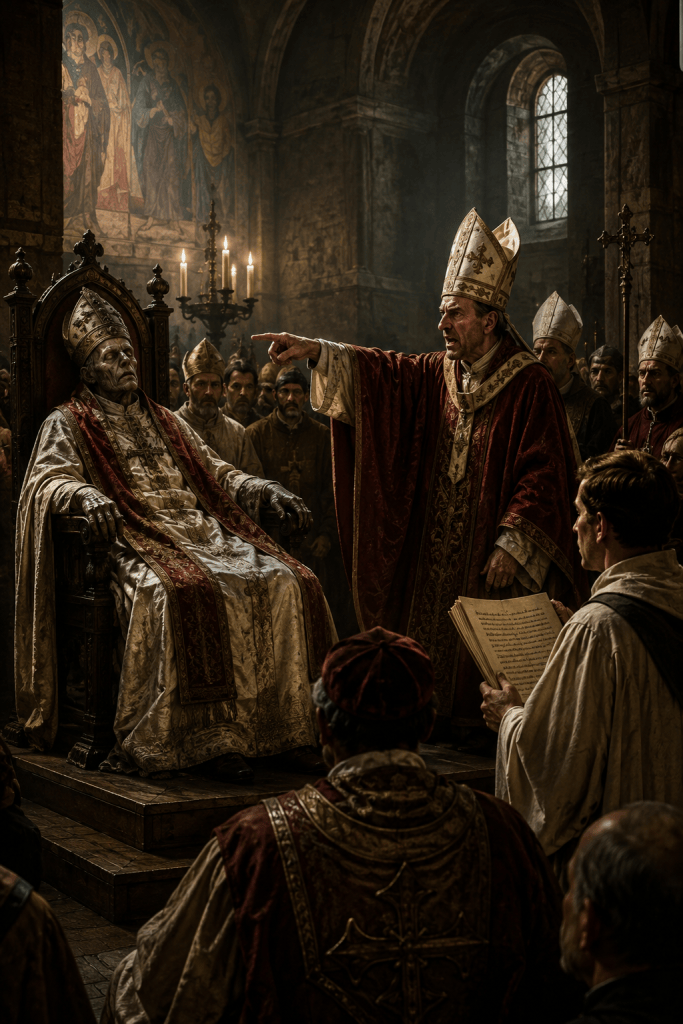
The man being judged was Pope Formosus, but he was not represented merely by documents, witnesses or memories of his pontificate. His body had been removed from its tomb, dressed once again in papal vestments and brought into the basilica, where it was reportedly placed upon a seat before the assembled clergy. According to later accounts of the proceedings, a deacon was assigned the extraordinary task of answering on behalf of the dead pope while Pope Stephen VI presided over the accusations against his predecessor.
The episode would become known as the Cadaver Synod, and later tradition would remember it under the chilling Latin designation Synodus Horrenda, the Horrible Synod. Although its most sensational details sound as though they belong to a Gothic novel rather than to ecclesiastical history, the trial itself was very real, and its purpose becomes considerably more understandable once the violent political struggles surrounding the papacy at the end of the ninth century are brought into view.
The corpse on the throne was horrifying, but the real struggle concerned the living.
Before the Corpse, There Was a Powerful Churchman
Long before his body was brought into a courtroom, Formosus had been one of the most prominent and controversial churchmen of his generation. Born around the beginning of the ninth century, he eventually became bishop of Porto, an important episcopal see near Rome, and acquired a reputation as an able missionary and diplomat whose ecclesiastical career brought him into contact with some of the most significant political conflicts of his age.
His abilities did not protect him from enemies. During the pontificate of Pope John VIII, Formosus became involved in a serious dispute with papal authorities and was accused of abandoning his diocese, conspiring against the pope and aspiring improperly to the Roman see. He was excommunicated and compelled to swear that he would never return to Rome or resume his episcopal functions, although changing political circumstances eventually allowed him to be restored to communion and to return to his position.
When Formosus was elected pope in October 891, therefore, he arrived at the papal throne carrying both considerable experience and a history that his enemies would later use against him. One particularly important canonical problem concerned his position as bishop of Porto, because church law strongly discouraged the transfer of a bishop from one episcopal see to another, and his eventual election as Bishop of Rome provided his opponents with an argument that could later be transformed into an accusation of illegitimacy.
Had this been merely a technical ecclesiastical dispute, Formosus might never have become the defendant in history’s most famous posthumous trial. What transformed the controversy into something far more dangerous was the struggle for political control of Italy and the imperial crown.
A Pope Caught Between Rival Rulers
The political landscape of late ninth-century Italy was extraordinarily unstable. The Carolingian order that had once provided a measure of imperial unity was disintegrating, powerful aristocratic families competed for territory and influence, and the papacy frequently found itself caught between rulers whose military strength could determine who controlled Rome itself.
Among the most powerful forces in Italy was the house of Spoleto. Formosus initially recognized its position and crowned Lambert of Spoleto as co-emperor, but relations deteriorated, and the pope eventually sought assistance from Arnulf of Carinthia, the East Frankish king whose intervention offered the possibility of breaking Spoletan dominance.
Arnulf crossed into Italy and entered Rome in 896, after which Formosus crowned him emperor. The decision was politically explosive because it represented a rejection of the interests of Lambert and his powerful mother, Ageltrude, while simultaneously tying the papacy to Arnulf’s military fortunes.
Those fortunes changed almost immediately. Arnulf became seriously ill during his Italian campaign and was forced to withdraw, leaving the political situation unresolved, while Formosus himself died on 4 April 896. The pope was buried according to the customs of his office, and under ordinary circumstances his participation in the struggle might have ended there.
Instead, the political balance shifted again, the Spoletan faction recovered its influence, and Formosus’s enemies discovered that death did not necessarily prevent them from attacking the legitimacy of everything he had done.
Nine Months After Burial, the Grave Was Opened
Following Formosus came the extremely brief pontificate of Boniface VI, whose reign lasted only a matter of days, and then Stephen VI became pope. During Stephen’s pontificate, probably in January 897, an extraordinary decision was made: Formosus would be prosecuted formally despite the inconvenient fact that he had been dead for months.
His grave was opened and the corpse was removed.
Historical accounts describe the body being dressed again in papal vestments and brought into the Lateran Basilica, where an ecclesiastical assembly had been convened. The dead pope was positioned before the court as though his physical presence were necessary for the proceedings, while Stephen VI assumed the role of his accuser and judge.
Later narrative sources describe a deacon standing beside Formosus and answering questions on his behalf, creating an almost surreal scene in which the forms of a conventional ecclesiastical hearing were maintained even though the defendant was incapable of hearing the charges, understanding the proceedings or defending himself.
It would be easy to dismiss the entire spectacle as nothing more than an eruption of medieval superstition or personal madness, yet doing so would obscure the political calculation behind it. Stephen and the enemies of Formosus were not interested merely in humiliating a corpse; they wanted to destroy the legal and ecclesiastical consequences of Formosus’s pontificate.
To accomplish that, they first had to establish that he should never have been pope at all.
What Could a Dead Pope Be Accused Of?
The accusations revived controversies that had followed Formosus during his lifetime, particularly those involving his earlier position as bishop of Porto and the canonical restrictions concerning the transfer of bishops between sees. His opponents argued, in effect, that he had occupied the Roman see illegitimately and had therefore exercised papal authority that he should never have possessed.
Other accusations concerned the oaths and obligations arising from his earlier conflict with John VIII, but the significance of the proceedings extended far beyond Formosus’s personal reputation. If his election to the papacy could be declared invalid, then the decisions he had made while occupying the office could also be challenged, including his ecclesiastical appointments and the ordinations he had performed.
This was where the trial became politically useful, because Formosus had created networks of authority through the bishops and clergy he had ordained. Invalidating those acts could weaken men whose positions depended upon him while strengthening their rivals, which meant that the prosecution of a dead pope could have very real consequences for powerful living churchmen.
The corpse could not defend itself, and the verdict was hardly in doubt.
Formosus was condemned.
Punishing a Man Who Could No Longer Feel Punishment
Once the court had declared Formosus guilty, the proceedings entered their most macabre phase. His papal vestments were stripped from the corpse, and the acts associated with his pontificate were declared invalid. According to the traditional accounts, three fingers of his right hand, associated with the gesture of papal blessing, were cut away, an act whose symbolism was far more important than any physical punishment that could obviously no longer be inflicted upon the dead man.
Everything about the treatment of the body communicated the same message: the authority Formosus had exercised as pope was being erased symbolically from his remains.
His body was subsequently buried in a common grave rather than being allowed to retain the honor associated with papal burial. Later accounts state that it was then removed once more and thrown into the River Tiber, transforming a former pope, bishop and imperial kingmaker into a mutilated corpse discarded in the water flowing through Rome.
Some of the vivid details of the trial survive through chroniclers writing after the event, which means that historians must distinguish carefully between the firmly established outline of the Cadaver Synod and dramatic elements preserved by later narrative tradition. There is no serious doubt, however, that Formosus was exhumed and subjected to a posthumous ecclesiastical trial under Stephen VI, nor that subsequent popes considered the proceedings sufficiently serious to overturn their consequences.
Whatever Stephen hoped to achieve, the spectacle did not bring stability to Rome.
It helped produce the opposite.
The Living Judge Soon Followed the Dead Defendant
The reaction against Stephen VI was rapid and severe. His political position collapsed during the months following the Cadaver Synod, and he was eventually deposed, imprisoned and strangled in the summer of 897.
The reversal is one of the most striking features of the entire episode. At the beginning of the year, Stephen had possessed enough authority to order the exhumation and condemnation of a former pope; only months later, he himself was a prisoner whose pontificate had ended violently.
Formosus, meanwhile, began an extraordinary posthumous rehabilitation.
Tradition records that his body was recovered after being thrown into the Tiber, and later in 897 Pope Theodore II convened a synod that annulled the judgment against him and recognized the validity of his ordinations. His remains were restored to an honorable papal burial, reversing the humiliation imposed during Stephen’s pontificate.
Theodore II occupied the papal throne for only a short period, but his actions were followed by those of John IX, who continued the rehabilitation of Formosus and convened synods that rejected the Cadaver Synod and attempted to prevent similar proceedings from occurring again. At Ravenna in 898, the measures against Formosus were overturned, while records associated with the grotesque trial were ordered destroyed.
The dead pope, in effect, had received an appeal and won.
Why the Ordinations of a Dead Pope Could Threaten the Living
The controversy did not disappear simply because Formosus was returned to his tomb, because the question of his legitimacy created a theological and legal problem with potentially enormous consequences.
A pope ordained bishops, and those bishops could subsequently ordain priests, consecrate other bishops and perform sacramental acts whose legitimacy depended upon their own ecclesiastical authority. If the ordinations performed by Formosus were invalid because he had supposedly occupied the papal office illegitimately, then doubts could spread through an expanding chain of clergy whose authority ultimately traced back to him.
The problem therefore resembled a crack moving through the foundations of a building. What began as an attack on one dead pope could destabilize the status of numerous living churchmen and create uncertainty about sacraments and appointments that had already taken place.
Writers defending Formosus consequently argued vigorously for the validity of his ordinations, while the controversy continued to influence papal politics after the principal participants were dead. Pope Sergius III, who became pope in 904, was associated with renewed hostility toward the Formosan position, demonstrating how difficult it was to bury a dispute that had already survived the man at its center.
The Cadaver Synod was therefore never simply an absurd trial of a corpse. It represented an attempt to use canon law, ritual and physical humiliation to rewrite the legal consequences of an earlier pontificate.
Was Stephen VI Insane?
Modern retellings sometimes explain the episode by portraying Stephen VI as a deranged pope whose hatred of Formosus drove him to an act of grotesque irrationality. The temptation is understandable, because exhuming a decomposing predecessor and placing him before an ecclesiastical tribunal certainly appears incomprehensible when viewed outside its historical setting.
There is, however, no reliable basis for diagnosing Stephen’s mental state more than eleven centuries after his death, and the political context provides motives that do not require such speculation. Formosus had supported Arnulf of Carinthia against the interests of the Spoletan faction, while his ecclesiastical acts had created positions and loyalties that remained important after his death. Declaring his pontificate illegitimate could therefore serve political interests by weakening the authority of his supporters and strengthening those who wanted his legacy destroyed.
Seen in this context, the trial becomes more disturbing rather than less, because it suggests that the grotesque treatment of the corpse was not necessarily meaningless madness. It could function as calculated political theater in which the body of a dead pope became an instrument for changing the balance of power among living men.
The courtroom was merely the stage.
The real struggle was taking place throughout Rome and Italy.
The Painting That Gave the Trial a Face
Almost a thousand years after the Cadaver Synod, French painter Jean-Paul Laurens created one of the most memorable visual interpretations of the episode. His 1870 painting Le Pape Formose et Étienne VI depicts the dead Formosus seated rigidly before Stephen, surrounded by clergy inside a dark architectural space whose theatrical lighting intensifies the horror of the confrontation.
The painting should not be mistaken for a reconstruction based on eyewitness evidence, because Laurens was creating a nineteenth-century historical drama rather than documenting the precise appearance of the Lateran in 897. Nevertheless, his composition captures something fundamental about the episode: the dead figure appears strangely passive and almost dignified while the living men surrounding him generate the violence and menace of the scene.
Perhaps this is why the image remains so effective. The corpse is not really the frightening part.
The frightening part is what the living are willing to do with it.
A Trial That Was Never Really About the Dead
The Cadaver Synod continues to fascinate because it violated an expectation that seems almost universal: whatever conflicts surround a person during life, death eventually removes that person from the immediate struggle for power.
Formosus was denied even that final separation.
His enemies could no longer force him to surrender authority, retract his decisions or answer accusations, so they attacked the surviving structures of his pontificate instead. By removing his body from the grave and placing it physically before a tribunal, they transformed a legal dispute into an extraordinary ritual in which the dead were temporarily dragged back into the political world of the living.
For a brief moment in Rome in 897, the boundaries between courtroom and tomb, punishment and memory, law and political revenge became almost impossible to distinguish. A dead pope was dressed in the clothing of the office he had once occupied, a living pope demanded answers that the defendant could never provide, and an ecclesiastical assembly pronounced judgment upon a man whose earthly punishment had already been completed by death.
Yet the final irony belongs to Formosus.
The judgment against him was overturned, his ordinations were defended, his remains were restored to honorable burial and the spectacle intended to destroy his legacy instead ensured that his name would be remembered for more than a thousand years.
Stephen VI, who had attempted to place a dead predecessor permanently among the condemned, was himself deposed, imprisoned and strangled only months after the trial.
Formosus returned to his tomb.
The Cadaver Synod entered history.
And perhaps that is the most unsettling part of the entire story, because beneath the decomposing body, the papal robes and the macabre courtroom lies something far more recognizable than medieval superstition: the ancient human desire to rewrite the past when controlling the present is no longer enough.
Sources & Further Reading
Liudprand of Cremona, Antapodosis — an important later narrative source for the episode, although it was written decades afterward and its dramatic details must therefore be approached critically.
Horace K. Mann, The Lives of the Popes in the Early Middle Ages — provides historical context for Formosus, Stephen VI and the political struggles surrounding the late ninth-century papacy.
Catholic Encyclopedia, “Pope Formosus” — useful for the ecclesiastical career of Formosus, the Cadaver Synod and his subsequent rehabilitation.
Bilal, M. and Tubbs, R. S., “Popes Convict Dead Pope Twice! The Unbelievable Cadaver Synod,” Clinical Anatomy (2017) — a modern scholarly discussion of the treatment of Formosus’s corpse and the extraordinary posthumous proceedings.
Encyclopaedia Britannica, entries concerning Formosus and the ninth-century papacy — useful for the broader political and ecclesiastical context.

