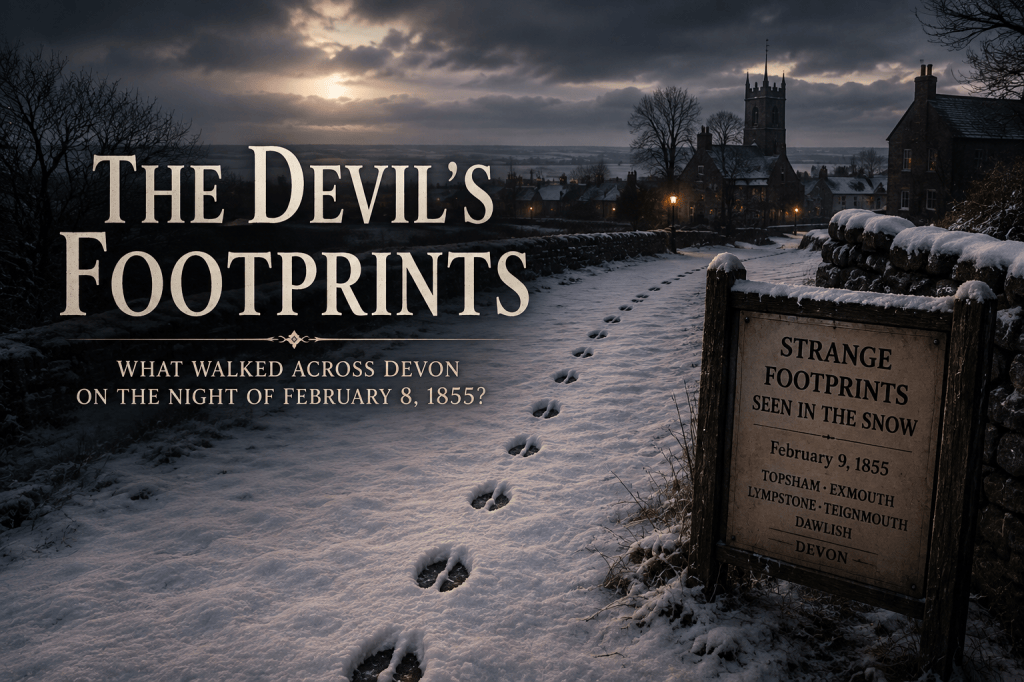
The Devil’s Footprints: What Walked Across Devon on the Night of February 8, 1855?
On the morning of February 9, 1855, residents of several towns and villages in Devon awoke to a landscape transformed by snow and to a mystery that would outlive almost everyone who saw it. Across gardens, roads, fields and enclosed courtyards appeared lines of unusual impressions that many witnesses compared to the marks of a small hoof, although the creature that might have produced them was nowhere to be found.The tracks were reported around communities including Topsham, Lympstone, Exmouth, Teignmouth and Dawlish, and before long newspapers were describing them in places that seemed increasingly difficult to explain. They appeared in open countryside but were also said to continue into walled gardens, across narrow walls and, according to contemporary reports, even over the snow-covered tops of houses.What particularly disturbed observers was not simply the shape of the marks but the strange manner in which many of them seemed to proceed. Rather than displaying the alternating pattern expected from an ordinary four-legged animal, some trails appeared to consist of impressions following one another in an almost single line, separated by surprisingly regular intervals.Within days, naturalists, clergymen, journalists and ordinary residents were debating what could possibly have crossed the snowy Devon countryside.Some proposed badgers, birds, rodents, toads or an escaped kangaroo, while others suspected that several completely ordinary animals had produced different tracks that frightened observers subsequently combined into a single extraordinary mystery.Among the more superstitious inhabitants, however, another possibility began to circulate.Perhaps the tracks belonged to no ordinary animal at all.Perhaps, during that cold February night, the Devil himself had walked through Devon.
A Snowfall That Left Something Behind
The mystery began after snow fell across parts of southern Devon during the night of February 8–9, 1855. When residents emerged the following morning, they discovered unusual trails impressed into the fresh covering.The story spread remarkably quickly.
On February 16, The Times reported that considerable excitement had been caused in Topsham, Lympstone, Exmouth, Teignmouth and Dawlish by the discovery of strange foot-tracks. The newspaper noted that the marks had been observed not only in ordinary fields and roads but in locations that appeared much more difficult for an animal to reach, including gardens and courtyards enclosed by walls and fences.
The newspaper also recorded the supernatural interpretation already circulating among local people, reporting that some believed the marks might have belonged to Satan and that the mystery had generated enough interest to be discussed from the pulpit.The event was therefore not a legend invented generations afterward. Newspapers were discussing the strange tracks while the snow, the witnesses and the excitement surrounding them were still contemporary realities.Yet those same reports also reveal something important that later retellings sometimes obscure: people did not agree about exactly what they had seen.
What Did the Footprints Actually Look Like?
Modern illustrations often depict the Devil’s Footprints as a perfectly uniform trail of tiny cloven hooves stretching uninterrupted across Devon, but the surviving nineteenth-century descriptions are considerably messier and therefore considerably more interesting.Some witnesses compared the impressions to a donkey’s hoof or horseshoe, while others described them as divided or cloven. Measurements also varied from place to place, and drawings reproduced by the Illustrated London News showed different forms rather than one perfectly consistent mysterious footprint.One report described impressions roughly four inches long and less than three inches wide, separated by intervals of approximately eight inches, while accounts from other locations recorded different dimensions and shapes.This inconsistency is crucial.If every observer across Devon had recorded an identical footprint with precisely the same dimensions and stride, the case for a single mysterious source would be considerably stronger. Instead, the historical record suggests that several types of unusual marks may have been grouped together under one rapidly spreading story.The mystery may therefore have begun not with one impossible trail, but with many puzzling trails discovered after the same unusual weather.Once newspapers began connecting them, Devon suddenly seemed to have been crossed by a single invisible visitor.
The Tracks That Seemed to Ignore Walls
The most famous part of the story concerns the apparent ability of the tracks to continue through or across obstacles that should have interrupted the path of an ordinary animal.Contemporary reports described impressions on walls, rooftops and inside enclosed gardens. Residents sometimes claimed that the trail approached an obstacle and appeared again on the opposite side, creating the impression that whatever had made the marks had crossed barriers without changing its direction.This transformed a curious zoological puzzle into something far more unsettling.A fox could cross a field, a bird could land in a garden and a badger could leave unusual impressions in melting snow, but what kind of animal could apparently maintain the same mysterious trail over walls, roofs and fences?The newspapers themselves struggled with the question.Reports described local people gathering in groups to inspect the tracks, comparing theories and following trails through the landscape, while speculation grew with every new location in which unusual marks were discovered.Some residents treated the affair humorously, but others were genuinely frightened.The supernatural explanation had found ideal conditions in which to grow.
When Devon Began Talking About the Devil
Victorian England was living through enormous scientific and technological change, but traditional beliefs, folklore and religious interpretations remained deeply embedded in everyday culture. A strange trail appearing overnight after snowfall could therefore exist simultaneously as a natural-history puzzle, a newspaper curiosity and a supernatural warning.The nickname “Devil’s Footprints” captured the imagination because some of the impressions were interpreted as resembling a cloven hoof, a form long associated in European Christian imagery with demonic figures.Newspaper coverage demonstrates that the Satanic interpretation was already circulating in February 1855, although it would be misleading to imagine that everyone in Devon accepted it.Indeed, some journalists openly mocked the panic. Trewman’s Exeter Flying Post, reporting later that month, described the excitement in terms suggesting that it belonged more appropriately to the “dark ages,” while still acknowledging that the mysterious tracks had genuinely been observed across numerous locations.The disagreement itself tells us something important.Devon was not simply terrified by a supernatural event.Devon was arguing about one.
The Kangaroo That Probably Never Escaped
Among the most memorable explanations was the suggestion that a kangaroo had escaped from a private menagerie.To Victorian readers, the idea was not quite as ridiculous as it sounds today. Exotic animals were kept in private collections, and a kangaroo moving through snow could potentially produce unfamiliar tracks that local residents failed to recognize.The theory became associated with the Reverend G. M. Musgrave of Withycombe Raleigh, who discussed the possibility of an escaped kangaroo.There was, however, a problem.Musgrave later indicated that he had encouraged the kangaroo story largely because he wanted to divert frightened parishioners away from the belief that the Devil was roaming through Devon.In other words, one of the most famous explanations may itself have been deliberately promoted as a reassuring alternative to supernatural panic rather than as the result of evidence that an actual kangaroo had escaped.Even if a kangaroo had been loose, another difficulty remained: tracks were being reported across a broad area and on both sides of the Exe estuary.The hypothetical animal would have needed to undertake a remarkable winter journey.
Richard Owen Suspected a Badger
A considerably more serious zoological explanation came from Richard Owen, one of nineteenth-century Britain’s most prominent anatomists and the scientist who had coined the term “Dinosauria.”Writing to the Illustrated London News, Owen suggested that a badger could have produced at least some of the mysterious impressions.The theory had several advantages. Badgers were native to Britain, could travel considerable distances while searching for food and possessed feet capable of leaving marks that might appear unexpectedly hoof-like after snow had partially melted or distorted their original form.Owen also questioned the assumption that a single animal had produced every trail. If numerous badgers and other animals had been active across Devon during the same snowy conditions, witnesses in different communities might have discovered similar-looking but unrelated tracks.This possibility becomes especially important when we remember how quickly the newspaper story expanded.Once people knew that mysterious footprints were being reported elsewhere, almost any unusual trail in the snow could become part of the phenomenon.
Could Mice Have Created the Devil’s Hooves?
One of the most intriguing explanations involves an animal considerably smaller than a badger.A hopping mouse can bring its feet together during a leap, producing a combined impression that looks surprisingly different from the ordinary footprint people expect from a rodent. Under certain snow conditions, repeated jumps can create a neat series of marks resembling tiny hoof-like impressions.The possibility was already being discussed in 1855, when correspondence published by the Illustrated London News compared the mysterious Devon tracks with marks made by rodents and other small animals.Later researchers revisiting the case have considered mice particularly useful for explaining trails found in places such as rooftops, narrow walls and enclosed spaces, because rodents could reach locations that would seem extraordinary if observers imagined a much larger hoofed creature.Melting snow could then perform the final transformation.A small animal’s detailed footprint might lose the impressions of toes and claws as temperatures changed, leaving behind a larger, smoother depression whose original shape was no longer obvious.By the time a person discovered it, the mouse could be gone and its ordinary tracks could have become something that looked remarkably unfamiliar.
Birds, Toads and Other Suspects
The list of proposed culprits did not stop with badgers and mice.Contemporary correspondents suggested birds, particularly waders, whose footprints could change dramatically depending upon the depth and consistency of snow. Others considered otters, foxes and various small mammals.In March 1855, Trewman’s Exeter Flying Post even published an account from a man near Torquay who had followed strange tracks in his garden until he discovered a large toad beneath the stump of a tree. He believed that the animal’s impressions closely resembled illustrations of the mysterious Devon tracks.A toad obviously cannot explain every report scattered across southern Devon, but that is precisely the point.Perhaps nothing explains all of them because there was never a single phenomenon requiring one explanation.Badgers could have produced one trail, rodents another, birds another and melting snow could have altered all of them.A newspaper narrative could then do what newspapers, folklore and human memory frequently do extremely well: transform many separate incidents into one unforgettable story.
Did One Creature Really Travel One Hundred Miles?
One of the most repeated claims about the Devil’s Footprints is that a single trail extended for approximately one hundred miles during a single night.It is also one of the details that deserves the greatest caution.The surviving reports certainly describe unusual tracks across a broad region, but they do not establish an uninterrupted hundred-mile trail made by one creature. Locations, measurements and descriptions differ, and the idea of a single continuous journey appears stronger in later retellings than in the fragmented evidence left by witnesses and newspapers.The distinction fundamentally changes the mystery.A single animal leaving identical tracks for one hundred miles while crossing estuaries, roofs and walls would present an extraordinary physical problem.Numerous animals leaving superficially similar tracks across a snowy county would present a very different one.The second scenario may be less supernatural, but it reveals something equally fascinating about the way mysteries are created.People did not need to invent the footprints.They only needed to connect them.
The Reverend Who Preserved the Evidence
Much of what researchers know about the episode owes something to material associated with Henry Thomas Ellacombe, the vicar of Clyst St George.Documents connected with Ellacombe included correspondence about the tracks and drawings or tracings showing what witnesses believed they had seen. These materials became particularly important to later researchers because they demonstrated that the footprints were not described uniformly.Some were rounded, some appeared hoof-like, some suggested claws or toes, and their measurements varied.This surviving evidence creates an uncomfortable problem for the most spectacular version of the legend.The closer we move toward the original reports, the less the Devil’s Footprints resemble one perfectly consistent supernatural trail.Yet this does not make the story uninteresting.It makes it better.Instead of asking what impossible creature crossed Devon, we can ask how an entire region came to believe that many mysterious marks might belong to the same visitor.
Weather May Have Been the Invisible Accomplice
Snow is an unreliable recorder.A footprint impressed into fresh snow does not necessarily preserve the shape of the foot that created it. Temperature, wind, sunlight, freezing and thawing can enlarge or distort the original impression, sometimes removing fine details while preserving only the deepest part of the track.This process can produce a phenomenon sometimes described as enlargement through thawing, in which a small print gradually becomes larger and more rounded.A bird track can lose recognizable toes.A rodent’s clustered impressions can merge.A paw can begin to resemble something more like a hoof.If different animals crossed Devon during the night and their tracks subsequently underwent similar weathering, observers could have encountered impressions that looked more alike than the original footprints actually were.The snow, in other words, may not merely have preserved the mystery.It may have helped create it.
Why the Mystery Survived
The Devil’s Footprints endured because no explanation managed to account convincingly for every reported detail, particularly when those details were treated as parts of a single event.A badger explains some features but not every rooftop.Rodents can explain small single-file tracks and access to narrow surfaces but seem inadequate when applied indiscriminately to every witness account.Birds and toads can reproduce particular shapes but not the entire geographical legend.Weather explains distortion but still requires animals to have produced the original impressions.The mistake may be assuming that one solution is necessary.The historical evidence permits a much more complicated possibility in which several ordinary causes occurred simultaneously and were joined together by extraordinary circumstances: unusual snowfall, unfamiliar animal tracks, changing weather, frightened communities, religious imagery and newspapers eager to report a mystery that became more remarkable each time another town was added to the story.None of this requires the witnesses to have lied.They may genuinely have seen tracks they could not identify.What changed was the interpretation.
So What Walked Across Devon?
More than 170 years later, there is no surviving footprint that can be subjected to modern forensic examination, no photograph capable of settling the matter and no animal waiting to be identified from biological evidence.What remains are newspaper reports, letters, drawings, later recollections and a story that became larger than the snow in which it began.It is entirely possible that no single creature ever crossed Devon that night.Mice may have jumped across rooftops, badgers may have searched fields for food, birds may have crossed gardens and other animals may have left tracks that changed shape as the snow thawed. Residents who had already heard rumors about mysterious hoofprints would naturally examine every unusual mark more carefully, while newspapers connected reports separated by miles into one enormous trail.Yet there remains something wonderfully unsettling about returning to Devon on that February morning in imagination.The inhabitants did not possess our later theories. They opened their doors and discovered strange impressions where there had been fresh snow the night before, followed them toward walls and gardens, heard that identical marks had supposedly appeared in neighboring towns and discovered that nobody could tell them with certainty what had made them.By the time darkness returned, some residents were reportedly reluctant to venture outside.Whatever walked through Devon in February 1855 may therefore have been several animals, altered snow and a rapidly expanding rumor rather than a single impossible visitor.But for one winter morning, before explanations had time to catch up with imagination, something seemed to have crossed the sleeping countryside without respecting walls, roofs, rivers or locked gates.The snow eventually melted.The footprints disappeared with it.The mystery did not.—Sources & Further ReadingThe Times, February 16, 1855 — one of the important contemporary newspaper reports describing the unusual tracks around Topsham, Lympstone, Exmouth, Teignmouth and Dawlish, as well as the excitement and supernatural speculation they generated.The Illustrated London News, February–March 1855 — published drawings, correspondence and proposed explanations for the Devon tracks, including contributions discussing badgers, rodents and other animals.Trewman’s Exeter Flying Post, February–March 1855 — valuable local reporting that demonstrates both the extent of contemporary interest and the skepticism with which some observers treated the mystery.Henry Thomas Ellacombe papers — correspondence and tracings associated with the vicar of Clyst St George became important evidence for later researchers because they preserve differing descriptions of the tracks.Mike Dash, “The Devil’s Hoofmarks: Source Material on the Great Devon Mystery of 1855,” Fortean Studies — a detailed modern collection and analysis of primary and secondary material concerning the event.G. A. Household, The Devil’s Footprints: The Great Devon Mystery of 1855 — a collection of historical material concerning the newspaper reports and proposed explanations surrounding the case.
Sources & Further Reading
The Times, February 16, 1855 — one of the important contemporary newspaper reports describing the unusual tracks around Topsham, Lympstone, Exmouth, Teignmouth and Dawlish, as well as the excitement and supernatural speculation they generated.
The Illustrated London News, February–March 1855 — published drawings, correspondence and proposed explanations for the Devon tracks, including contributions discussing badgers, rodents and other animals.
Trewman’s Exeter Flying Post, February–March 1855 — valuable local reporting that demonstrates both the extent of contemporary interest and the skepticism with which some observers treated the mystery.
Henry Thomas Ellacombe papers — correspondence and tracings associated with the vicar of Clyst St George became important evidence for later researchers because they preserve differing descriptions of the tracks.
Mike Dash, “The Devil’s Hoofmarks: Source Material on the Great Devon Mystery of 1855,” Fortean Studies — a detailed modern collection and analysis of primary and secondary material concerning the event.
G. A. Household, The Devil’s Footprints: The Great Devon Mystery of 1855 — a collection of historical material concerning the newspaper reports and proposed explanations surrounding the case.

